จำนวน Repository ( 757 )
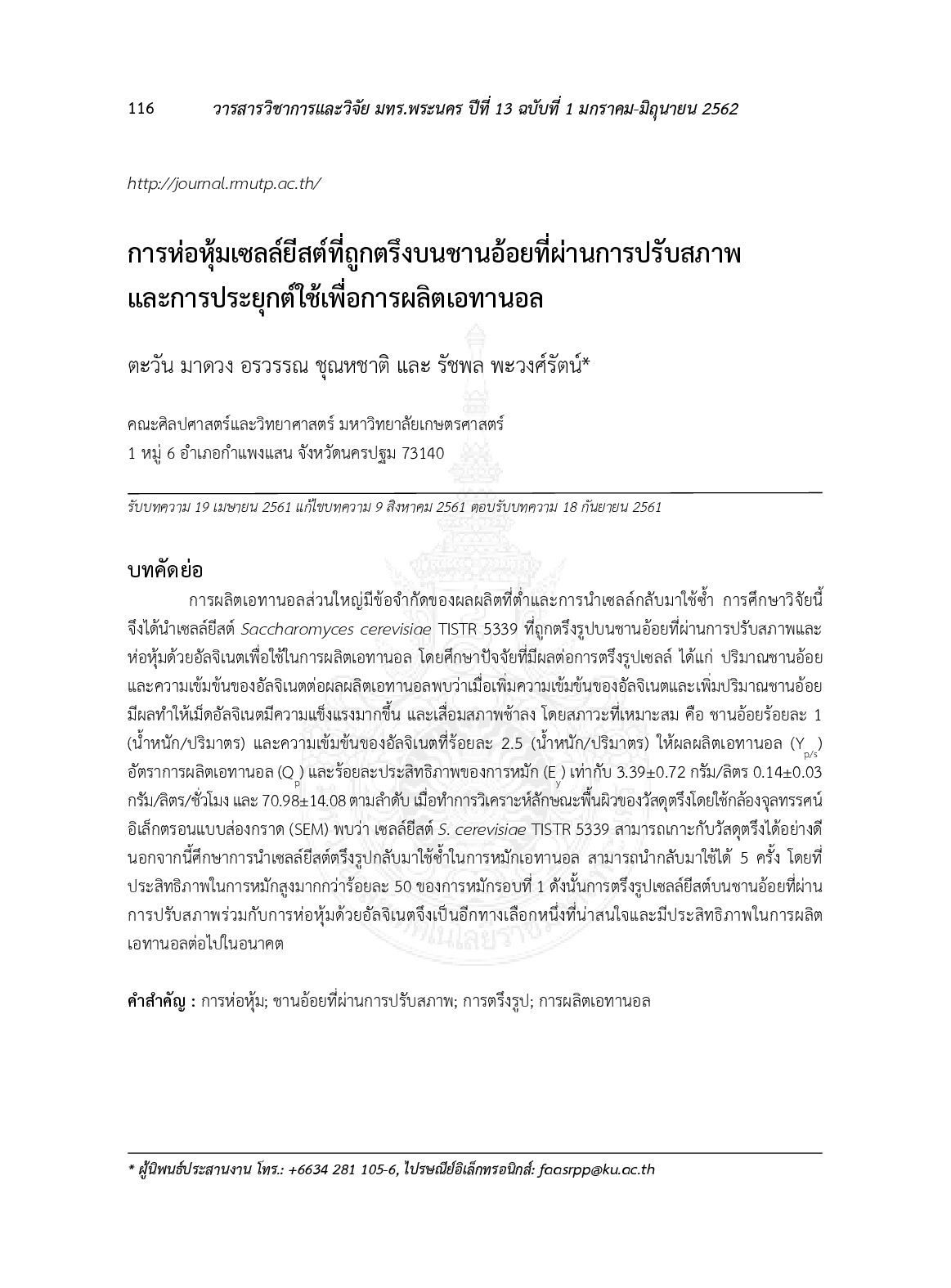
การห่อหุ้มเซลล์ยีสต์ที่ถูกตรึงบนชานอ้อยที่ผ่านการปรับสภาพและการประยุกต์ใช้เพื่อการผลิตเอทานอล
Most of ethanol production processes are limited by low ethanol production rate and recyclable problem of ethanologenic organisms. In the present study Saccharomyces cerevisiae TISTR 5339 entrapped in an aqueous mixture of alginate and pretreated-bagasse was used for ethanol production of immobilization parameter of yeast cells consisting of amount of bagasse and alginate concentration on ethanol production were investigated. The results showed that increase in alginate concentration and the amount of bagasse can increase structural strength and reduce deterioration of bead. The optimal condition of immobilization was 1.0% (w/v) bagasse and 2.5% alginate. Ethanol yield (Yp/s) ethanol production rate (Qp) and efficiency of fermentation (Ey) obtained from the bagasse-alginate immobilized yeast cell was 3.39±0.72 g/l0.14±0.03 g/l/h and 70.98±14.08% respectively. The ultrastructure obtained from SEM illustrated that S. cerevisiae TISTR 5339 was well incorporated within the bagasse-alginate matrix. Moreover the bagasse-alginate immobilized yeast cells were reusable at least 5 times with Ey higher than 50% of 1st round of fermentation. Therefore the pretreated bagasse-alginate immobilized yeast cells is an alternatively interesting techniques with effiiciency for ethanol production in the future.
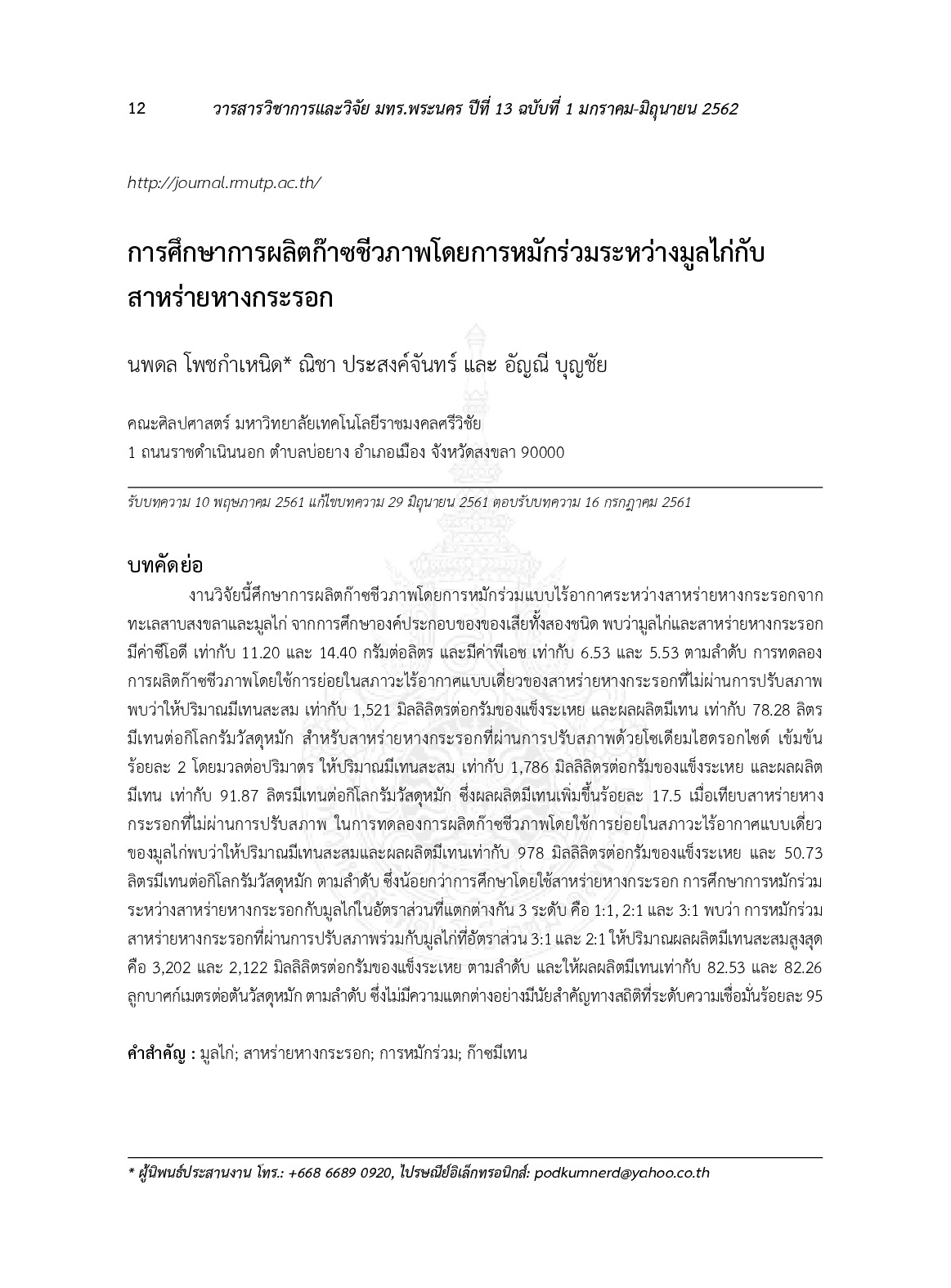
การศึกษาการผลิตก๊าซชีวภาพโดยการหมักร่วมระหว่างมูลไก่กับสาหร่ายหางกระรอก
This work presented the production of biogas using anaerobic co-digestion between hydrilla verticillata (HV) from Songkhla Lake Basin and chicken manure (CM). From the study of compositions of both wastes it was found that the COD of CM and HV were 11200 and 14400 mg/l and pH were 6.5 and 5.5 respectively. The biogas production using anaerobic single-digestion of untreated hydrilla verticillata (UHV) gave accumulative methane of 1251 ml-CH4/g-VS and methane production of 78.28 L-CH4/kg-substrate was obtained. For hydrilla treated with 2% w/v NaOH (THV) the accumulative methane was 1786 ml-CH4/g-VS and the obtained methane production was 91.87 L- CH4/kg-substrate which was 17.5 % increase when compared to the UHV. For the biogas production using anaerobic single-digestion of CM it was found that the accumulative methane and methane production were 978 ml-CH4/g-VS and 78.28 L- CH4/kgsubstrate respectively. These were lower than the studies using HV. The study of anaerobic co-digestion of HV and CM at three different ratios; 1:1 2:1 and 3:1 was studied. It was found that the anaerobic co-digestion using THV and CM at ratio 3:1 and 2:1 gave the highest potential for biogas production. The accumulate methane of 3202.20 and 2079.19 ml- CH4/g-VS were obtained respectively. The methane productions were 2.53 and 82.26 L-CH4/ton-substrate for ratio 3:1 and 2:1 respectively which is no significant different at 95 % confidence interval.
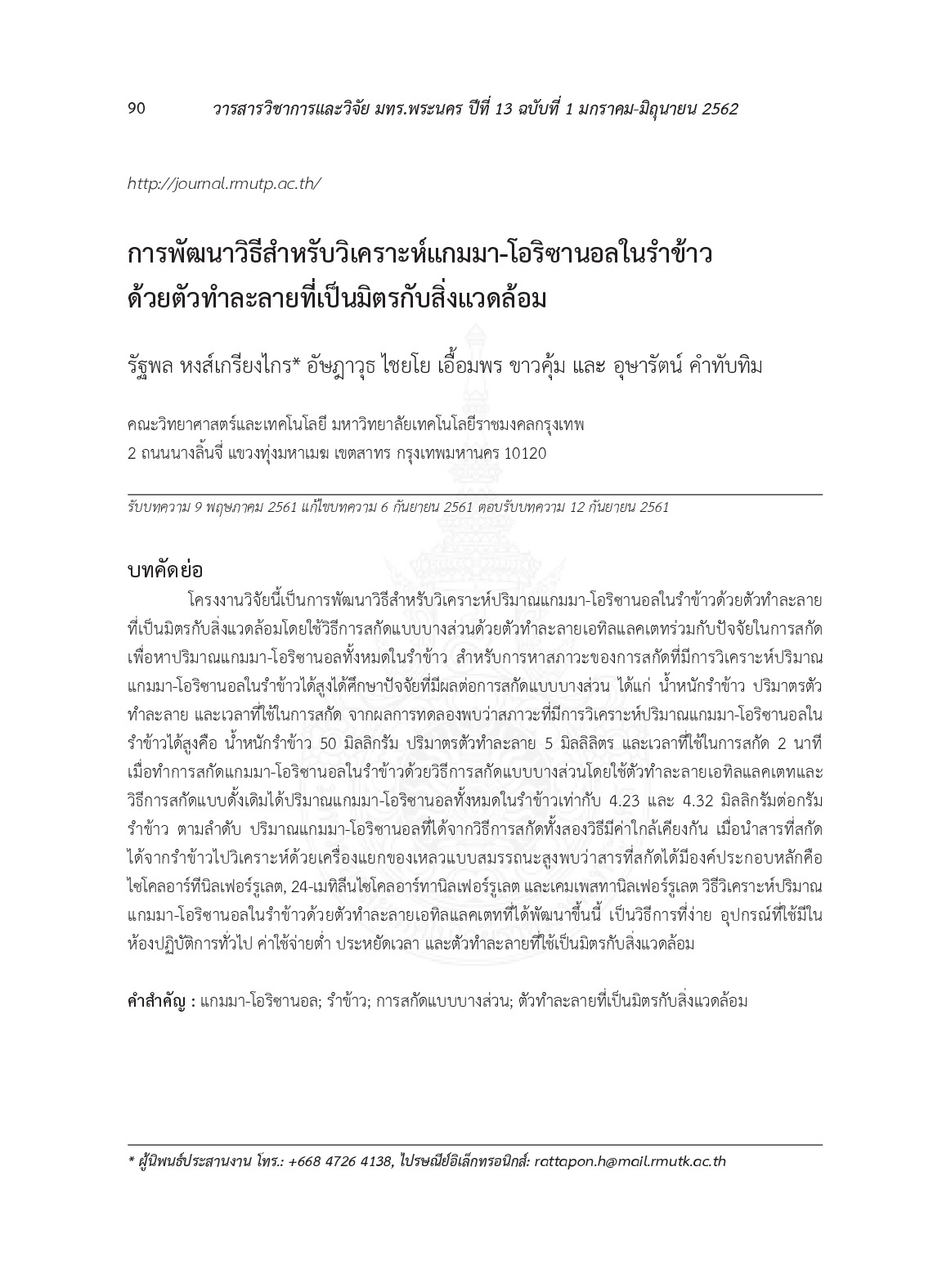
การพัฒนาวิธีสำหรับวิเคราะห์แกมมา-โอริซานอบในรำข้าวด้วยตัวทำละลายที่เป็นมิตรกับสิ่งแวดล้อม
This research project aim to develop method for analysis of gamma-oryzanol in rice bran with environmental friendly solvent. The total content of gamma-oryzanol in rice bran was investigated using the combination between partial extraction method with ethyl lactate solvent and the study of factors on partial extraction. The parameters that effect the amount of gamma-oryzanol with partial extraction method consist of weight of rice bran volume of solvent and extraction time were conducted. The result shown the maximum content of gamma-oryzanol that extracted with 50 milligrams of rice bran 5 milliliters of ethyl lactate and 2 minutes of extraction time. The quantity of gamma-oryzanol in rice bran that observed using partial extraction method with ethyl lactate solvent and classical extraction method were 4.23 and 4.32 milligram per gram rice bran respectively. The results from both extraction methods were well agreement. When the extracted rice bran was separated with High Performance Liquid Chromatography the result shown the main compositions of extracted rice bran including cycloartenyl ferulate 24-Methylene cycloartanyl ferulate and campestanyl ferulate. The develop method for analysis of gamma-oryzanol in rice bran using partial extraction with ethyl lactate solvent is easy use only small apparatus in laboratory cheap short-time consuming and use environmental friendly solvent.
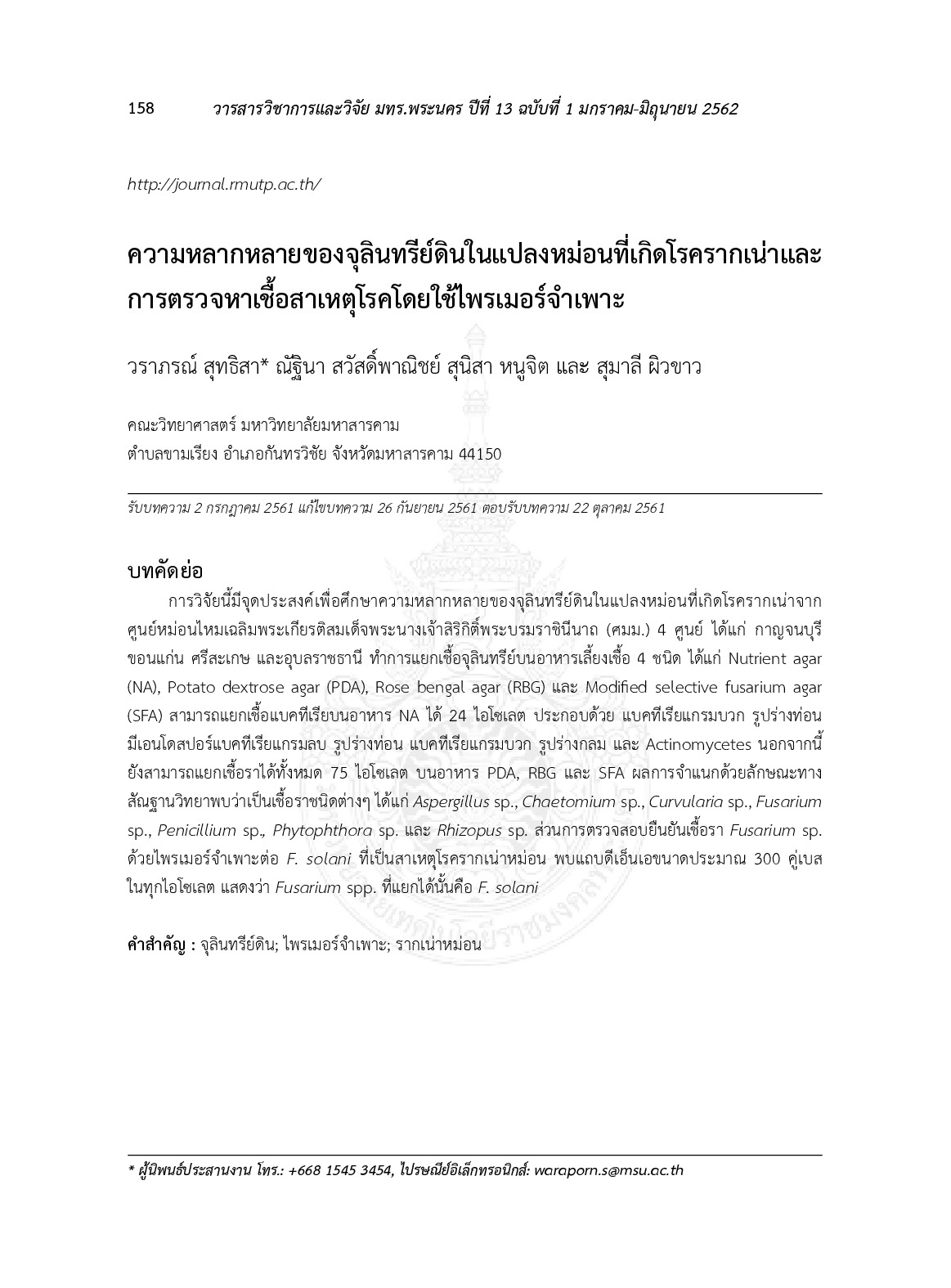
ความหลากหลายของจุลินทรีย์ดินในแปลงหม่อนที่เกิดโรครากเน่าและการตรวจหาเชื้อสาเหตุโรคโดยใช้ไพรเมอร์จำเพาะ
The diversity of soil microorganisms in mulberry root rot disease infesting fields was investigated from The Queen Sirikit Sericulture Center at Kanchanaburi Khon Kaen Sisaket and Ubon Ratchathani provinces. Isolation of the soil microorganisms was performed on four media as nutrient agar (NA) potato dextrose agar (PDA) rose bengal agar (RBG) and modified selective fusarium agar (SFA). Twenty-four bacterial isolates were arisen from NA including gram positive endospore forming rod gram negative rod gram positive cocci and Actinomycetes. Similarly 75 isolates of fungi were gained from PDA RBG and SFA and could be defined to be Aspergillus sp. Chaetomium sp. Curvularia sp. Fusarium sp. Penicillium sp. Phytophthora sp. and Rhizopus sp. by their morphological characteristics. Verification of the causal pathogen of mulberry root rot disease could be accomplished using specific primers for F. solani in which a DNA band at approximately 300 bp was revealed.
กรอบแนวคิดรูปแบบความสัมพันธ์เชิงสาเหตุของปัจจัยที่ส่งผลต่อการพัฒนาองค์กรปกครองส่วนท้องถิ่นสู่การเป็นองค์การที่มีขีดสมรรถนะสูงในประเทศไทย
This article aims at reviewing literature and supposing the hypotheses that present a conceptual framework of a causal relationship model of factors influencing the development of local administrative organizations into high performance organizations in Thailand. From the literature reviews some important points to be tested were found as follows: 1. The compositions of local administrative organizations development into high performance organizations consisted of 6 factors: 1) Total Management Quality; 2) Openness and Action Orientation; 3) Long-term Orientation; 4) Local Innovation Continuous Improvement and Renewal; 5) Quality of Human Resource Management System and 6) Readiness for Change of local Personnel. 2. The causal relationship model of factors influencing the development of local administrative organizations into high performance organizations are as follows: 1) Transformational leadership has a positive direct effect on high performance local administrative organizations; 2) Organizational culture has a positive direct effect on high performance local administrative organizations; 3) Organizational structure and design have a positive direct effect on high performance local administrative organizations and 4) Transformational leadership has a positive indirect effect on high performance local administrative organizations through organizational culture and organizational structure and design. This framework can be used to study and test against empirical data.