จำนวน Repository ( 220 )
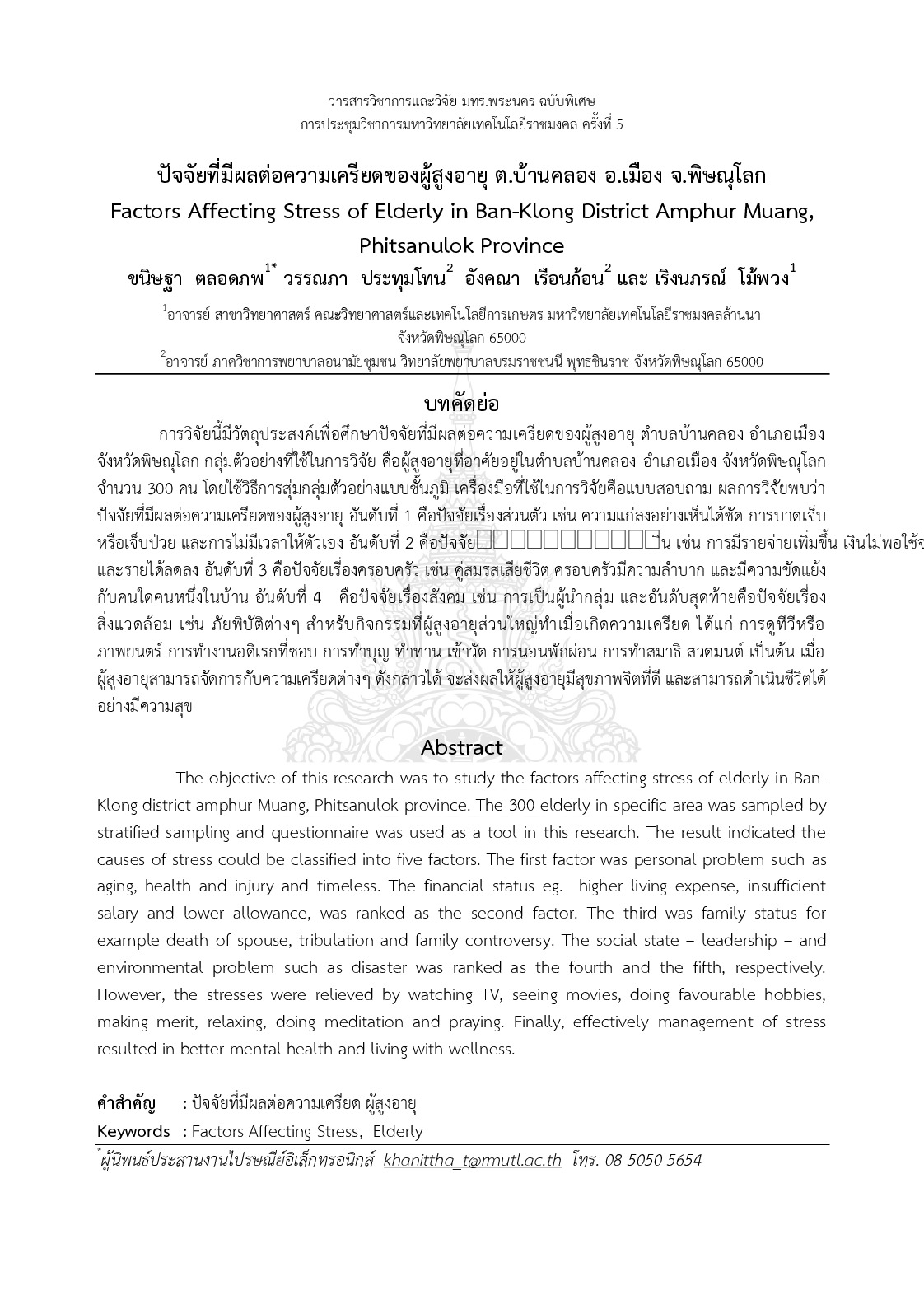
Factors affecting stress of elderly in ban-klong district amphur muang, phitsanulok province
The objective of this research was to study the factors affecting stress of elderly in Ban-Klong district amphur Muang Phitsanulok province. The 300 elderly in specific area was sampled by stratified sampling and questionnaire was used as a tool in this research. The result indicated the causes of stress could be classified into five factors. The first factor was personal problem such as aging health and injury and timeless. The financial status eg. higher living expense insufficient salary and lower allowance was ranked as the second factor. The third was family status for example death of spouse tribulation and family controversy. The social state – leadership – and environmental problem such as disaster was ranked as the fourth and the fifth respectively. However the stresses were relieved by watching TV seeing movies doing favourable hobbies making merit relaxing doing meditation and praying. Finally effectively management of stress resulted in better mental health and living with wellness.
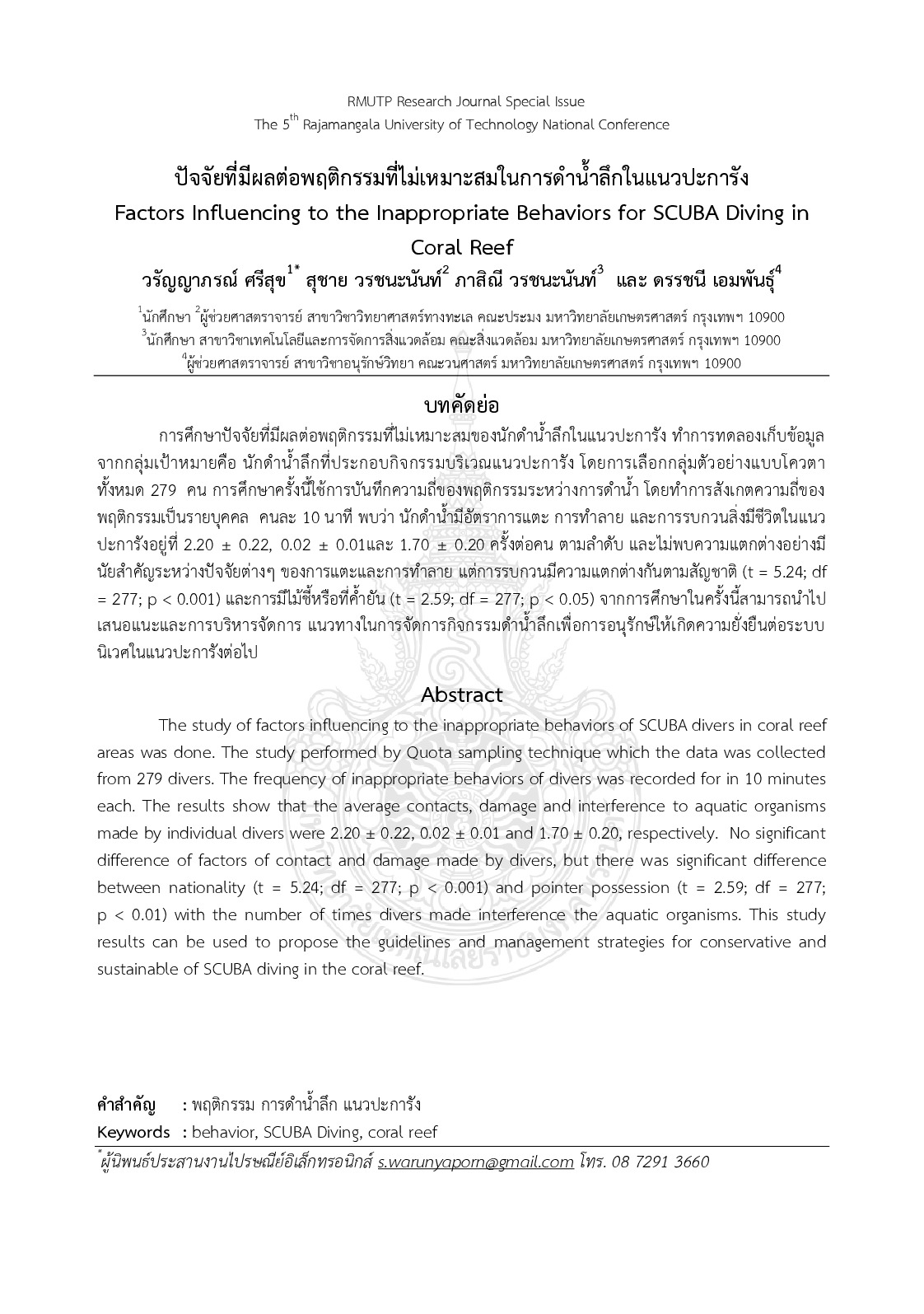
Factors influencing to the inappropriate behaviors for scuba diving in coral reef
The study of factors influencing to the inappropriate behaviors of SCUBA divers in coral reef areas was done. The study performed by Quota sampling technique which the data was collected from 279 divers. The frequency of inappropriate behaviors of divers was recorded for in 10 minutes each. The results show that the average contacts damage and interference to aquatic organisms made by individual divers were 2.20 0.22 0.02 ? 0.01 and 1.70 0.20 respectively. No significant difference of factors of contact and damage made by divers but there was significant difference between nationality (t = 5.24; df = 277; p < 0.001) and pointer possession (t = 2.59; df = 277; p < 0.01) with the number of times divers made interference the aquatic organisms. This study results can be used to propose the guidelines and management strategies for conservative and sustainable of SCUBA diving in the coral reef.
Psycho-social Factors Related to Effective Teaching Behavior of Business Administration Faculty Lecturers at Rajamangala University of Technology, Bandkok Metropolitan
The objectives of this research were: 1) to study psycho-social factors related to effective teaching behavior of the lectures at Faculty of Business Administration Rajamangala university of Technology Bangkok metropolitan 2) to study social characteristics and psychological characteristics that could predict effective teaching behavior of the lectures in overall and small groups at Faculty of Business Administration Rajamangala university of Technology Bangkok metropolitan 3) to study the interaction between social characteristics and psychological characteristics affecting to effective teaching behavior of the lectures at Faculty of Business Administration Rajamangala university of Technology Bangkok metropolitan. The sample used in this study consisted of 252 lectures at Faculty of Business Administration Rajamangala university of Technology Bangkok metropolitan. There were three independent variables. One was social support and the other two were innovation acceptance and attitude towards effective teaching behavior. The dependent variable was effective teaching behavior. Statistical analysis stepwise multiple regressions Two –Way ANOVA were applied to analyze lecturers in both overall and small groups according to their biosocial factors. The results of the study are as follows. 1. Three major variables to predict the lecturers’ effective teaching behavior are variables from social characteristics and psychological characteristics. In the overall group the percentage of the predictability score is 54.40. In smaller groups the percentage of the predictability score ranges from 44.60 to 62.90. The highest score is predicted by attitude towards effective teaching innovation acceptance and social support in Rajamangala university of Technology Ratanakosin. 2. The analysis from Two –Way ANOVA shows that the lecturers who highly accepted innovation and received high social support showed highly effective teaching. However the factors of innovation acceptance as well as social support had no interaction with the lecturers’ effective teaching behavior. When looking into each independent variable it was found that the score of effective teaching behavior varied according to the innovation acceptance in overall group and smaller groups which were classified into groups of male lecturers female lecturers inexperienced lecturers experienced lecturers higher-than-bachelors degree lecturers single lecturers married lecturers and lecturers from four centers of Rajamangala university of Technology. It was also found that the score of social support varied in both overall group and smaller groups of male lecturers female lecturers younger lecturers senior lecturers experienced lecturers higher-than-bachelors degree lecturers and married lecturers. In case of lectures having attitude of effective teaching behavior and being socially supported when looking into each of the independent variables and there was no interaction between them. The score of effective teaching behavior varied in accordance with attitude of effective teaching behavior in groups of male lecturers female lecturers younger lecturers senior lecturers inexperienced lecturers experienced lecturers lecturers with higher than bachelors degree married lecturers groups of lectures from Rajamangala university of Technology Phra Nakhon Rajamangala university of Technology Ratanakosin Rajamangala University of Technology Krungthep. Finally the variations which are resulted from social support in groups of male lecturers female lecturers younger lecturers inexperienced lecturers experienced lecturers lecturers with higher than bachelors degree married lecturers groups of lectures from Rajamangala university of Technology Ratanakosin and Rajamangala University of Technology Rajamangala University of Technology Tawan-ok.
The Factors that Effects 0n Household Saving Behaviors in Koh Peah Community, Trang Province
The Factors that Effects on Household Saving Behaviour in Koh Peach Community Trang Province This study investigates effects on household saving behaviour in Koh Paech Community Trang Province. The objectives are (1) to examine the household saving behaviour (2) to analyse various factors affecting the household saving behaviour and (3) to compare household saving behaviour between general household and those which are members of the Saving Group for Production. For primary data questionnaires are employed to obtain information from a total 326 households interviewed in July 2012. These data are examined and evaluated by way of simple statistical analysis with multiple regression used to investigate the relationship between household saving and factors determining it such as the household leader’s age income expenditure and level of education. The study includes consideration of the boosting household consumption policies of the Thai government. Results of this paper indicate that most household leaders are male (70.9%) and half of them are over the age of 50 years. The majority are agriculturists (57%) and most have an elementary education (58.3%). Average number of dependents is two and the average income of households interviewed is 352904 baht/year. Average household expenditure is 186151 baht/year average assets are 2681596 baht/year average debt is 311809 baht and average household saving is 91008 baht/year. Multiple regression analysis reveals that income (0.78) and assets (0.18) both have highly significant positive relationships with household saving while for expenditure (-0.36) there is a highly significant negative relationship. An unexpected finding of no effect from interest rates on household saving may be due to a preference for convenience over returns from saving. In comparing saving behaviour the result show that households which are members of the Saving Group for Production have an average saving of 80342 baht/year. They mostly save money before spending and usually have monthly security deposits. For general households the average saving is 96274 baht/year. They mostly spend rather than save money and have infrequent security deposits.
ปัจจัยที่ส่งผลต่อเจตคติต่อการทำงานในโรงงานอุตสาหกรรมเสื้อผ้าของนักศึกษา คณะเทคโนโลยีคหกรรมศาสตร์ มหาวิทยาลัยเทคโนโลยีราชมงคลพระนคร
This research aims to study the factors affecting the attitude of students in faculty of home economics technology towards work in factory of garment industry. Contain factor of personal characteristics of students the family background of students and the learning environment of students. Population is divisions of fashion merchandising technology and fashion clothing & textile design class 1-4 of Year 2555 total 210 people. Tool used was the questionnaire. Statistics used were percentage mean standard deviation correlation coefficient of Pearson and multiple regression analysis. The results showed factors affecting attitude towards work in factory of garment industry of students in faculty of home economics technology statistically significant at the .01 level has 3 factors. Sort by factors affecting most to the least 1) learning environment of students 2) Number of subjects for textile cutting and sewing learned ever 3) Personal characteristics of students and could explain the variability of attitude towards work in factory of garment industry at 77.1 percent of this population.