จำนวน Repository ( 1852 )
พัฒนาอิฐประสานจากวัสดุคอมโพสิทดินลูกรังผสมพลาสติกเพื่อใช้ในอุตสาหกรรมก่อสร้าง
จากการทดลองวิจัยพบว่าดินลูกรัง ที่ใช้ในการททำวิจัยเป็นดินชั้นคุณภาพ A4 ประเภทของดินทรายแป้ง (Silty Soils) โดยมีอัตราส่วนผ่านตะแกรงเบอร์ 4 เทากับ 99.20% อัตราส่วนผ่านตะแกรงเบอร์ 10 เทากับ 96.20% อัตราส่วนผ่านตะแกรงเบอร์ 40 เทากับ 92.34% และอัตราส่วนผ่านตะแกรงเบอร์ 200 เทากับ 72.08% ดินลูกรังมีค่าพิกัด Atterberg พิกัดเหลว (Liquid Limit) เทากับ 17.49% พิกัดพลาสติก (Plastic Limit) เทากับ 15.08 % และดัชนีมวลดิน (Plasticity Index) เทากับ 2.41% องค์ประกอบทางเคมีของดินลูกรังพบว่าดินลูกรังมีซิลิกอน ออกไซด์ (SiO2) อลูมิน่า ออกไซด์ (Al2O3) ไอรอน ออกไซด์ (Fe2O3) เป็น 58.60 % 25.50% 13.00% ตามลำดับและพบสารประกอบ Silicon Oxide (SiO2) : Quartz ดินลูกรังมีผลการทดสอบหาความหนาแน่นปรากฏมีค่า 2.69 g/cm3 ความถ่วงจำเพาะ 2.32 ค่า Loss on Ignition 3.43 % การกระจายตัวของขนาดอนุภาค 28.42 μmขนาดรูพรุน 42.62 μm และพรุน ตัว 47.74% การขึ้นรูปตามอัตราส่วนของ ดินลูกรัง – พลาสติก ที่ดินลูกรัง 100% 90% และ80% ไม่สามารถอัดขึ้นรูปได้เนื่องจากดินมีมวลที่ละเอียดเมื่อขึ้นรูปจะไม่เกิดการยึดเกาะระหว่างมวลกับพลาสติกดังรูปในตารางและอัตราส่วนดินลูกรังตังแต่ 70%-0%สามารถขึ้นรูปได้สมบูรณ์ ตัวอย่างทดสอบดินลูกรัง-พลาสติกที่มีกำลังอัดสูงขึ้นตามเวลาที่ทำการกำ เนื่องจากวัสดุ HDPE มีความเหนียวและยืดหยุ่นทำให้วัสดุทดสอบไม่มีการแตกหักแต่จะเปลี่ยนรูปตามแรงที่กระทำ ซึ้งพบว่าดินลูกรังผสมพลาสติกเมื่อเพิ่มปริมาณพลาสติกมากขึ้นกำลังรับแรงเพิ่มตามสำดับผู้ใช้ควรเลือกใช้ตามความเหมาะสมกับงาน ปริมาณดินลูกรัง 50% ขึ้นไปตัวอย่างจบน้ำและปริมาณดินลูกรังตำกว่า 50% ก้อนตัวอย่างทดสอบลอยน้ำ ตัวอย่างสามารถดูซึมน้ำได้น้อยกว่า 30% ทุก ตัวอย่างที่สามารถขึ้นรูปได้ ซึ้งสามารถนำไปใช้ในงานก่อสร้างได้ ดินลูกรังผสมปลาสติกไม่เกิดการเปลี่ยนแปลงปริมาตรหรือเกิดน้อยมาก ซึ้งเป็นคุณสมบัติที่ดีของวัสดุก่อสร้าง ผลการทดสอบด้วยกล้องขยายกำลัง 50x พบว่าดินลูกรังสามารถขึ้นรูปได้ด้วยการประสานของพลาสติกโดยยิงมีอัตราสวนของพลาสติกมากยิงทำให้มีความสามารยึดเกาะขึ้นรูปและกำลังได้ดีตามไปด้วย
โครงการออกแบบและพัฒนาผลิตภัณฑ์เซรามิกส์ที่ใช้ในการก่อผนักเพื่อการอนุรักษ์การใช้พลังงานภายในอาคาร
This research aims to study and test a ceramic product in using to constructs a wall. This research is based on a previous studying to develop a ceramic product that saves the energy in the building. The early test shows the product has out door heat resisting capability and it is very user-friendly. However the test was only an early stage. The research still lack of a real life situation test and has very little feedback from the consumers. All of which are very importance to farther develop this product into a production stage. The research has 2 steps. First step to testing the heat and humidity resisting quality of the product the researcher is building four testing blocks (dimension 1x1x1 meter). Each block has different material on one of its side block 1 has brick block 2 has concrete masonry unit block 3 has autoclaved aerated concrete and block 4 has ceramic block. The other three side of each block have a heated and humidity resisting form. The researches test the following; heat energy the temperature inside the blocks and humidity inside the block. After comparing the difference between the airs inside and out-side of the blocks the block 2 with concrete masonry unit has the best humidity resisting quality and is the most user-friendly product. In the term of heat resisting block 3 with autoclaved aerated concrete perform the best. Second step to test the user-friendliness of the product the researcher found 2 groups of consumers. First group are the wall constructing expert. This group has a hard time using this product and can’t get use d to the product so they find this product to be too thin and too weak. Second group the home owner feel the product has a thinner wall and believe it’s weaker than a typical construction brick. There for they still don’t know how to use this product.
การพัฒนาเส้นด้ายจากซังข้าวสู่เชิงพาณิชย์
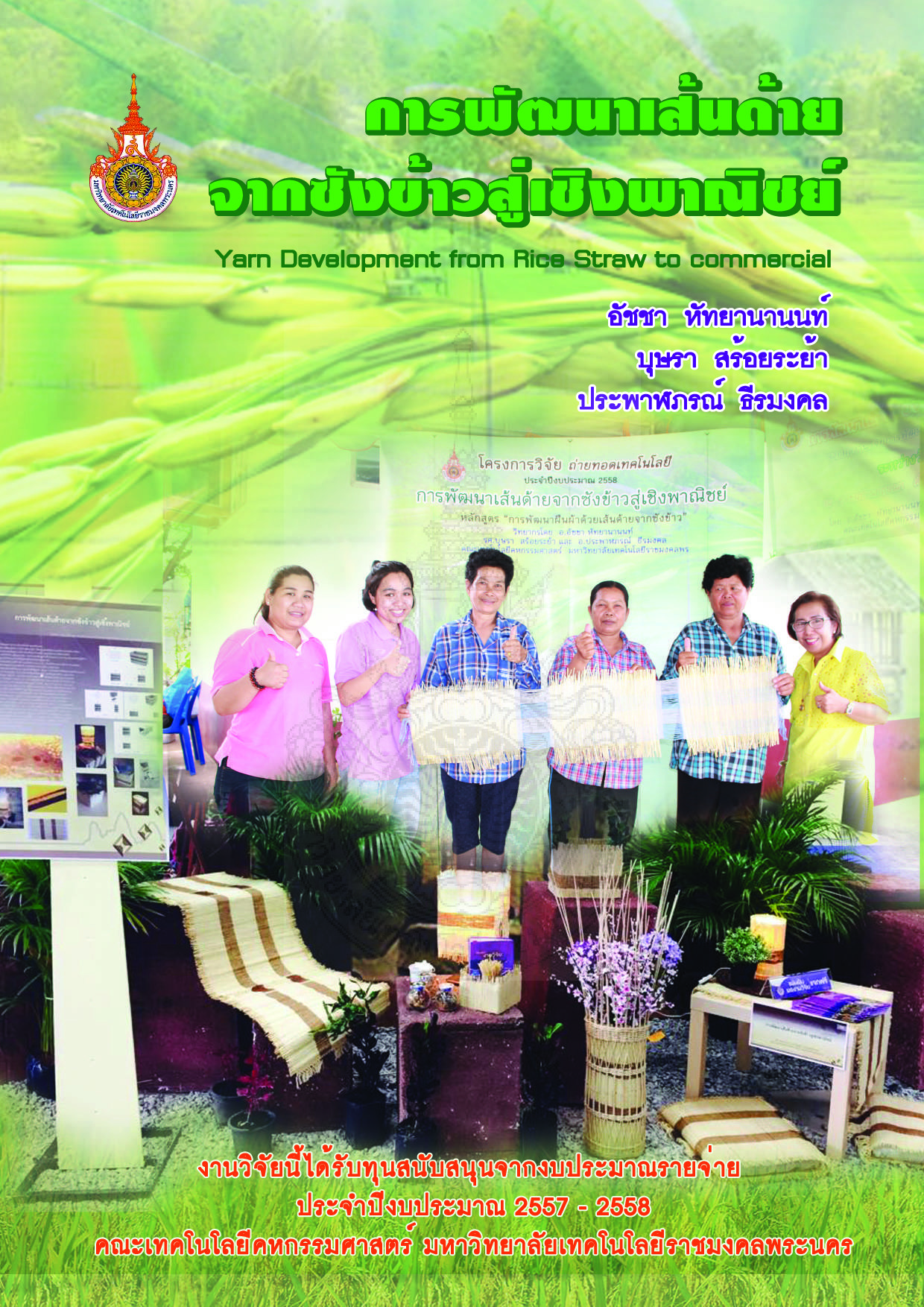
This research is Yarn Development from Rice straw to commercial. It aims to study the process of seperating fibers from rice straw. To study the physical properties of fibers from rice straw and to study the process of manufacturing yarn from rice straw fibers. The research material is rice straw fibers after that data was analyzed byphysical textile testing laboratory. The result of the first year’s research was the rice straw yarn has been developed as woven and develop into commercial products to promote. The process of separating fibers from rice straw which dried the sun for a few days. Selecting the rice straw fiber length at least 30 cm. to subtract the joints of the lower end of the stem by hand. peel off the rice straw fiber and place flat on a horizontal line. Then Rice straw fiber were tested in the physical laboratory was found that it is cellulose fibers tensile strength (Newton) at 28.18 elongation (percent) is at 2.01. The amounts of metals has plenty of CADMIUM at 0.1 mg/kg CHROMIUM (TOTAL) / (VI) at 0.5 mg/kg COPPER at 0.5 mg/kg and LEAD at 0.1 mg/kg which was not found to be risk for using. The fiber cross-section of rice straw fiber were found to be oval the middle is clearly. The fiber length is smooth and transparent when viewed from the side to see the clarity of the fiber. Rice straw fiber was weave in plain structure. Warp yarn uses a special brown cream and brown flat yarns. We use rice straw fiber with the same type of yarn. There are 2 warp yarn and using natural color without blench. Rice straw fabric was dyeing with dried hibiscus flowers (Kaa-Jeab herb) and mordant as ashes. The result is red light because of rice straw fiber surface is smooth and lustrous. Therefrom When woven as a fabric to develop be 4 products prototype : table lamps tablecloths in Japanese style potted plants and Accessories Box The result of the second year’s research there are focus group inquire for people it is interesting in this research and Date for transfer knowledge as: Ban-Krit-Sa- Na community Krit-Sa-Na sub-district bang-pra-ma district in Supanburi province. To plan the schedule and set the date place amount of participate and lectures 34 people The range of time to transfer as 3 days on 3 – 5 May 2015 and asking for consumer satisfaction of the curriculum and lecture for “transfer knowledge Yarn Development from Rice straw to commercial” by Questionnaire of participate satisfaction. Last the evaluation data was analyzed by using SPSS program in mean and percentage. The second year found that mostly participates were female aged under 21 years old finished the secondary school and also there are farmer. The participates are their income under 5000 baht and no income. For the participates questions relation to technology transfer of “Yarn Development from Rice straw to commercial” about course divided into 3 parts: The purpose The curriculum and The knowledge. The satisfaction of participates about project divided into 3 parts: Service process Lecturer and Facilities found that have been satisfied at maximum average and highest level of satisfaction in every parts of both satisfied participates questions. The participants are mainly used to provide benefits to themselves for one month to apply the gained after the training. Satisfaction with the benefits of technology transfer and utilization. Satisfaction at the highest level the participants used knowledge to apply with local and waste material. Moreover the participates make product as soon as finish course and they are planning to produce the table Hand Woven for weaving the Rice straw yarn fabric and push it to be OTOP products. The comments and suggestions of the participants found that they need for re-training again. They would like to have a longer period of training in order to gain more knowledge. All lecturer can transfer knowledge during the training as well.
การทดสอบประสิทธิภาพการยับยั้งแบคทีเรีย Escherichia coli และ Salmonella spp. ของสารสกัดจากหอมหัวใหญ่
จากการศึกษาการสกัดสารสกัดหยาบจากหอมหัวใหญ่ ด้วยวิธีการแช่ยุ่ย (marceration) โดยใช้ตัวทาละลาย 3 ชนิด คือเฮกเซน เอทานอล และเมทานอล พบว่าการสกัดสารสกัดหยาบจากหอมหัวใหญ่ที่มีน้าหนักแห้ง 2 กิโลกรัม จะได้ปริมาณสารสกัดหยาบที่สกัดได้จากตัวทาละลายทั้ง 3 ชนิด เท่ากับ 1.305 3.260 และ1.306กรัมตามลาดับ จากการศึกษาฤทธิ์ในการยับยั้งการเจริญของแบคทีเรีย 2 สายพันธุ์ ได้แก่ Escherichia coli และ Salmonella spp. ของสารสกัดหอมหัวใหญ่โดยใช้ตัวทาละลาย คือ เอทานอล เฮกเซน และเมทานอล พบว่า สารสกัดที่สกัดด้วยเอทานอลมีฤทธิ์ในการยั้บยั้งการเจริญของ Escherichia coli ได้ โดยมีขนาดของวงใสเท่ากับ 6 มิลลิเมตรแต่ไม่มีฤทธิ์ยับยั้งการเจริญของแบคทีเรีย Salmonella spp. ค่าความเข้มข้นต่าสุดที่สามารถยับยั้งการเจริญเติบโตของเชื้อ Escherichia coli จากการคัดเลือกผลจากวิธี disc diffusion techniques ซึ่งพบว่าสารสกัดหอมหัวใหญ่ที่สกัดด้วยเอทานอลมีฤทธิ์ในการยับยั้งการเจริญของ Escherichia coli ได้ จึงทาการศึกษาหาค่าความข้มข้นต่าสุด(MIC) ของสารสกัดที่สกัดด้วยเอทานอลในการยับยั้งการเจริญของ Escherichia coli ด้วยวิธี Macro broth dilution technique พบว่า ที่ความเข้มข้นของสารสกัดหอมหัวใหญ่เท่ากับ 25 50 และ 100 มิลลิกรัมต่อมิลลิลิตร มีการตกตะกอนของสารสกัด แลสารละลายด้านบนมีลักษณะใส แสดงว่า Escherichia coli ไม่สามารถเจริญได้ เมื่อเปรียบเทียบกับที่ความเข้มข้นที่น้อยกว่า 12.5 มิลลิกรัมต่อมิลลิลิตร ซึ่งสารละลายขุ่นทั้งหลอด แสดงว่า Escherichia coli สามารถเจริญได้ ดังนั้นจึงสรุปได้ว่า ค่าความเข้มข้นต่าสุด (MIC) ของสารสกัดที่สกัดด้วยเอทานอลในการยับยั้งการเจริญของ Escherichia coli เท่ากับ 25 มิลลิกรัมต่อมิลลิลิตร