จำนวน Repository ( 166 )
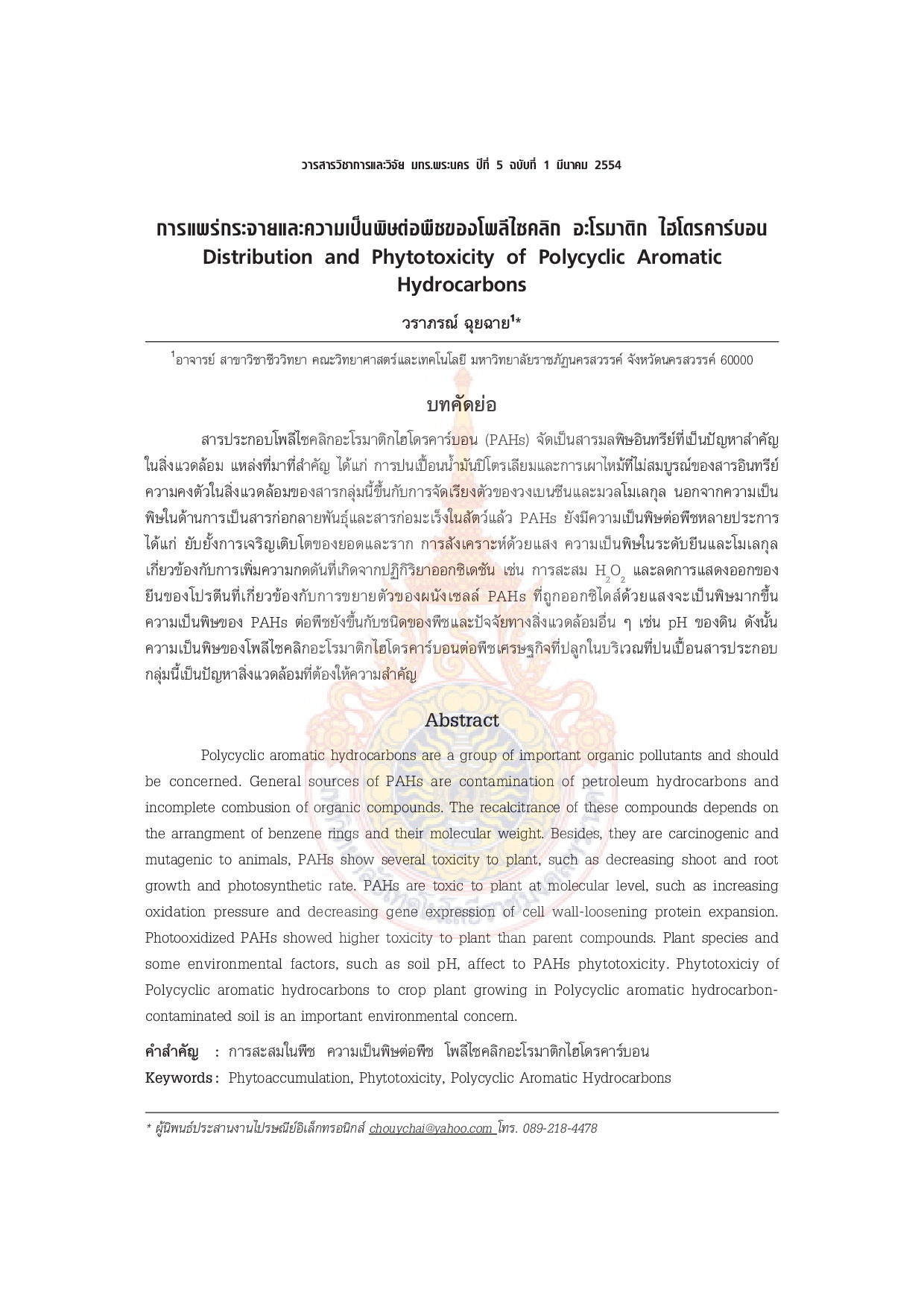
Distribution and Phytotoxicity of Polycyclic Aromatic
Polycyclic aromatic hydrocarbons are a group of important organic pollutants and should be concerned. General sources of PAHs are contamination of petroleum hydrocarbons and incomplete combusion of organic compounds. The recalcitrance of these compounds depends on the arrangment of benzene rings and their molecular weight. Besides they are carcinogenic and mutagenic to animals PAHs show several toxicity to plant such as decreasing shoot and root growth and photosynthetic rate. PAHs are toxic to plant at molecular level such as increasing oxidation pressure and decreasing gene expression of cell wall-loosening protein expansion. Photooxidized PAHs showed higher toxicity to plant than parent compounds. Plant species and some environmental factors such as soil pH affect to PAHs phytotoxicity. Phytotoxiciy of Polycyclic aromatic hydrocarbons to crop plant growing in Polycyclic aromatic hydrocarboncontaminated soil is an important environmental concern

Recycling of tools Scrap
This research is to study the recycle process of hard materials high hardness type and cemented carbide produced by press forming and sintering process included cemented carbide mixed with tungsten carbide cobalt silicon titanium and others. The research aims to recovery tungsten to use it again. It starts in cleaning and ball milling materials for resizing from length 12-25 mm. width 10-15 mm and thickness 2.5-8.0 mm. then disintegrated with the electric-chemical process filtering metal powder cleaning and drying. The result of dissolved materials with electricchemical process in 85% condensed HCl 6-24 volts and 3-10 amperes. The solution heats up 180 degree Celsius is found that material will be 550 11m of W03 the same as usage of Phosphoric Solution. The result of the study in dissolved materials by using the conductor of electricity is found that usage of cobalt is the best to disintegrate tungsten carbide better than tungsten carbide and stainless steel 10-15%. The result of this research is found that the best practice of tungsten carbide recovery is dissolved materials with electric-chemical process in not over 7N condensed HCl 6.00 volts and 3.00 amperes. The metal powder will be almost 100% pure tungsten carbide and particle sized distribution is 34-360 11m. After ball milling for 24 hours particle sized distribution is less than 60 11m compared with the imported metal powder. It is concluded that the recycle of cemented carbide into tungsten carbide powder qualified for sintering work and produced to the durable hard materials. It ensures that this research is useful for the related industry and the approach for production of tungsten carbide which was instead of the imported metal powder.
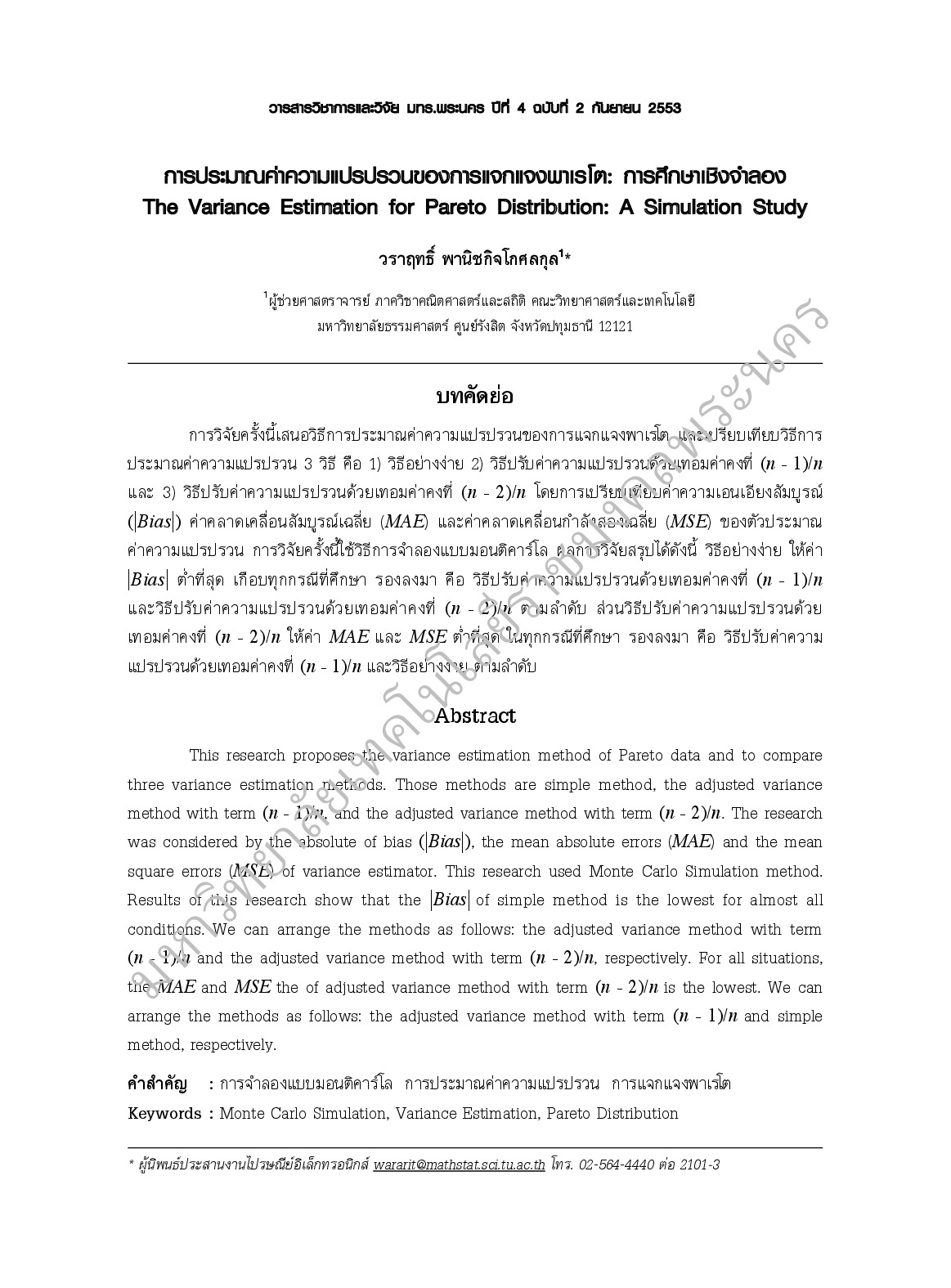
การประมาณค่าความแปรปรวนของการแจกแจงพาเรโตะ : การศึกษาเชิงจำลอง
This research proposes the variance estimation method of Pareto data and to compare three variance estimation methods. Those methods are simple method the adjusted variance method with term (n - 1)/n and the adjusted variance method with term (n - 2)/n. The research was considered by the absolute of bias (|Bias|) the mean absolute errors (MAE) and the mean square errors (MSE) of variance estimator. This research used Monte Carlo Simulation method. Results of this research show that the |Bias| of simple method is the lowest for almost all conditions. We can arrange the methods as follows: the adjusted variance method with term (n - 1)/n and the adjusted variance method with term (n - 2)/n respectively. For all situations the MAE and MSE the of adjusted variance method with term (n - 2)/n is the lowest. We can arrange the methods as follows: the adjusted variance method with term (n - 1)/n and simple method respectively.
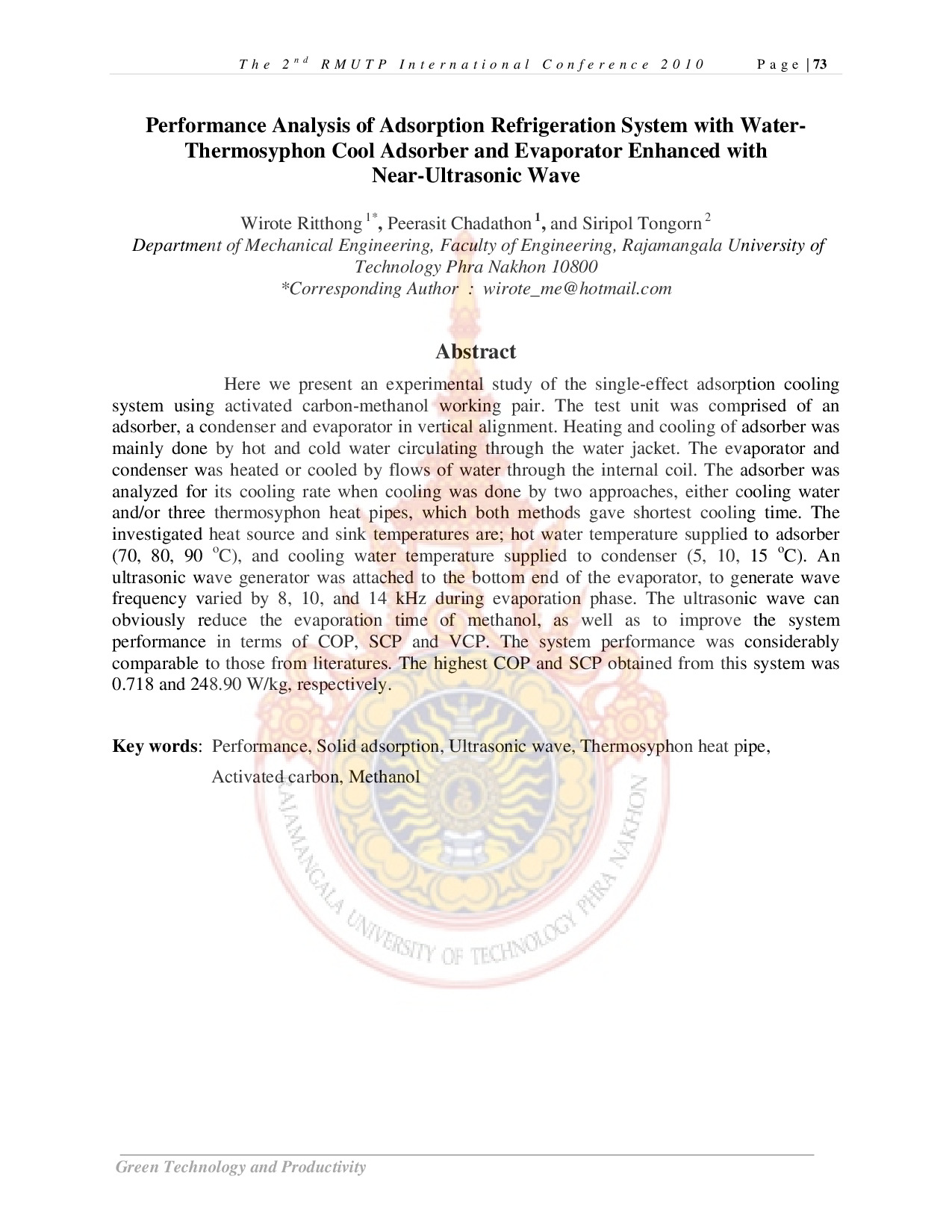
Performance Analysis of Adsorption Refrigeration System with Water-Thermosyphon Cool Adsorber and Evaporator Enhanced with Near-Ultrasonic Wave
Here we present an experimental study of the single-effect adsorption cooling system using activated carbon-methanol working pair. The test unit was comprised of an adsorber a condenser and evaporator in vertical alignment. Heating and cooling of adsorber was mainly done by hot and cold water circulating through the water jacket. The evaporator and condenser was heated or cooled by flows of water through the internal coil. The adsorber was analyzed for its cooling rate when cooling was done by two approaches either cooling water and/or three thermosyphon heat pipes which both methods gave shortest cooling time. The investigated heat source and sink temperatures are; hot water temperature supplied to adsorber (70 80 90 oC) and cooling water temperature supplied to condenser (5 10 15 oC). An ultrasonic wave generator was attached to the bottom end of the evaporator to generate wave frequency varied by 8 10 and 14 kHz during evaporation phase. The ultrasonic wave can obviously reduce the evaporation time of methanol as well as to improve the system performance in terms of COP SCP and VCP. The system performance was considerably comparable to those from literatures. The highest COP and SCP obtained from this system was 0.718 and 248.90 W/kg respectively.
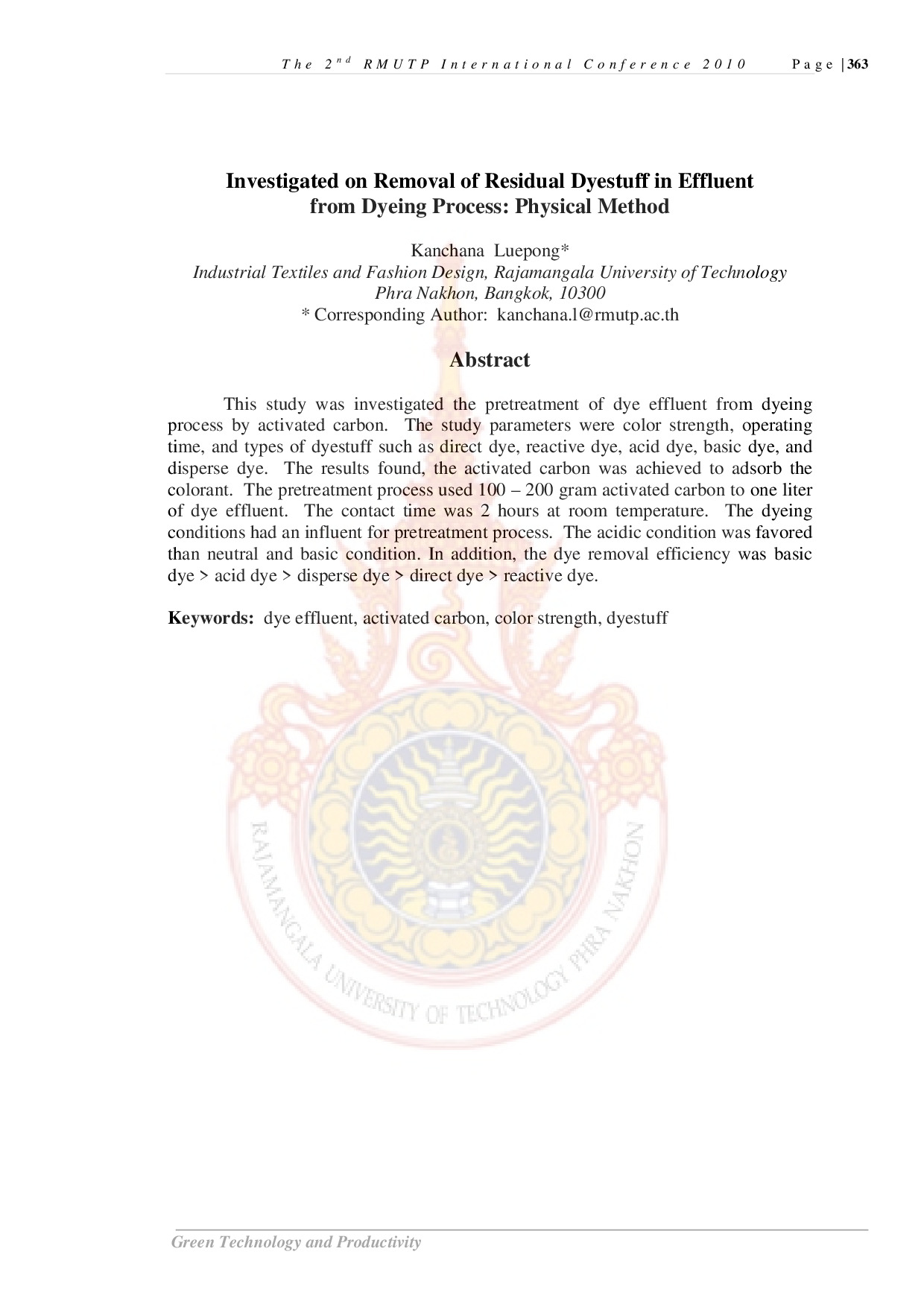
Investigated on Removal of Residual Dyestuff in Effluent from Dyeing Process: Physical Method
This study was investigated the pretreatment of dye effluent from dyeing process by activated carbon. The study parameters were color strength operating time and types of dyestuff such as direct dye reactive dye acid dye basic dye and disperse dye. The results found the activated carbon was achieved to adsorb the colorant. The pretreatment process used 100 – 200 gram activated carbon to one liter of dye effluent. The contact time was 2 hours at room temperature. The dyeing conditions had an influent for pretreatment process. The acidic condition was favored than neutral and basic condition. In addition the dye removal efficiency was basic dye > acid dye > disperse dye > direct dye > reactive dye.