จำนวน Repository ( 193 )

Electrical conservation and development of energy management system for public building
This research was a study of energy management in public building. The goals of this project are to decrease energy consumption and to enhance energy management system of the building. Regarding the energy survey the building lights are turned on for 24 hr. per day in order to satisfactorily serve the customers. In the study it was found that the energy consumption of electric light on the fourth floor roof can be reduced by changing the light “Floodlight MH. 4x250W” to be “High bay LED 4x150W” For the merit this project can save the energy around 6632570 baht per year and switching towards high-efficiency lanterns and replacing FL. T8 light bulbs installed in the walkways with FL. T5 models. This reduces lighting cost by 361425 baht per year. Moreover the energy management system was analyzed by using SWOT Analysis. As a result we observed the barriers to communication must be overcome to promote energy conservation. One approach is to increase the performance through the use of communication strategies within organizations. This method will help align employees understanding and participating in activities of conserve energy.
Analysis of needs and expert’s opinions on the competency required of computer Job category for work integrated learning (WiL) in higher education
The aim of this research is to analyze the needs and opinions of experts concerning competency required for computer related jobs in the present and the future. Its outcomes would be used in designing a Work-integrated learning (WiL) programs in undergraduate computer related programs (Computer Engineering Software Engineering Computer Science Information Technology and Information System) which meet quality standard specified by The Association for Computing Machinery (ACM) The Association for Information Systems (AIS) and The Institute of Electrical and Electronics Engineer - Computer Society (IEEE-CS). The forty educational institutions and industries in line with the development of hardware and software the installation of operating system the installation and maintenance of the network the application of information technology and the use of information system in management were invited to participate in this study. The instruments employed for data collection were questionnaires comprising six parts: 1) General Knowledge of Computer Personnel; 2) Knowledge of Computer Engineering Personnel; 3) Knowledge of Software Engineering Personnel. 4) Knowledge of Computer Science Personnel; 5) Knowledge of Information Technology Personnel and 6) Knowledge of Information System Personnel. Statistic devices used in analyzing the data were frequency percentage arithmetic mean and standard deviation. The results were also compared with the performance analysis of Competency of Computer Jobs Category in ASEAN countries Japan Europe and America. The results were also validated by 12 specialists using a purposive sampling from educational institutions enterprises and the professional associations. It was found that the Competency Required of Computer Job Category for educational management on WIL program were: 1) Computer Architect 2) Computer Support 3) Computer Specialist 4) Project Manager 5) Software Development 6) Applied Program Specialist 7) Computer Consultant 8) Sale and Marketing and 9) Computer Education Trainer. All job positions should be consistent with the empirical data which are statistically significant at p-value =0.05. The Competency Required of Computer Job Category overall fit are accepted.
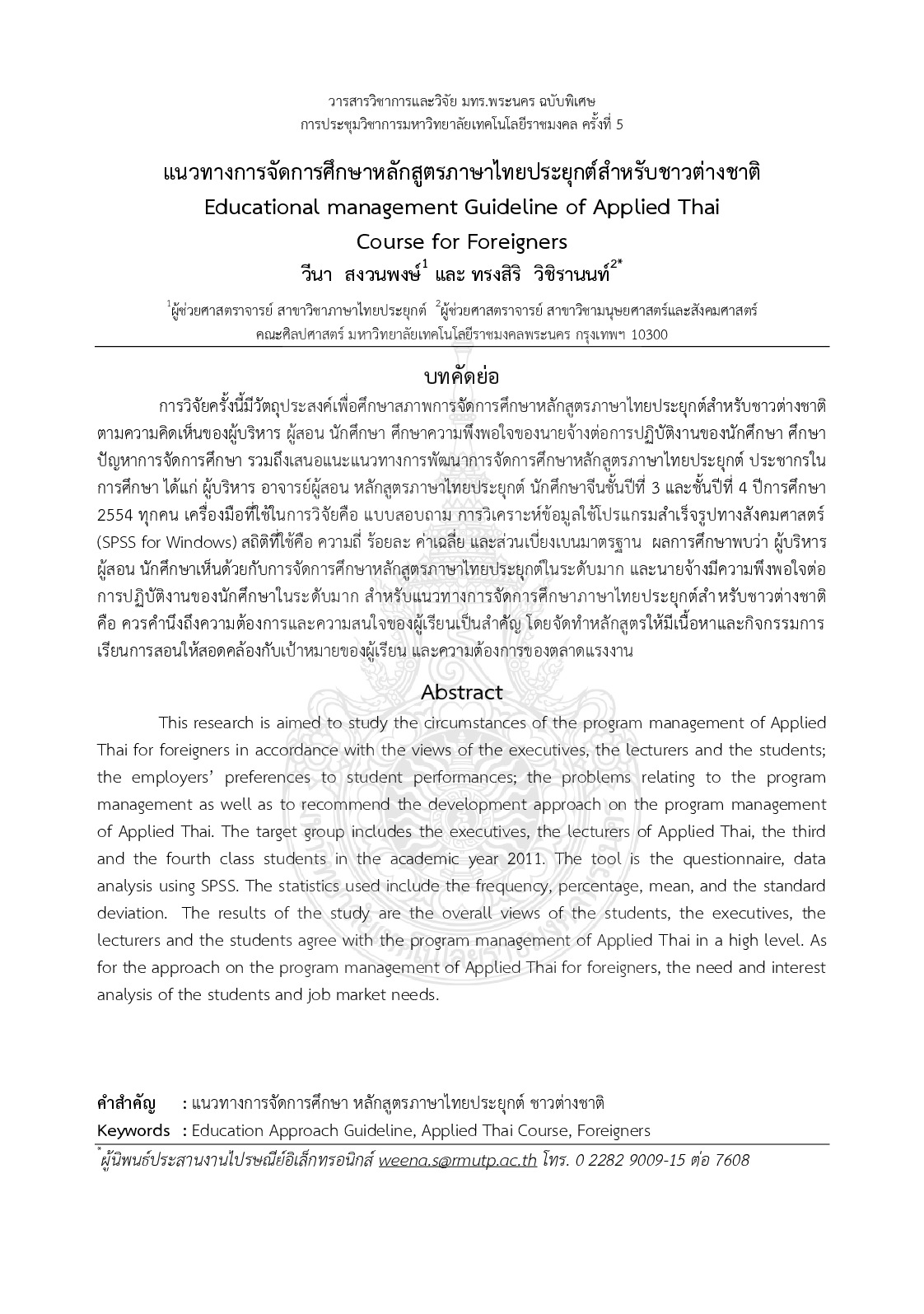
Educational management guideline of applied thai course for foreigners
This research is aimed to study the circumstances of the program management of Applied Thai for foreigners in accordance with the views of the executives the lecturers and the students; the employers’ preferences to student performances; the problems relating to the program management as well as to recommend the development approach on the program management of Applied Thai. The target group includes the executives the lecturers of Applied Thai the third and the fourth class students in the academic year 2011. The tool is the questionnaire data analysis using SPSS. The statistics used include the frequency percentage mean and the standard deviation. The results of the study are the overall views of the students the executives the lecturers and the students agree with the program management of Applied Thai in a high level. As for the approach on the program management of Applied Thai for foreigners the need and interest analysis of the students and job market needs.
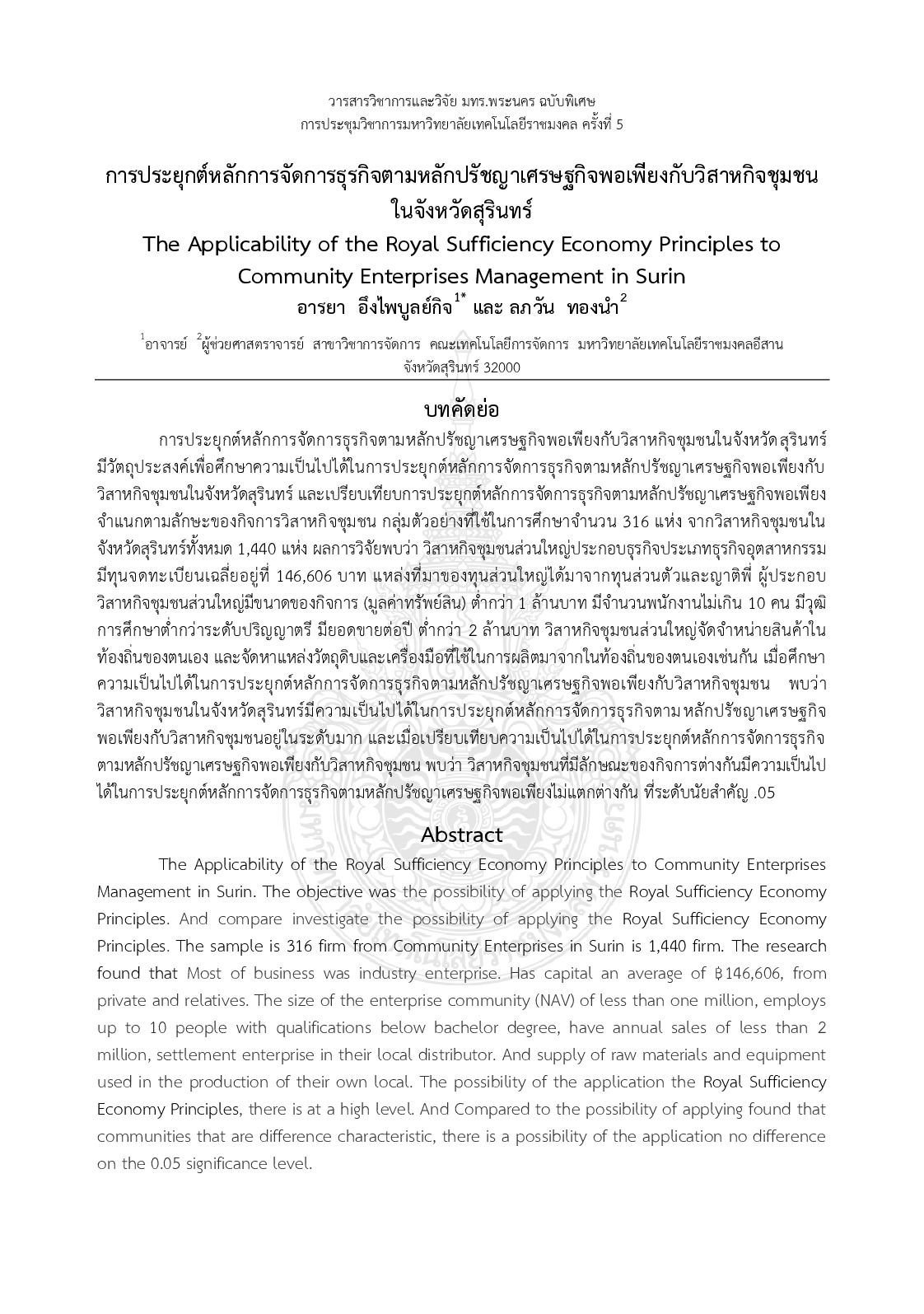
The applicability of the royal sufficiency economy principles to community enterprises management in Surin
The Applicability of the Royal Sufficiency Economy Principles to Community Enterprises Management in Surin. The objective was the possibility of applying the Royal Sufficiency Economy Principles. And compare investigate the possibility of applying the Royal Sufficiency Economy Principles. The sample is 316 firm from Community Enterprises in Surin is 1440 firm. The research found that Most of business was industry enterprise. Has capital an average of ฿146606 from private and relatives. The size of the enterprise community (NAV) of less than one million employs up to 10 people with qualifications below bachelor degree have annual sales of less than 2 million settlement enterprise in their local distributor. And supply of raw materials and equipment used in the production of their own local. The possibility of the application the Royal Sufficiency Economy Principles there is at a high level. And Compared to the possibility of applying found that communities that are difference characteristic there is a possibility of the application no difference on the 0.05 significance level.
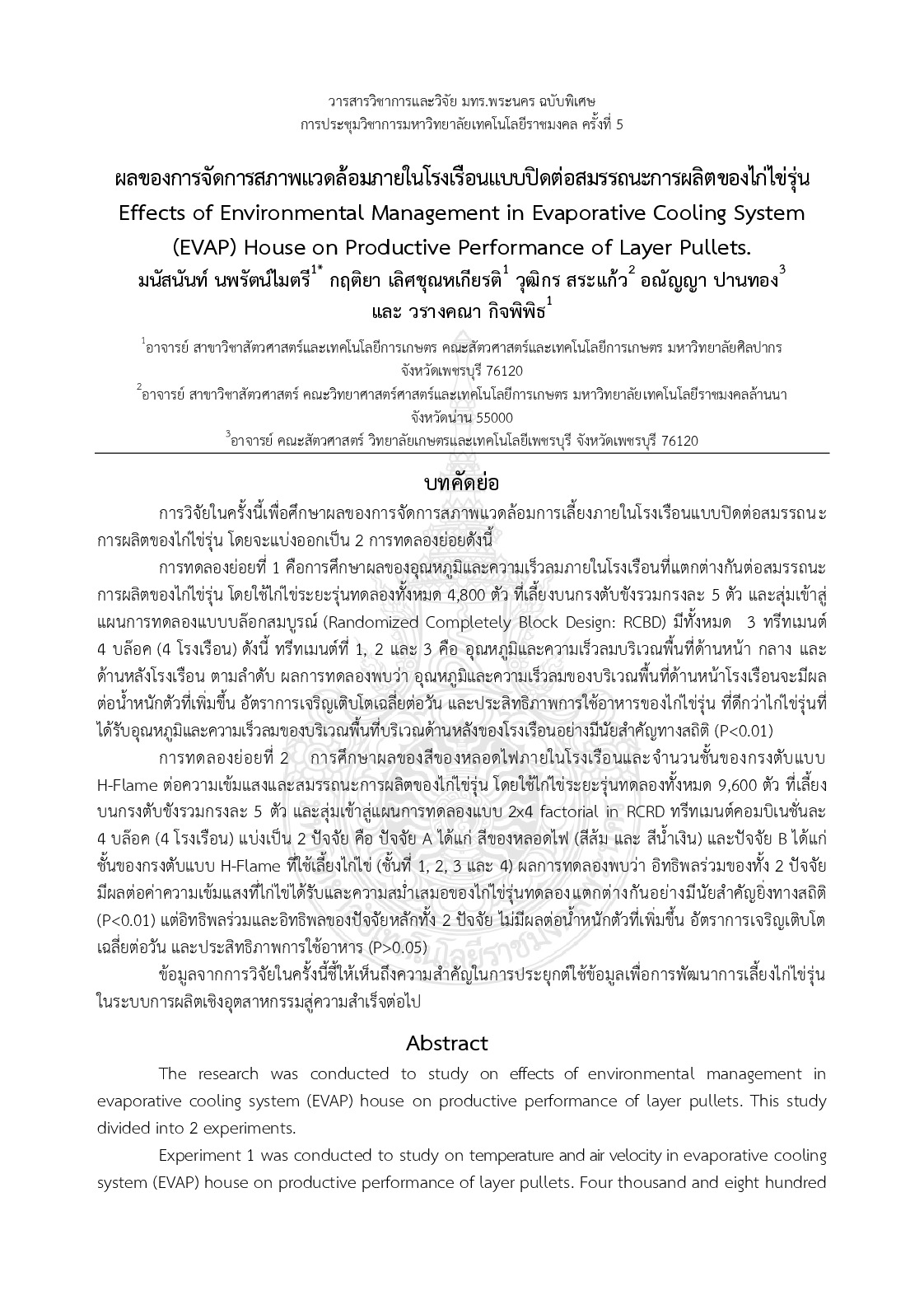
Effects of environmental management in evaporative cooling system (EVAP) house on productive performance of layer pullets
The research was conducted to study on effects of environmental management in evaporative cooling system (EVAP) house on productive performance of layer pullets. This study divided into 2 experiments. Experiment 1 was conducted to study on temperature and air velocity in evaporative cooling system (EVAP) house on productive performance of layer pullets. Four thousand and eight hundred layer pullets were raised on battery cage with 5 birds per cage and assigned in a Randomized Completely Block Design (RCBD) experiment with three treatments. Each treatment consisted of four blocks (four houses) and followed different temperature and air velocity in raising area of evaporative cooling system (EVAP) house as front area central area and back area. Results showed that temperature and air velocity in front area was grater body weight gain (BWG) average daily gain (ADG) and feed conversion ratio (FCR) of layer pullets than layer pullets were raised in back area of evaporative cooling system (EVAP) house (P<0.01) Experiment 2 was conducted to study on light color and number of H-Flame battery cage row in evaporative cooling system (EVAP) house on light intensity and productive performance of layer pullets. Nine thousand and six hundred layer pullets were raised on H-Flame battery cage with 5 birds per cage and assigned in a 2x4 factorial in Randomized Completely Block Design (RCBD) experiment with two factors. Factor A was light color comprised of range and blue). While Factor B was number of battery cage row comprised (first row second row third row and fourth row). Each treatment consisted of four blocks (four houses). Results showed that interaction between factor A and B on light intensity and uniformity of layer pullets with highly significantly different (P<0.01). However interaction between factor A and B and main effect (factor A and B) were investigated on body weight gain (BWG) average daily gain (ADG) and feed conversion ratio (FCR) (P>0.05). The data from this research was suggests the important for implicate to improve the egg production industry in further success.