จำนวน Repository ( 286 )
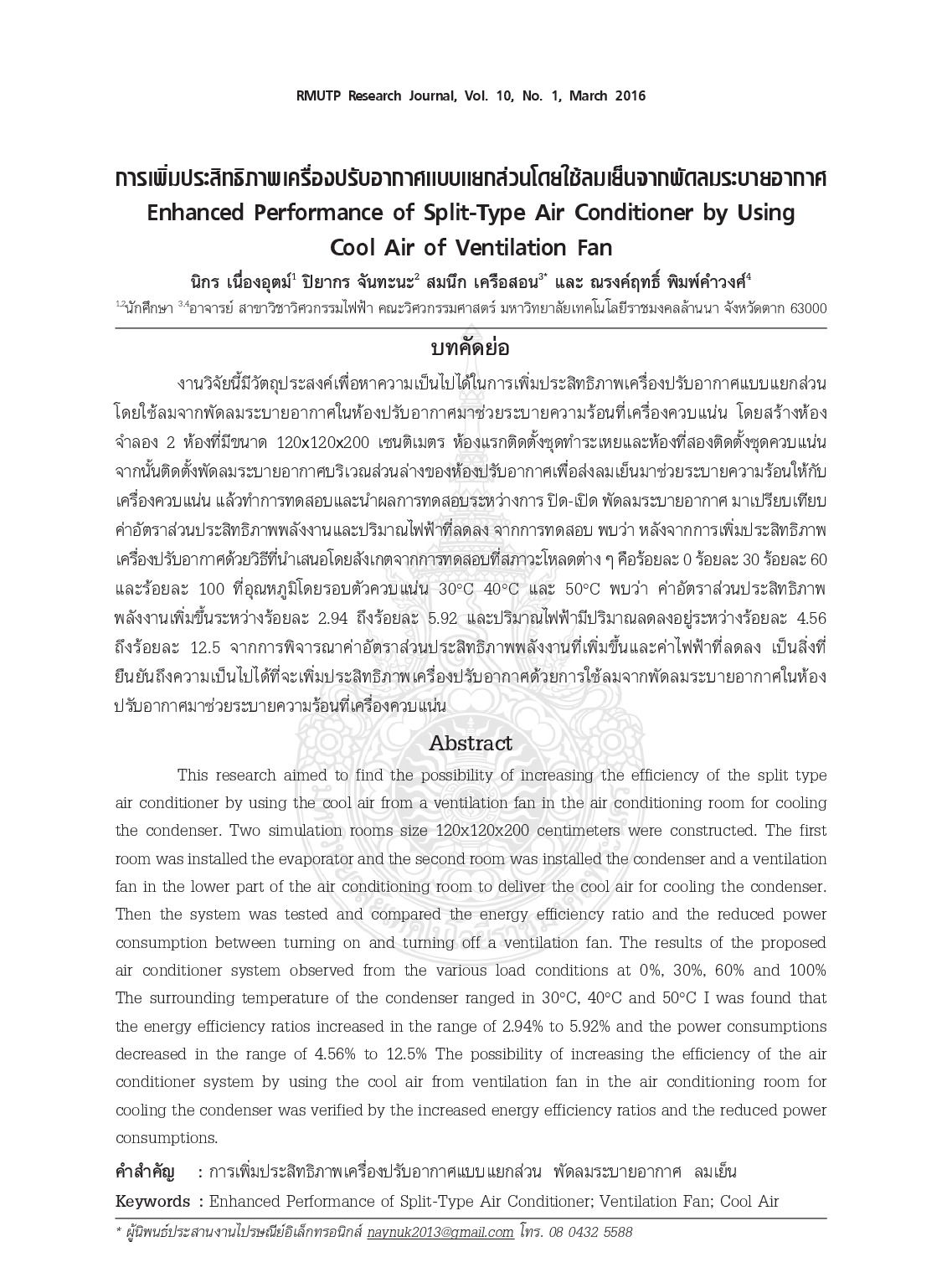
การเพิ่มประสิทธิภาพเครื่องปรับอากาศแบบแยกส่วนโดยใช้ลมเย็นจากพัดลมระบายอากาศ
This research aimed to find the possibility of increasing the efficiency of the split type air conditioner by using the cool air from a ventilation fan in the air conditioning room for cooling the condenser. Two simulation rooms size 120x120x200 centimeters were constructed. The first room was installed the evaporator and the second room was installed the condenser and a ventilation fan in the lower part of the air conditioning room to deliver the cool air for cooling the condenser. Then the system was tested and compared the energy efficiency ratio and the reduced power consumption between turning on and turning off a ventilation fan. The results of the proposed air conditioner system observed from the various load conditions at 0% 30% 60% and 100% The surrounding temperature of the condenser ranged in 30C 40C and 50C It was found that the energy efficiency ratios increased in the range of 2.94% to 5.92% and the power consumptions decreased in the range of 4.56% to 12.5% The possibility of increasing the efficiency of the air conditioner system by using the cool air from ventilation fan in the air conditioning room for cooling the condenser was verified by the increased energy efficiency ratios and the reduced power consumptions.
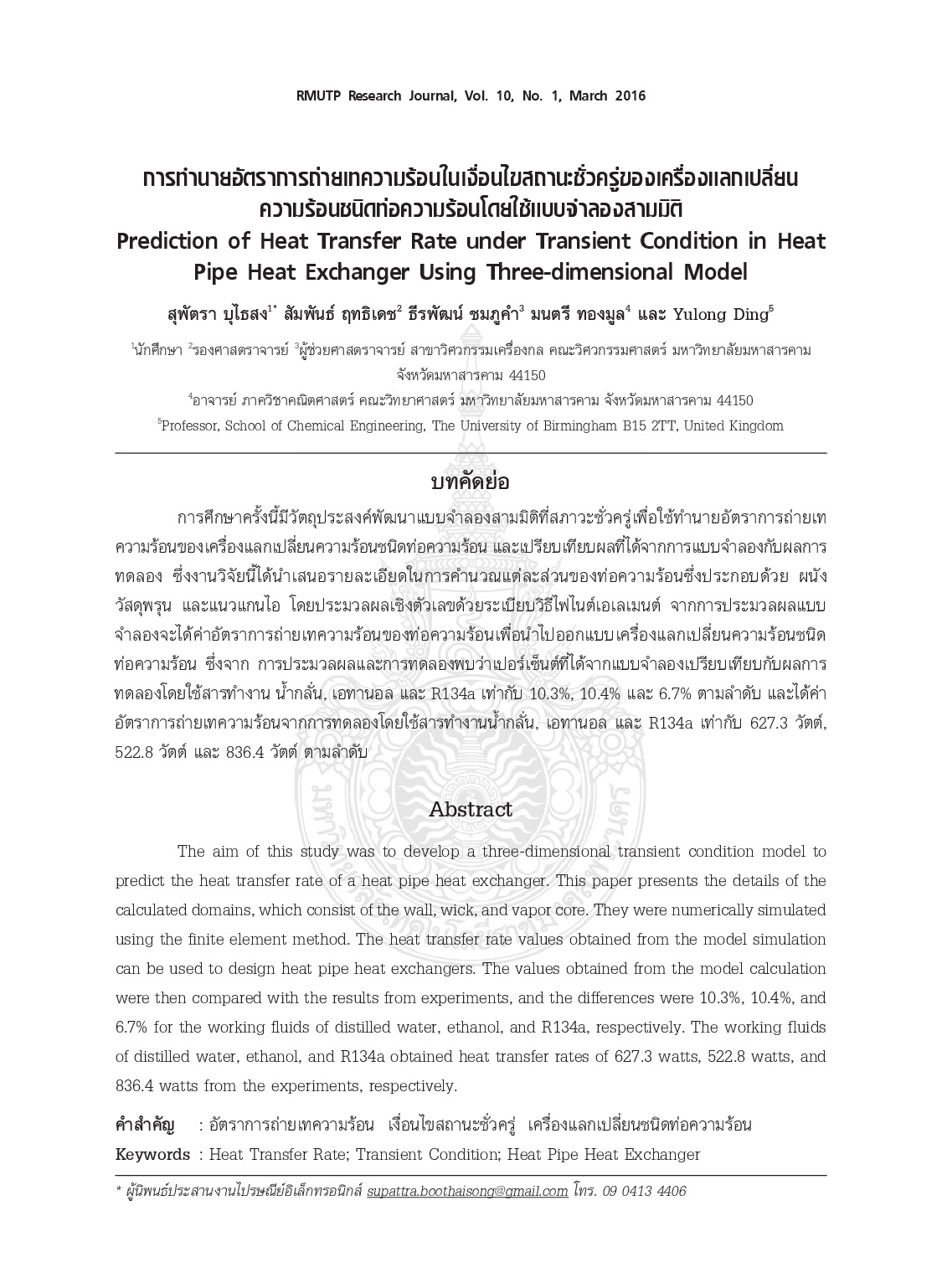
การทำนายอัตราการถ่ายเทความร้อนในเงื่อนไขสถานะชั่วครู่ของเครื่องแลกเปลี่ยนความร้อนชนิดท่อความร้อนโดยใช้แบบจำลองสามมิติ
The aim of this study was to develop a three-dimensional transient condition model to predict the heat transfer rate of a heat pipe heat exchanger. This paper presents the details of the calculated domains which consist of the wall wick and vapor core. They were numerically simulated using the finite element method. The heat transfer rate values obtained from the model simulation can be used to design heat pipe heat exchangers. The values obtained from the model calculation were then compared with the results from experiments and the differences were 10.3% 10.4% and 6.7% for the working fluids of distilled water ethanol and R134a respectively. The working fluids of distilled water ethanol and R134a obtained heat transfer rates of 627.3 watts 522.8 watts and 836.4 watts from the experiments respectively.
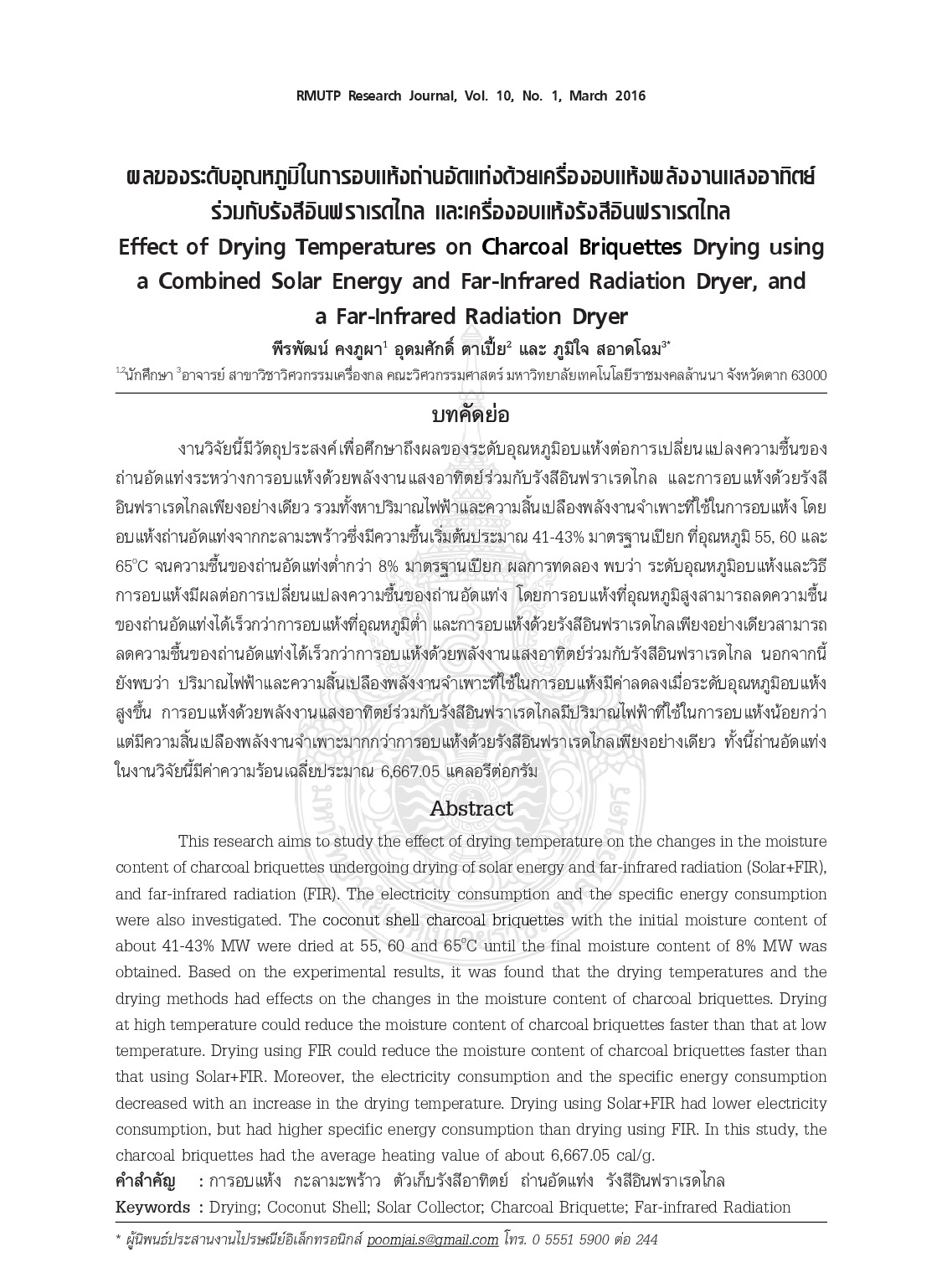
ผลของระดับอุณหภูมิในการอบแห้งถ่านอัดแท่งด้วยเครื่องอบแห้งพลังงานแสงอาทิตย์ร่วมกับรังสีอินฟราเรดไกล และเครื่องอบแห้งรังสีอินฟราเรดไกล
This research aims to study the effect of drying temperature on the changes in the moisture content of charcoal briquettes undergoing drying of solar energy and far-infrared radiation (Solar+FIR) and far-infrared radiation (FIR). The electricity consumption and the specific energy consumption were also investigated. The coconut shell charcoal briquettes with the initial moisture content of about 41-43% MW were dried at 55 60 and 65oC until the final moisture content of 8% MW was obtained. Based on the experimental results it was found that the drying temperatures and the drying methods had effects on the changes in the moisture content of charcoal briquettes. Drying at high temperature could reduce the moisture content of charcoal briquettes faster than that at low temperature. Drying using FIR could reduce the moisture content of charcoal briquettes faster than that using Solar+FIR. Moreover the electricity consumption and the specific energy consumption decreased with an increase in the drying temperature. Drying using Solar+FIR had lower electricity consumption but had higher specific energy consumption than drying using FIR. In this study the charcoal briquettes had the average heating value of about 6667.05 cal/g.
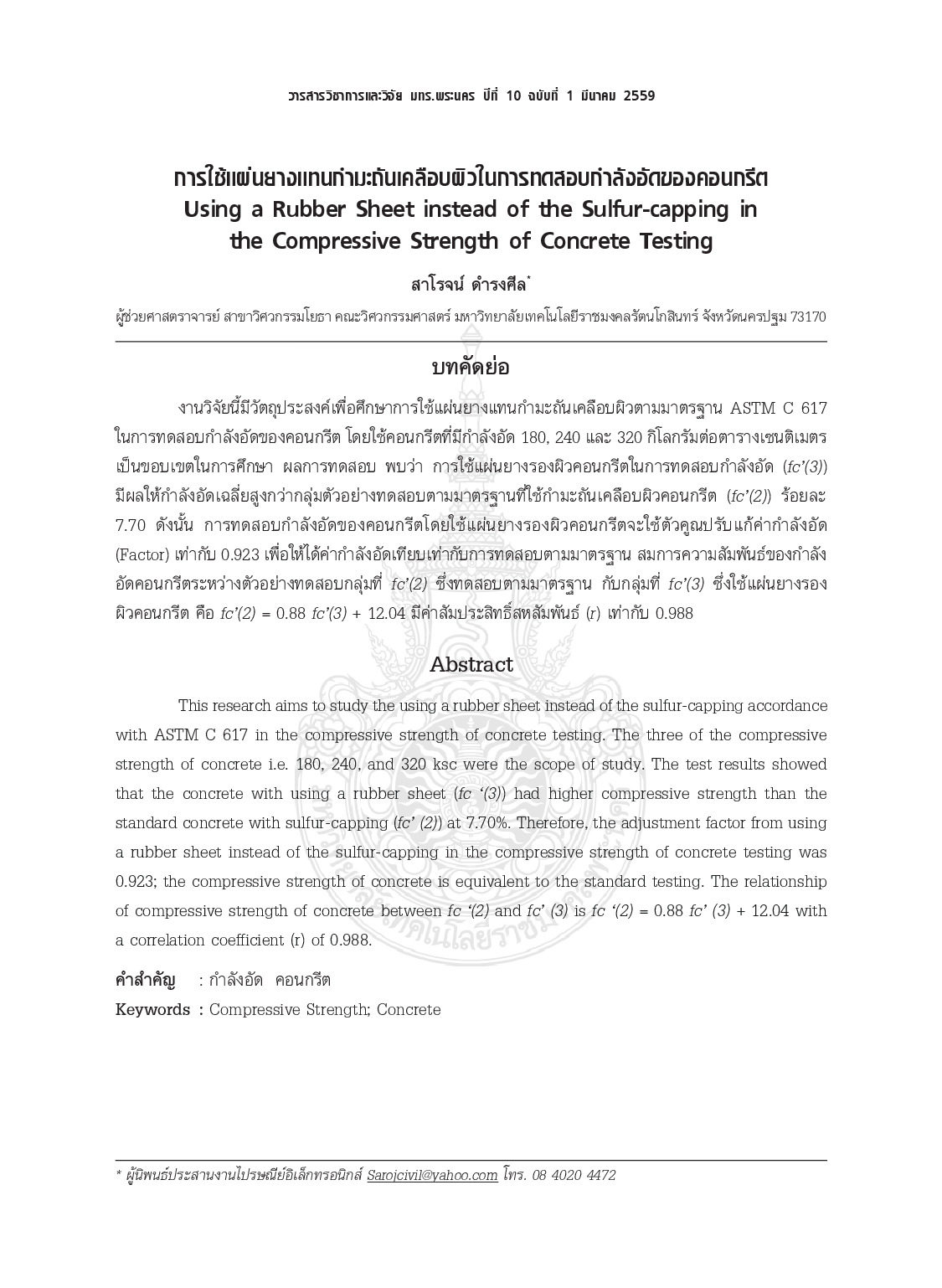
การใช้แผ่นยางแทนกำมะถันเคลือบผิวในการทดสอบกำลังอัดของคอนกรีต
This research aims to study the using a rubber sheet instead of the sulfur-capping accordance with ASTM C 617 in the compressive strength of concrete testing. The three of the compressive strength of concrete i.e. 180 240 and 320 ksc were the scope of study. The test results showed that the concrete with using a rubber sheet (fc (3)) had higher compressive strength than the standard concrete with sulfur-capping (fc (2)) at 7.7%. Therefore the adjustment factor from using a rubber sheet instead of the sulfur-capping in the compressive strength of concrete testing was 0.923; the compressive strength of concrete is equivalent to the standard testing. The relationship of compressive strength of concrete between fc (2) and fc (3) is fc (2) = 0.88 fc (3) + 12.04 with a correlation coefficient (r) of 0.988.
การใช้ยางมะตอยชนิดPMAเป็นหลังคาเพื่อลดน้าหนักโครงสร้างอาคาร
This research aims to study the properties of PMA asphalt shingle roof mixed withnatural latex by various contents of natural latex to PMA asphalt (e.g. 0.0 0.5 1.0 1.52.0 2.5 and 3.0 by weight). The heat pot was used to mix the mixture with lower than160 degree of Celsius. The PMA asphalt shingle roof mixed with natural latex sampleswere cast in 20 x 20 x 0.5 centimeter of dimension and added the fiber plate and stoneflake to reinforce and decorate the roof plate. The properties of the roof plates weretested under ASTM standard. From the results it is found that all samples can resist thetemperature higher than 200 degree of Celsius and the increasing of natural latex (lowerthan 1.5 of ratio) can improve the hardness property while the tensile strength andelongation properties are decreased. However when the amount of natural latexincreased to 2.0 of ratio the tensile strength are increased. After compare the PMA asphalt shingle roof mixed with natural latex (2.0 of ratio) and the general shingle roof found that the researched shingle roof can use as well as the general shingle roof and more tightly. The research results can develop to the PMA shingle roof products and replace the import shingle roofs.