จำนวน Repository ( 192 )

การพัฒนานวัตกรรมรูปแบบกระเป๋าแฟชั่นจากผ้าไหมนาโพธิ์ บุรีรัมย์ ภายใต้โครงการ การพัฒนานวัตกรรมรูปแบบผลิตภัณฑ์สิ่งทอ (OTOP) จากผ้าไหมนาโพธิ์ บุรีรัมย์ ด้วยวัฒนธรรมเชิงอุตสาหกรรมสู่สากล (AEC)
The research aims to develop the innovation development of fashion bags design and the product design by using silk fabric Napho District Buriram. To introduce the technical innovation development of fashion bags design and development of the product design by using silk fabric Napho District Buriram and to develop Thai Community Product Standard (TCPS.) in Buriram Province. The instruments used in research were interview the comment assessment form and the designs assessment form. The sample consisted of 100 interested people. The statistics tools used in data analyzing were frequency percentage mean and standard deviation. The result of the research found that Ban Napho Community Enterprise Group in Buriram Province produced the silk fabric with complex patterns in various colours and styles. It was local knowledge that was unique and useful in conservation education as well as in development. Ban Napho Group have designed and produced textile products by using silk fabric such as Tailor fabric clothing bag scarf and other but they needed to be continually upgrade the designs in order to modernize. The result in this research regarding to fashion bag design revealed that most respondents from the 100 interested people were female employee aged 31 to 40 years having an average income 5001 to 10000 baht and below a Bachelors degree. For the design assessment the result showed that these interested people had positive attitude level in prototype fashion bag No.5 for pattern design application and the overall average at 84 85 and 86 percentages respectively. The transfer of technology evaluation the results showed that prototype fabric bag No.5 was positive attitude in high level for overall pattern design and decorating at 86 percentages and prototype fabric bag No.6 was at 82 percentages respectively. The research finalized the highest score of prototype fabric bags and 5 phototypes were selected without respectively such as phototype No.1 2 5 6 and 9. They were selected for making the sample in order to introduce the knowledge to the local community.
การพัฒนานวัตกรรมรูปแบบลวดลายทอและสีผ้าไหมนาโพธิ์ บุรีรัมย์
Mudmee silk and silk weaving are the long carried cultural wisdom heritages inherited from ancestors. Buriram is another province where weaves Thai silk especially in Na Pho district. Na Pho Silk Weaving Center (Na Pho Handicraft Center) has been known for madmee silk and silk weaving in quality standardization and popular. It is retaining traditional patterns and colors. New patterns are created but not much and not very suitable to produce various products. There is an attempt to revamp image of silk fabric and mudmee silk to raise value and use of color in universal design. The development for silk fabric designing and coloring in Na Pho received support for standardization. The design patterns has been inspired by mudmee silk’s ancient patterns Na Pho district Buriram province. The highlight of ancient patterns including Lai Khom Lai Tad Lai Song Pool Lai Khor Lai Eid Tong Lai Kra Tae Nang Tan or Lai Nak Lai Kho Pai and Lai Kho Lo (Butterfly) are applied in the process of assigning weaves/colors the size of the space and color placement for various patterns and application but it is still retaining the original pattern. Single color is applied for such patterns and become visible through its different including navy blue blue and bluepurple. Study of variation results in color fastness to washing color fastness to light color fastness to water and color fastness to perspiration of silk fabric and mudmee silk showed after dyeing. Color fastness to washing exhibited very good wash fastness level of (4-5) Color fastness to light exhibited excellent light fastness level of (5) Color fastness to perspiration (acid and alkaline) exhibited very good level of (4-5) and Color fastness of water exhibited moderate level of (4) The assessment reviews regarding patterns textures colors and products from silk fabric and mudmee silk from 20 samples of Na Pho Silk Weaving Center (Na Pho Handicraft Center) Na Pho district Buriram Province revealed that Pattern of silk fabric and mudmee silk of Na Pho Buriram province still retained pattern and exhibited excellent value of (75 percent) and good value of (25 percent). Pattern was contemporary between traditional motifs and new design exhibited excellent value of (50 percent) good value of (40 percent) and moderate value of (10 percent). Pattern was not difficult and not too easy. It was suitable to weave for silk fabric and mudmee silk exhibited excellent value of (85 percent) and good value of (15 percent). Pattern layout still retained the method of the traditional motifs exhibited excellent value of (60 percent) good value of (30 percent) and moderate value of (10 percent). Placement and spacing of patterns were balanced and not too tight exhibited excellent value of (70 percent) good value of (25 percent) and moderate value of (5 percent). The suitable of pattern layout in vertical horizontal diagonal and stripes which involved in the manufacture of textile products exhibited excellent value of (75 percent) good value of (20 percent) and moderate value of (5 percent). Color placement was harmonized and suitable for manufacture of textile products exhibited excellent value of (60 percent) good of (35 percent) and moderate value of (5 percent). Pattern become visible through its difference when dark color is applied for silk fabric and mudmee silk with exhibited excellent value of (65 percent) and good value of (35 percent). The suitable of apply single color and color which is similar to for the fashion and textile product exhibited excellent value (50 percent) good value (35 percent) and moderate value (15 percent). The application of the new pattern from the silk fabric and mudmee silk products exhibited contemporary with excellent value of (85 percent) good value of (10 percent) and moderate value of (15 percent). Bags products from using silk fabric and mudee silk maintained the same identity with excellent value of (70 percent) and good value of (30 percent). Textiles products from silk fabric and mudee silk Na Pho Buriram province exhibited excellent value of (60 percent) good value of (35 percent) and moderate value of (5 percent)
การพัฒนาเครื่องย้อมสีเส้นด้ายผักตบชวาและวัสดุเสริมเพื่อพัฒนาวิสาหกิจขนาดกลางและขนาดย่อม
Water Hyacinth Yarns and Their Transformed Materials Dyeing Machine for Developing Small and Medium-Sized Enterprises was a research project what an aim for producing a prototype dyeing machine. The machine was used at the small enterprise in Nakhon Prathom province. The dyeing machine was contributed by stainless steel. The outer dimension was 100 centimeters in height 130 centimeters in length and 90 centi-meters in width. The inner structure contains with perforate stainless steel drum. It had diameter as 80 centimeters with 90 centimeters length. The container capacity was 27 liters for the raw material as 10 kg of the dry Water Hyacinth Yarns or 5 kg of the dry Water Hyacinth roots. The machine was running test for reactive dyeing process at 80oC for 30 minutes. The machine was achieved for reduce time operation as 5 times and gas consumption as 2.38 times. The break-even point was 1.09 year and B/C as 2.22. Moreover it can solve the fuzzy yarns problem and the volatile smoke during the tradition dyeing. The knowledge was transferred to the stakeholders at the target area as “Chumchonjaksanpaktobchawha Bann klongnokkratum” enterprise in Nakhon Pra thom province. They were satisfied in this benefit in good to very good level.
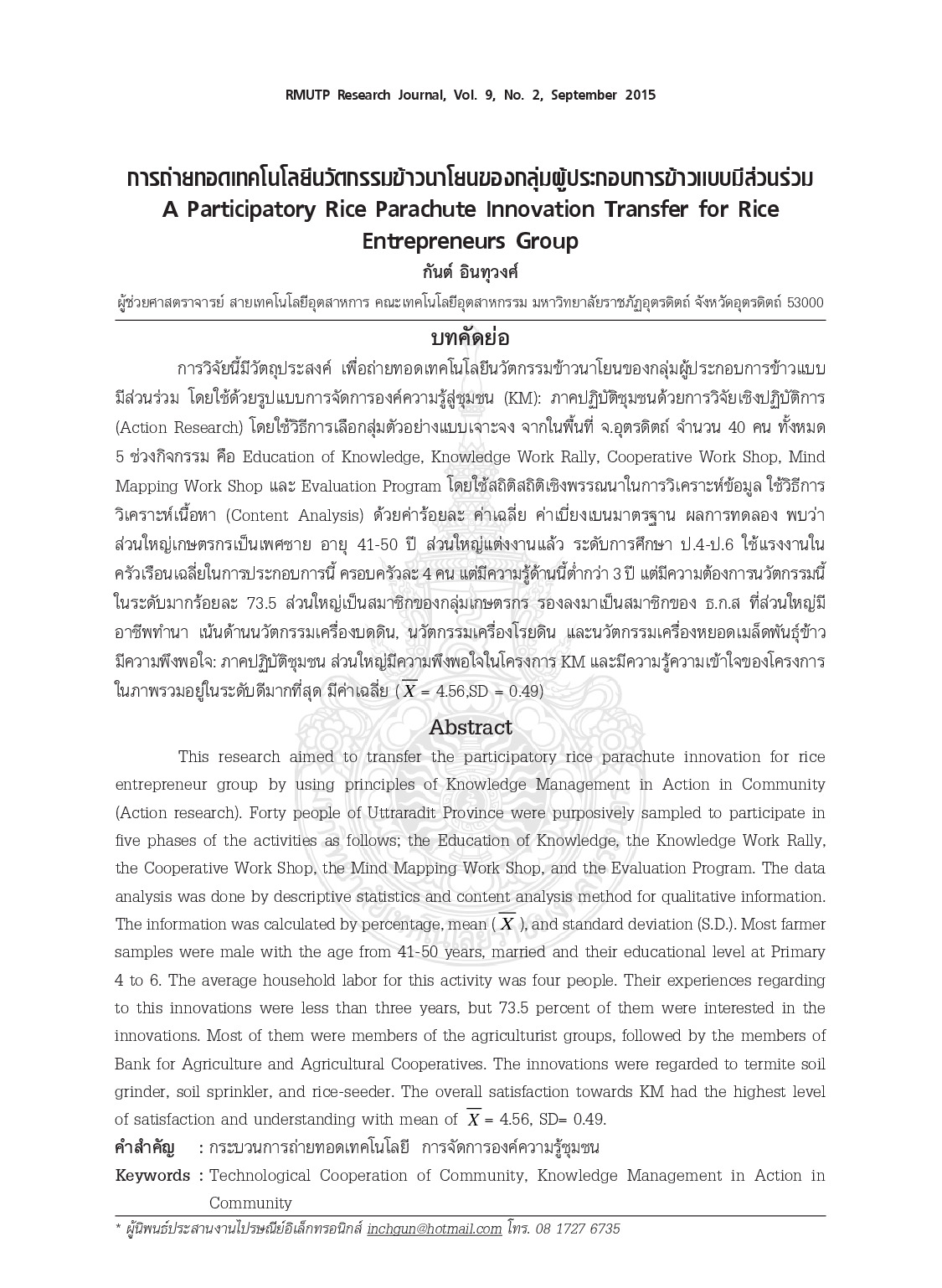
การถ่ายทอดเทคโนโลยีนวัตกรรมข้าวนาโยนของกลุ่มผู้ประกอบการข้าวแบบมีส่วนร่วม
This research aimed to transfer the participatory rice parachute innovation for rice entrepreneur group by using principles of KM: Knowledge Management in Action in Community (Action Research). Forty people of Uttraradit Province were purposively sampled to participate in five phases of the activities. The first activity was the Education of Knowledge the second activity was the Knowledge Work Rally the third activity was the Cooperative Work Shop the fourth activity was the Mind Mapping Work Shop and the fifth activity was the Evaluation Program. Statistics used in data analysis was descriptive statistics and qualitative information was analyzed by using content analysis method. The information was calculated by percentage mean ( ) and standard deviation (S.D.). Most of the samples were male with the age ranged from 41-50 years. Most farmers were married and their educational level was between Primary 4 and Primary 6. The average household labor amount for rice parachute agricultural practice was four people. Their experiences regarding to the rice parachute innovations were less than three years but 73.5 percent of them were interested in the innovations. Most of them were members of the agriculturist groups followed by the members of Bank for Agriculture and Agricultural Cooperatives. Most of them were farmers who have learned the innovations regarding termite soil grinder soil sprinkler and rice-seeder. As for the overall satisfaction towards KM: Knowledge Management in Action in Community most of them had the highest level of satisfaction and understanding with mean of = 4.56 SD= 0.49. In conclusion the participatory innovation transfer project by providing the know-how to the communities using the KM Principle: Knowledge Management in Action in Community was at the highest satisfactory level.
A Study of Competencies of Community Enterprise (OTOP) Entrepreneurs in the Central Region of Thailand toward ASEAN Economic Community
The objectives of this research is to study the current competencies assess competency requirement of community enterprise (OTOP) entrepreneurs in the central region of Thailand and provide them guidelines toward ASEAN Economic Community. The research instruments used for data-gathering were semi-structured interview. The results of the interviews were created by using independent variables in questionnaire. The samplers of this research are the 189 community enterprise (OTOP) entrepreneurs with a 82.54% response rate. The results were as follows : Attributes and skills indicated by current competencies were at high level while knowledge was medium level. The competency requirement attributes skills and knowledge were at high level respectively. The fundamental preparation for competency of community enterprise (OTOP) entrepreneurs in the central region of Thailand toward ASEAN Economic Community should develop competencies in knowledge attributes and skills especially in the international trading regulation international language information technology and management. The community enterprise (OTOP) entrepreneurs should increase skills in the continuous expertise in product development and organization as well as seeking for new markets and creating continuous business networking including organizational innovation acceleration. The community enterprise (OTOP) entrepreneurs should develop attributes to seek for business opportunities widen continuous knowledge and innovation and increase potential organizational development. The suggestions were that the community enterprise (OTOP) entrepreneurs should develop competencies and seek for source of information and ask for government support to get into ASEAN Economic Community. The government sector should support knowledge skills attributes and cooperate with school financial and other to develop potential of community enterprise (OTOP) entrepreneurs in a long term.