จำนวน Repository ( 270 )

การพัฒนาผลิตภัณฑ์อาหารจากกล้วยเพื่อธุรกิจอาหารเจ
This research aims to 1) develop pork roll product from cultivated banana flesh and banana flour for vegetarian food business; 2) develop suitable and unique packaging for food product using cultivated banana flesh and banana flour instead of meat; and 3) transfer technology in developing food product using cultivated banana flesh and banana flour instead of meat for vegetarian food business. Regarding suitable amount of banana flour used in place of isolated soy protein in pre-emulsion preparation from 4 levels of banana flour used at 0 10 15 and 20 percent it was found that increasing amount of banana flour used in place of isolated soy protein caused significant increase of L* value in the product (p<0.05). Moreover hardness and flexibility in texture profile of the product were not significantly different from the control product (p>0.05). In terms of sensory evaluation tasters gave the highest score for meat-emulated reducedemulsion product that used banana flour in place of isolated soy protein at 15 percent. For packaging of pork roll product it was found that Model-A package was the most suitable with recommendations to add tight-closed material to prevent contamination from outside and to print expiry date as well as food safety certified sign. Furthermore consumers’ overall satisfactory in packaging model was found to be highest at the mean of 4.31. Finally transferring of technology in a form of training workshop in developing food product from banana flour for vegetarian food business for Ban Lak Khon Bakery Housewife Community Enterprise and entrepreneurs in Nonthaburi province showed that post-training test scores were significantly higher than pre-training scores at .05 level. This indicated that technological transfer in a form of real-practice workshop provided increasing knowledge in developing food product from banana flour for vegetarian food business. Moreover it was also found that trainees were highly satisfied in both overall service (mean of 4.85) and by-aspect: servicing staff (4.93) procedure/steps (4.87) trainers (4.83) and usefulness of service (4.75) respectively.
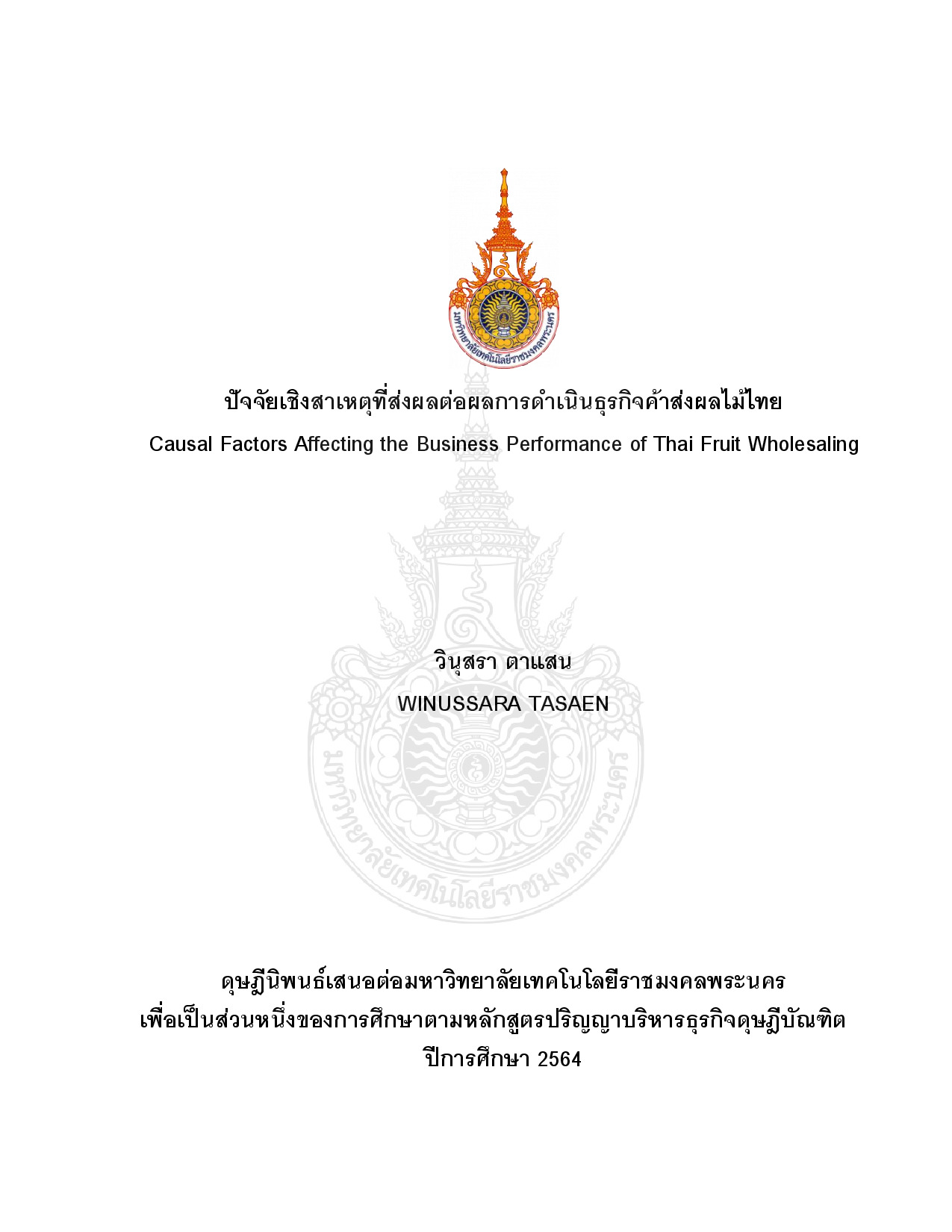
ปัจจัยเชิงสาเหตุที่ส่งผลต่อผลการดำเนินธุรกิจค้าส่งผลไม้ไทย
This research aims to study causal factors affecting the performance of the Thai fruit wholesaling. The objectives were to 1) study the level of focus on entrepreneurial orientation value creation service innovation and business performance of Thai fruit wholesalers in Talaad Thai Pathum Thani Province 2) to create and test the structural equation model of the entrepreneurial orientation value creation service innovation and business performance of Thai fruit wholesalers in Talaad Thai Pathum Thani Province 3) to study the direct effect and indirect effect of entrepreneurial orientation value creation and service innovation influencing the business performance of Thai fruit wholesalers in Talaad Thai Pathum Thani Province. The sample group used in this research consisted of 600 Thai fruit wholesalers in Talaad Thai Khlong Nueng Subdistrict Khlong Luang District Pathum Thani Province. The instrument used for the data collection was a questionnaire using accidental sampling. Descriptive statistics such as frequency percentage mean standard deviation and inferential statistics such as correlation coefficient (r) and structural equation model (SEM) were used to evaluate the data. The research results revealed that the elements of the entrepreneurial orientation factors value creation service innovation and business performance were on average at the highest level. When testing the relationship between every element in the entrepreneurial orientation factor value creation service innovation and the business performance were found to have a statistically significant relationship. In the analysis of the structural equation model (SEM) it was found that service innovation was directly influenced by entrepreneurial orientation with a statistical significance of 0.01 with a coefficient of 0.877 and 77 percent of causal variables were predicted. The business performance was directly influenced by an entrepreneurial orientation value creation and service innovation with 0.92 -0.49 and 0.49 respectively indirectly influenced by entrepreneurial orientation with -0.064. The highest total effect on entrepreneurial orientation was 0.880. The entrepreneurial orientation and service innovation had a significant impact on business performance at 0.01 and had predictive coefficients of 78% and 85% respectively.
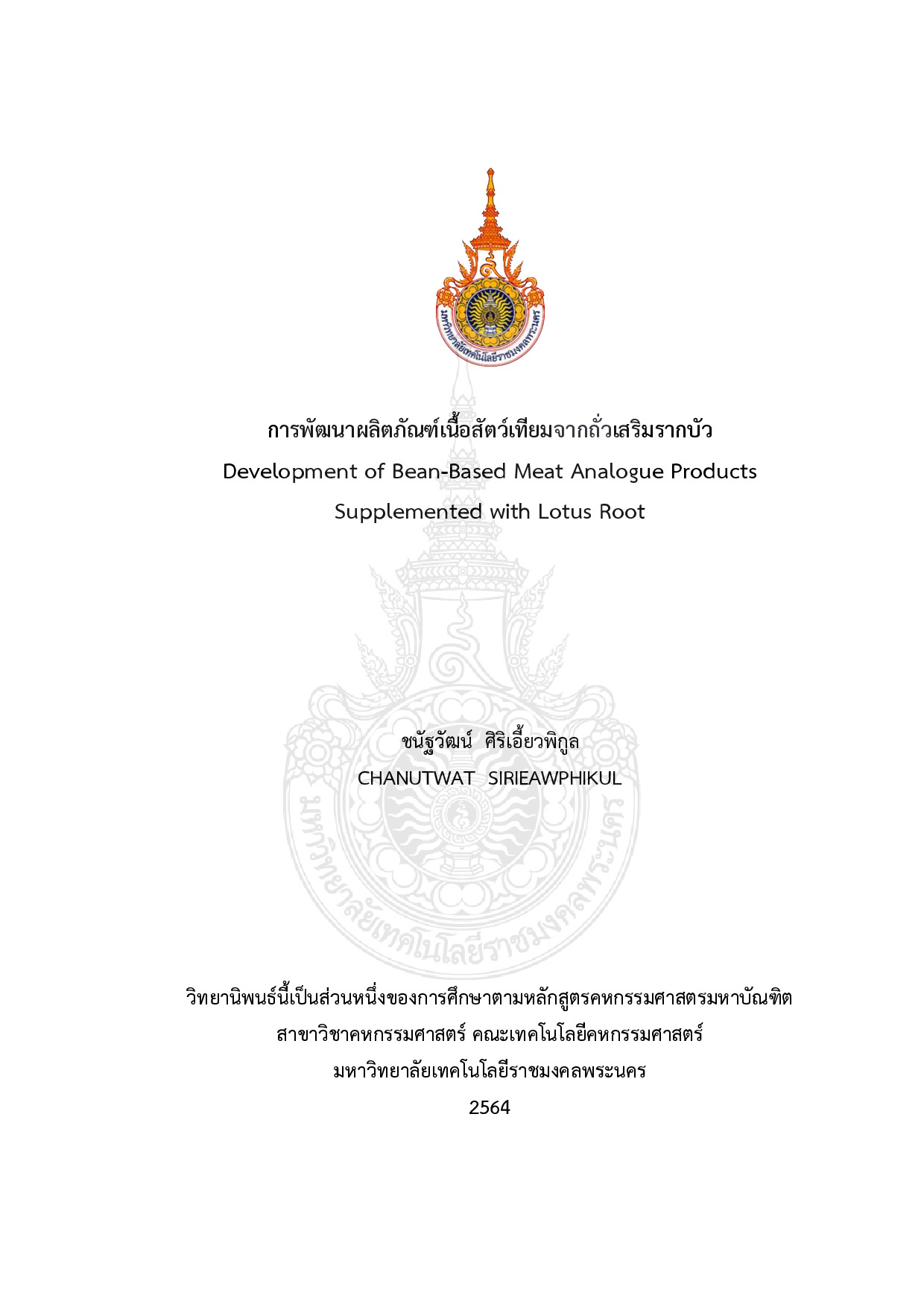
การพัฒนาผลิตภัณฑ์เนื้อสัตว์เทียมจากถั่วเสริมรากบัว
The objectives of this study were 1) to study the basic formula of Bean-Based Meat Analogue Products Supplemented. 2) To study the appropriate amount of lotus root utilization as supplementation in bean-based meat analogue products and to study the nutritional value of bean-based meat analogue products supplemented with lotus root. 3) To study the acceptance of bean-based meat analogue products supplemented with lotus root. 4) To study the consumer acceptance of bean-based meat analogue products recipes supplemented with lotus root. The results showed that the basic formulation of bean-based meat analogue in the recipe 2 which contains 50 grams of soybeans 60 grams of green peas 40 grams of white beans 10 grams of shiitake mushrooms and 5 grams of beetroot was the most accepted by 5 experts. The results of sensory evaluation showed that lotus root supplementation in a 10% bean-based meat analogue formulation was statistically significantly higher than that of 5% 15% and 20% lotus root supplementation (p≤.05). The results of the calculation by software package showed that the amount of dietary fiber in the basic formula was 15.56 gram which was lower than the formula that supplemented with lotus root. The amount of protein in the basic formula was 41.40 grams which was lower than the lotus root fortified formula. The results of a consumer acceptance test of 30 people using the 9-Point Hedonic Scale rating method showed that the majority of consumers liked the shape and color. As for the taste smell texture and overall liking it was at a moderate level of acceptance and 93.33% accepted the bean-based
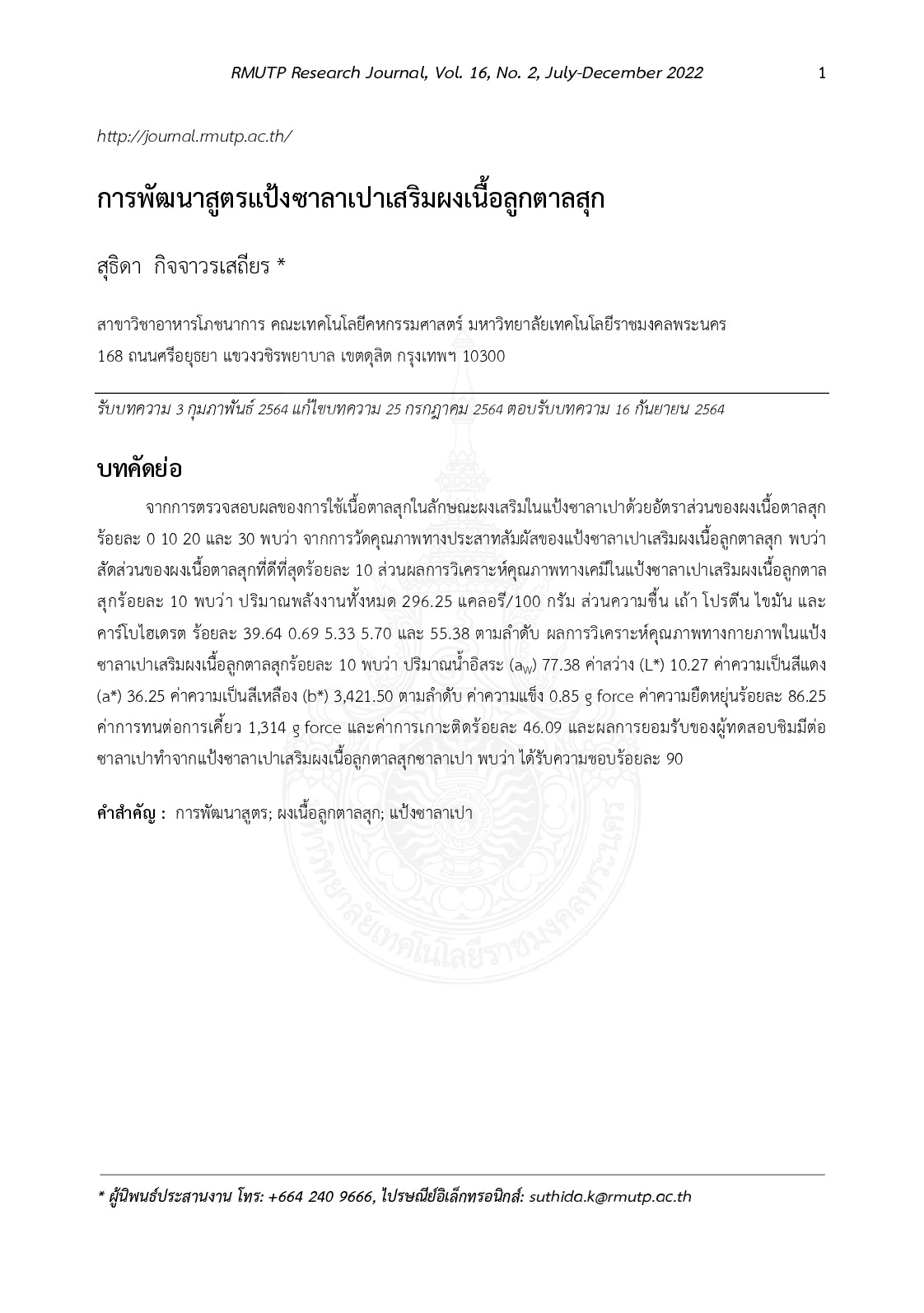
การพัฒนาสูตรแป้งซาลาเปาเสริมผลเนื้อลูกตาลสุก
The results of the using of toddy palm pulp powder form added to steamed buns using ratios of 0 10 20 and 30 %. It was found that from the sensory quality measurements of steamed buns by supplemented toddy palm pulp powder was 10%. As the results of chemical quality analysis of 10% steamed buns by supplemented toddy palm pulp powder was found that the total energy content was 296.25 calories per100g. the moisture ash protein fat and carbohydrate was 39.64 0.69 5.33 5.70 and 55.38 % respectively. The results of physical quality analysis of 10% steamed buns by supplemented toddy palm pulp powder showed that water activity (aw) 77.38 brightness (L*) 10.27 red (a*) 36.25 yellow (b*) 3421.50 respectively Hardness 0.85 g force Springiness 86.25 % Chewiness 1314 g force and Cohesiveness 46.09%. From consumer acceptance testing of 40 testers 90 % of them accepted in this product.
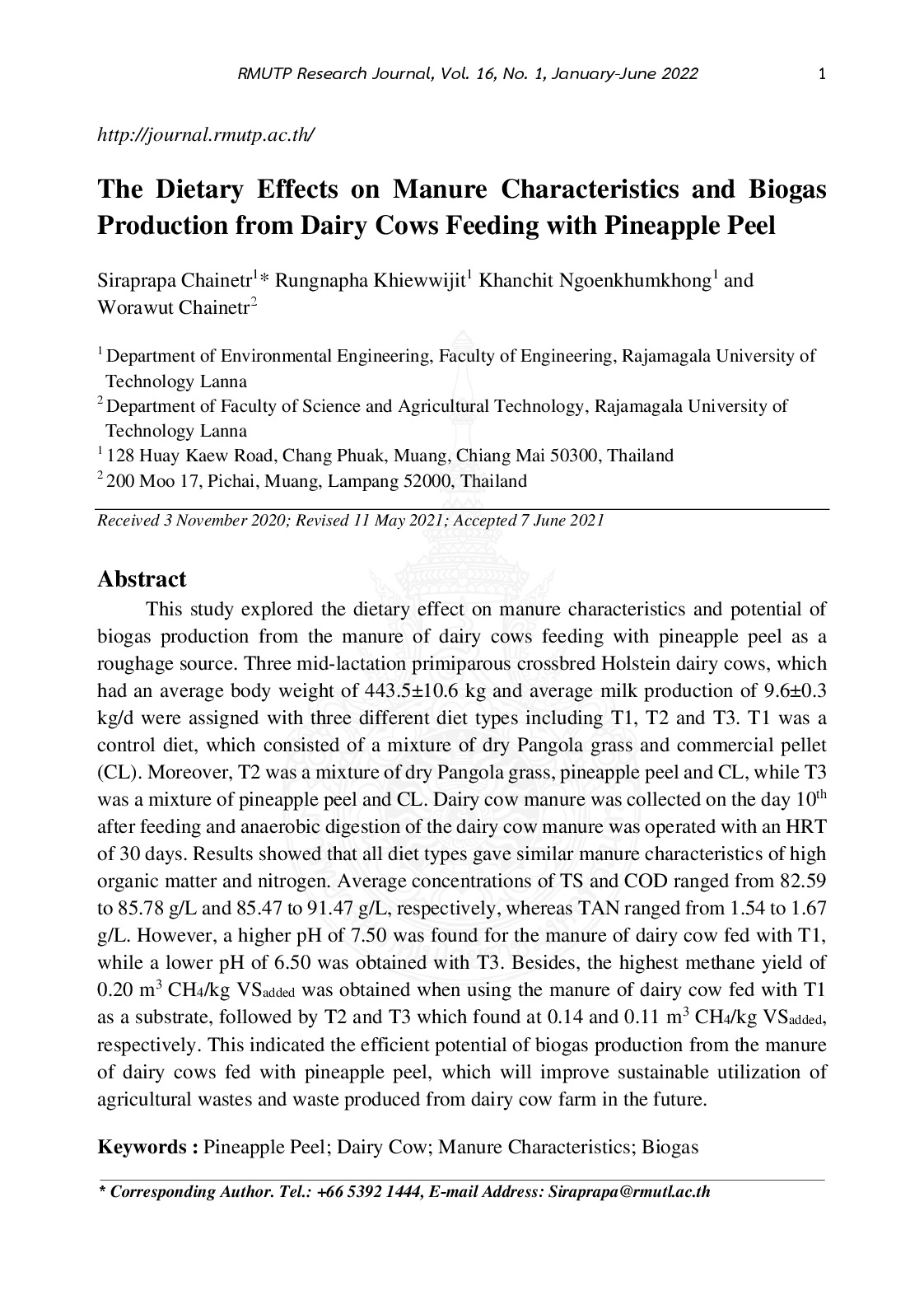
The Dietary effects on manure characteristics and biogas production from dairy cows feeding with pineapple peel
This study explored the dietary effect on manure characteristics and potential of biogas production from the manure of dairy cows feeding with pineapple peel as a roughage source. Three mid-lactation primiparous crossbred Holstein dairy cows which had an average body weight of 443.5±10.6 kg and average milk production of 9.6±0.3 kg/d were assigned with three different diet types including T1 T2 and T3. T1 was a control diet which consisted of a mixture of dry Pangola grass and commercial pellet (CL). Moreover T2 was a mixture of dry Pangola grass pineapple peel and CL while T3 was a mixture of pineapple peel and CL. Dairy cow manure was collected on the day 10th after feeding and anaerobic digestion of the dairy cow manure was operated with an HRT of 30 days. Results showed that all diet types gave similar manure characteristics of high organic matter and nitrogen. Average concentrations of TS and COD ranged from 82.59 to 85.78 g/L and 85.47 to 91.47 g/L respectively whereas TAN ranged from 1.54 to 1.67 g/L. However a higher pH of 7.50 was found for the manure of dairy cow fed with T1 while a lower pH of 6.50 was obtained with T3. Besides the highest methane yield of 0.20 m3 CH4/kg VSadded was obtained when using the manure of dairy cow fed with T1 as a substrate followed by T2 and T3 which found at 0.14 and 0.11 m3 CH4/kg VSadded respectively. This indicated the efficient potential of biogas production from the manure of dairy cows fed with pineapple peel which will improve sustainable utilization of agricultural wastes and waste produced from dairy cow farm in the future.