จำนวน Repository ( 816 )
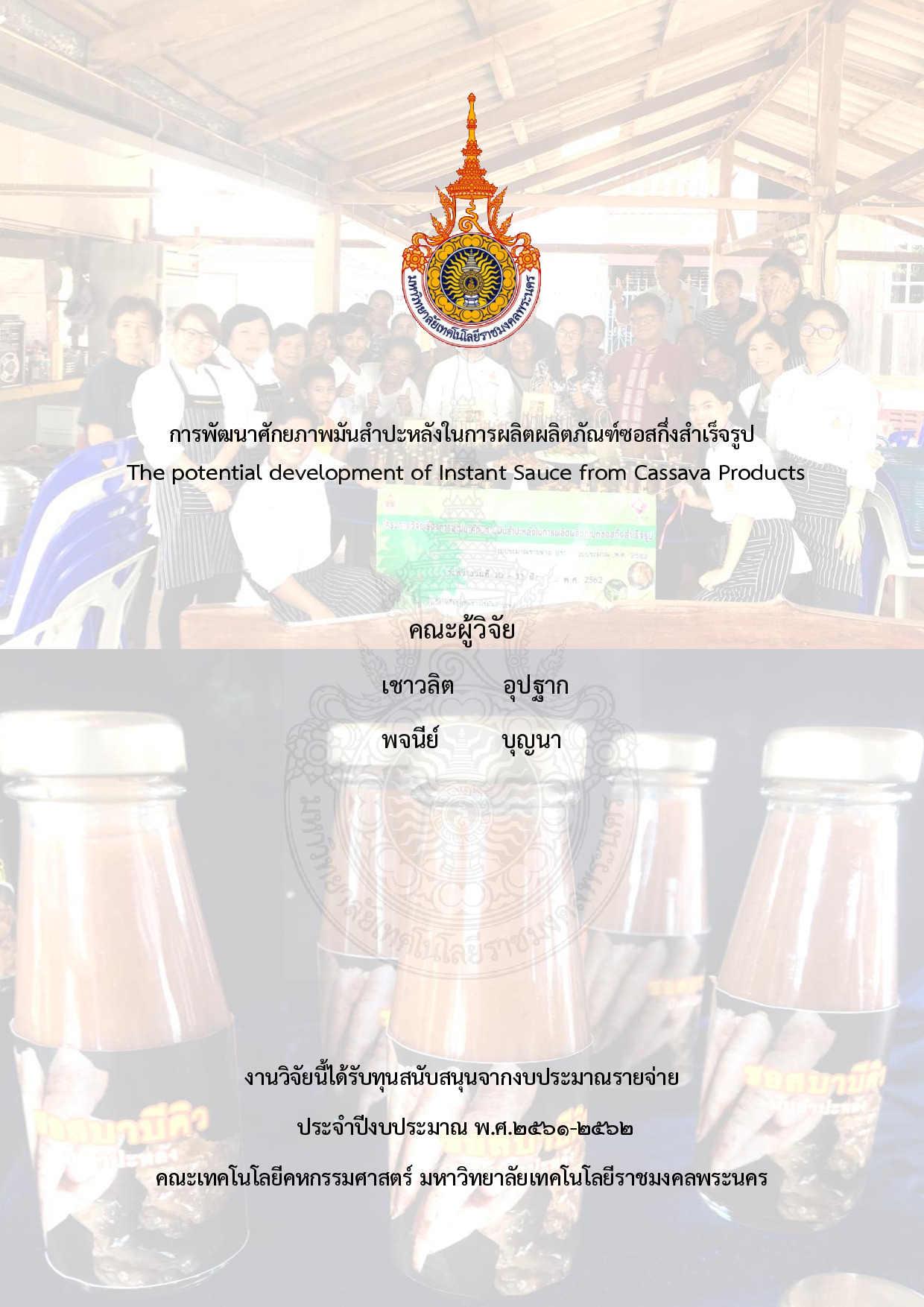
การพัฒนาศักยภาพมันสำปะหลังในการผลิตผลิตภัณฑ์ซอสกึ่งสำเร็จรูป
This research has objectives to study about production process of four types of finished sauce product made from cassava to study about quality of finished sauce product made from cassava to study about consumer test towards finished sauce product made from cassava. From the test it was found that study about quantity of suitable cassava supplement to the four types of finished cassava product by testing about acceptance of testers who were 40 instructors in field of Food and Nutrition field of Food and Nutrition Science and field of Food Service Industry. The method was to give marks for favor in type of 9-point hedonic scale by supplementing cassava into Teriyaki Sauce at levels of 0 20 40 and 60 percent of total ingredient. It was found that the testers accepted the sauce at level of 20 percent which was in the most favorite level. Semi-finished frying sauce supplemented with cassava at level of 0 40 60 and 80 percent of total ingredient; it was found that the testers accepted the level of 60 percent of Barbeque sauce supplemented with cassava at level of 0 40 60 and 80 percent of total ingredient; it was found that the testers accepted level of 40 percent in the level of much favor of semi-finished flavored fermented frying sauce supplemented with cassava at level of 0 20 40 and 60 percent of total ingredient it was found that the testers accepted the sauce at level of 40 percent which is in the level of much favor. Nutritional value of semi-finished sauce product it was found that Teriyaki sauce for 20 percent has moisture value of 78.66 percent fat value of 1.08 percent fiber for 1.36 percent ash for 2.29 percent and protein for 3.34 percent. Semi-finished frying sauce it was found that semi-finished frying sauce supplemented with cassava for 60 percent had moisture value of 80.85 percent fat value of 0.55 percent fiber for 1.35 percent ash for 3.35 and percent and protein for 3.29 percent. cassava for 60 percent it was found that chemical quality had moisture for 82.31 percent fat value for 0.75 percent fiber for 1.51 percent ash for 2.41 percent and protein for 3.37 percent. Semi-finished fermented flavored sauce it was found that semi-finished fermented flavor sauce supplemented with cassava for 40 percent it was found that chemical quality had moisture value for 83.67 percent fat value for 0.07 percent fiber 4.54 percent ash for 4.54 percent and protein for 2.42 percent. However supplementing of cassava into process of finished food products of 4 types; supplementing can be made but there shall be realizing about chemical elements of starting components for example moisture and fat quantity. These components may have effect on physical features for example smell smell and taste and texture. These features affected acceptance of products. The result of study about acceptance of consumers (Consumer test) towards product of semi-finished sauce supplemented with cassava and 100 consumers in Faculty of Home Economics Technology Rajamangala University of Technology Phra Nakhon and people in Tevet Market. Feeling towards acceptance of semi-finished sauce product supplemented with cassava it was found that consumers were satisfactory towards Teriyaki sauce product in moderate favor level having feeling on product in appearance color smell smell and taste in moderate favor level. Feeling towards acceptance of semi-finished sauce product it was found that consumers were satisfactory towards semi-finished frying sauce product 60 percent in moderate favor level having feeling on product in appearance color smell smell and taste in moderate favor level. Feeling towards acceptance of semi-finished fermented sauce product it was found that consumers were satisfactory towards semi-finished fermented sauce product 75 percent in moderate favor level having feeling on product in appearance color smell smell and taste in moderate favor level. Result of technology transfer in project of cassava potential development in production of semi-finished sauce product Tapioca Farmer Community Enterprise Group 480 Khon Buri District and Nong Bunmak District Nakhon Ratchasima Province 45 trainees; most were female having age of 36-45 years to be 96.00 percent. From evaluation it was found that 45 respondents used knowledge to be 100 percent and satisfactory of service receivers in academic aspect and professional aspect towards benefit from service of trainees in level from much to the most to be 100 percent.
การพัฒนาคุณภาพเส้นใยไหมด้วยนาโนเทคโนโลยี เพื่อกลุ่มธุรกิจเกษตรกรเลี้ยงหนอนไหมจังหวัดสุรินทร์
This research is to study the quality development of silk fibers by nanotechnology for the Silkworm farmer business groups of Surin Province. The research purposes are to study the efficiency and process of silkworm rearing using nanotechnology. To test the quality of silk fibers obtained from raising silkworms using nanotechnology. To compare of silkworm rearing results using nanotechnology and to transfer technology to improve silk quality with nanotechnology for silkworm farming business group in Surin Province. The results are as follows 1. The researchers designed the recording schedule which the party can record the changes easily of silk worm development during each day. This research allows the researchers to collect data from the farmer is more easily and finely into 4 groups of experiments with 3 nanotechnology formulas: 1. ZINC OXIDE 2. SILVER NANO and 3. ZINC OXIDE and SILVER NANO with 50:50 percentages each. The silk used in the experiment was “Nang Noi” which is popularly silkworm variety in every household in Surin province.When experimenting must clean the house and rinsing the container with DI WATER for aperiod of 7 months 2. This research is divided into 4 groups. Group 1: Silkworm feed normal methods without the use of nanotechnology. Group 2 silkworms feed with Nano substances such as ZINC OXIDE SILVER NANO ZINC OXIDE and SILVER NANO in 15 percentage concentration. Group 3 silkworms feed with Nano substances are ZINC OXIDE SILVER NANO ZINC OXIDE and SILVER NANO with 30 percentage concentration. Group 4 silkworms feed with Nano substances are ZINC OXIDE SILVER NANO ZINC OXIDE and SILVER NANO with 45 percentage concentration 3. The Results and comparison of silkworm rearing using nanotechnology the best formula feed is formula 1. When feeding Nano-sprayed on mulberry leaves using 3% 15% zinc silver and silver zinc it is found that the growth of worms in each age was good growth and not being a disease. Moreover Silkworms are slightly better and more alert than normal farming. The length in ages 3 - 4 - 5 is going in a better direction. Amount of eating mulberry leaves in each age. As usually eating more in ages 2 and 3 after passing the silk production process and testing the quality of silk fibers in the laboratory were found that the silk fibers are smooth not lacking toughness: Tenacity at 3.06 4.60 and 4.60 respectively and also result in fiber amount increase and also the color of the silk fibers is golden quite clear beautiful and consistent color. 4. When technology transfer to the Silkworm farmer business groups of Surin Province as workshop for 3 days. Most participants are satisfied with the highest levels in all questions.
การพัฒนารูปแบบเครื่องนุ่งห่ม จากผ้าทอพื้นเมือง จังหวัดพิษณุโลก
The research entitled “Development of Designed Clothing from Native Woven Fabrics of Phitsanulok” aims to 1) investigate the information of Phitsanulok’s native woven fabric patterns 2) develop designed clothing from native woven fabrics of Phitsanulok and 3) measure the consumer satisfaction for the clothing from native woven fabrics of Phitsanulok. The sample of this research comprised 398 working age women selected by using the accidental sampling technique form working age woman resided in Mueang district of Phitsanulok province. The questionnaire and clothing prototypes were used as a tool for the consumer satisfaction data collecting. The descriptive used for statistical analysis in the study were the frequency percentage arithmetic mean and standard deviation.
การสร้างสื่อเสมือนจริงเพื่อส่งเสริมการท่องเที่ยว เกาะพะงัน
This quantitative research aimed to promote 360 degree virtual Reality tourism of Ko Pha Ngan Surat Thani province. The research is presented virtual reality 360 degree with moving the camera 360 degree and still the camera to study the satisfaction of tourists to 360 degree virtual reality tourism media. The informants were male and female tourists who have never travelled to Koh Phangan between the ages of 15 - 45 years and living in Bangkok 400 people. The data were collected by using quantitative research. The sorting data collection search from documents study of the results of promoting tourism in Koh Phangan by using Virtual Reality to collect data and using tools such as structured interviews and surveys.
การพัฒนาศักยภาพมันสำปะหลังในการผลิต ผลิตภัณฑ์น้ำพริก
The purpose of this research to study the process of destruction of cyanide in cassava. Prior to use in product of Thai pastes and study use of cassava in Thai pastes production of 4 types in tha dang pastes roasted chili paste lohng reuua paste Tamarind chili paste. study physical properties and chemical properties of product and consumer test studies in cassava products affective. in order that transfer technology of development products to the community. The study process to destroy cyanide in cassava before to use in products of pastes. The steaming process in cassava is the low dose of cyanide 18.9 ppm. Studies using cassava to produce 4 types of pastes. The average score of tha dang pastes supplement of cassava 15 percentage in terms of appearance color taste texture and overall liking. The average score was 7.20.7.30.7.00.7.20 and 7.50. This is a preference at a moderate level. Sensory evaluation of roasted paste supplement of cassava 40 percent in terms of appearance color taste texture and overall liking. The average score was 7.86 8.05 7.79 7.86 7.71 and 7.79 This is a preference at a moderate level. Sensory evaluation of lohng reuua paste supplement of cassava 10 percent in terms of appearance color aroma taste texture and overall liking. The average score was 7.30 6.70 7.00 7.50 7.30 and 7.25. This is a preference small and medium-like. Sensory evaluation of tamarind paste supplement of cassava 20 percent in terms of appearance color aroma taste texture and overall liking. The average score was 7.40 7.15 7.15 7.20 7.20 and 7.50. there is a preference moderate inclination. When all 4 types of products were tested for physical chemical and microbiological. we found increasing the amount of cassava in products has affect the color of the products and increase of fat and fiber in the products. All 4 types of cassava products of biomass are no harmful by Thai Industrial Standards Institute. The study on consumer acceptance of the products cassava paste the 4 types. The consumers test responded to the questionnaire were female. The age of the respondents is 21-30year and occupation of the respondents are students. Most of the revenue will be at 10001-15000 baht. The consumers liking the product in rate like very much to like most and accept all 4 types of cassava products. Most consumers buy for storing themselves including buying as souvenirs. The price of products in consumers agree on the price of 35 baht.