จำนวน Repository ( 440 )
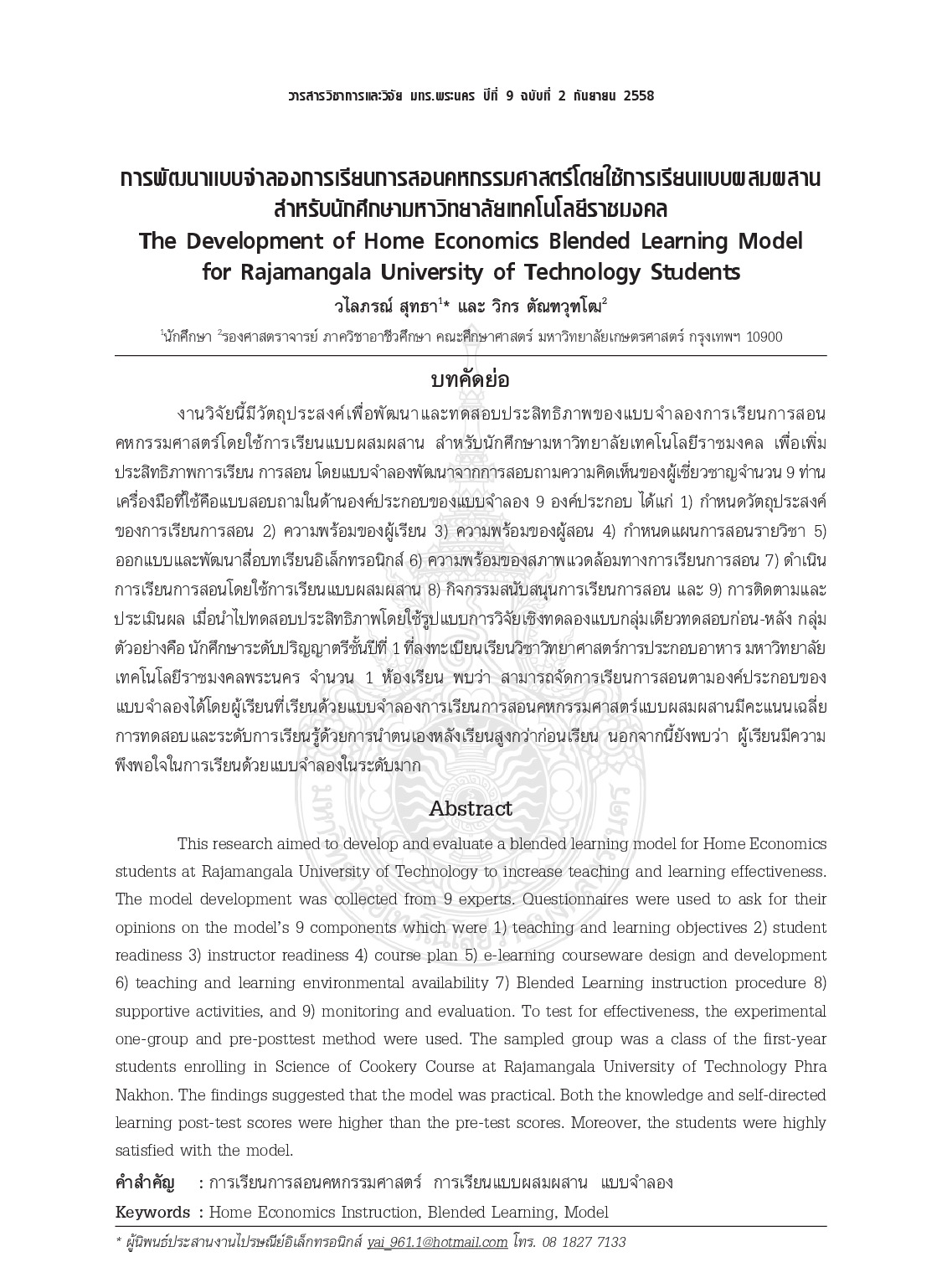
การพัฒนาแบบจำลองการเรียนการสอนคหกรรมศาสตร์โดยใช้การเรียนแบบผสมผสาน สำหรับนักศึกษามหาวิทยาลัยเทคโนโลยีราชมงคล
This research aimed to develop and evaluate a blended learning model for Home Economics students at Rajamangala University of Technology to increase teaching and learning effectiveness. The model development was collected from 9 experts. Questionnaires were used to ask for their opinions on the model’s 9 components which were 1) teaching and learning objectives 2) student readiness 3) instructor readiness 4) course plan 5) e-learning courseware design and development 6) teaching and learning environmental availability 7) Blended Learning instruction procedure 8) supportive activities and 9) monitoring and evaluation. To test for effectiveness the experimental one-group and pre-posttest method were used. The sampled group was a class of the first-year students enrolling in Science of Cookery Course at Rajamangala University of Technology Phra Nakhon. The findings suggested that the model was practical. Both the knowledge and self-directed learning post-test scores were higher than the pre-test scores. Moreover the students were highly satisfied with the model.
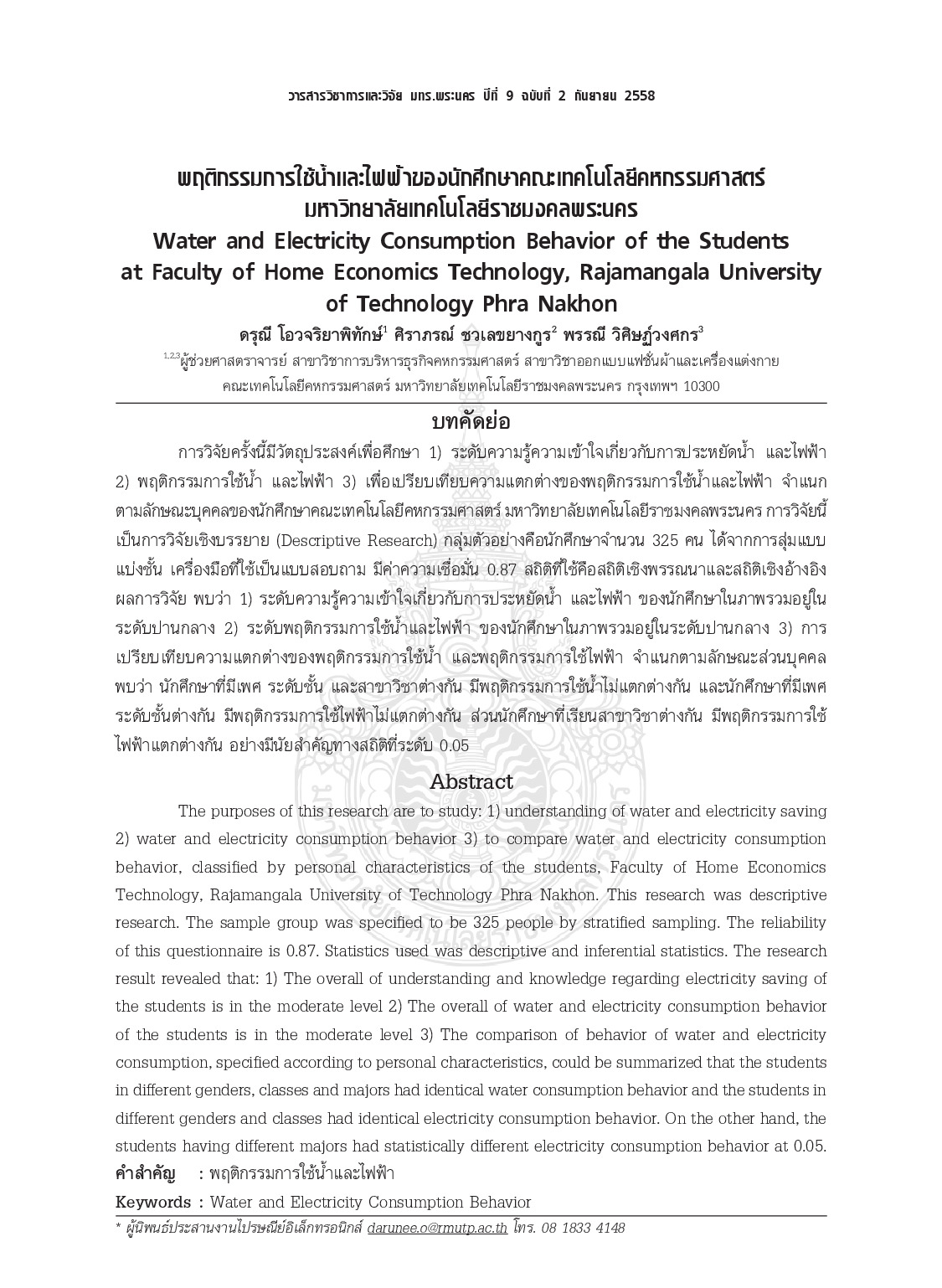
พฤติกรรมการใช้น้ำ และไฟฟ้าของนักศึกษาคณะเทคโนโลยีคหกรรมศาสตร์ มหาวิทยาลัยเทคโนโลยีราชมงคลพระนคร
The purposes of this research are to study: 1) understanding of water and electricity saving 2) water and electricity consumption behavior 3) to compare water and electricity consumption behavior classified by personal characteristics of the students Faculty of Home Economics Technology Rajamangala University of Technology Phra Nakhon. This research was descriptive research. The sample group was specified to be 325 people by stratified sampling. The reliability of this questionnaire is 0.87. Statistics used was descriptive and inferential statistics. The research result revealed that: 1) The overall of understanding and knowledge regarding electricity saving of the students is in the moderate level. 2) The overall of water and electricity consumption behavior of the students is in the moderate level. 3) The comparison of behavior of water and electricity consumption specified according to personal characteristics could be summarized that the students in different genders classes and majors had identical water consumption behavior and the students in different genders and classes had identical electricity consumption behavior. On the other hand the students having different majors had statistically different electricity consumption behavior at 0.05.
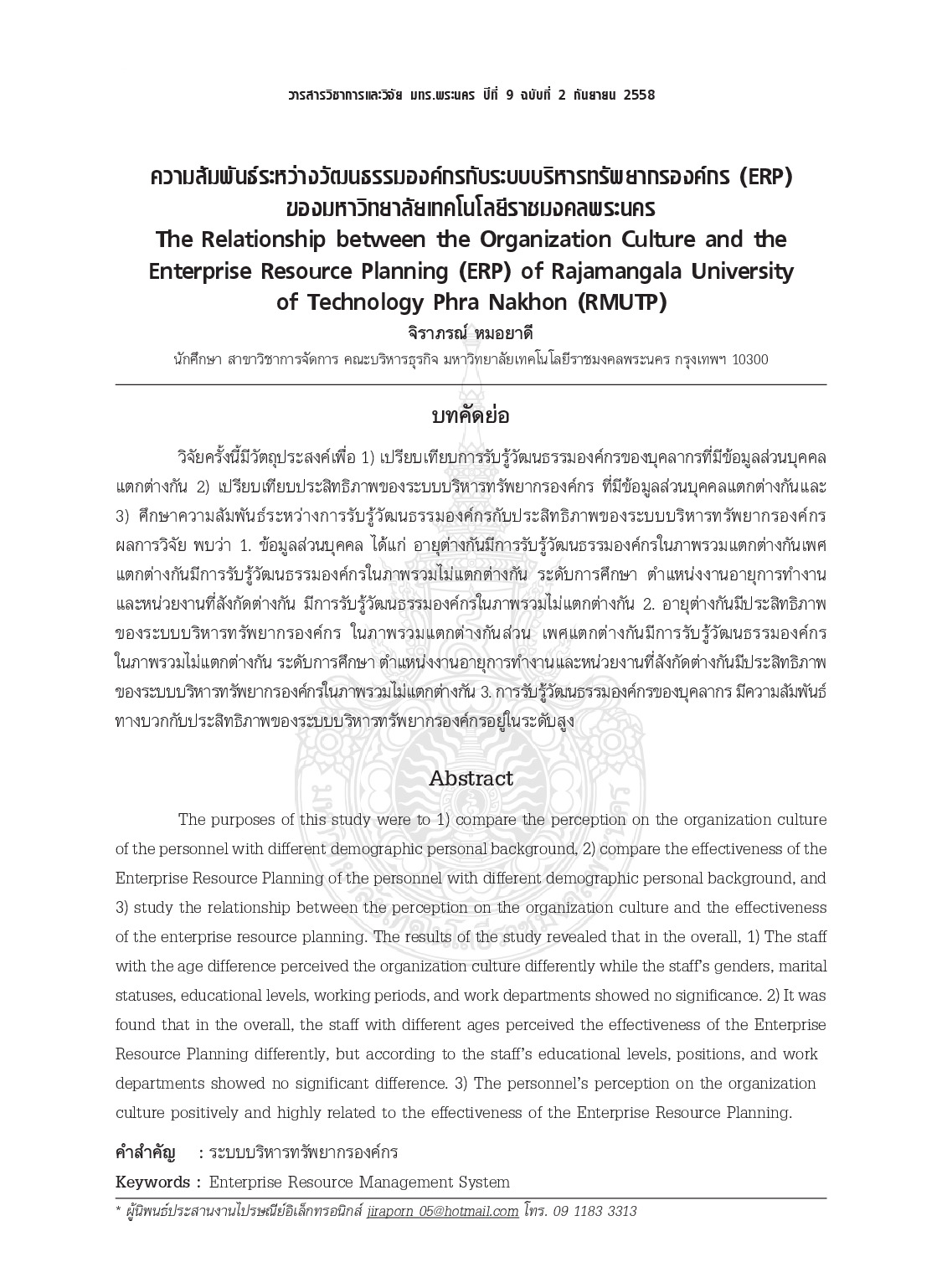
ความสัมพันธ์ระหว่างวัฒนธรรมองค์กรกับระบบบริหารทรัพยากรองค์กร (ERP) ของมหาวิทยาลัยเทคโนโลยีราชมงคลพระนคร
The purposes of this study were to 1) compare the perception on the organization culture of the personnel with different demographic personal background 2) compare the effectiveness of the Enterprise Resource Planning of the personnel with different demographic personal background and 3) study the relationship between the perception on the organization culture and the effectiveness of the enterprise resource planning.The results of the study revealed that in the overall1) The staff with the age difference perceived the organization culture differently while the staff’s genders marital statuses educational levels working periods and work departments showed no significance. 2) It was found that in the overall the staff with different ages perceived the effectiveness of the Enterprise Resource Planning differently but according to the staff’s educational levels positions and work departments showed no significant difference. 3) The personnel’s perception on the organization culture positively and highly related to the effectiveness of the Enterprise Resource Planning.
ความพึงพอใจของนักศึกษาชั้นปีที่ 1 ที่มีต่อการจัดกิจกรรมนักศึกษา มหาวิทยาลัยเทคโนโลยีราชมงคลพระนคร
การวิจัยเรื่องความพึงพอใจของนักศึกษาชั้นปีที่ 1 ที่มีต่อการจัดกิจกรรมนักศึกษามหาวิทยาลัยเทคโนโลยีราชมงคลพระนคร มีวัตถุประสงค์เพื่อศึกษาความพึงพอใจของนักศึกษาชั้นปีที่ 1 ที่มีต่อการจัดกิจกรรมนักศึกษามหาวิทยาลัยเทคโนโลยีราชมงคลพระนคร และศึกษาความต้องการของนักศึกษาชั้นปีที่ 1 ที่มีต่อการจัดกิจกรรมนักศึกษามหาวิทยาลัยเทคโนโลยีราชมงคลพระนคร กลุ่มตัวอย่างได้แก่ นักศึกษาชั้นปีที่่ 1 ที่มีต่อการจัดกิจกรรมนักศึกษามหาวิทยาลัยเทคโนโลยีราชมงคลพระนคร กลุ่มตัวอย่างได้แก่ นักศึกษาชั้นปีที่ 1 มหาวิทยาลัยเทคโนโลยีราชมงคลพระนคร ทั้ง 9 คณะ ที่เข้าร่วมกิจกรรมปีการศึกษา 2557 จำนวน 355 คน ซึ่งกำหนดขนาดตัวอย่างตาราง Krejcie&Morgan และทำการสุ่มแบบตามความสะดวก เครื่องมือที่ใช้ในการเก็บรวบรวมข้อมูลในการวิจัยครั้งนี้ ได้แก่ แบบสอบถามความพึงพอใจของนักศึกษาที่มีต่อการจัดกิจกรรมนักศึกษามหาวิทยาลัยเทคโนโลยีราชมงคลพระนคร สถิติที่ใช้ในการวิเคราะห์ข้อมูล ได้แก่ ค่าเฉลี่ย ค่าร้อยละ ส่วนเบี่ยงเบนมาตรฐานผลการวิจัยพบว่า 1.1 ผลการวิเคราะห์ข้อมูลทั่วไปของผู้ตอบแบบสอบถาม ส่วนใหญ่เป็นเพศหญิง คิดเป็นร้อยละ 61.01 ศึกษาอยู่ในคณะบริหารธุรกิจ คิดเป็นร้อยละ 37.42 การจัดอันดับประเภทของกิจกรรมที่เคยเข้าร่วมทั้ง 5 กิจกรรม พบว่า ส่วนใหญ่เข้าร่วมกิจกรรมด้านวิชาการและวิชาชีพเป็นอันดับที่ 1 คิด เป็นร้อยละ 27.20 อันที่่ 2 ได้แก่ กิจกรรมด้านกีฬาและส่งเสริมสุขภาพ คิดเป็นร้อยละ 22.61 อันดับที่4 ได้แก่ กิจกรรมด้านคุณธรรม จริยธรรม คิดเป็นร้อยละ 17.24 และอันดับที่ 5 ได้แก่ กิจกรรมด้านศิลปวัฒนธรรม คิดเป็นร้อยละ 9.58 และเมื่อพิจารณาถึงเหตุผล การเข้าร่วมกิจกรรม พบว่า ส่วนใหญ่มีความสนใจการเข้าร่วมกิจกรรม คิดเป็นร้อยละ 72.64 1.2 ผลการวิเคราะห์ระดับความพึงพอใจของนักศึกษาชั้นปีที่ 1 ที่มีต่อการจัดกิจกรรมนักศึกษามหาวิทยาลัยเทคโนโลยีราชมงคลพระนคร นักศึกษาชั้นปีที่ 1 มีความพึงพอใจต่อการจัดกิจกรรมนักศึกษามหาวิทยาลัยเทคโนโลยีราชมงคลพระนครโดยภาพรวมอยู่ในระดับมาก (=3.92S.D.=0.84) เมื่่อพิจารณาการจัดกิจกรรมแต่ละด้าน พบว่า การจัดกิจกรรมทุกด้านมีระดับความพึงพอใจอยู่ในระดับมาก ดังนี้ ด้านคุณภาพของกิจกรรมนักศึกษา (=4.00S.D.=0.81) รองลงมาได้แก่ ด้านกระบวนการจัดกิจกรรมนักศึกษา (=3.82S.D.=0.85) ด้านเจ้าหน้าที่ / วิทยากร (=3.96S.D.=0.88) และด้านสิ่งอำนวยความสะดวก (=3.91S.D.=0.81) 1.3 ผลการวิเคราะห์ความต้องการของนักศึกษาชั้นปีที่1 ที่มีต่อการจัดกิจกรรมนักศึกษามหาวิทยาลัยเทคโนโลยีราชมงคลพระนคร นักศึกษาชั้นปีที่ 1 มีความต้องการต่อการจัดกิจกรรมนักศึกษามหาวิทยาลัยเทคโนโลยีราชมงคลพระนครโดยภาพรวมอยู่ในระดับมาก (=3.98S.D.=0.85) เมื่อพิจารณาการจัดกิจกรรมแต่ละด้าน พบว่า การจัดกิจกรรมทุกด้านมีระดับความต้องการอยู่ในระดับมาก (เรียงตามลำดับมากไปหาน้อย) ดังนี้ ด้านเจ้าหน้าที่/วิทยากร (=4.30S.D.=0.87) รองลงมาได้แก่ ด้านคุณภาพของกิจกรรมนักศึกษา (=4.02 S.D.= 0.82) ด้านสิ่งอำนวยความสะดวก (=3.99S.D.=0.85) และด้านกระบวนการจัดกิจกรรมนักศึกษา (=3.88S.D.=0.88)
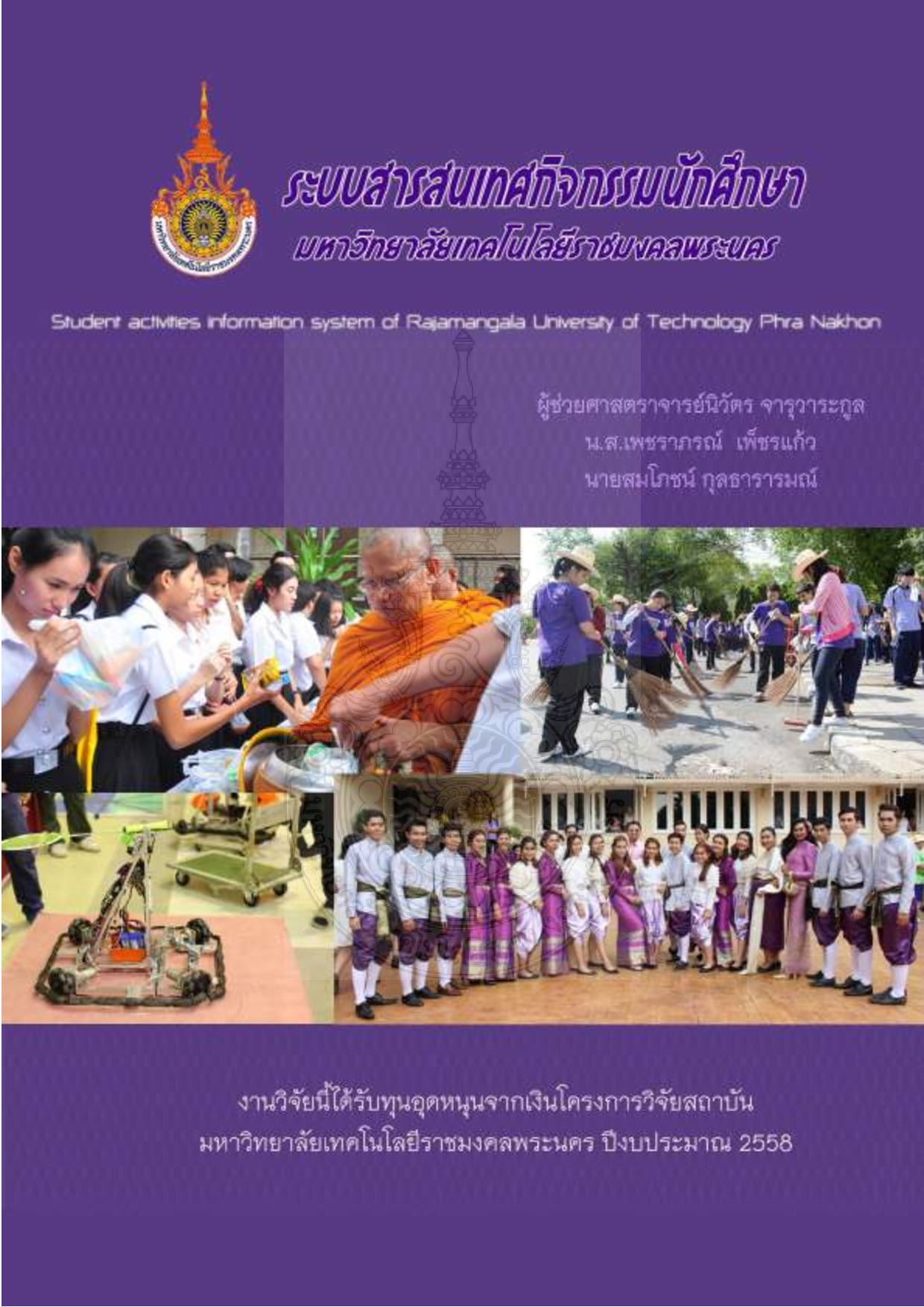
ระบบสารสนเทศกิจกรรมนักศึกษา มหาวิทยาลัยเทคโนโลยีราชมงคล
To manipulate students data which participate in activity projects of the university. Student activity management information system support working of student development division to know how many students join campus activities in each year. This information can increase efficiency for clubs and staffs to set up proper activities according to student requirement. Each student activities data will be printed in activities transcript report when graduate that help rising employment rate in the future. The system was developed tested and assessed by 5 experts get a good level of satisfaction in whole process. The average result of the assessment is 3.99 and standard deviation is 0.38. In conclusion the system accomplishes in good quality able to enhance management of student activity system effectively.