จำนวน Repository ( 211 )

ความรู้ ทัศนคติและพฤติกรรมการบริโภคผักและผลไม้ ของนักเรียนชั้นมัธยมศึกษาตอนต้น โรงเรียนสาธิตมหาวิทยาลัยศรีนครินทรวิโรฒ ประสารมิตร (ฝ่ายมัธยม)
The purposes of this research were to : 1) knowledge 2) attitude 3) vegetables and fruits consumption Behavior 4) the relationship between knowledge and consumption of vegetables and fruits Behavior and 5) the relationship between the attitude of junior high school students Srinakharinwirot University Demonstration School (secondary). The samples junior high school students School University Srinakharinwirot (secondary education) were studying into 2nd semester 2017 academic year 268 people used the questionnaire. The statistics used for data analysis were frequency percentage mean standard deviation and the Chi-Square. The results showed that to : 1) most students have no knowledge of the consumption of fruits and vegetables at a good level 2) attitude to the consumption of vegetables and fruits of students were moderating 3) most students have been a habit of consuming vegetables and stir occasionally the consumption of leave stems the fresh fruit consumption was often an apple banana orange grape mango guava strawberry and pineapple were the reason. Consumption of vegetables was delicious and fruit consumption because was delicious the food choices breakfast of steamed boiled and poached. Lunch fried food and dinner choices eat steamed boiled and poached. For snacks breakfast and afternoon snacks were eating oranges and grapes .The consumption of vegetables in one day less than 4 ladles and fruit consumption in one day less than 3 parts 4) the relationship between knowledge consumption of vegetables and fruit to the consumption of vegetables and fruits found that the relationship between the frequency of consumption of processed foods such as vegetables pickled dried and the frequency of consumption of fruit compote. The frequency of consumption of fruits and stir. There was no relationship between and 5) the relationship between attitudes in the consumption of vegetables and fruits with the consumption of vegetables and fruits found that the relationship between the frequency of consumption of fresh vegetables fruit pickle consumption frequency. The reason for vegetables and for the consumption of fruit and what kind of fruit consumption. Statistically significant was at the .05 level. There were no relationship.
ปัจจัยที่มีความสัมพันธ์กับพฤติกรรมการบริโภคขนมไทยของนักเรียนระดับประกาศนียบัตรวิชาชีพ วิทยาลัยเทคนิคสมุทรสงคราม
The purposes of this research were : 1) To study the individual factors 2) To study the behavior on Thai dessert consumption 3) To study the relationship between individual factors and Thai dessert consumption in Samaut Songkhram Technical College The samples were 239 vocational certificate Students in Smaut Songkhram Technical College. The Instruments were questionnaire and a Test The statistics were the frequency percentage and the Chi-squared test. Results found that : 1) the students mostly were female studying in Accounting whose their parents’income not over 10000 baht per month have knowledge of Thai dessert at the good level. 2) The sample mostly consume boiled Thai dessert 1-3 times a week because of the delicious taste The each payment is up to 20-41 baht because the price was not expensive the preference Banana Leaves packaging and perception of news about Thai dessert through internet. 3) The result on studying factors found that the individual factors such as sex was most related to the preference. Educational level was related to the preference of packaging. Subject type was related to the favorite on Thai dessert. The preference in consuming Thai dessert in because of consumption the payment packaging and perception of news for the parents’income was related to the payment with statistically significant at 0.05 level.
การพัฒนาศักยภาพสับปะรดตกเกรดในผลิตภัณฑ์น้ำพริกสำเร็จรูปพร้อมบริโภค
This research is an experimental research. To study the pineapple chili falls size to develop a product ready for consumption adds value to the products. By studying the types of chili chili 3 chili hell catfish. Chili fish meal by studying the basic formulas for each type of chili. Then the basic formula of chili hell. Spicy Catfish Chili fish meal which has been recognized by the panelists was conducted right amount of pineapple led to replace the dried shrimp in chili hell. Replace meat in chili catfish catfish. Meat and substituted fish meal in fish sauce. At 25 percent 50 and 75. The experiment was a randomized complete block (Randomized Complete Block Design RCBD) then the result of sensory quality in appearance color aroma taste texture and overall liking with tasting A credit rating of nine (9-Point Hedonic Scale) used a sample of 30 students a teacher and students in food and nutrition. Faculty of Economics Rajamangala University of Technology Phra Nakhon. The sensory evaluation. In volume 4 different levels: 0 25 50 and 75 percent of pineapple were: 1) Hell pineapple chili 75 percent most in the appearance color aroma taste texture and overall liking. Which averaged 8.57 8.30 8.53 8.43 8.30 and 8.40 respectively in preference 2) pineapple curry fish meal. The panelists acknowledged that the 75 percent most of the appearance color aroma taste texture and overall liking. Which averaged 8.30 8.20 8.20 8.33 8.13 and 8.20 respectively in preference 3) pineapple curry catfish. The panelists acknowledged that the 75 percent most of the appearance color aroma taste texture and overall liking. Which averaged 8.47 8.33 8.53 8.33 8.13 and 8. 40 respectively in the revelry. The researchers chose to use renewable pineapple smoothie dried fish meat and fish at 75 percent a formula to determine the proper replacement of a pineapple curry catfish in hell. Chili fish meal Spicy Catfish Since it is a formula that has been the most respected in all aspects. Including appearance color aroma taste texture and overall liking. It looks good tastes good and sweet pineapple is good.
การพัฒนาผลิตภัณฑ์เบเกอรี่จากหยวกกล้วยและส่วนเหลือทิ้งใน การผลิตกล้วยตากของกลุ่มวิสาหกิจชุมชนแม่บ้านบางตาโฉม จังหวัดสิงห์บุรีสู่เชิงพาณิชย์อย่างยั่งยืน
Bakery Products Development from the Banana Pseudo-stems and Waste from Dried Banana Production at Ban Bang Ta Chom Community Enterprise Sing Buri Province for Sustainable Commerce. Research on bakery product development from paprika and bananas in Production of Dried Banana of Bang Ta Chom Housewife Community Enterprise Group Sing Buri province for sustainable commercialization in order to: 1. Develop bakery products from 4 types of Banana Pseudo-stems and Waste 2. study the formulas and production processes of bakery products from Banana Pseudo-stems and Waste 3. study the consumer test of bakery products from 4 types of Banana Pseudo-stems and Waste and 4. To transfer technology Little Bakery products from Banana Pseudo-stems and Waste then bring the shelf life in conditions ranging from 0-10 days and compare the physical properties. Chemical and microorganisms such as pH value color measurement and total number of microorganisms found that Khanom Jeen noodles stored in modified atmosphere conditions have longer shelf life than those stored. At normal atmospheric conditions and vacuum conditions. Chemical analysis results showed that the bakery products decreased their pH over time. With values between 4.31 ± 0.00 and 2.99 ± 0.01 and bakery products Stored at 100% carbon dioxide (CO2) modified atmosphere packed in a sealed nylon / PET vacuum plastic bag. Store at room temperature. Can be stored for up to 10 days and found that the total number of microbes increased when the storage life is longer But not over the standard of community products so the products are safe and not harmful to consumers. Consumer test results show that consumers like and are interested in buying bakery products that use 100 percent carbon dioxide (CO2) at 75 percent.
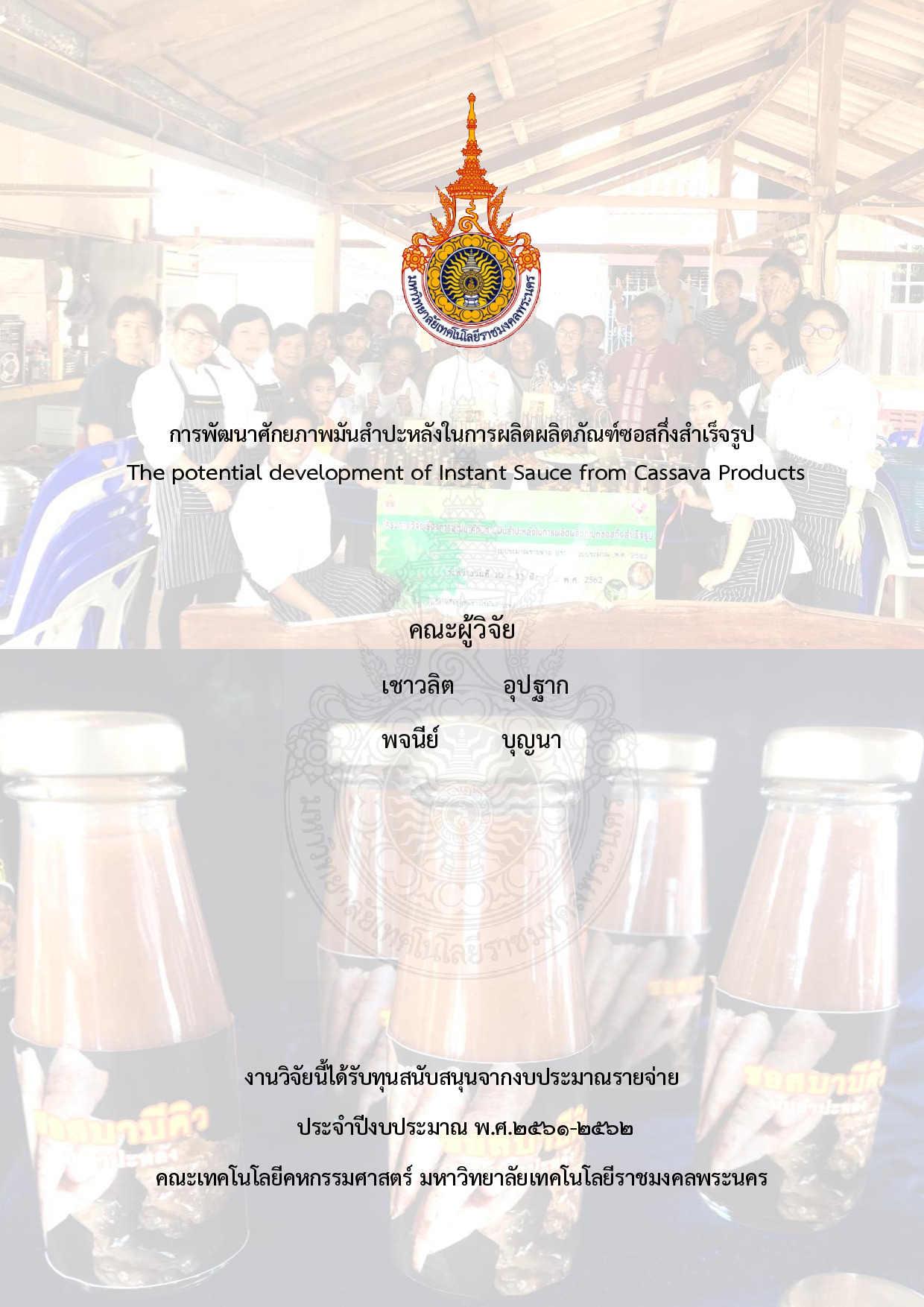
การพัฒนาศักยภาพมันสำปะหลังในการผลิตผลิตภัณฑ์ซอสกึ่งสำเร็จรูป
This research has objectives to study about production process of four types of finished sauce product made from cassava to study about quality of finished sauce product made from cassava to study about consumer test towards finished sauce product made from cassava. From the test it was found that study about quantity of suitable cassava supplement to the four types of finished cassava product by testing about acceptance of testers who were 40 instructors in field of Food and Nutrition field of Food and Nutrition Science and field of Food Service Industry. The method was to give marks for favor in type of 9-point hedonic scale by supplementing cassava into Teriyaki Sauce at levels of 0 20 40 and 60 percent of total ingredient. It was found that the testers accepted the sauce at level of 20 percent which was in the most favorite level. Semi-finished frying sauce supplemented with cassava at level of 0 40 60 and 80 percent of total ingredient; it was found that the testers accepted the level of 60 percent of Barbeque sauce supplemented with cassava at level of 0 40 60 and 80 percent of total ingredient; it was found that the testers accepted level of 40 percent in the level of much favor of semi-finished flavored fermented frying sauce supplemented with cassava at level of 0 20 40 and 60 percent of total ingredient it was found that the testers accepted the sauce at level of 40 percent which is in the level of much favor. Nutritional value of semi-finished sauce product it was found that Teriyaki sauce for 20 percent has moisture value of 78.66 percent fat value of 1.08 percent fiber for 1.36 percent ash for 2.29 percent and protein for 3.34 percent. Semi-finished frying sauce it was found that semi-finished frying sauce supplemented with cassava for 60 percent had moisture value of 80.85 percent fat value of 0.55 percent fiber for 1.35 percent ash for 3.35 and percent and protein for 3.29 percent. cassava for 60 percent it was found that chemical quality had moisture for 82.31 percent fat value for 0.75 percent fiber for 1.51 percent ash for 2.41 percent and protein for 3.37 percent. Semi-finished fermented flavored sauce it was found that semi-finished fermented flavor sauce supplemented with cassava for 40 percent it was found that chemical quality had moisture value for 83.67 percent fat value for 0.07 percent fiber 4.54 percent ash for 4.54 percent and protein for 2.42 percent. However supplementing of cassava into process of finished food products of 4 types; supplementing can be made but there shall be realizing about chemical elements of starting components for example moisture and fat quantity. These components may have effect on physical features for example smell smell and taste and texture. These features affected acceptance of products. The result of study about acceptance of consumers (Consumer test) towards product of semi-finished sauce supplemented with cassava and 100 consumers in Faculty of Home Economics Technology Rajamangala University of Technology Phra Nakhon and people in Tevet Market. Feeling towards acceptance of semi-finished sauce product supplemented with cassava it was found that consumers were satisfactory towards Teriyaki sauce product in moderate favor level having feeling on product in appearance color smell smell and taste in moderate favor level. Feeling towards acceptance of semi-finished sauce product it was found that consumers were satisfactory towards semi-finished frying sauce product 60 percent in moderate favor level having feeling on product in appearance color smell smell and taste in moderate favor level. Feeling towards acceptance of semi-finished fermented sauce product it was found that consumers were satisfactory towards semi-finished fermented sauce product 75 percent in moderate favor level having feeling on product in appearance color smell smell and taste in moderate favor level. Result of technology transfer in project of cassava potential development in production of semi-finished sauce product Tapioca Farmer Community Enterprise Group 480 Khon Buri District and Nong Bunmak District Nakhon Ratchasima Province 45 trainees; most were female having age of 36-45 years to be 96.00 percent. From evaluation it was found that 45 respondents used knowledge to be 100 percent and satisfactory of service receivers in academic aspect and professional aspect towards benefit from service of trainees in level from much to the most to be 100 percent.