จำนวน Repository ( 2131 )
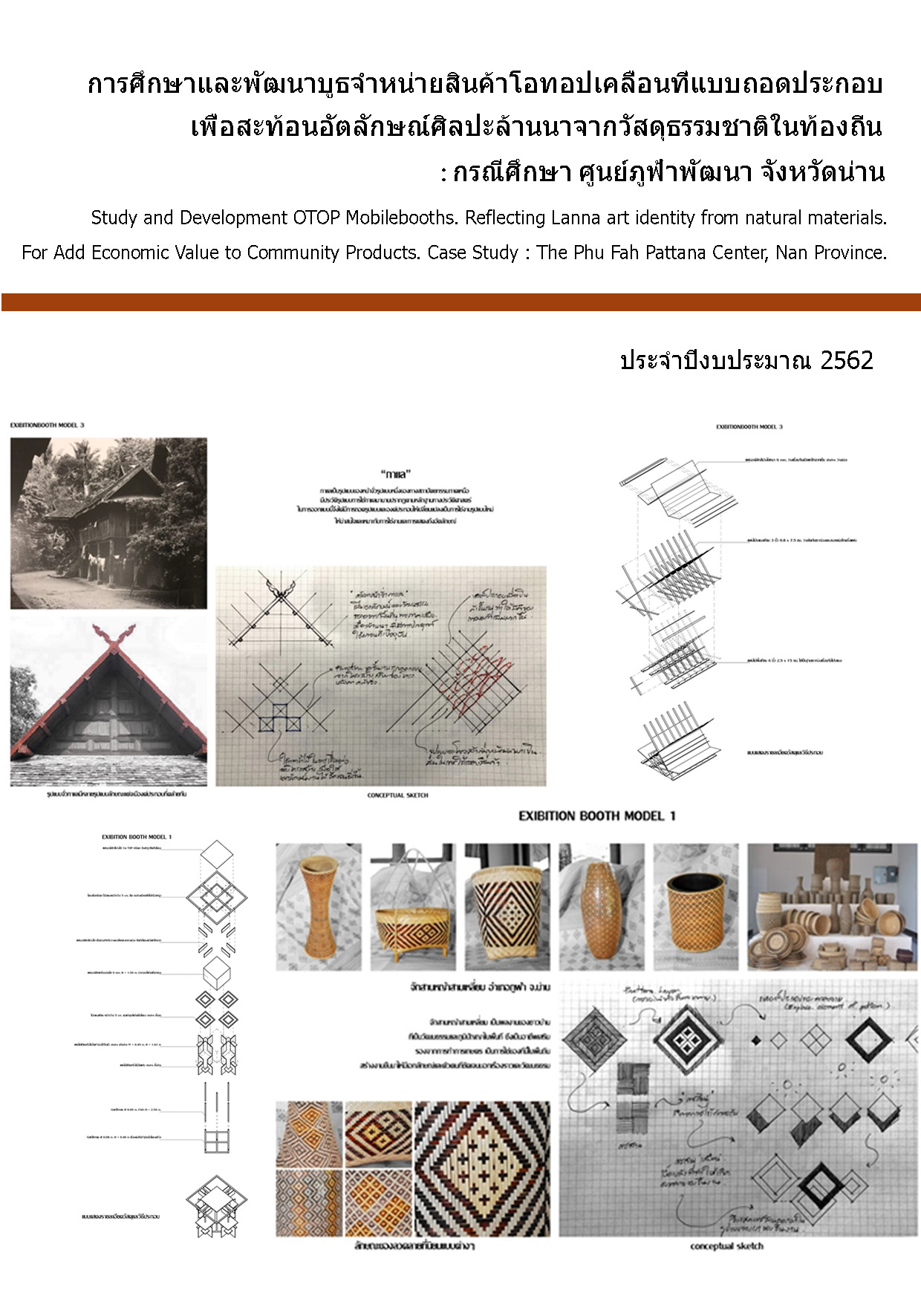
การศึกษาและพัฒนาบูธจำหน่ายสินค้าโอทอปเคลื่อนที่แบบถอดประกอบ สะท้อนอัตลักษณ์ศิลปะล้านนาจากวัสดุธรรมชาติในท้องถิ่นเพื่อเพิ่มมูลค่าทางเศรษฐกิจให้กับผลิตภัณฑ์ในชุมชน : กรณีศึกษา ศูนย์ภูฟ้าพัฒนา จังหวัดน่าน
This research aims to improve the booth model of OTOP products from Phu Fah Pattana Center Nan Province. To increase marketing channels by distributing products to various locations in order to increase sales to community products. The design must take into account the convenience of rapid assembly and dismantling for a limited time. The characteristics of the booth must be disassembled interesting in looks that reflect the identity of Lanna art. There is a beautiful strong structure to support the weight of the product. The size and proportion are suitable for the usage habits of consumers. Which will help promote products in the community that have higher sales stronger communities. Able to divide the product market in the country and can create marketing channels to other countries. It is a good result for the villagers in the community that will have the guarantee of self-sufficiency and sustainably sufficient lives. From the analysis of the Lanna Wisdom Identity Model there are 4 types of concepts which are The concept of the components of the house GalaeThe concept from the barn Concept of the components of the house Kwan Concept of triangular pattern woven grass. After that it was developed to the stage to interpret the meaning of space in form of booth. And then lead to the design of 4 booths. And conducted a questionnaire to find satisfaction with each type of booths that responded to various usability benefits including satisfaction with the appearance and usage characteristics that responded to the behavior of Most users. Conclusion Booths from the concept of Lanna house components called galae have the highest percentage of satisfaction in 3 aspects which are Percentage of satisfaction with the layout of the booth Percentage satisfaction with workpiece assembly and disassembling storage and transportation Percentage of satisfaction with the perception of Lanna identity. For the satisfaction with the size the proportion of use and the convenience of use the booth from the concept of the components of the house Kwan with the highest rate of percentage satisfaction.
การพัฒนาผลิตภัณฑ์เครื่องประกอบการแต่งกายสตรีจากเศษผ้าทอเหลือใช้ กลุ่มวิสาหกิจชุมชน เย็บผ้าและศิลปะประดิษฐ์จากผ้า ตำบลเขาแก้วศรีสมบูรณ์ อำเภอทุ่งเสลี่ยม จังหวัดสุโขทัย
This research aim to develop a product for women dressing from waste woven fabrics. Community Enterprise Group Sewing and fabric art Khao Kaeo Srisomboon Subdistrict Thung Saliam District Sukhothai with a purpose study the patterns of women dress. Design and develop a model for women dress from the modern waste cloth that can be used in daily life efficiently and transfer technology to develop products for women dress from different forms of woven fabrics to interested parties or textile entrepreneurs in Sukhothai Province to develop and promote creative economic products of the community. The research results were summarized as follows. 1. Design and develop a pattern for women dress from waste woven fabrics Resulting in a modern product form It can be used effectively in daily life. The research team designed the product of the dress with the idea of using art and culture combined with the use of waste cloth from the design process to create a contemporary product that looks modern suitable for the gender and age of the users. Including product use opportunities as well which the community can make and generate income is another way in this research There has been a development of a pattern for a womans dress outfit from leftover woven fabrics. Thai art conservation Which the community can make and generate income including the community the design and development of sewing is a prototype product. Cloak hats bags and shoes totaling 4 products 5 prototypes total 20 prototypes and selecting one prototype for transmission. 2. Transmitting product development technology for women dress from waste woven fabrics community enterprise groups Sewing and fabric art Khao Kaeo Srisomboon Subdistrict Thung Saliam District Sukhothai Carrying out knowledge transfer By organizing theoretical and practical training sessions for 2 days of knowledge transfer 30 participants from 6 to 7 August 2020 at the community enterprise group Sewing and fabric art Khao Kaeo Srisomboon Subdistrict Thung Saliam District Sukhothai Project participants gain knowledge on waste fabric processing learn about product development processes design and sewing and take action and develop products. As the researchers have prepared the device The results were assessed by using a questionnaire on the satisfaction of the trainees. There were 3 lecturers: Assistant Professor Saowaluck Kongka Chuiwan Kritaporn Chooseng and Ajarn Mallika Chongchit. 3. Satisfaction with technology transfer curriculum product development womens dress from waste woven fabrics 1) General information of the target group of female gender accounted for 100.00 percent most age 41-50 years old 50.00 percent. Secondary education Representing 63.33 percen They are housewives accounting for 33.33%. Monthly income is 5000-10000 baht 33.33%. Experience in sewing and dressing. Most of them used to do distribution as a career. Representing 73.33 percent 2) ask the satisfaction of the trainees. It is a question that asks about satisfaction with the course. It is divided into 6 aspects which are content aspects of the course. In design material material and equipment Facilities and value and utility found that the target audience Most are most satisfied in all aspects.
การศึกษาความต้องการของการเปิดหลักสูตรวิชาการคิดและการแก้ปัญหา
The study of the requirements for opening thinking and problem solving course uses a questionnaire method from a sample of 160 people from all 9 faculties. Using a QR code questionnaire/link with students of Rajamangala University of technology Phra Nakhon. To analyze the basic statistical results (percentage mean standard deviation). The research results were found that the student’s opinion on the teaching of thinking and problem solving course had a total average of 4.10 (high opinion level). By means of descending mean as follows problem solving had the highest average value at 4.26 followed by creativity thinking future thinking applied thinking critical thinking analytical thinking strategic thinking analogy thinking integration thinking synthetic thinking conceptual thinking and critical thinking.
การพัฒนาปูนดิบจากเปลือกหอยครางเพื่อส่งเสริมวิสาหกิจชุมชน
This research aimed to study the optimum conditions for making raw lime from shells which consisted of 9 conditions: calcined at three levels of 700 800 and 900 degrees Celsius for 1 2 and 3 hours. Calcium element content in raw lime using X-ray fluorescence (XRF) measurement and structural analysis of calcium compounds by X-Ray Diffraction (XRD). The research results were found. 1. Optimal conditions for making lime mortar are temperature 800 degrees Celsius duration 2 hours. The physical characteristics of raw lime are white and porous. 2. The calcium content from the shells calcination at 800 degrees Celsius for 1 2 and 3 hours was 98.22% 96.70% 97.89%. 3. Changes in the calcium compounds of raw lime obtained by calcining the shell at 800 degrees Celsius for 1 hour were mainly found in the form of calcium carbonate (CaCO3). At 2 3 hours calcium carbonate (CaCO3) is mostly converted to form calcium hydroxide (Ca(OH)2)compound calcium oxide (CaO) compound is formed.
การจัดการความรู้ภูมิปัญญาท้องถิ่นเพื่อพัฒนาผลิตภัณฑ์ชุมชนสู่ความยั่งยืน
The purpose of this study was to examine the knowledge management of local wisdom. This qualitative research was mainly conducted at Bang-Khurat Subdistrict Bangbuathong Nonthaburi. The research tools were in-depth and focus group interview. The statistical data analysis was SWOT and content analysis. The results were found as follows: 1. Community products: Bang-Khurat’s local products were commercially available including 1. traditional Khao-Chae 2. plastic basketry 3. clay artificial flowers 4.silk artificial flowers 5. genuine leather/patent leather bag products 6. magnetic mobile 7. leather bags 8. silk-lined pottery 9. organic riceberry 10. water spinach farm groups 11. OTOP Nawatwithi tourism community Khlong Ta-Chom Village moo.9 Bang-Khurat Subdistrict. 2. The SWOT analysis of Bang-Khurat products: It was revealed as following: 1. Strength: There were good leaders well-qualified staff and high-quality materials found in the local community. 2. Weakness: Most of the staff did not have enough money and lack of IT marketing and public relation knowledge. The last problem was ignorance of younger generation. 3. Opportunity: As a result of todays many more lines of businesses the community had opportunities to do E-commerce establish a small and micro community enterprise (SMCE) to earn their living increase income and build their brand. Moreover the government sectors were ready to support the community. 4. Threat: According to the community discussions their main obstacles were production marketing and technology. 3. Bang-Khurat s knowledge management: The source of knowledge came from their ancestors knowledgeable persons experts from the outside communities autonomy learning and study visit. 4. Body of knowledge’s process: The characteristics of local wisdom were both traditional and developed mostly starting from acquiring the knowledge experimenting adapting and improving the original products to the new ones. 5. Knowledge transfer: The knowledge was transmitted both formally and informally to their offspring interested neighbors students and youth in the community. 6. Knowledge management plans: They included family businesses group member training taking knowledge notes online teaching and providing some learning courses for local schools and academic institutions. 7. Knowledge management problems: According to the community discussions there were lack of continuity management and coordinators no official grouping limited scope of knowledge ignorance of younger generation and lack of inheritors.