จำนวน Repository ( 278 )
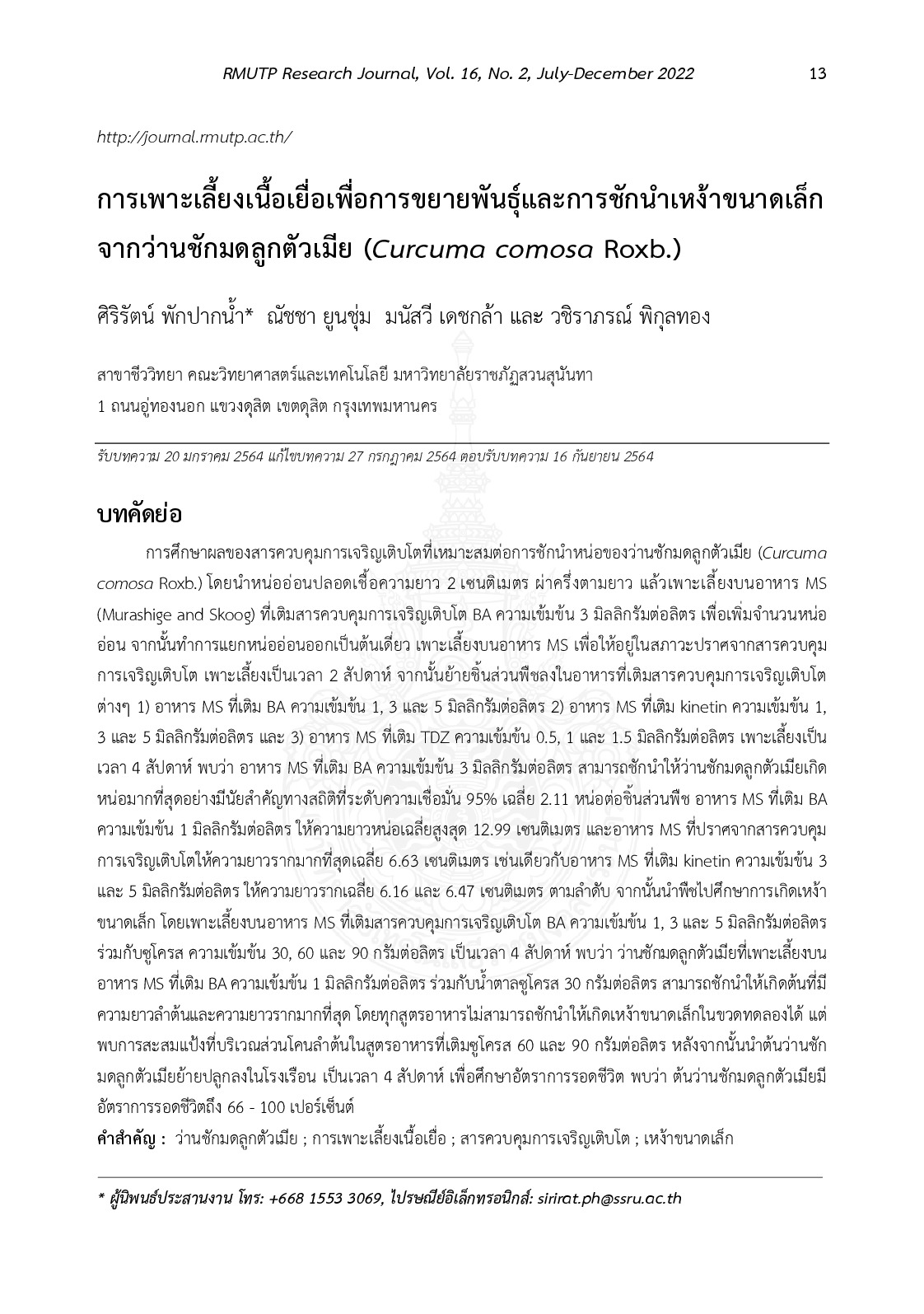
การเพาะเลี้ยงเยื่อเพื่อการขยายพันธุ์และการชักนำเหง้าขนาดเล็กจากว่านชักมดลูกตัวเมีย Curcuma comosa roxb
This study was conducted to determine the effects of plant growth regulators on in vitro propagated plantlets and microrhizome inductions of Curcuma comosa Roxb. for an efficient development of plant regeneration. In vitro sprouted shoots (2 cm length) of C. comosa were incised in longitudinal section and subcultured on MS media supplemented with 3 mg/L BA for shoot multiplication and plant regeneration. Subsequently the regenerated plants were transferred to MS medium with various concentrations of plant growth regulators; BA (1 3 5 mg/L) kinetin (1 3 5 mg/L) and TDZ (0.5 1 1.5 mg/L). The result showed that MS medium supplemented with 3 mg/L BA was the most effective in shoot induction with the significantly maximum average number of 2.11 shoot buds per responding explant. Moreover MS medium supplemented with 1 mg/L BA produced the longest average of shoot bud explants (12.99 cm) while the basal MS medium induced the longest average of root multiplication (6.63 cm). Furthermore microrhizome induction was produced under in vitro conditions derived young shoot buds upon transfer to MS medium containing various combinations of 1 3 and 5 mg/L BA and 30 60 and 90 g/L sucrose concentrations. The optimum combination in the induction of significantly highest average length of both stem (18.32 cm) and root (7.52 cm) multiplication was obtained on MS basal medium supplemented with 1 mg/L BA and 30 g/L sucrose for 4 weeks. Although microrhizome formation was not produced by the different amount of BA and sucrose in induction medium starch accumulation was found at the base of the stem explants cultured on MS medium containing 60 and 90 g/L sucrose concentrations. Additionally in vitro propagated C. comosa plantlets through microrhizome induction were grown under greenhouse conditions for 4 weeks and further developed into normal plants resulting in successfully high survival rates of 66 – 100% in the cultivated C. comosa.
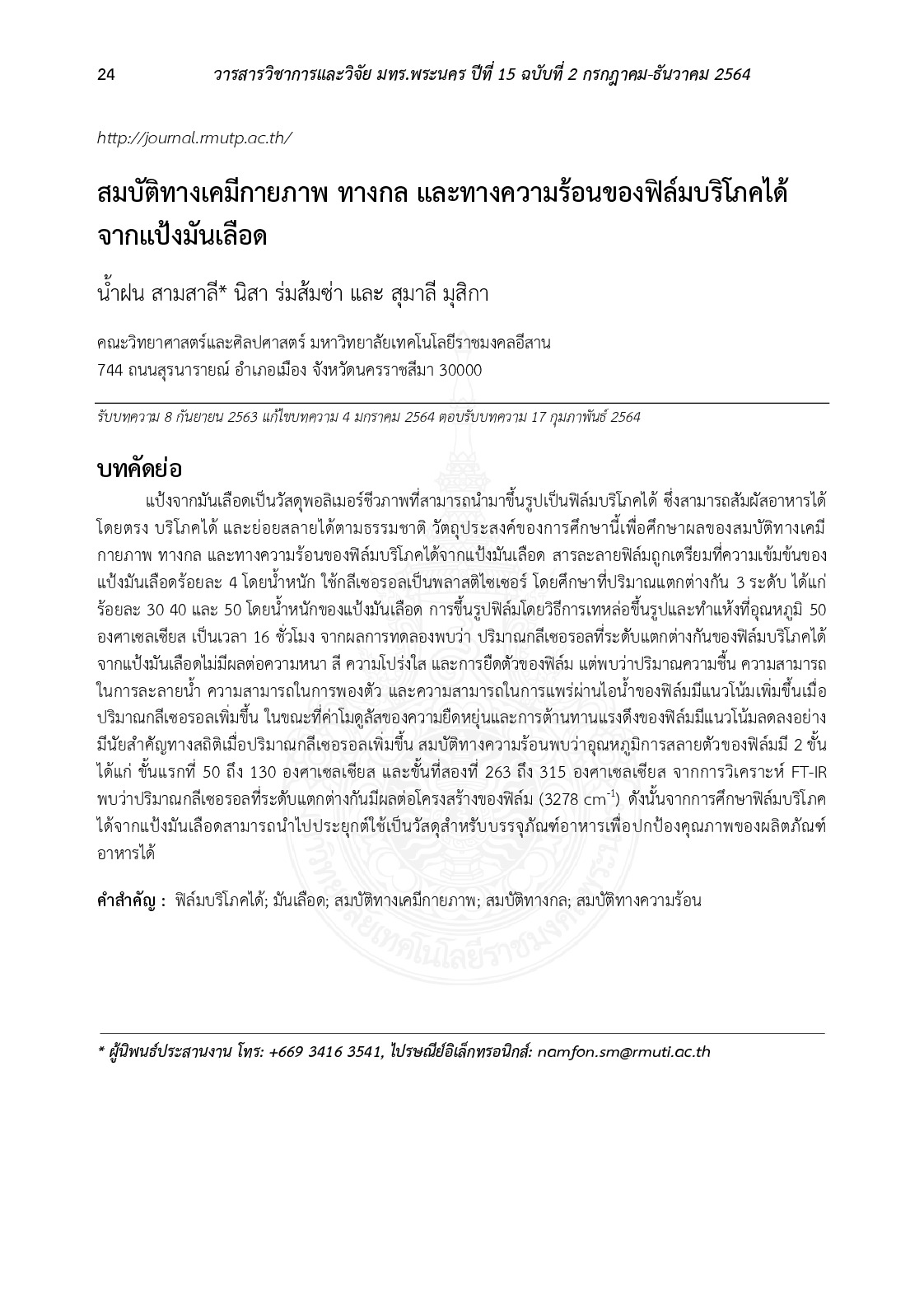
สมบัติทางเคมีกายภาพ ทางกล และทางความร้อนของฟิล์มบริโภคได้จากแป้งมันเลือด
Man Lueat (Dioscorea alata) flour is a biopolymer material that can be formed into an edible film. It can be contacted directly with food consumed and naturally biodegraded. The aims of this research were to study the effect of physicochemical mechanical and thermal properties of edible film from Man Lueat flour. The film forming solution was prepared by Man Lueat flour at 4% w/w. The glycerol was used as a plasticizer. It was studied at 3 different levels; 30 40 and 50% w/w of Man Lueat flour. The film forming solutions were formed using the solution casting method and dried at 50 °C for 16 h. Results showed that the glycerol content at different levels of the edible film from Man Lueat flour had no effect on the thickness color transparency and elongation at break. However the moisture content water solubility swelling property and water vapor permeability of the film tended to increase when increasing the glycerol content. In contrast the Young’s modulus and tensile strength of films tended to decrease significantly when the glycerol content increased. Thermal properties were found that decomposition temperature of films occurred 2 stage; the first stage occurs between 50 to 130 ° C and the second stage occurs between 263 to 315 ° C. The analysis of FT-IR showed that the different levels of glycerol affected the structure of the film (3278 cm-1). Therefore the edible film from Man Lueat flour can be applied as a food packaging material to protect the quality of food products.
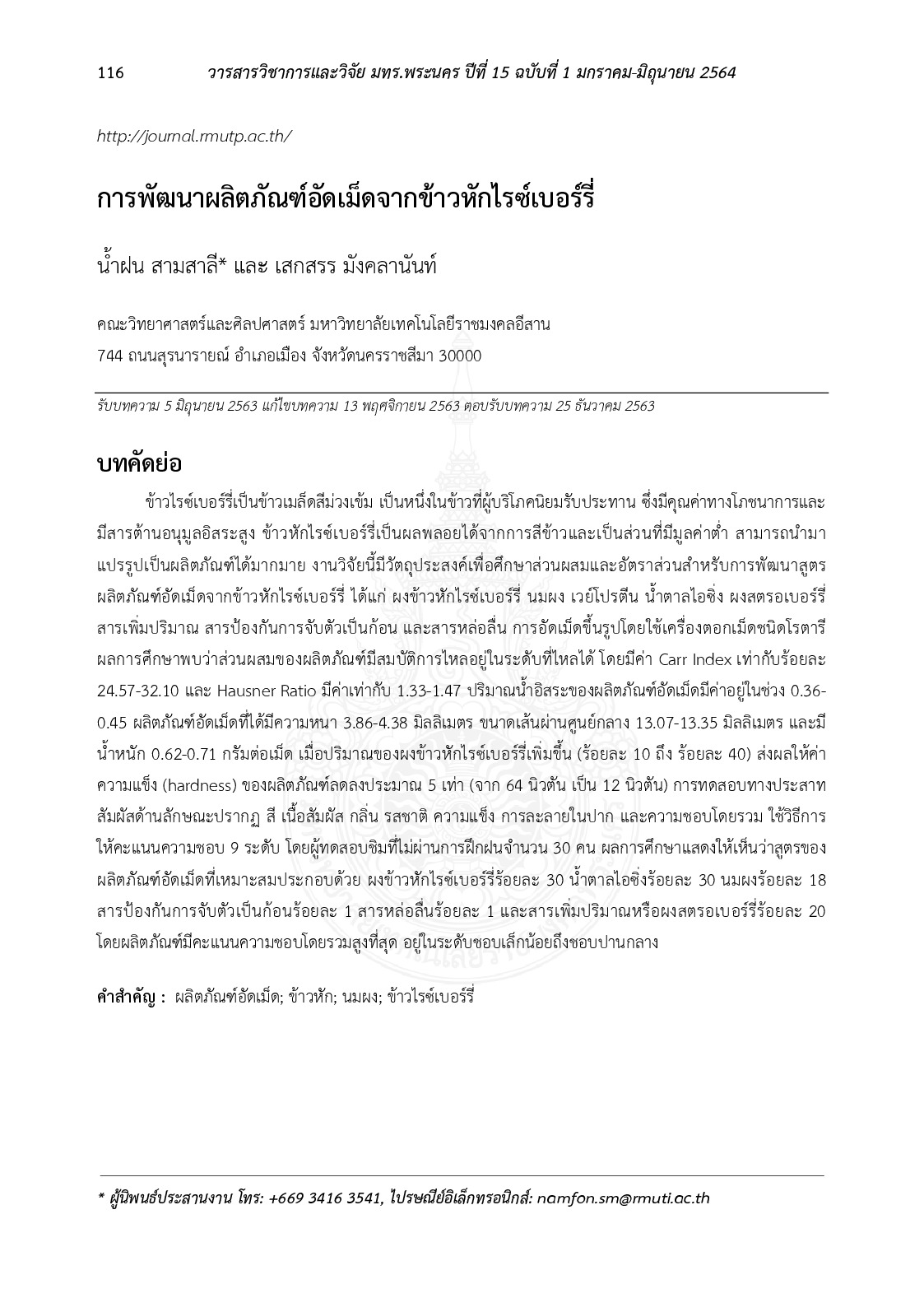
การพัฒนาผลิตภัณฑ์อัดเม็ดจากข้าวหักไรซ์เบอร์รี่
Riceberry rice is dark purple coloured grains. It is one of the most famous rice for consumers. There are nutrients and high antioxidant properties. Riceberry broken rice (RBR) is a by-product from the rice milling process and has a low value. It can be processed into various products. The purpose of this research was to study the ingredients and the ratios for tablet formulations including RBR powder milk powder whey protein icing sugar strawberry powder bulking agent anticaking agent and lubricant agent. Tabletting of powders was performed using a rotary tablet press machine. It was found that the powder products exhibited passable flow with the Carr Index of 24.57-32.10% and the Hausner Ratio value of 1.33-1.47. The water activity value of product was in the range 0.36-0.45. The tablets had thickness 3.86-4.38 mm diameter 13.07-13.35 mm and weight 0.62-0.71 g/tablet. The increase of RBR powder content (10% - 40%) decreased hardness value of tablet products about 5 times (from 64 N to 12 N). Sensory evaluation of products in appearance color texture odor flavor hardness dissolution in the mouth and overall liking were conducted using 9 - point hedonic scale with 30 untrained panelists. The results showed that the optimal tablet formulation consisted of 30% RBR powder 30% icing sugar 18% milk powder 1% anticaking agent 1% lubricant agent and 20% bulking agent or strawberry powder. They showed the highest overall liking scores in ranges of “like slightly” to “like moderately”

การพัฒนาและสร้างสรรค์บรรจุภัณฑ์ด้วยกลวิธีเปเปอร์มาเช่
This study aims to study the use of recycled paper as a new material. To develop and create a packaging Paper Mache can be used to substitute for wood and plastic in packaging for storing items and for reducing waste from paper and plastic. They can be utilized in real life and to study the satisfaction of small packaging with papermaking. The sample is General Population Consumers using made of wood and plastic. The tool used was a questionnaire with 100 people randomly generated. Data were analyzed using percentage mean and standard deviation testing for the value of the F test. The results showed that 5 experts found that 4 persons were satisfied with the results of the study. The average was 4.60 satisfied with the development and creation of packaging by Paper Mache. The target group of 100 people is at a high level. The average was 4.12 4.09 4.05 4.05 as follows: 1. Experts were satisfied with the results of the study developed and produced the packaging with the papermaking technique. It was found that 5 experts found that 4 persons gave the overall opinion about the characteristics of the paper pulp formula 2 was an average of 4.60. At most levels on the texture aspect (before dryness) the average was 4.75 The highest level can be used to actually have an average. 4.60 Moisture content was at the highest level of 4.50 And for liquid absorption and texture the average dry weight was 4.40 at the highest level 2. There was satisfaction with the development and creation of packaging with Paper Mache. It was found that 100 consumers of plastic packaging were satisfied with plastic flower pots at a high level 4.12 in average followed by multi-purpose boxes. The average level was 4.09 and the small scale was 4.05 and the bin was dry. (For home use) at a high level. The mean score was 4.05