จำนวน Repository ( 2131 )
การมีส่วนร่วมของพนักงานต่อการดำเนินงานด้านความรับผิดชอบต่อสังคม (CSR) ของนิคมอุตสาหกรรม 304 จังหวัดปราจีนบุรี
The purposes of this research were to investigate the perception on activity maneuver and supporting factors regarding employees participation in Corporate Social Responsibility (CSR). The sample consisted of 250 employees of Prachin Buri Industrial Estate 304 Prachin Buri Province. The research results are as follows. The employees’ perception on activity maneuver information in CSR in the overall was at the highest level (= 4.62 S.D. = 0.44). The overall perception on the information had a statistically significant positive relationship with employees’ participation at the .01 level (r = .347). When considering each aspect the perception on activity information positively correlated with participation in CSR activities at the .01 level of significance (r = .295). The results of the appropriate model analysis used to forecast the employees’ perception on CSR activity indicated that the perception of policy information had a p-value of .012 meaning that the policy factor could predict the employees’ information perception at 0.05 statistical significance with a tolerance of .704 the VIF was 1.420. As for the planning aspect the tolerance value was .617 with the VIF value of 1.621 and the activity guideline aspect had its tolerance value of .532 with the VIF value of 1.881. This means that the perception regarding policy planning and guideline aspects was not beyond the Multicollinearity variables because their tolerance values were not lower than .2 and VIF did not exceed 10. Also the results of the regression coefficient analysis of factors affecting the information perception on CSR activities in the form of raw scores (B) were .298 .168 and .209 indicating that the variables predicting the perceived social responsibility included policy (X1) planning (X2) and activity guidelines (X3) and the three variables can together predict the level of awareness of CSR activities. These three factors could jointly predict the information perception on CRS at 11 percent. Factors promoting the employee participation on social responsibility were generally at a moderate level ( = 2.94 S.D. = 1.22) and there was a statistically significant positive correlation with employee participation at the .01 level (r = .855). When looking at each aspect it was found that factors promoting the employee participation in training and activities were positively related to the social responsibility aspect statistically significant at .01 (r = .773) and (r = .841). The results of the analysis of the appropriate models used to predict the factors contributing to employee participation showed that employees’ activity and training participation had the positive influence on CSR activities with p-value of .000 and .001 which was less than 0.05 indicating that their attendance could predict promoting factors of the employee participation statistically significant at the .05 level. This means activity and training participation factors could contribute to the promotion of employee participation statistically significant at the .05 level. While the training had a tolerance value of .225 the VIF value of 4.450 the activity participation had a tolerance value of .259 the VIF value of 3.858. As for being a group member the tolerance ship was .193 with the VIF value of 5.185 showing that participating in training and membership did not go beyond the Multicollinearity due to the tolerance value of not less than 2 and VIF value of not more than 10. The result of the regression coefficient analysis of factors affecting the level of factors contributing to employee participation on CSR operations were .157 .391 and .028 showing that the predicting variables of the employee participation promotion were training (X4) and participation (X5) and group membership (X6). The three variables could predict the level of factors contributing to employees participation on CRS at 72.70%
การพัฒนาหลักสูตรระยะสั้นเพื่อเพิ่มขีดความสามารถในการแข่งขัน
The objectives of the research were to 1) study the desirable characteristics of a short course 2) study the need for short course training 3) study motivation for short course training 4) study media exposure channels about short course training in mass communication technology and 5) guidelines of short course Training development for enhancement in competitive of Faculty of Mass Communication Technology Rajamangala University of Technology Phra Nakhon. Data were collected from 400 samples by using questionnaire. Data was analyzed by mean standard deviation (S.D.). The results showed as follows: 1) Desirable characteristics of a short course in mass communication technology found that most of them were interested in studying on Saturday-Sunday between 09.00-16.00 (68.75%) studying 3-6 hours or 1 day (47.25%) online training 50% and practice 50% (53.00%) completing a course (82.00%) requires a certificate after study (87.00%) and the average cost was 4962.17 baht. 2) The need for short course training in mass communication technology was 20 courses including 1) shooting and editing video with mobile phone for online sales 2) photography for storytelling on mobile phone 3) online marketing 4) graphic design for brand communication 5) Website development for community brand communication 6) photo retouching techniques 7) making sales with smartphones 8) offline marketing campaign 9) online selling via social network 10) application for online teaching 11) video and audio editing 12) creating Thai wisdom for community products 13) speaking and communication in the community 14) packaging design for community products 15) creative thinking to brand building 16) graphic design for storytelling 17) computer graphics design 18) photography for digital media 19) e-commerce website creation and 20) computers for the elderly. 3) Motivation for short course training in mass communication technology was at high level (=4.01) including self-motivation was at high level (=4.14) career motivation was at high level (=4.06) and social motivation was at high level (=3.79). 4) media exposure channels about short course training in mass communication technology was at middle level (=3.15) including Facebook was at a high level (=4.34) website was at a high level (=3.57) Television was at a high level (=3.56) acquaintances were at a moderate level (=3.35) radio broadcasting was at a moderate level (=2.82) and newspapers were at a moderate level (=2.82) 5) Guidelines for developing short course training to increase competitiveness found that desirable characteristics of short course training on Saturday-Sunday between 09.00-16.00 (68.75%) studying 3-6 hours or 1 day (47.25%) online training 50% and practice 50% (53.00%) completing a course (82.00%) requires a certificate after study (87.00%) and the average cost was 5000 baht that the most of them can pay the cost 1000 bath. The public relations channels via Facebook and agency website. The short courses of the Faculty of Mass Communication Technology consisted of 14 courses including 1) shooting and editing video with mobile phone for online sales 2) photography for storytelling on mobile phone 3) online marketing 4) graphic design for brand communication 5) Website development for community brand communication 6) photo retouching techniques 7) making sales with smartphones 8) offline marketing campaign 9) online selling via social network 10) application for online teaching 11) video and audio editing 12) creating Thai wisdom for community products 13) speaking and communication in the community 14) packaging design for community products.
การศึกษาระดับปัจจัยที่เหมาะสมสำหรับการปรับปรุงกระบวนการอบอ่อนเหล็กแผ่นม้วน
The objective of this research is to study the suitable factor level for the improvement of annealing furnace for rolled coils steel sheet. The experimenting has been performed to find suitable oxygen level by 5 annealing furnace experiment. The research has been started by collection the combustion. After that the burning adjustment by changing combustion technology with 5 levels of BGCV control valve open as 23% 40% 50% 75% and 100% has been implemented. The combustion adjustment data are recorded analyzed and compared with incomplete combustion value. The research result has been found that after improvement the combustion value. The percentage of oxygen level are improved to the better quality which standard at MV0-49% equal 2.5-4 O2% and MV50-100% equal 1.5-2.5 O2% conclusion 1 furnace as follows at the MV23.1% MV40% MV50% MV75% and MV100% level of oxygen as 2.5% 3% 3% 2% 1.5% and level of carbon monoxide as 0 ppm 2 ppm 2 ppm 2 ppm and 0 ppm respectively. Resulting of fuel energy consumption in the annealing process has been reduced around 225608 baht /year/furnace. Therefore it can depict that energy saving and annealing furnace efficiency improving are increased. The modified parameters will be applied to be the new standard reference values for the further engineer’s operational manual.
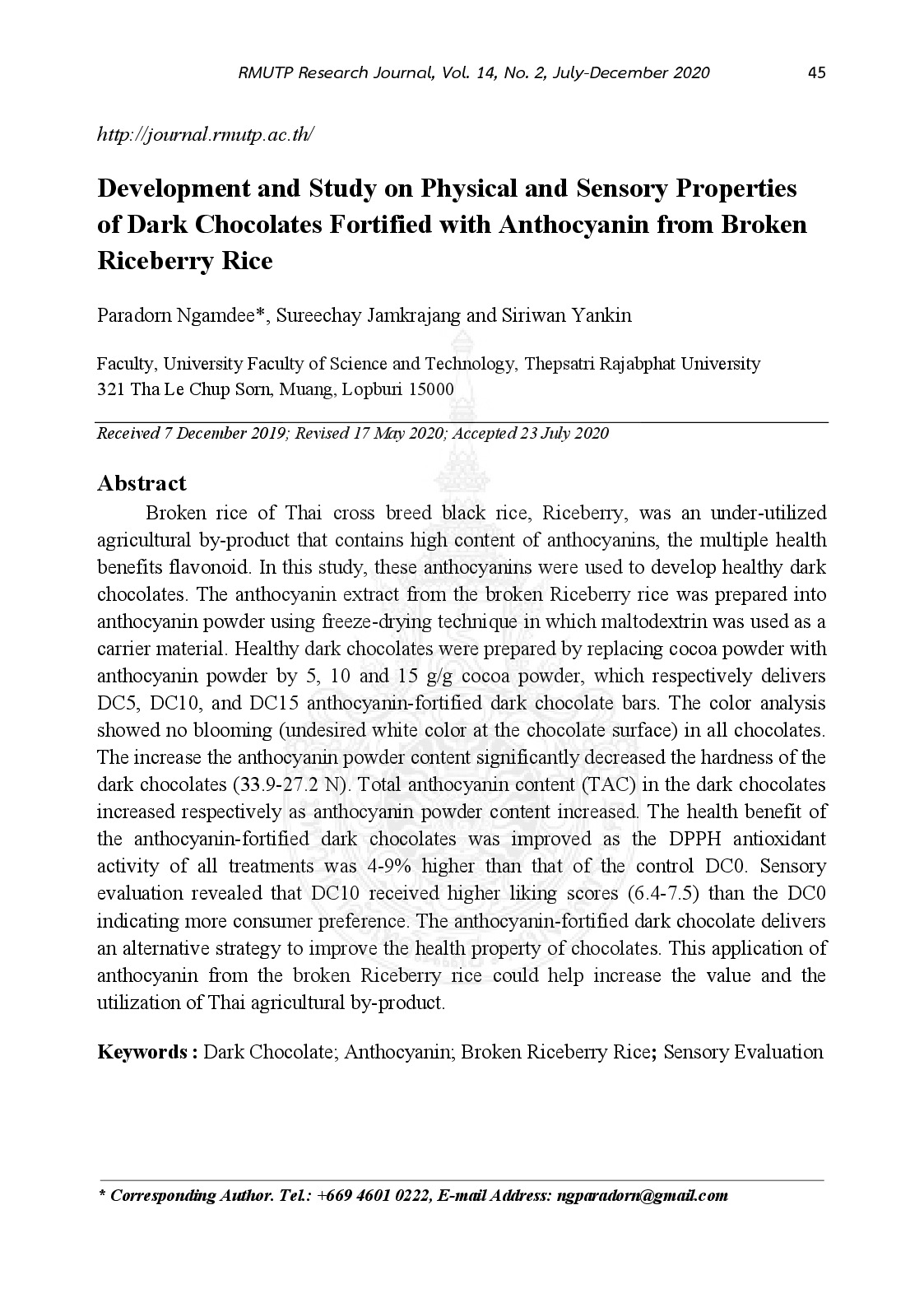
Development and study on physical and sensory properties of dark chocolates fortified with anthocyanin from broken riceberry rice
Broken rice of Thai cross breed black rice Riceberry was an under-utilized agricultural by-product that contains high content of anthocyanins the multiple health benefits flavonoid. In this study these anthocyanins were used to develop healthy dark hocolates. The anthocyanin extract from the broken Riceberry rice was prepared into anthocyanin powder using freeze-drying technique in which maltodextrin was used as a carrier material. Healthy dark chocolates were prepared by replacing cocoa powder with anthocyanin powder by 5 10 and 15 g/g cocoa powder which respectively delivers DC5 DC10 and DC15 anthocyanin-fortified dark chocolate bars. The color analysis showed no blooming (undesired white color at the chocolate surface) in all chocolates. The increase the anthocyanin powder content significantly decreased the hardness of the dark chocolates (33.9-27.2 N). Total anthocyanin content (TAC) in the dark chocolates increased respectively as anthocyanin powder content increased. The health benefit of the anthocyanin-fortified dark chocolates was improved as the DPPH antioxidant activity of all treatments was 4-9% higher than that of the control DC0. Sensory evaluation revealed that DC10 received higher liking scores (6.4-7.5) than the DC0 indicating more consumer preference. The anthocyanin-fortified dark chocolate delivers an alternative strategy to improve the health property of chocolates. This application of anthocyanin from the broken Riceberry rice could help increase the value and the utilization of Thai agricultural by-product.
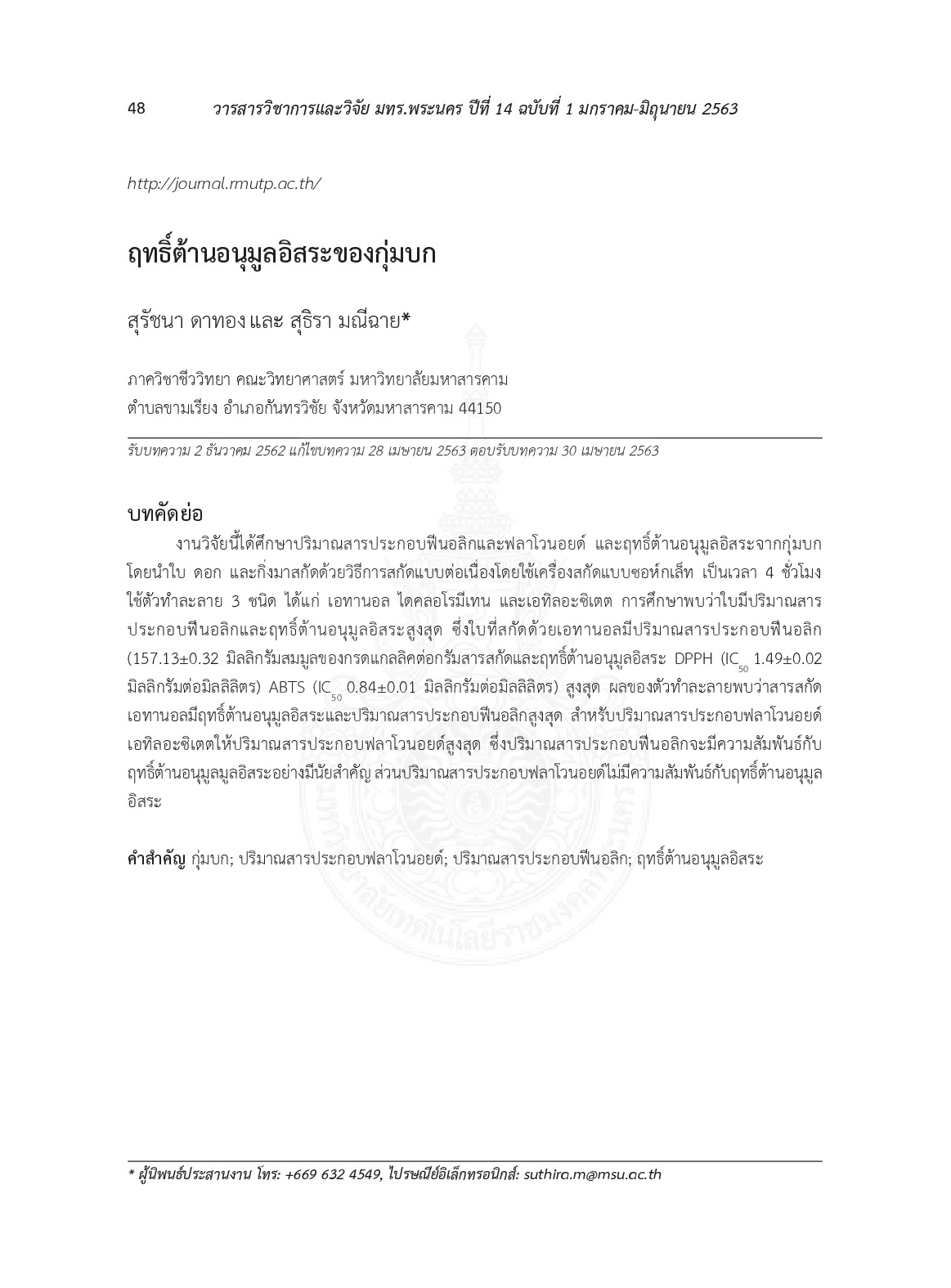
ฤทธิ์ต้านอนุมูลอิสระของกุ่มบก
The aim of this research was determine total phenolic content total flavonoid content and antioxidant activity by DPPH and ABTS assay from leaves flower and stem of Crateva adansonii DC. subsp. trifoliate (Roxb) Jacobs that was extracted by Soxhlet method using ethanol dichloromethane and ethyl acetate as solvent. Leaves extract showed the highest total phenolic content and antioxidant activity. Ethanolic leaf extract showed the highest total phenolic content (157.13±0.32 mg GAE/g extract) and antioxidant activity by DPPH assay (53.64±3.78% (IC50 = 1.49±0.02 mg/ml)) and ABTS assay (76.51±0.97% (IC50 = 0.84±0.01 mg/ml)).When we considering solvent effect found that ethanolic extract showed the highest total phenolic content and antioxidant activity. Total flavonoid content ethyl acetate extract showed the highest total flavonoid content. Total phenolic content significantly correlated with antioxidant activity.