จำนวน Repository ( 234 )
นวัตกรรมสารสกัดน้ำมันกระเทียมบนกระดาษชั้นในเครื่องกรอง PM2.5 ในการกำจัดมลพิษจุลินทรีย์ปนเปื้อนในอากาศ เพื่อก้าวผ่านสถานการณ์ COVID-19
Garlic is an ancient food and medicinal plant that has been used for centuries. The research team was interested in creating a garlic oil extract that could help reduce microbial contamination in the air during the prolonged period of the COVID-19 situation. A prototype sugarcane leaf paper filter was treated with garlic oil extract to improve its air purification properties and to reduce the number of microorganisms. This study investigated garlic oil extracts that were produced by a garlic fermentation process with isolated lactic acid bacteria. The oil was then extracted using steam distillation or maceration with 80% ethyl alcohol. Both these methods demonstrated that they were effective in inhibiting pathogenic microorganisms contaminating isolated from air (Fungi: Penicillium sp. Aspergillus spp. and Rhizopus sp. and Bacteria: E. coil Bacillus subtilis and Staphylococcus sp.) by Agar Diffusion method. It was found that the garlic oil extract distilled from steam was the best choice for further development as a coating for filter paper. Garlic oil extract can be stored at room temperature for at least 15 days after being coated on filter papers. After that the filters with garlic extract-coated filters made by sewing together four folded filter papers could remove the dust of 2.5 sizes as well as HEPA filters but had a disadvantage in filtering dust that was at least 10 PPM. This paper filter prototype was environmentally friendly because it could decompose on the ground within 12-15 days and reduce the spread of infection problems. From overall the prototype of the garlic oil extraction process can be developed at a commercial industrial level to produce large quantities of garlic extract with desired quality tracking features. It helps reducing environmental problems in a sustainable way; reducing waste conserving energy and using environmentally friendly materials.
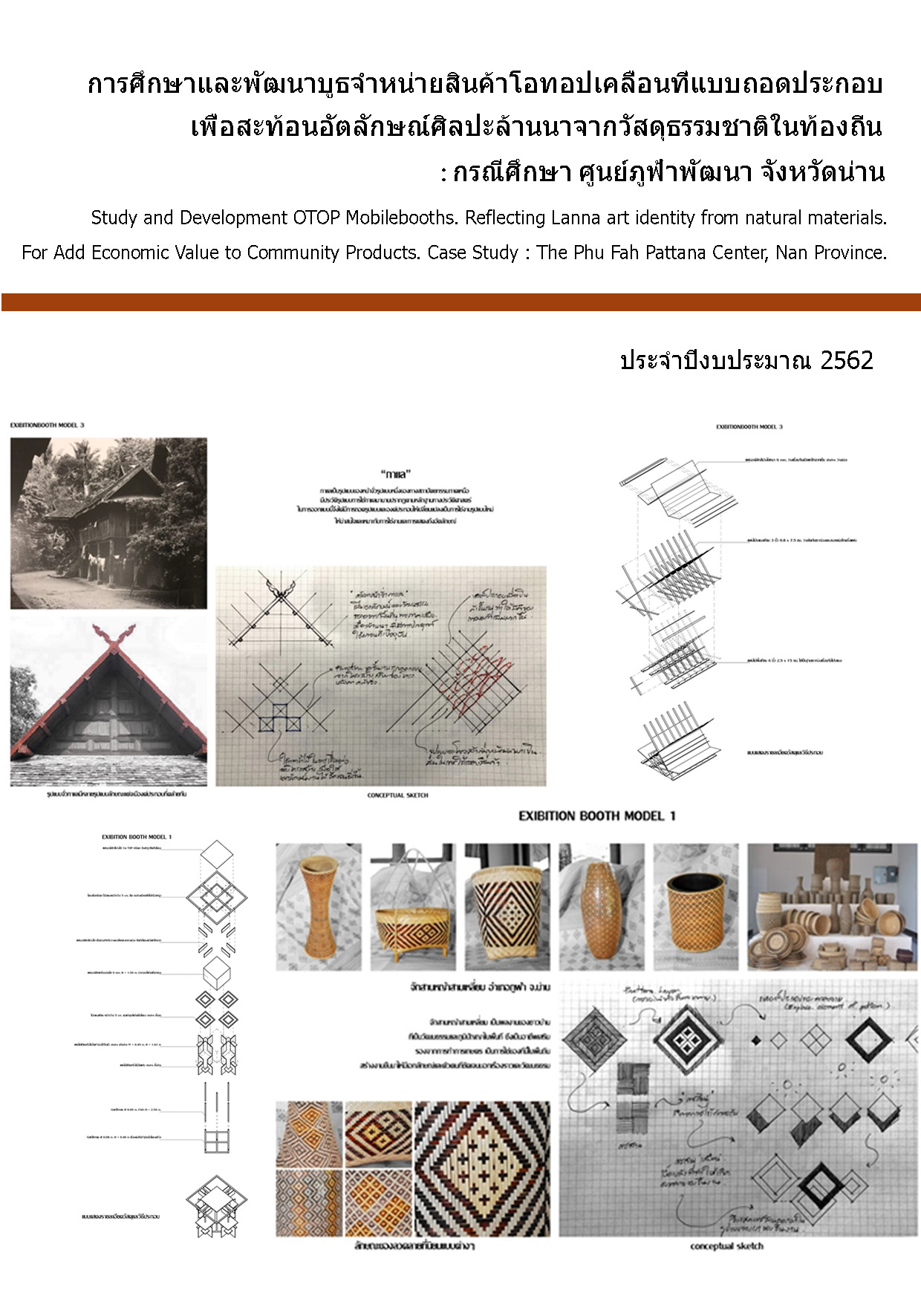
การศึกษาและพัฒนาบูธจำหน่ายสินค้าโอทอปเคลื่อนที่แบบถอดประกอบ สะท้อนอัตลักษณ์ศิลปะล้านนาจากวัสดุธรรมชาติในท้องถิ่นเพื่อเพิ่มมูลค่าทางเศรษฐกิจให้กับผลิตภัณฑ์ในชุมชน : กรณีศึกษา ศูนย์ภูฟ้าพัฒนา จังหวัดน่าน
This research aims to improve the booth model of OTOP products from Phu Fah Pattana Center Nan Province. To increase marketing channels by distributing products to various locations in order to increase sales to community products. The design must take into account the convenience of rapid assembly and dismantling for a limited time. The characteristics of the booth must be disassembled interesting in looks that reflect the identity of Lanna art. There is a beautiful strong structure to support the weight of the product. The size and proportion are suitable for the usage habits of consumers. Which will help promote products in the community that have higher sales stronger communities. Able to divide the product market in the country and can create marketing channels to other countries. It is a good result for the villagers in the community that will have the guarantee of self-sufficiency and sustainably sufficient lives. From the analysis of the Lanna Wisdom Identity Model there are 4 types of concepts which are The concept of the components of the house GalaeThe concept from the barn Concept of the components of the house Kwan Concept of triangular pattern woven grass. After that it was developed to the stage to interpret the meaning of space in form of booth. And then lead to the design of 4 booths. And conducted a questionnaire to find satisfaction with each type of booths that responded to various usability benefits including satisfaction with the appearance and usage characteristics that responded to the behavior of Most users. Conclusion Booths from the concept of Lanna house components called galae have the highest percentage of satisfaction in 3 aspects which are Percentage of satisfaction with the layout of the booth Percentage satisfaction with workpiece assembly and disassembling storage and transportation Percentage of satisfaction with the perception of Lanna identity. For the satisfaction with the size the proportion of use and the convenience of use the booth from the concept of the components of the house Kwan with the highest rate of percentage satisfaction.
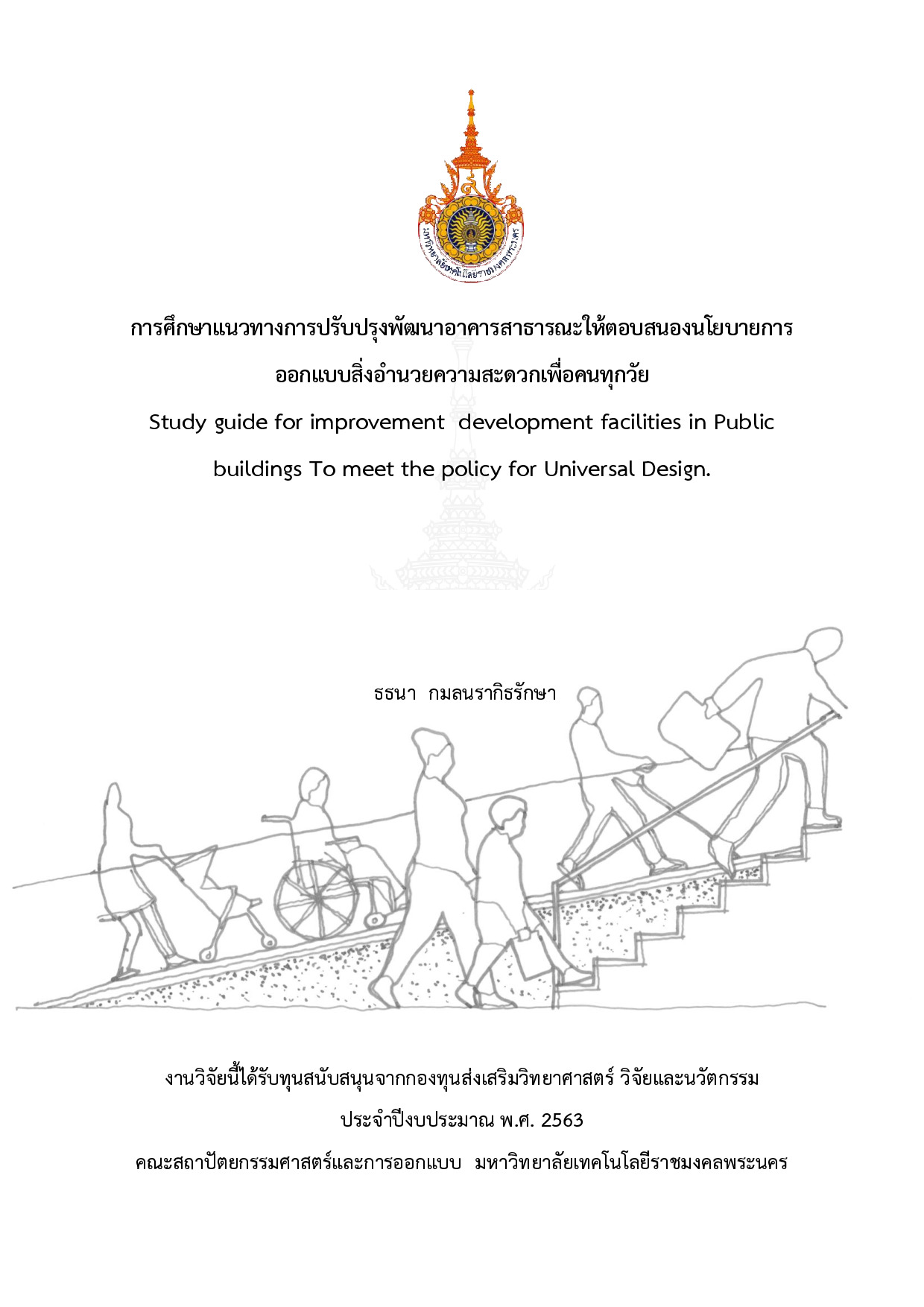
การศึกษาแนวทางการปรับปรุงพัฒนาอาคารสาธารณะให้ตอบสนองนโยบายการออกแบบสิ่งอำนวยความสะดวกเพื่อคนทุกวัย
Study guide for improvement development facilities in Public buildings To meet the policy for Universal Design. With the increasing number of people with disabilities and the elderly when combined with the population of children pregnant women or people with disabilities it was found that in the future these populations will be more inclusive. Driving the environment suitable for the disabled and the elderly It is an issue that is widely campaigned around the world. Office of the Promotion and Development of the Quality of Life of Persons with Disabilities The Ministry of Social Development and Human Security has recognized this importance. This will lead to the creation of an environment friendly to people of all ages all ages. Universal Design. It is a universal idea that the United Nations has tried to spread and promote Based on the original concept for people with disabilities to obtain living facilities in buildings and environments according to the Promotion of Non-Handicapping Physical Environment for Disabled Persons project they have been developed respectively Accessible Design Adaptable Design Barrier. Free Design which is finally accepted by the general public The principle of Universal Design that begins with the equality of the user of different ages and abilities. Can be modified Easy to use manually The interpretation is understandable. It has fault tolerances is light and has a size and space for access and use. Study guide for improvement development facilities in Public buildings To meet the policy for Universal Design. Given the importance and origins of this problem the researchers deem it appropriate to study the theoretical concepts to develop a model for improving the environment and facilities in the former public building. For equality and convenience with the assumption that the improvement model can meet the functional benefits for people of all ages who want to use various services As a guideline for creating a prototype building standard for people of all ages For interested people or agencies to apply to their own buildings.
การพัฒนาสมรรถนะวิศวกรนักปฏิบัติทักษะสูงเพื่อรองรับอุตสาหกรรม 4.0 อย่างยั่งยืน
The objective of this research was to develop the engineering students in accordance with the Bachelor of Engineering (B.Eng.) curriculum (industrial engineering) through the work-integrated learning program under which the students worked in the production line from Monday to Friday and studied the theories on Saturday. The learning program continued throughout the semester under the collaboration with Thai Cutting Tools Manufacturers (TCTM) of which 26 companies participated in the program. The program determined the development plan for the students of IE.102 course: Basic Production Process for Engineers through the project-based learning (PBL) program in accordance with the CDIO standard (Standards No.1-4). Twenty-seven (27) students of the work-integrated learning (WiL) program worked in 7 companies which were manufacturers and developers of cutting tools machine tools high precision parts and machines. All participating companies were designer and developers of new products and innovations and their products were distributed in and outside the country. Hence the students learnt from working in the production line to create new products according to the production plan. The products newly created through the integrated production method consisted of machine tools automated machines lathe milling drilling fitting grinding welding and metal sheets. The students learnt to use the tools to assemble and create the machines and developed the technology operation skill for production of high precision products. The learning and working were combined and applied to create those products. The students’ skills were developed in compliance with the CDIO standard (Standards No. 5) as the program required them to work in the workspaces to create the products in compliance with the CDIO standard (Standards No.6). The students created the cutting tools in compliance with the CDIO standard (Standard No.7) such as drills center drills end mills reamers insert tools and cutter tools. The students also created shafts gears bushes bolts and wedge assembled the parts in the power transmission of the machines the electric and electronic circuits of the machines and the electric motors and created the machines and molds for production. The teaching arrangement learning assessment and examination of the students’ competency were assessed from the integrated learning skills. Each student undertook the practices to develop the personal and interpersonal skills. The program development was based on self-learning under the supervision monitoring and recommendation of the lecturers specialized in the product design product creation and production management to develop the students in compliance with the CDIO standard (Standard No.7).The students practiced different skills such as conceiving designing implementing and operating respectively. In addition the students reported the progress under the project-based learning program and assessed the learning results before and after the learning session. Based on the study development under the “work college” project it was found that the students could develop the basic engineering skills throughout the semester. The basic engineering skills comprised the followings; 1) Integrated skill on the machine and tool operation in the basic engineering production process 2) Drawing and production drawing analysis skills 3) Material feature analysis skill for production 4) Machine-operating skill for production 5) Measuring tool-operation skill for product quality inspection 6) Machine tool and equipment operation skill for production of finish products 7) Part and component replacement skill for machine maintenance 8) Problem-solving skill in part and component production in case of incompliance with production drawing 9) Analysis skill of production process and conditions for operation at the workplace 10) Interpersonal skill obtained through the duty performance correction of defect parts in accordance with the advices of supervisors problem-solving with colleagues and project development. The 27 students gained the experiences through the work performance in the workplace according to the learning by doing approach. They performed duties developed the project solved problems and obtained the technology operation skill for production in accordance with the assigned tasks. They were trained to systematically solve the work problems. All of them produced cutting tools high precision tools and other tools from drawings and innovative development. They were equipped with basic engineering skills in compliance with the course curriculum standard and CDIO (Standards No. 8). The research findings affirmed that the students’ competency was increased with statistical significance of 0.5. Each of them developed a project under the project-based learning program. The developed projects were highly important. The students’ competency was developed through work performance covering product creation problem-solving. They learnt about the created products and their lifecycle in accordance with the science and engineering study approach. They were trained to identify the problems analyze the causes design the solutions implement the drawing designs and create the new products from the experimental results. The students were developed under the work-integrated learning program in accordance with the CDIO standard. The engineering skills were equipped through the creation of high precision tools and hard metal tools. Through the integrated learning the students obtained the basic engineering knowledge on the mathematic and physic calculations creation of the engineering drawings material analysis for engineering production project management and technology and innovation creation. The students communicated in English during working at the workplace. They understood the material features designed products for production and used these products to further create other products. They understood the connection of the supply chain in the industry with regard to production of 4 product categories which helped the students on creativity knowledge integration for engineering product creation product integration for further production and utilization of the industrial supply chain. The research contributed to the engineer development with regard to science research and innovation for the sustainable development.

การออกแบบและพัฒนาผลิตภัณฑ์ของตกแต่งจากก้านทางมะพร้าวเพื่อการออกแบบ ผลิตภัณฑ์ตกแต่งบ้านสู่การสร้างอาชีพให้เศรษฐกิจชุมชนอย่างยั่งยืน กรณีศึกษา ตำบลบางแค อำเภออัมพวา จังหวัดสมุทรสงคราม
This research main objective is to design and develop products lamps and wooden plate made from coconut leaves for home decorating items. The research began by studies the style and quality of coconut leaves after that questionnaire interview and observation of the behavior of people in the community were the tools to conduct this research. Samutsongkram District is the sample and the population was acquired by sampling group. The analysis of the data showed that the average percentage of products used in home decor products such as lamps and wooden plate. The products are used to decorate the home. The house should take into account the nature of the product because it allows the access to nature and the lifetime of the product are breaking easily digested because it is made from natural materials.