จำนวน Repository ( 33 )
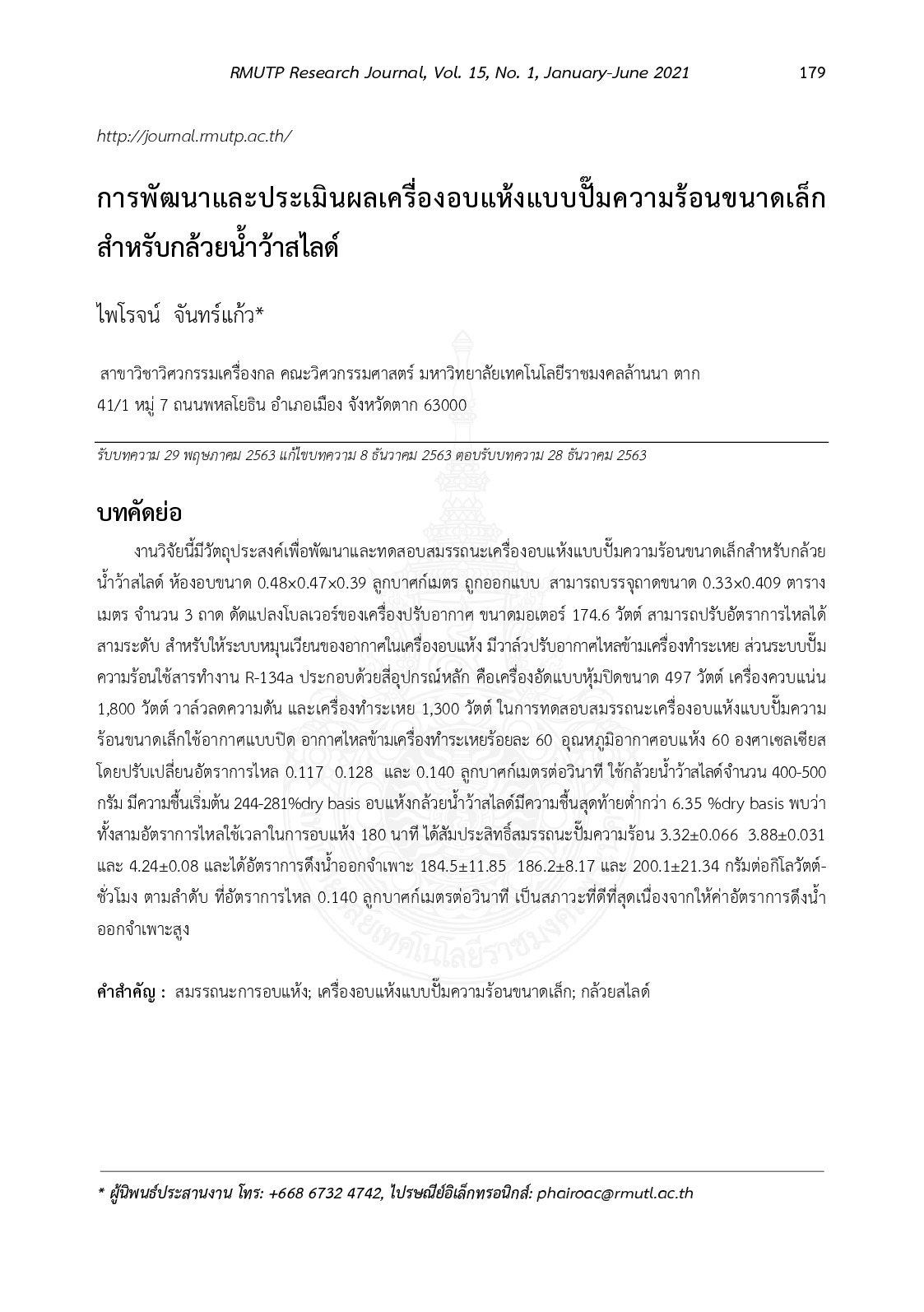
การพัฒนาและประเมินผลเครื่องอบแห้งแบบปั๊มความร้อนขนาดเล็กสำหรับกล้วยน้ำว้าสไลด์
The purposes of this research were to develop and to test performance of mini heat pump dryer for slice banana. Drying chamber of 0.48×0.47×0.39 m3 was designed and it could contain three trays. The three trays had dimension of 0.33×0.409 m2. A blower with 174.6 W motor of air condition was modify and could adjust flow rates of three levels for air cycle system in dryer. The air system had bypass air at evaporator. The refrigerant of R-134a and four main parts were used in the heat pump system. The four main parts were a 497 W hermetic compressor a 1800 W condenser an expansion valve and a 1300 W evaporator. Experiments for test performance of the mini heat pump dryer used close loop air system an evaporator bypass air of 60 % a temperature of 60 oC and various flow rates of 0.117 0.128 and 0.140 m3/s. Slide bananas of 400-500 g had an initial moisture content of 244-281 %dry basis and were dried until final moisture content lower than 6.24±0.007 %dry basis. It was found that the flow rates of 0.117 0.128 and 0.140 m3/s had coefficients of performance (COPh) of 3.32±0.066 3.88±0.031 and 4.24±0.08 respectively and had specific moisture extraction rates (SMER) of 184.5±11.85 186.2±8.17 and 200.1±21.34 g/kWh respectively. The flow rate at 0.140 m3/s was the best condition because it had high specific moisture extraction rate.
การพัฒนาระบบอบแห้งดีปลีด้วยเครื่องอบแห้งแบบโรตารีร่วมกับการแผ่รังสีอินฟราเรด
The objective of this research was to study of rotary drying of high-moisture long pepper by using a combined hot air and infrared radiation. The experiment was carried out at the drying temperatures of 80 90 and 100 °C infrared power level of 500 W hot air velocity of 2.5 m/s and rotary revolution of 3 6 and 9 rpm. In this study two patterns were examined by the different drying conditions namely 1) hot air drying and 2) combined hot air and infrared radiation drying. The effects of above drying parameters on the change in moisture content of long pepper and specific energy consumption (SEC) of the drying system were investigated. The results showed that the combined hot air and infrared radiation drying was shorter drying time than hot air drying. The lowest total SEC during drying process of 26.77 MJ/kg water when the drying temperatures of 80 °C infrared power level of 500 W hot air velocity of 2.5 m/s and rotary revolution of 3 rpm were used.
การพัฒนาผลิตภัณฑ์เห็ดหอมอบแห้งด้วยไมโครเวฟร่วมกับลมร้อนแบบสายพานลำเลียง
Drying an agricultural product with hot air (HA) method causes a long drying time and results in high specific drying energy consumption (SEC). The dried product has high shrinkage percentage and low rehydration. Therefore this research aims to develop dried shiitake mushroom using belt-conveyor combined microwave-hot air drying method (MHB). The shiitake mushroom was dried by MHB at microwave power of 300 W 400 W 500 W and 600 W and air temperature of 65 oC with air velocity of 0.3 m/s and recycled air of 80% and by the HA drying method at air temperature of 65 oC. The samples were dried until their final moisture content less than 11.1% dry basis. The drying kinetics SEC of drying process and quality of dried shiitake mushroom were evaluated. The quality of dried product was considered in terms of color shrinkage rehydration texture water activity and microstructure. The results showed that the shiitake mushroom drying using MHB gave higher drying rate than that of HA drying method leading to short drying time and resulting in low SEC. The drying rate of un-blanched shiitake mushroom was higher than that of blanched shiitake mushroom. Dried shiitake mushroom from MHB drying gave lower values in shrinkage percentages and hardness but higher rehydration and larger pore size than that dried by HA drying. However the color values (L* +a* and +b*) of dried shiitake mushroom in all cases were not significantly different. Meanwhile dried shiitake mushroom from un-blanched case gave lower values in shrinkage percentage and hardness but higher values in all colors and rehydration and larger pore size than those of blanched case.
การผสานแนวทางการลดกำลังสูญเสียเพื่อประยุกต์ใช้ในระบบจำหน่ายไฟฟ้า
This thesis presents the combined loss reduction approach to apply in distribution system. The thesis objective reduces the loss in the distribution system when all voltage magnitude levels at connection points must under the limits. Therefore the Simulated Annealing Technical selects as searching tool to find the suitable location of DG and Capacitor. The propose technique applies to the distribution system 69 buses model. The results shown that this technique can reduce in power losses from properly organize the location of DG and Capacitor. Moreover it can also balance and increase the voltage levels. The propose Simulated Annealing Technical is used to determine and organize the sectionalizing and tie switches in the feeder which installs DG and Capacitor by considering the power losses and the number of time to change the status of disconnecting switches.
การผลิตไก่อบโอ่งโดยใช้ความร้อนจากรังสีอินฟราเรดไกล
The objectives of this research were to construct a jar oven for the production of roasted chicken using heat from far-infrared radiation and to find the amount of electricity and specific energy consumption used in the production of roasted chicken. The physical properties in terms of color softness cooking yield and water holding capacity of roasted chicken were also investigated. By using far-infrared radiation at electrical power levels of 1000 1200 and 1400 watts to roast marinated chicken which had an initial mass of about 1650 grams until the mass of the roasted chicken had a lower than 1220 grams. From the experimental results it was found that the production of roasted chicken at far- infrared radiation with a high electrical power level requires significantly less electricity and specific energy consumption than that with low electrical power level (P≤0.05). Roasted chicken breasts with far-infrared radiation at 1400 watts had significantly higher lightness (L value) but lower redness (a value) and yellowness (b value) than those of 1000 watts (P≤0.05). However lightness (L value) yellowness (b value) and redness (a value) of the roasted chicken breast with far-infrared radiation at 1200 watts were not significantly different from those at 1000 and 1400 watts (P>0.05). The shear force and water holding capacity of roasted chicken were significantly increased when the electrical power levels of far-infrared radiation increased (P≤0.05). Moreover the electrical power levels of far-infrared radiation (1000 1200 and 1400 watts) did not significantly affect the cooking yield of roasted chicken (P>0.05).Sponso