จำนวน Repository ( 22 )
พฤติกรรมการมีวินัยในตนเองของนักศึกษาคณะบริหารธุรกิจ มหาวิทยาลัยเทคโนโลยีราชมงคลพระนคร
The research studies self-discipline behaviour of business administration student of Rajamangala University of Technology Phra Nakhon Pha Nakorn. There are 2 main points in objective: 1) To study the power to predict student’s self-discipline behaviour by psychological characteristic psycho-situational characteristic and social characteristic in collected group and subgroups. 2) To examine the interaction between psychological characteristic psycho-situational characteristic and social characteristic that relates to self-discipline behaviour in collected group and subgroups. The survey of 400 undergraduates was conducted to assess self-discipline behaviour of students. Moreover there are 6 independent variables in this research including 2 variables of psychological characteristic (future orientation and self-control and achievement motivation) 2 psycho-situational characteristic variables (perceived self-efficacy and attitude toward self-discipline behaviour and 2 variables of social characteristic (good role model from family and supportive rearing while the dependent variable is self-discipline behaviour. Basic statistics multiple regression analysis and two-way ANOVA were used to analyse. All of the analysis was also used in both collected group and subgroup according to socio-demographic characteristic. The results of this research are as follow: 1. 6 variables in term of psychological characteristic psycho-situational characteristic and social characteristic can predict self-discipline behaviour in collected group accounting for 59.5 per cent while subgroups are between 32.1 to 44.8 per cent. The most prediction is female group. Furthermore the most significant predicting factor is attitude toward self-discipline behaviour which is in equation in collected group and subgroups and it is the first significant predicting factor in collected group and male group as well as the student group who study in first and second years in bachelor’s degree. 2. Students who have high level of future orientation and self-control and good role model from family will have great self-discipline behaviour. In fact it is found that future orientation and self-control and good role model from family disconnect with student’s self-discipline behaviour at the level of significance of 0.05. However when analysing each independent variable self-discipline behaviour varies with future orientation and self-control. It appears on collected group and 4 subgroups which consist of male group female group the first and second year undergraduate group and the third and fourth year undergraduate group. In addition good role model from family influences self-discipline behaviour that can be found in collected group and 4 subgroups such as male group female group the first and second year undergraduate group and the third and fourth year undergraduate group. 3. The students who have high achievement motivation and supportive rearing are estimated to have great self-discipline behaviour. Whereas it is apparent that achievement motivation and supportive rearing do not interact with self-discipline behaviour at the level of significance of 0.05. On the contrary when considering each independent variable achievement motivation affects self-discipline behaviour in collected group and subgroups (male group female group the first and second year undergraduate group and the third and fourth year undergraduate group). At the same time self-discipline behaviour is also determined by supportive rearing that presents in both of collected group and subgroups which include male group female group the first and second year undergraduate group and the third and fourth year undergraduate group.
จิตสำนึกการอนุรักษ์สิ่งแวดล้อมของนักศึกษาคณะบริหารธุรกิจ มหาวิทยาลัยเทคโนโลยีราชมงคลพระนคร
The study was aimed to investigate environmental conservation conscience and related knowledge of Business Administration undergraduates at Rajamangala University of Technology Phra Nakhon. It was also intended to examine the relationship between the environmental conservation knowledge and the students’ environmental conservation conscience. The samples were 208 fourth year students studying in the second semester of at the Faculty of Business Administration in 2013. The data were collected through the questionnaire regarding the environmental conservation conscience and related knowledge and were analyzed by the frequency distribution percentage distribution standard deviation t-test and One – Way ANOVA. In case of 0.05 statistical differences was found Scheffe’s method was applied for adjusting significance levels in a linear regression analysis to account for multiple comparisons as well as Pearson Product Moment Correlation statistically significant at 0.05 level. The result showed that Business Administration undergraduates highly displayed their environmental conservation conscience and related knowledge and moderately related (r = 0.407) and statistically significant at level of 0.05.
การพัฒนาระบบการบริการอิเล็กทรอนิกส์คณะบริหารธุรกิจผ่านเครือข่ายอินเตอร์เน็ต
This study was aimed at researching and developing software for the information management of Electronic Service System Through Internet for Business Administration Faculty of Rajamangala University of Technology Phra Nakhon (RMUTP). The purpose was to increase the effectiveness of the information management process. To design this software the PHP Version 5.0 was used in combination with MySQL Version 5.0 database. The software was assessed with two groups of teacher staff and student : one in the RMUTP of Electronic Service System Through Internet. These teacher staff and student used the software before responding to the questionnaire about the software use : related to the software general usability and user satisfaction with the software. It was found that the software was assessed at a good level of use.
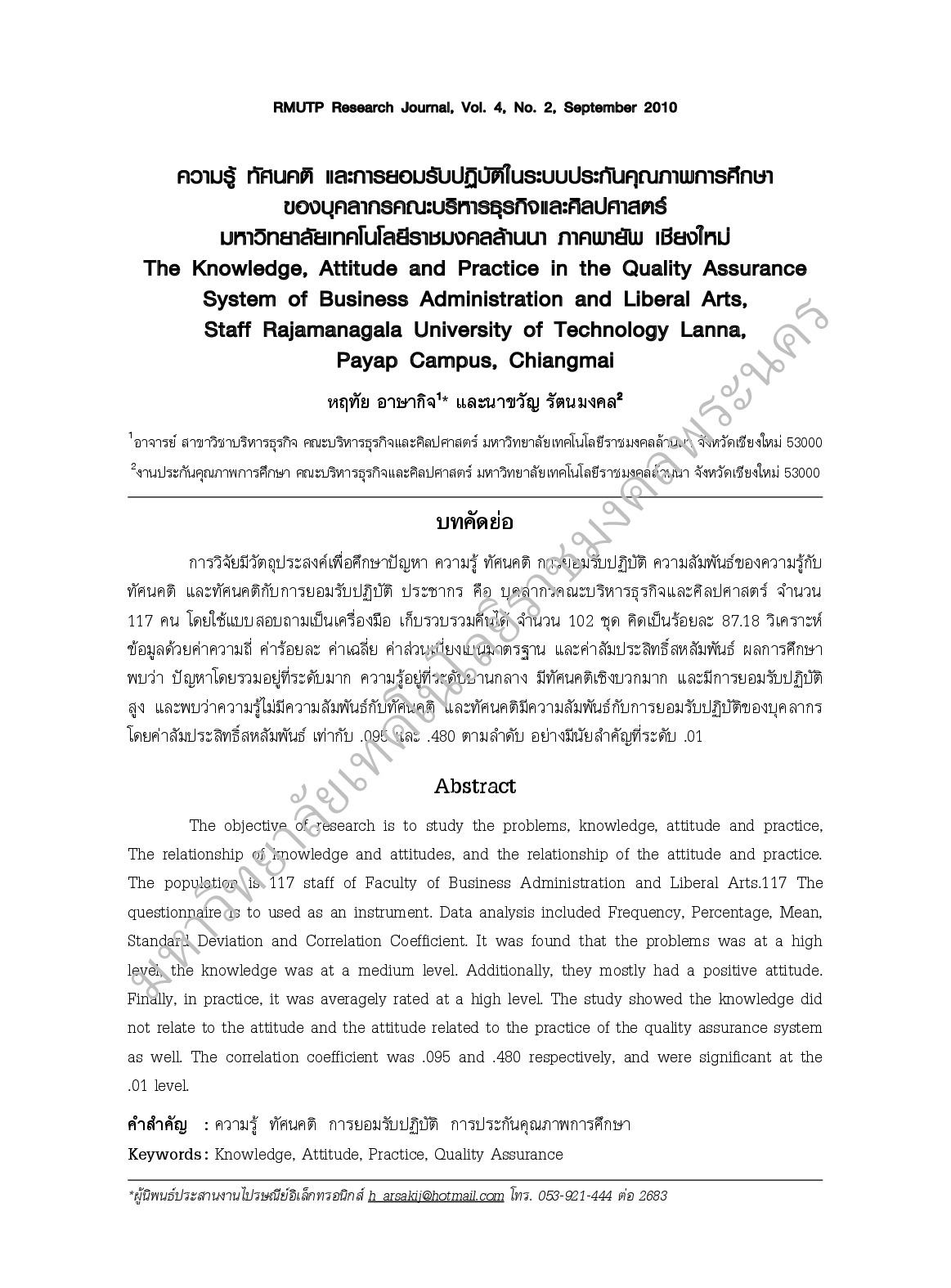
ความรู้ ทัศนคติ และการยอมรับปฏิบัติในระบบประกันคุณภาพการศึกษาของบุคลากรคณะบริหารธุรกิจและศิลปศาสตร์มหาวิทยาลัยเทคโนโลยีราชมงคลล้านนา ภาคพายัพ เชียงใหม่
The objective of research is to study the problems knowledge attitude and practice The relationship of knowledge and attitudes and the relationship of the attitude and practice. The population is 117 staff of Faculty of Business Administration and Liberal Arts.117 The questionnaire is to used as an instrument. Data analysis included Frequency Percentage Mean Standard Deviation and Correlation Coefficient. It was found that the problems was at a high level the knowledge was at a medium level. Additionally they mostly had a positive attitude. Finally in practice it was averagely rated at a high level. The study showed the knowledge did not relate to the attitude and the attitude related to the practice of the quality assurance system as well. The correlation coefficient was .095 and .480 respectively and were significant at the .01 level.
Students problems and needs for educational management of business Phra Nakhon
The objectives of this research were to 1) study perceived problems of students for educational management of Business Administration Faculty Rajamangala University of Technology Phranakhon 2) compare perceived problems of students for educational management classified by gender students year and field of study and 3) study needs of students for educational management of Business Administration Faculty. The sample studied were 341 undergraduate students selected by proportional stratified random sampling categorized by students year of study and simple random sampling was also used. The data was collected through questionnaires constructed by researcher. The statistics used for data analysis were mean standard deviation one way analysis of variance and Scheffes multiple comparison method. The results were as follows: 1.Problems concerning instructors content of study and method of teaching were less perceived by students. Evaluation and measurement teaching and learning management infrastructure concerns and instructional media and instruments were perceived as problems at intermediate level. 2.Students from different year and field of study and from different gender had statistically difference of perceived problems for educational management. 3.The highest needs for educational management concerning instructor aspect was love and understanding from teachers. Regarding the aspects of study contents method of teaching evaluation and measurement and teaching -learning management the highest needs were applying knowledge using an interesting instructional media evaluating according to contents organizing suitable study schedule of each term respectively. Enough and clean toilets as well as enough educational equipments were the highest needs for the aspects of infrastructure and educational media and instrument respectively.