จำนวน Repository ( 18 )
พัฒนาดินซีเมนต์ลูกรังผสมวัสดุเถ้าทิ้งจากผลผลิตอุตสาหกรรมและเกษตรกรรมเป็นอิฐประสาน
จากการทดลองวิจัยพบว่าตัวอย่างดินลูกรังผสมเถ้าทิ้งจากอุตสาหกรรมและเกษตรกรรมสามารถเป็นวัสดุก่อสร้างอิฐประสานได้ตามความเหมาะสมตามอัตราส่วนและกาลังที่ต้องการ โดยมีองค์ประกอบทางเคมีของดินลูกรัง เถ้าแกลบและเถ้าชานอ้อย พบว่าดินลูกรังมีซิลิกอน ออกไซด์ (SiO2) อลูมิน่า ออกไซด์ (Al2O3) ไอรอน ออกไซด์ (Fe2O3) เป็น 58.60 % 25.50% 13.00% ตามลาดับและพบสารประกอบ Silicon Oxide (SiO2) : Quartz เถ้าแกลบมีซิลิกอน ออกไซด์ (SiO2) แคลเซียม ออกไซด์ (CaO) โพแทสเซียม ออกไซด์ (K2O) เป็น 94.00% 2.00% 2.80% ตามลาดับและพบสารประกอบ Silicon Oxide (SiO2) : Cristobalite เถ้าชานอ้อยมีซิลิกอน ออกไซด์ (SiO2) แคลเซียม ออกไซด์ (CaO) โพแทสเซียม ออกไซด์ (K2O) เป็น 74.7% 07.8% 5.4% ตามลาดับและพบสารประกอบ Silicon Oxide (SiO2) : Quartz ผลการทดสอบกาลังอัดพบว่าตัวอย่างทดสอบเถ้าแกลบที่มีกาลังอัดน้อยกว่า 70 ksc. 34 ตัวอย่างระหว่าง 70-100 ksc. 7 ตัวอย่าง และมากกว่า 100 ksc. 24 ตัวอย่าง ตัวอย่างทดสอบเถ้าชานอ้อยที่มีกาลังอัดน้อยกว่า 70 ksc. 25 ตัวอย่างระหว่าง 70-100 ksc. 8 ตัวอย่างและมากกว่า 100 ksc. 32 ตัวอย่าง ซึ้งพบว่าดินลูกรังและเถ้าทิ้งเมื่อเพิ่มปริมาณปูนมากขึ้นกาลังรับแรงเพิ่มตามสาดับผู้ใช้ควรเลือกใช้ตามความเหมาะสมกับงาน ผลการทดสอบการดดูดซึมน้าพบว่าอิฐประสานจากเถ้าแกลบและเถ้าชานอ้อยหลังการแช่น้าไม่สามารคงรูปอยู่ได้ 11 ตัวอย่างซึ่งเห็นว่าไม่มีวัสดุที่ก่อให้เกิดการแข็งตัว อิฐประสานจากเถ้าแกลบและเถ้าชานอ้อยสามารถดูซึมน้าได้น้อยกว่า 30% จานวน 51 ตัวอย่างและ 53 ตัวอย่าง ตามลาดับ ซึ้งสามารถนาไปใช้ในงานก่อสร้างได้ผลการทดสอบการเปลี่ยนแปลงปริมาตรจากความชื้นพบว่าอิฐประสานจากเถ้าแกลบและเถ้าชานอ้อยไม่เกิดการเปลี่ยนแปลงปริมาตรหรือเกิดน้อยมากจานวน 10 และ14 ตัวอย่างตามลาดับซึ้งเป็นคุณสมบัติที่ดีของวัสดุก่อสร้าง

Biomass potential of 56 accessions of leucaena as animal and biofuel feedstocks
Biomass yield between 56 accessions of leucaena were observed at Suwanvajokkasikit Field Crops Research Station Nakhonratchasima province. Randomized block design was used with 3 replications and 56 accessions as treatments. Leucaena was harvested at 2 years of age. Plant length wood yield branch yield and leaf yield were collected. Averaged plant length was in range of 6.84-11.87 meters with KU19 was highest in length. Five accessions that produced more wood yield were KU15 KU38 KU1 KU19 and KU10. Yield of these accessions were 24.07 21.96 16.71 15.36 and 14.95 t/rai with ash content at 1.43 1.04 1.76 3.66 and 1.34 percent respectively while native leucaena (KU20) had the lowest yield (0.91 t/rai). Branch yield among the accessions; KU1 KU10 KU38 KU 15 and KU19 had the greatest branch yield averaged 3.04 2.76 1.62 1.42 and 1.38 t/rai respectively. While top five in leaf yields were in KU15 KU56 KU45 KU39 and KU19 at 1.12 1.11 0.88 0.87 and 0.86 t/rai respectively.
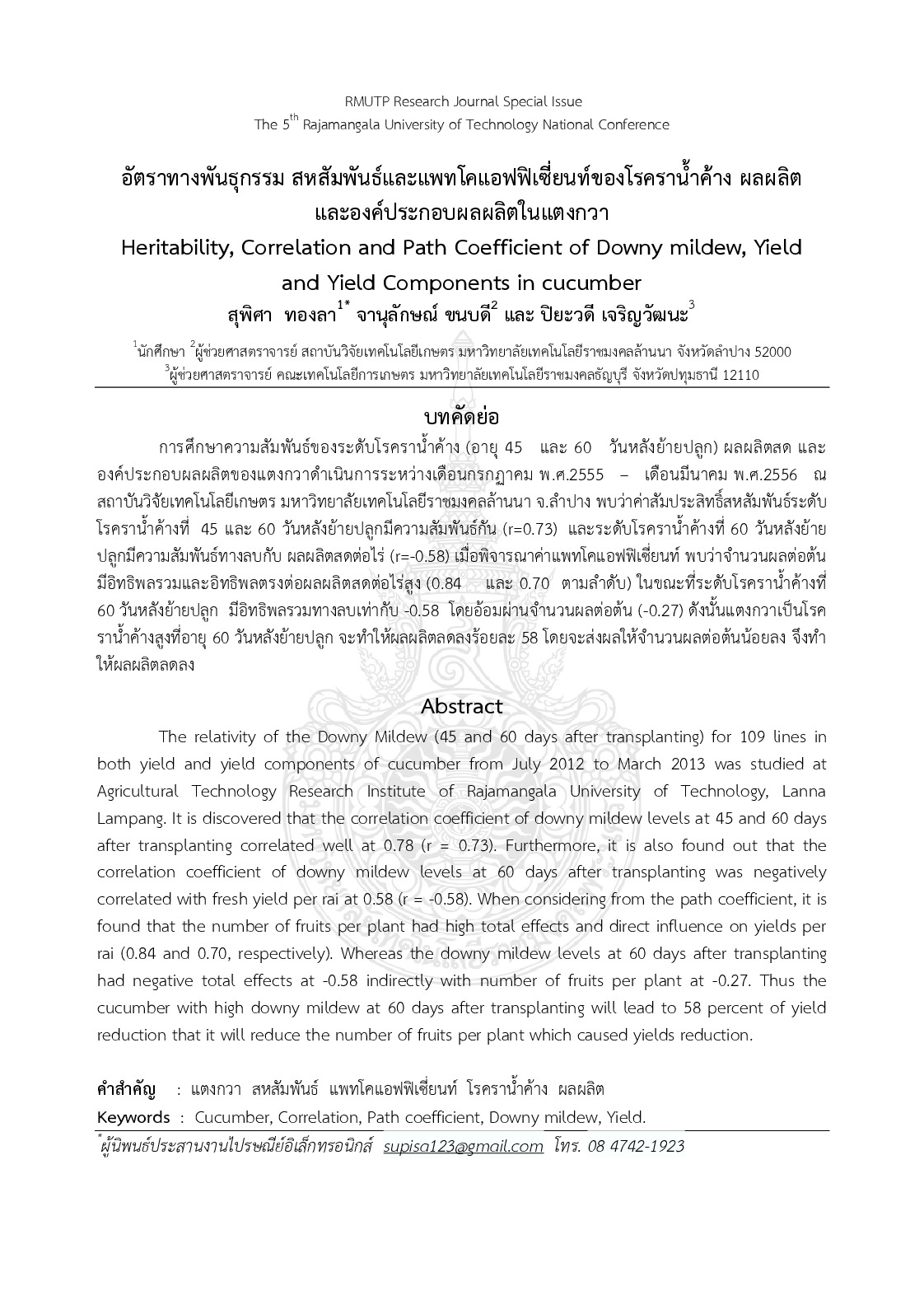
Heritability, correlation and path coefficient of downy mildew, yield and yield components in cucumber
The relativity of the Downy Mildew (45 and 60 days after transplanting) for 109 lines in both yield and yield components of cucumber from July 2012 to March 2013 was studied at Agricultural Technology Research Institute of Rajamangala University of Technology Lanna Lampang. It is discovered that the correlation coefficient of downy mildew levels at 45 and 60 days after transplanting correlated well at 0.78 (r = 0.73). Furthermore it is also found out that the correlation coefficient of downy mildew levels at 60 days after transplanting was negatively correlated with fresh yield per rai at 0.58 (r = -0.58). When considering from the path coefficient it is found that the number of fruits per plant had high total effects and direct influence on yields per rai (0.84 and 0.70 respectively). Whereas the downy mildew levels at 60 days after transplanting had negative total effects at -0.58 indirectly with number of fruits per plant at -0.27. Thus the cucumber with high downy mildew at 60 days after transplanting will lead to 58 percent of yield reduction that it will reduce the number of fruits per plant which caused yields reduction.