จำนวน Repository ( 22 )
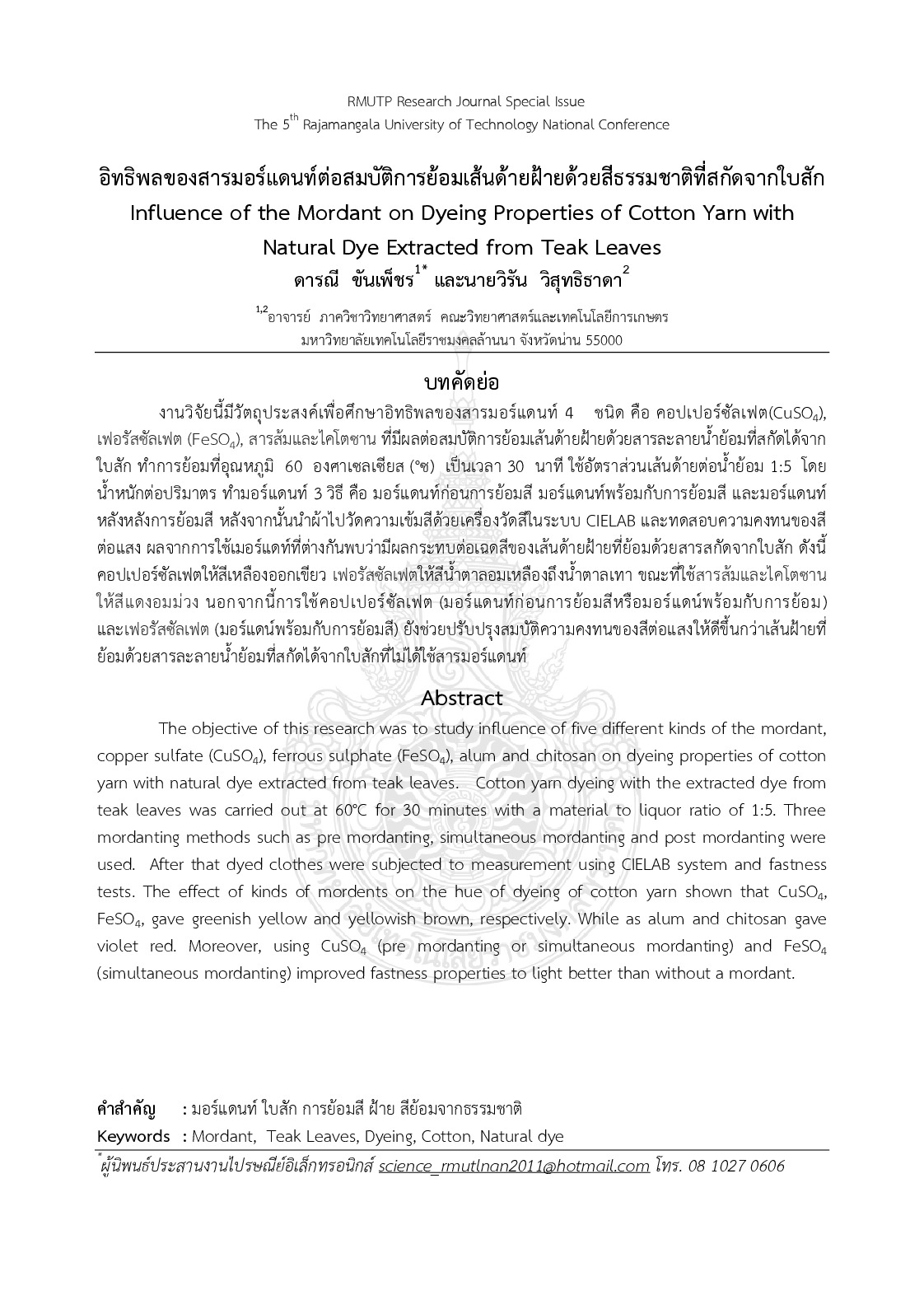
Influence of the mordant on dyeing properties of cotton yarn with natural dye extracted from teak leaves
The objective of this research was to study influence of five different kinds of the mordant copper sulfate (CuSO4) ferrous sulphate (FeSO4) alum and chitosan on dyeing properties of cotton yarn with natural dye extracted from teak leaves. Cotton yarn dyeing with the extracted dye from teak leaves was carried out at 60?C for 30 minutes with a material to liquor ratio of 1:5. Three mordanting methods such as pre mordanting simultaneous mordanting and post mordanting were used. After that dyed clothes were subjected to measurement using CIELAB system and fastness tests. The effect of kinds of mordents on the hue of dyeing of cotton yarn shown that CuSO4 FeSO4 gave greenish yellow and yellowish brown respectively. While as alum and chitosan gave violet red. Moreover using CuSO4 (pre mordanting or simultaneous mordanting) and FeSO4 (simultaneous mordanting) improved fastness properties to light better than without a mordant.

การควบคุมการย้อมสีธรรมชาติและพัฒนาประยุกต์กับลายทอกะเหรี่ยงภายใต้แผนงานวิจัยการจัดการองค์ความรู้ทางสิ่งทอในการพัฒนาและอนุรักษ์ภูมิปัญญาชุมชน กรณีศึกษาผ้าทอกะเหรี่ยง
A research study as Natural Dye Controlled and Applied to Karen Pattern Styles was divided to 2 main studies. The first was natural dye control by varying the condition amount of auxiliaries and mordanting process. The second study was developed and applied the natural shade color to the Karen patterns and using questionnaires as the tool for measure the customer satisfactions level. The results distributed to the target. All the results transferred to the target group at Bann Yang Nam Klad Tai Phetchaburi province. Natural dyed controlling was found the condition was reflect to shade of dye especially the primary condition of natural dye. Almost studied dyes were good using the primary condition as acid condition for Arceanut plam and Butterfly Pea the neutral condition for Sappan tree core of jack fruit tree and Ebony tree. However Curcumin was good dyeing in acid condition whereas the primary condition as neutral. The amount of auxiliary as salt was effect to deep of dye shade. The optimize stage was ranging about 10-20 g/l. Addition the pre mordanting was a good results for this research cause of forming the Chelate ring to bonding between dye and substrate. The natural dye applied into the Karen pattern was shown the modern style pattern and vast application for using and design products. The customer acceptances were good to excellent. The content distributed to the group thus it made a new knowledge occupational and immediately usage.
การพิมพ์สีธรรมชาติจากเปลือกลูกจากแห้ง
The aim of this research is to study white and colour resist printing of dye extracted from dry nipa palm shell. The printing recipes and fixation condition were studied in this work. The result of white resist printing showed that 30 % owp of sodium carbonate (Na2CO3) was used to be a resisting agent. The steam fixation for 15 minutes was suitable to show a good white resist printing in whiteness and sharpness of printing pattern. The whiteness value was 35.05. The washing and rubbing fastness were good to very good and light fastness was fair. The tensile strengths of warp and weft directions were decreased to 10.29 % and 4.25 % respectively. The colour resist printing was using Curcuma longa Linn. powder as illuminant dye. The dye was miscible in 30 % owp of sodium carbonate. The colour resist printing results were corresponding as white resist printing results. The 15 minute of steam fixation showed a good colour resist printing. The Curcuma longa Linn dye could be fixed on silk fabric and showed a good colour strength and sharpness of pattern. The washing and rubbing fastness were good to very good. And light fastness was fair. The tensile strengths of warp and weft directions were decreased to 18.37 % and 4.18 % respectively.
การพัฒนาสารกั้นสีจากแป้งที่ได้จากหัวบอนเพื่อใช้ในการพิมพ์ย้อมผ้าแบบรีซีสต์
The purpose of this research was to study the white resist printing with colour resistant material from flour of wild taro (Colocasia Esculenta (L.) Schott) and using reactive pigment and natural dyes as dyestuffs. Five formulas of printing pastes were applied to light cotton thick cotton and silk fabrics by the use three techniques nauely Silk screen (White resist and colour resist methods)stencil and batik. The optimal ratio of colour resistant materials from flour of wild taro were compose of 20 grams flour of wild taro 32-36 ml. water 30-34 ml. sodium chloride 10-13 ml. calcium hydroxide and 1-4% vegetable oil. The viscosities of printing paste from five recipes were shown in the rage between 559.9-671.9 Centipoise. All five recipes can resist dyestuffs and also easy to remove the flour of wild taro. The pattern at resist printing area of fabrics shows sharpness and whiteness. The colour fastness to washing water and perspiration on cotton and silk fabric results were ranging between poor to fair level when using reactive and natural dyes as dyestuff. However the fastness property of pigment dye shows medium to good level. The colour fastness to rubbing is shown to be in range of 4 to 4-5 for all recipes. The ratings of colour fastness to light in terms of colour change are fair to good (4 to >6).
การพัฒนาหม้อนึ่งแรงดันสูงเพื่อการสกัดสีและย้อมสีธรรมชาติภายใต้แผนงานวิจัย การจัดการองค์ความรู้ทางสิ่งทอในการพัฒนาและอนุรักษ์ภูมิปัญญาชุมชน กรณีศึกษาผ้าทอกะเหรียง
This research had an aim to develop an autoclave for using in natural dyes extraction and dyeing process. The autoclave used the stainless steel as the major material what it was a noble durable material and good resistance for the chemical used in the processes. The achievement results showed by the comparison data between the conventional process and the development using autoclave in term of extraction efficiency deep of shade (K/S) time equivalent process time and amount of gas consumption saver. The knowledge from the research would transfer to the target group at Bann Yang Nam Klad Tai Phetchaburi province. The results were following as 1. For the extraction process: the extraction process using 100oC for 45 min. They obtained product was the same dye quality but the autoclave process was smaller water evaporation as 26.71% whereas the conventional process was 41.99%. 2. For the dyeing process: All condition from the autoclave using make a deeper dye shade (K/S) than conventional process. The dyeing time equivalent as 15 minutes to make the depth shape via autoclave process as alike the conventional process for 45 min. 3. Saving time and gas consumption: the autoclave process could save 66.67% time process and 88.99% amount of gas consumption. 4. The Complacency for knowledge assignment: the satisfaction level in the content time and period was good. Furthermore the utilization the instructors and the value obtained were excellent. This research accomplished the study objectives. The results were not only corresponding to energy conservation but them also reducing the chemical toxic and pollutant vapor inhalant to the worker.