จำนวน Repository ( 30 )

การพัฒนาผลิตภัณฑ์เปลือกกล้วยน้ำว้าแช่อิ่มอบแห้ง
This research aimed to investigate the suitable method to product osmotically dehydrated banana peels and determine its shelf life as well as consumer acceptation. It was found that the proper method was the slow osmotic dehydration process with 30 40 and 50% of syrup (sucrose solution). This method led to the highest appearance color and flavor scores as accessed by the consumer. Therefore the slow osmotic dehydration process was selected for further study relating to the ratio between salt and malic acid (3:2 3:3 and 2:3 of syrup weight). The result show that no differences in appearance color flavor and texture scores were found among treatments however the sample treated with salt and malic acid in the ratio of 3:3 obtained the highest taste score. Thus the suitable process to produce the osmotically dehydrated banana peels was slow process with salt and malic in the ratio 3:3. According to the shelf life study the sample (100g) packed in metallic foil still compiled with Thai community standard of fruit and vegetable products during 12 weeks of storage under 25-30 °C. In addition the consumers also accepted the selected osmotically banana peel product.
การพัฒนาผลิตภัณฑ์สายบัวแผ่นอบกรอบจากบัวพันธุ์บัวสาย โดยกระบวนการอบแห้งแบบอบลมร้อน
The study of Crispy Lotus-Stem bakesby drying oven. The purpises of this study were to create create crispy lotus-stem recipe and the production process of crispy lotus-stem by drying oven. This study was to quantify amount of lotus-stem and Stabilizing agent that appropriate to produces crispy lotus-stem. Was conducted in 3 recipes (depend on ratio (%) of quantity lotus-stem: Stabilizing agent) are following 1) 95:5 2) 95:5 and 3) 95:5. Our study found that the ratio of lotus-stem: Tapiocastarch which appropriate to produces crispy lotus-stem were 95:5.Moreover this ratio was accepted mostly and after tasted the water activity aw values= 0.349the Crispyness values= 1753 and the Spectrophotometer values = (L*) 34.39(a*) 4.12 and (b*) 8.31 the chemical analysis found that fiber = 31.89% protein = 3.87% fat = 23.98% moisture = 2.65% and ash = 4.35% The study of temperature and duration to bake crispy lotus-stem by drying oven at 60 70 and 80 degree Our showed the appropriate temperature and duration to bake crispy lotus-stem by drying oven was 1 hour 30 minutes crispy Lotus-stem products by Drying Oven can Keep at room temperature degree Celsius for a period of 30 days.
กระบวนการผลิตกระเจี๊ยบเขียวแผ่นอบกรอบโดยการใช้เครื่องอบแห้งแบบลมร้อน
The study on baked crispy okra sheets (Hit 9701 species) by using a hot air dryer. The objective of this study was to investigate the okra sheets formula and manufacturing procees by hot air dryers with 3 methods; pouring finely blended okra onto the inside tray pouring finely blended okra onto the outside tray and pouring finely blended okra into an aluminum block. It was found that pouring finely blended okra into an aluminum block resulted in the least crack in the dried sheet with the rectangular shape remaining intact. After the forming method is decided on a study was conducted on the temperature to bake okra at 3 levels namely 70 80 and 90 C.It was found that baking okra at 80 C for 4.5 hours was suitable the baking and crispy okra sheets ended up with the lightness(L*) of 49.75 the green (a*) was-2.53 and yellowness (b*) of 23.71. The moisture content was at 5.07 % water activity content was 0.27 The hardness was 5.01 N and the crispness was 4.67. The results of chemical analysis showed that the carbohydrate content was 76.34% crude fibers was 10.72% ash content was 8.24% moisture content was 4.24% and fat content was 0.46%. From the study on the bacteriological quality it was found that the crispy okra sheet products can be stored at room temperature for 28 days.
ขนมโสมนัสเสริมแกนสับปะรดอบแห้ง
The study of Khanom Sommanat supplemented with dried pineapple cores revealed that the scraping was the most accepted for its appearance color aroma taste texture and overall liking. The average score is 6.92 6.88 7.27 7.26 7.00 and 7.38 respectively. Due to better grinding the texture is better than spinning and slicing the pineapple. The scrape was added to the Khanom Sommanat found that when added pineapple dried core at 10% of baked coconut. Most recognized for their appearance color flavor texture and overall taste. The scores were 7.20 7.18 7.32 7.35 7.32 and 7.36 respectively. The color L * (brightness) increased but the color a * (red) and the color b * (yellow) decreased. The hardness and crisp increase in weight 100 grams the nutritional value decreased. Carbohydrates protein ash fat but fiber content increases. The study on consumer acceptance of Khanom Sommanat supplemented with dried pineapple cores. It was found that the adoption of the product at 97 percent to the level of feeling. The mean score of 7.57 was moderate. Shelf life can be eaten at room temperature for at least 4 weeks in accordance with Thai dessert community product standard.
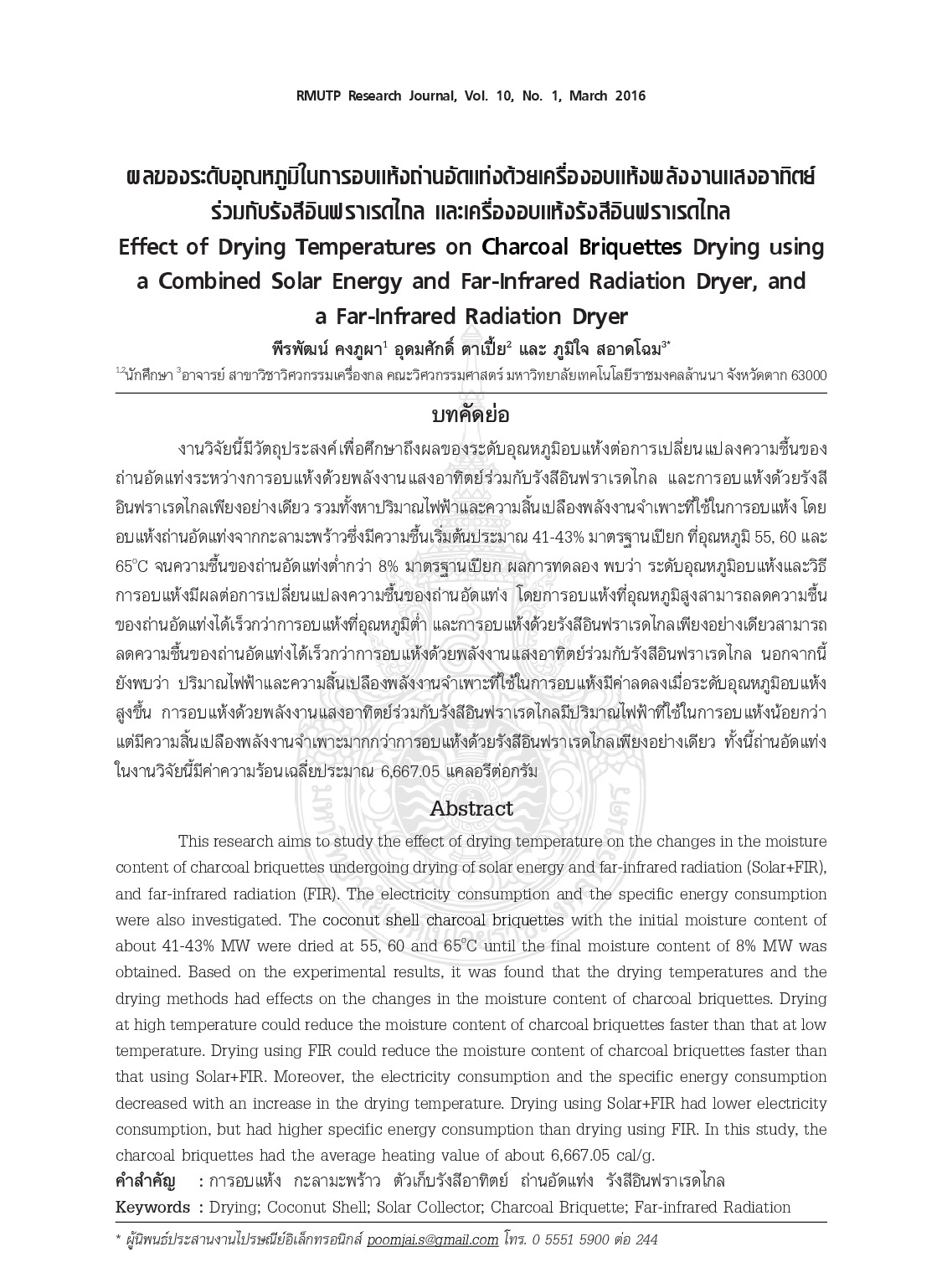
ผลของระดับอุณหภูมิในการอบแห้งถ่านอัดแท่งด้วยเครื่องอบแห้งพลังงานแสงอาทิตย์ร่วมกับรังสีอินฟราเรดไกล และเครื่องอบแห้งรังสีอินฟราเรดไกล
This research aims to study the effect of drying temperature on the changes in the moisture content of charcoal briquettes undergoing drying of solar energy and far-infrared radiation (Solar+FIR) and far-infrared radiation (FIR). The electricity consumption and the specific energy consumption were also investigated. The coconut shell charcoal briquettes with the initial moisture content of about 41-43% MW were dried at 55 60 and 65oC until the final moisture content of 8% MW was obtained. Based on the experimental results it was found that the drying temperatures and the drying methods had effects on the changes in the moisture content of charcoal briquettes. Drying at high temperature could reduce the moisture content of charcoal briquettes faster than that at low temperature. Drying using FIR could reduce the moisture content of charcoal briquettes faster than that using Solar+FIR. Moreover the electricity consumption and the specific energy consumption decreased with an increase in the drying temperature. Drying using Solar+FIR had lower electricity consumption but had higher specific energy consumption than drying using FIR. In this study the charcoal briquettes had the average heating value of about 6667.05 cal/g.