จำนวน Repository ( 23 )
การตรวจหาเครื่องจักรที่ผลิตสินค้าบกพร่องเพื่อวางแผนป้องกันและบำรุงรักษาโดยใช้ตัวแบบฮิดเดนมาร์คอฟ: กรณีศึกษาโรงงานผลิตเครื่องดื่ม
This research proposes a hidden Markov model for detecting machines with multiple fillers producing soft drink for quality control in order to reduce defective products. The proposed model is compared with a classical generalized estimating equations model (GEE). The monthly data the number of defective products the correctness and the time spending in correction were collected from a machine in a sample factory in Pratumthanee province. The two hidden states of the fillers are workable and unworkable. The states has a logistic distribution. The results show that the correctness of the filler error occurrence does not improve the probability of being in a unworkable state neither the period of time spending on correction. The current state seems to be the same as the previous state
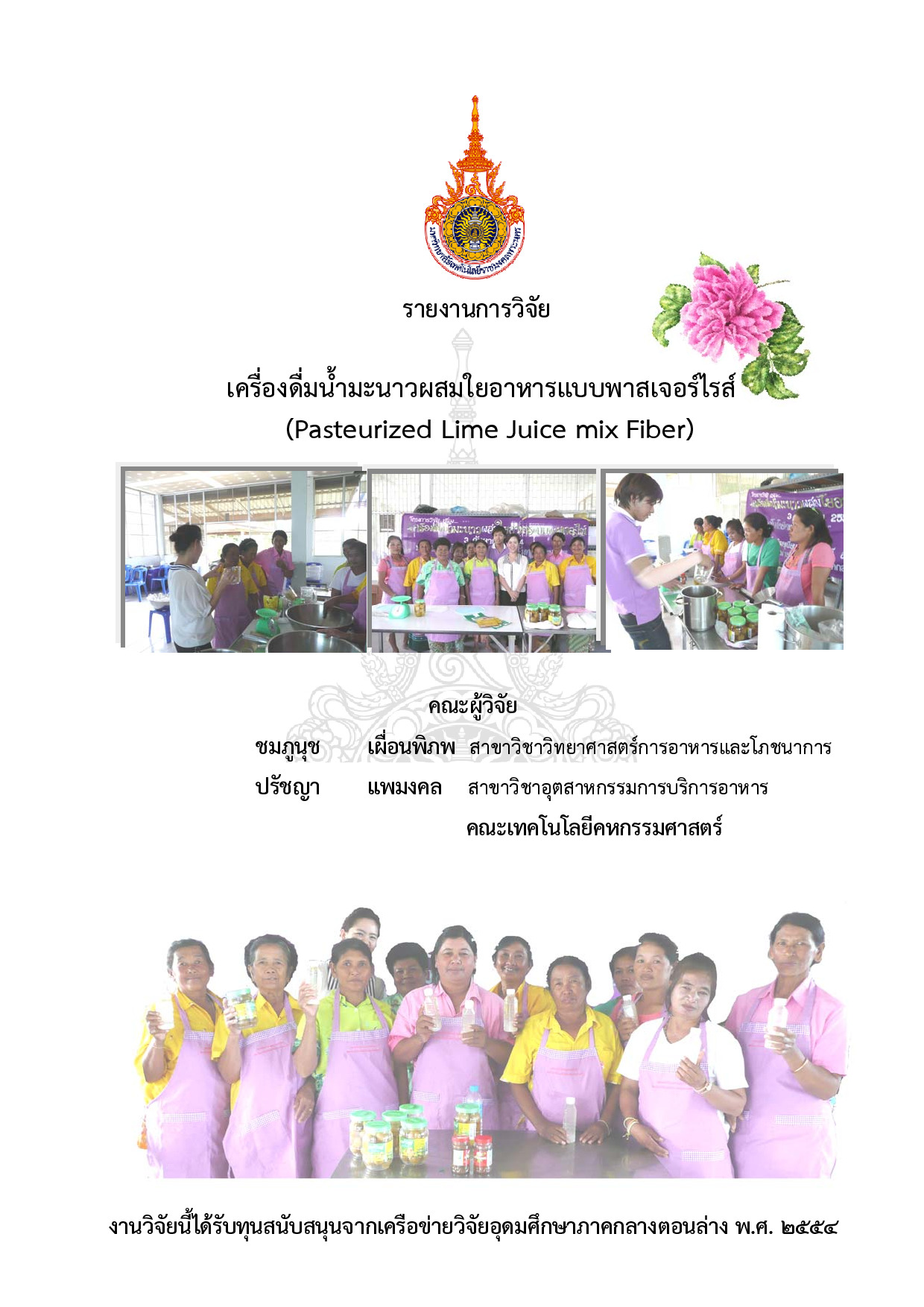
เครื่องดื่มน้ำมะนาวผสมใยอาหารแบบพาสเจอร์ไรส์
The research aimed to study and develope a pasteurized lime juice by adjust the concentrate level of lime juice mixed with konjac. Used Completely Randomized Design and significance among mean was assessed by using the one-way ANOVA and was detected mean and standard deviation were compared using Duncan’s New Multiple’s Range test (DMRT). Results were considered based on a significant difference at p value ≤ 0.05. From the results the final formula consisted of 21% lime juice 15% konjac 10% fructose syrup and 54% warm water. Combination of lime juice and konjac to produce healthy beverage for promote a good digestive system. Konjac has an ability water-holding capacity and form a soft gel with water. It was acts as a bulking agent in the colon. The product was pasteurized at 72-75°C for 15s and packaged in 180-220cc. it could be stored at 6±1°C for 7 days. The products were well accepted by consumers (n=30 duplicate) with scores of 7 (like moderately) used sensory evaluation by 9-point Hedonic Scale and analyzed. The color value which detected by the spectrophotometer was 42.64 ± 0.19 (L*) 4.33 ± 0.15 (a*) and 16.78 ± 0.10 (b*). Samples were taken each day for physical chemical and microbiological analysis including total plate count yeast and mold and E.coli by A.O.A.C 2000.

เครื่องดื่มน้ำนมถั่วเหลืองผสมน้ำแครอท
The purposes of the research on soy milk product mixed with carrot were to study the preparation of soy milk carrot juice extraction appropriate ratio of soy milk to carrot juice and sugar content shelf - life and consumers’ acceptance of the product. The study was focused on the product’s physical quality chemical composition sensory quality and micro-organism content. The results of the research revealed that soy milk with soy bean : water at 1:4 (by dry soy bean weight)used in extraction process; blanching of carrot prior to extracting which yields 70.31% of the juice and 4580 μg . (763.33 R.E) beta - carotene per 100 grams of carrot which is a higher amount than extracting fresh carrot ; the ratio of soy milk to carrot juice at 70:30 and 5% of sugar content by weight are appropriate in soy milk mixed with carrot production. The L*value a*value and b* value were 66.79 25.24 and 39.25 respectively. The viscosity was 17.33 centipoint; total soluble solid was 11.67 brix; and pH was 6.25. The acceptance scores on color flavour texture and overall preference were 7.98 8.00 7.93 and 8.05. This means preference on color and texture was moderate; the preference on flavour and texture was very high. For chemical composition it was found that there were 71.08 kcal. energy 4.40 g. protein 1.56 g. fat 9.86 g. carbohydrate and 1378 μg.(229.67 R.E.) beta-carotene per 100 grams. The cost of raw materials was 6.41 baht per 180 ml./bottle. The study of consumers’ product acceptance showed that most consumers had knowledge on nutrition; they accepted and had preference on the product at the moderate level. The price of 12.00 baht per 180 ml. bottle was accepted. It was also found that there was no physical or chemical change of the product when kept at 70C for 14 days. Total bacterial count was 4.8x10 CFU/cm3 when compared to Soy Milk Thai Community Product Standard (SPC. 529/2004) which specified that not exceeding 1x10⁴ CFU/ cm3 should be found in the product. It was evident that the product was still safe for consumption when kept for 14 days.
การผลิตโยเกิร์ตพร้อมดื่มจากน้ำเงาะและการเหลือรอดของแบคทีเรียแลคติก
The study aimed to investigate appropriate formula for drinking yoghurt production. The conditions were ratio of yoghurt : concentrated rambutan juice at 100 : 0 90 : 10 85: 20 and 75: 25 the effect of concentrated rambutan juice on physical and chemical and microbiological lactic acid bacteria survival appropriate proportion of syrup and lactic acid bacteria survival during storage of drinking yoghurt from rambutan juice. It was found that proportion of concentrated rambutan juice had no effect in color (L* a*) of the yoghurt (p>0.05) but its impact to b* and viscosity were significant (p≤0.05) they increased with the increased proportion of the concentrated rambutan juice. Yoghurt with 15% concentrated rambutan juice had 88% survival rate of lactic acid bacteria after stimulated digestive system. The results showed that optimal production formula of drinking yoghurt from concentrated rambutan juice and syrup were 90:10 Z(yoghurt: concentrated rambutan juice; 85:15) : syrup) Drinking yoghurt stored in the refrigerator at 4±1oC for 15 day was evaluated and found that LAB survival numbers were 9.90 log CFU/mL.
พฤติกรรมการบริโภคกาแฟสดของบุคลากรสายวิชาการ มหาวิทยาลัยเทคโนโลยีราชมงคลพระนคร
The purposes of the research were to study 1) personal factors of the academic staff at Rajamangala University of Technology Phra Nakhon (RMUTP) 2) fresh-coffee consumption behavior of the academic staff at RMUTP and 3) relationship between personal factors and fresh-coffee consumption behavior of the academic staff at RMUTP. The sample group consisted of 237 academic freshcoffee consuming personnels The instrument was a questionnaire. Frequency percentage mean standard deviation Chi-square and Phi correlation were used in data analysis via computer program. The results of the study indicated that 1) majority of the samples were female aged between 41-45. Most of them were master’s degree holding instructors with 25001-30000 baht monthly income; 2) most of the staff consumed approximately 4-5 glasses of freshly-brewed coffee weekly spending 41-50 baht per glass. Most purchased the fresh-coffee from a coffee booth or a coffee corner from 09.01-12.00 in the morning. Most of the samples preferred to drink iced (cold) fresh-coffee which had bitter sweet rich taste. Milk was once in a while added. Moreover they liked to drink fresh-coffee together with something sweet such as cake bread and pie; and 3) concerning the relationship between personal factors of academic staff at RMUTP it was found that age work status education level faculty and average monthly income had a statistically significant correlation at the level of 0.5 with the consumption behavior. None of the gender was found.