จำนวน Repository ( 20 )
ขนมตูเลย์เสริมผำอบแห้ง
The objectives of this study were to investigate the three basic tuiles recipes and to study the content of four types of wolffia dry in tuiles at 0% 2% 4% and6% of total ingredient weight. By planning randomized complete block design(RCBD) and evaluating sensory quality in appearance color odor taste texture (crispy) and overall preference with the use of testing methods for 9- Point Hedonic Scale. The study the basic formula for tuiles by allowing 40 tasters and the study this tuiles supplementaly with wolffia dry by allowing 80 testers to be undergraduates in food and nutrition Faculty of Home Economics Tecnology Rajamangkala University of Tecnology Phranakhon. Take average data(Mean) analyze variance (Analysis of Variance ANOVA) and compare differances mean values (Duncan’s New Multiple Test DMRT) The results of the 3 basic formulas of tuiles namely found that the tasting person accepted the formula 1 in appearance color taste texture (crispy) and overall preference. Average 8.02 7.95 8.08 7.93 and 8.13 respectively at the level medium to high level and the tasting person accepted the formula 3 in odor preference average of 7.70 at the level medium. When analyzed Variance and comparison of differences found that appearance color odor taste texture (crispy) and overall preference there are significant differences at the level of 0.05. The results of the study of the amount of tuiles supplementaly with wolffian dry in 4 formula found that the tasting person accepted the formula supplementaly 2% in color odor texture ( crispy) and overall preference average of 8. 15 7. 79 8. 28 and 8. 05 respectively at the level medium to high level and tasting person accepted the replace 0% in appearance and taste preference average of 8. 18 and 7. 88 at the level medium to high level. When analyzed variance and comparison of statistical differences found that appearance color odor taste texture ( crispy) and overall preference there are significant difference at the level of 0.05.
การพัฒนาผลิตภัณฑ์ขนมอบปราศจากกลูเตนด้วยข้าวไทย
The product development of gluten-free Bake goods with Thai rice. The rice used in research is the product of the Baan Chanode community enterprise of Khlong Yong - Lan Tak Fa Community such as Nakhonchaisri brown rice and black rice. It is processed into rice flour as a substitute for wheat flour to make gluten-free pastry product contains cookies products Tuile cookies and tart dough. Product development of gluten-free pastries with Thai rice with Nakhonchaisri brown rice and black rice can be made into a gluten-free product. Products that contain more fiber. They have a natural color of rice at the same time it resulted in a lower products texture characteristic score. Which affects acceptance The proper packaging is beautiful the respondents rated it on a very satisfactory level. Consumer acceptance testing The development of gluten-free pastries made with 3 Thai rice of 100 people found that most of the testers more than 80% accepted the product development of gluten-free pastries with Thai rice.
ขนมวาฟเฟิลเสริมเมล็ดเจีย
A study of waffle snacks with chia seeds was aimed at studying the basic recipe of waffle snacks. And to study the appropriate amount of chia seeds added in waffle snacks. The appropriate content of chia seeds added to The four levels were 0 2 3 and 4 percent of the total weight of the ingredients. By using the method of randomized complete block design or RCBD. This RCBD experimental plan will help assess the sensory quality in appearance (fluffy) color smell texture (Soft) and overall preference By using “9-Point Hedonic Scale” method experimental study used 80 people to test the flavor consist of lecturers and foods and nutrition students Faculty of Home Economics Technology Rajamangala University of Technology Phra Nakhon. The results were calculated the average to analysis of variance (ANOVA) and compare the mean difference at the confidence level 0.05 by using the method of least significant difference (LSD) and Duncan’s New Multiple Rang Test (DMRT) analyzing by statistical package program. From studying the appropriate amount of chia seeds in waffle snacks. 4 levels were found that the taster accepted 3 percent of the total weight of the ingredients. in appearance (fluffy) color smell texture (Soft) and overall preference liking. With an average score 8.00 7.98 7.90 7.87 8.00 and 7.95 respectively Is at the level that I like very. When analyzing variance and compare the statistical differences in appearance (fluffy) color smell texture (Soft) and overall preference liking. There was a statistically significant difference at level 0.05
การปรับปรุงคุณภาพขนมปังโดยใช้แป้งสุก
Bread is a bakery product with low moisture content. It have a hard and sticky texture that cause difficult to eat. Therefore in the present study the effect of gelatinized starch (wheat corn rice tapioca and glutinous starch) to improve of bread quality was determined. Starch were gelatinized and added as bread ingredients. Gelatinized starch influenced the quality of bread. The bread obtained gelatinized starch with high specific volume and moisture content but low density (p≤0.05). Sensory evaluation showed that the bread which contained from gelatinized tapioca starch obtained highest score especially texture and overall acceptance from the panelists. Tapioca gel has been used as texture improving agent in bead. The effect of tapioca gel on the quality of bread were determined. The tapioca gel (0 20 30 40 and 50% of wheat starch) was used in the formulation of the bread. Increasing tapioca gel improved specific volume moisture content density and sensory quality (p≤0.05); however these quality were deteriorated as add tapioca gel up to 50% (p≤0.05).
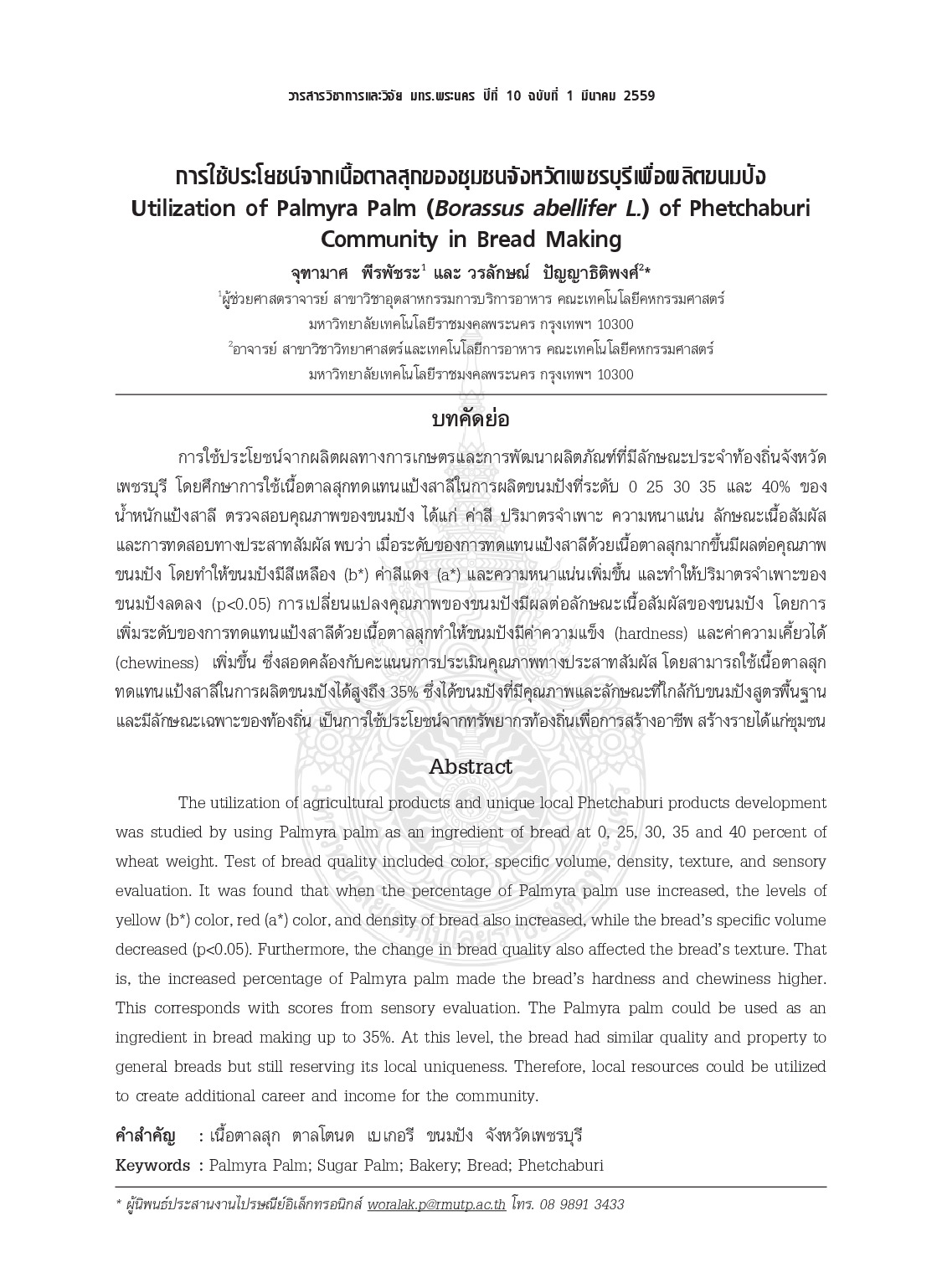
การใช้ประโยชน์จากเนื้อตาลสุกของชุมชนจังหวัดเพชรบุรีเพื่อผลิตขนมปัง
The utilization of agricultural products and unique local Phetchaburi products development was studied by using Palmyra palm as an ingredient of bread at 0 25 30 35 and 40 percent of wheat weight. Test of bread quality included color specific volume density texture and sensory evaluation. It was found that when the percentage of Palmyra palm use increased the levels of yellow (b*) color red (a*) color and density of bread also increased while the bread’s specific volume decreased (p<0.05). Furthermore the change in bread quality also affected the bread’s texture. That is the increased percentage of Palmyra palm made the bread’s hardness and chewiness higher. This corresponds with scores from sensory evaluation. The Palmyra palm could be used as an ingredient in bread making up to 35%. At this level the bread had similar quality and property to general breads but still reserving its local uniqueness. Therefore local resources could be utilized to create additional career and