จำนวน Repository ( 65 )
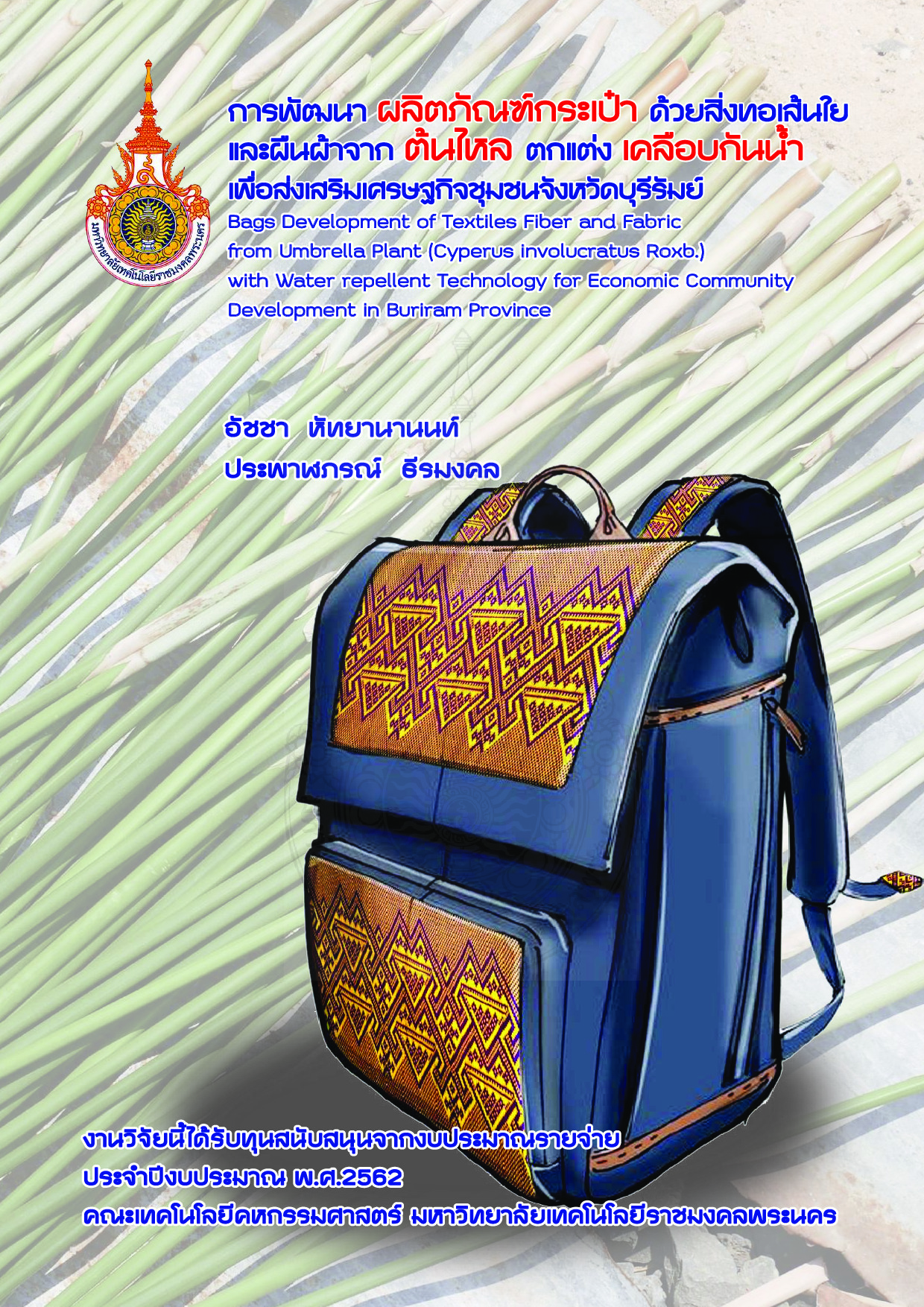
การพัฒนาผลิตภัณฑ์กระเป๋าด้วยสิ่งทอเส้นใยและผืนผ้า จากต้นไหลตกแต่งเคลือบกันน้ำ เพื่อส่งเสริมเศรษฐกิจชุมชนจังหวัดบุรีรัมย์
The proposes of this research were to study the development of bag products with textiles fibers and fabrics from decorative flowing water-resistant coating to promote community economy in Buri Ram Province. With the objective To study the process of producing yarn from fibers from the flow source To design and develop textile and bag products from yarn from the Lai Ton To study the effect of coating with waterproofing on bag products using textiles fibers and fabric from the flow. And to transfer knowledge and technology for utilization to community groups and interested people in next fiscal year This research can be summarized as follows: 1. The study of Ton Lai found that most villagers grow Lai Ton and make products as a supplementary career. In using this flow source in this research the researcher used a large flow source with a diameter of about 1 hour and can be separated into 4 small strands for research and production. The dyes used are synthetic because they will get fresh colors save time and be consistent. 2. The researcher designed 2 designs of weaving designs with the idea of using the original pattern to add edit and then create the pattern that the community groups like and can actually produce it as a product. After getting the fabric pattern then design into 10 bags of women and men bags using leather as an ingredient Decorate the bag to look interesting increase the price and increase the target audience. Which will be different from the original. That uses colored fabric and striped fabric as decorative items. 3. Coating with waterproofing on the bag products with textiles fibers and fabrics from the flow found that the fabric that has been coated with water repellent. When pouring water on the water surface there is a clumping together. No water penetration through fibers. When wiping clean the fibers are still dry not wet. Which is different from fabric that has not been coated namely water is able to penetrate immediately and create moisture on the fabric surface. If stored for a long time it can cause mold. 4. Schedule of technology transfer with the plan to transfer the research in the budget year 2020. For 3 day knowledge transfer and workshop was 30 participants. The group consisted of weaving mats from Ban Bu community Chorakhe Mak Subdistrict Prakhon Chai District. Buriram province
การปรับปรุงสมบัติทางกลของพอลิแลกติกแอซิดด้วยเส้นใยปาล์มน้ำมัน
This research work was to study the improvement of toughness of polylactic acid (PLA) and the cost reduction of raw material with addition of untreated and treated oil palm fiber (OPF). The detail of this work was divided into two parts. The first was to find the suitable condition for surface treatment of OPF with sodium hydroxide (NaOH). The second part was to study the effect of untreated and treated OPF contents on the mechanical properties of PLA. For surface treatment of OPF NaOH concentrations and immersion times were varied from 0 to 15 wt% and 0 to 30 min respectively. Aspect ratio (L/D) and surface of untreated and treated OPF were investigated by using optical microscope and scanning electron microscope (SEM) respectively. The result suggested that the most suitable condition for surface treatment of OPF was NaOH concentration of 10 wt% at immersion time of 20 min. Treated OPF was occurred microporous and had more rough as compare to untreated fiber. For the effect of untreated and treated OPF contents on the mechanical properties of PLA it was evaluated by tensile and impact testing. SEM was used for investigation of interfacial adhesion and fiber dispersion. The results showed that tensile modulus and impact strength tend to increase with adding 2.5 wt% OPF content and slightly changed at higher OPF content whereas ultimate tensile strength and elongation at break decreased with increasing fiber content. Surface treatment with NaOH led to enhancement of mechanical properties of composite due to improve interfacial adhesion and fiber dispersion.
การปั่นเส้นด้ายจากเส้นใยผลตาลสุก ด้วยกระบวนการปั่นด้ายแกนกลาง
The research aims to investigate on the yarn spinning production using processed Borassus fruit fibres bleached and soaked in water before arranging into fibres of proper size in preparation for the yarn spinning from Borassus fruit fibres using handspun core-spinning technique. The study found that yarns produced by such method are uneven with loose and tight twists and multiple knots along the threads. Furthermore Borassus fruit yarns have rough and coarse texture. Scientifically tested the properties of the yarns indicate that the highest yarn count of this Borassus fruit yarns is at 665.00 Tex while the lowest is at 383.33 Tex. Its tensile strength counts at the maximum level of 24.33 Newton with the elongation level of 21.90 Newton. The average tenacity comparing with yarn count is 0.04 Newton/Tex. The produced yarns consist of blending Borassus fruit fibres and Polyester at the proportion of 83: 18. After the spinning process Borassus fruit yarns are developed into textile weaving together using cotton as warp and Borassus fruit fibres as weft. The finished product was analysed showing that the warp and weft’s tension strength are at 581 Newton and 595 Newton respectively while the tenacity are at 65.05 Newton and 78.95 Newton in consecutive order. The blending proportion of woven textile is 49:45:6 of cotton Borassus fruit fibres and Polyester accordingly. Hence the study shows that the production of Borassus yarns is promisingly producible and the woven textile from such yarns could be used for further product development such as household textile.
ฟิล์มคอมโพสิตชีวภาพจากแป้งมันสำปะหลังเสริมแรงด้วยเส้นใยเซลลูโลสเปลือกทุเรียน
This research aimed to develop compound of prototypes polymer bio-composites from cassava starch (CS) reinforced with agriculture residue the rind of durian fruit. Cellulose extracted from durian rind using hot sodium hydroxide and bleaching treatment with hydrogen peroxide. The removal of lignin and hemicellulose components from durian rind were investigated by fourier transform infrared spectroscopy (FT-IR). Cassava starch bio-composite films were prepared by solution-casting technique which includes 0-50 wt% of durian rind (DR) or durian rind cellulose (DRC) as reinforcement agent and urea/glycerol (GU ratio = 50:50) as plasticizer. The physical and chemical properties of thermoplastic starch (TPS)/DR and TPS/DRC bio-composite films were investigated. The percent elongation at break of bio-composite films were increased when compared to control CS film. From 15TPS/DR (80/20) films showed increase the elongation at break from 7.28 to 14.00% when compared to CS control films. While 15TPS/DRC (80/20) bio-composite films exhibited that the highest elongation at break to 77%. Durian fiber (DR or DRC) loading decreased the water absorption of plasticized bio-composite films. Furthermore incorporation of DRC in composite can be enhanced film stability in water better than DR. Therefore the effect of DRC reinforcement agent on TPS bio-composite films can improve water resistance and mechanical properties especially in terms of flexibility. Finally the waste of bio-composite films was degraded completely in soil burial test.
การพัฒนากระดาษจากเส้นใยทะลายปาล์มน้ำมันเปลือกหุ้มผลปาล์มน้ำมันและเปลือกปอสา และสารเคลือบไคโตซาน
This research aimed to develop paper from oil palm empty fruit bunch (Fb) oil palm mesocarp (M) and paper mulberry (P) with chitosan coating to be used as single-use paper bag for dry food products. The optimal pulp preparation conditions for Fb M and P fibers were boiling in 25 25 and 15% NaOH solution at 170 170 and 100°C for 3 hours respectively. The optimal H2O2 concentrations for bleaching of Fb M and P pulps were 40% 40% and 0.2% respectively. The obtained pulps were used to prepare papers with the basis weight of 109 g/m2 . The papers consisted of Fb M and P pulps at ratios of 70:0:30 (FbP) 0:70:30 (MP) and 35:35:30 (FbMP). It was found that FbP paper showed superior physical and/or mechanical characteristics than those of MP and FbMP. FbP papers were then coated with chitosan solutions (0.2-0.6%) to further improve their mechanical properties and reduce their water absorption characteristics. The optimal concentration of chitosan was 0.4%. This study showed that all three types of pulps could be used to produce papers that had equal or superior mechanical- and water adsorption properties as compared to those of commercially available paper bags made from wood pulp.