จำนวน Repository ( 19 )

มาตรฐานน้ำดื่มบรรจุขวดที่จำหน่ายในจังหวัดอ่างทอง
In this study water quality standard of bottled drinking water distributed in Ang Thong Province was investigated. The results showed that clear plastic bottled drinking water presented completely label information and MFD./EXP. clearly appearance and odourless presented in all samples while Total Dissolved Solid (TDS) of tested clear plastic bottled drinking water samples were in a range of 1±0.00 to 277±0.00 mg/L. Coliform bacteria and fecal coliform bacteria of all tested water samples were less than 2.2 MPN/100 mL and E. coli and total heterotrophic bacteria were not found in all samples. pH values of 18 tested samples were less than 6.5 (60.00%) plastic bottled drinking water samples. Tested opaque plastic bottled drinking water samples showed completely label information and MFD./EXP. clearly appearance and odourless found in all samples while TDS of tested opaque plastic bottled drinking water samples were in a range of 12±0.00 to 13±0.00 mg/L. Coliform bacteria and fecal coliform bacteria of tested water samples were less than 2.2 MPN/100 mL and E. coli and total heterotrophic bacteria were not found in all samples. pH values of 3 tested samples were less than 6.5 (100.00%). Indeed assessment of both types of bottled drinking water samples distributed in Ang Thong Province Thailand based on 6 qualities assessment of standard for drinking water in sealed container set by Ministry of Public Health of Thailand revealed that the tested clear and opaque plastic bottled drinking water samples met the standard for 40.00% and 0% based on pH respectively.
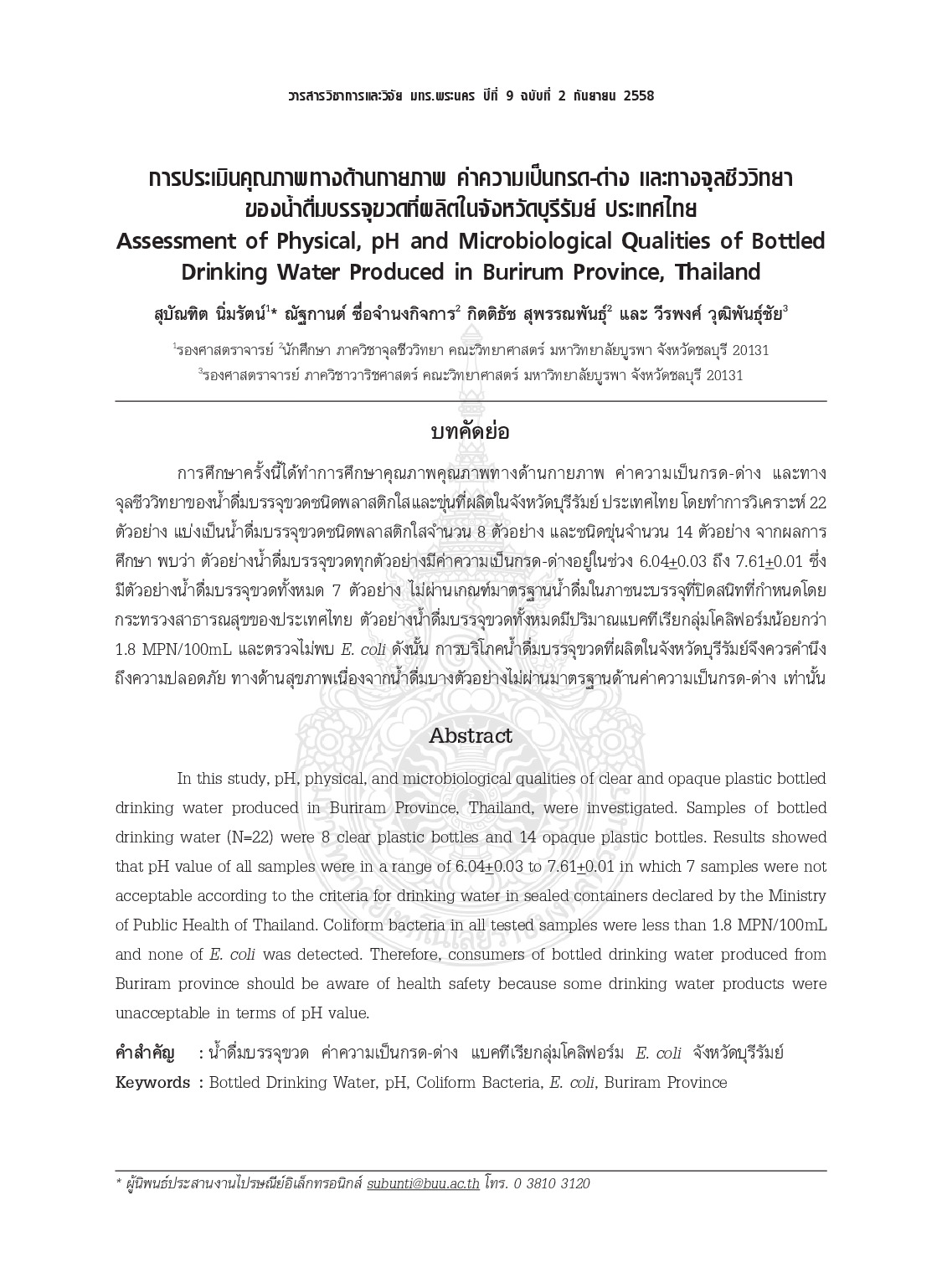
การประเมินคุณภาพทางด้านกายภาพ ค่าความเป็นกรด-ด่าง และทางจุลชีววิทยา ของน้ำดื่มบรรจุขวดที่ผลิตในจังหวัดบุรีรัมย์ ประเทศไทย
In this study pH physical and microbiological qualities of clear and opaque plastic bottled drinking water produced in Buriram Province Thailand were investigated. Samples of bottled drinking water (N=22) were 8 clear plastic bottles and 14 opaque plastic bottles. Results showed that pH value of all samples were in a range of 6.04 ± 0.03 to 7.61 ± 0.01 in which 7 samples were not acceptable according to the criteria for drinking water in sealed containers declared by the Ministry of Public Health of Thailand. Coliform bacteria in all tested samples were less than 1.8 MPN/100mL and none of E. coli was detected. Therefore consumers of bottled drinking water produced from Buriram province should be aware of health safety because some drinking water products were unacceptable in terms of pH value.
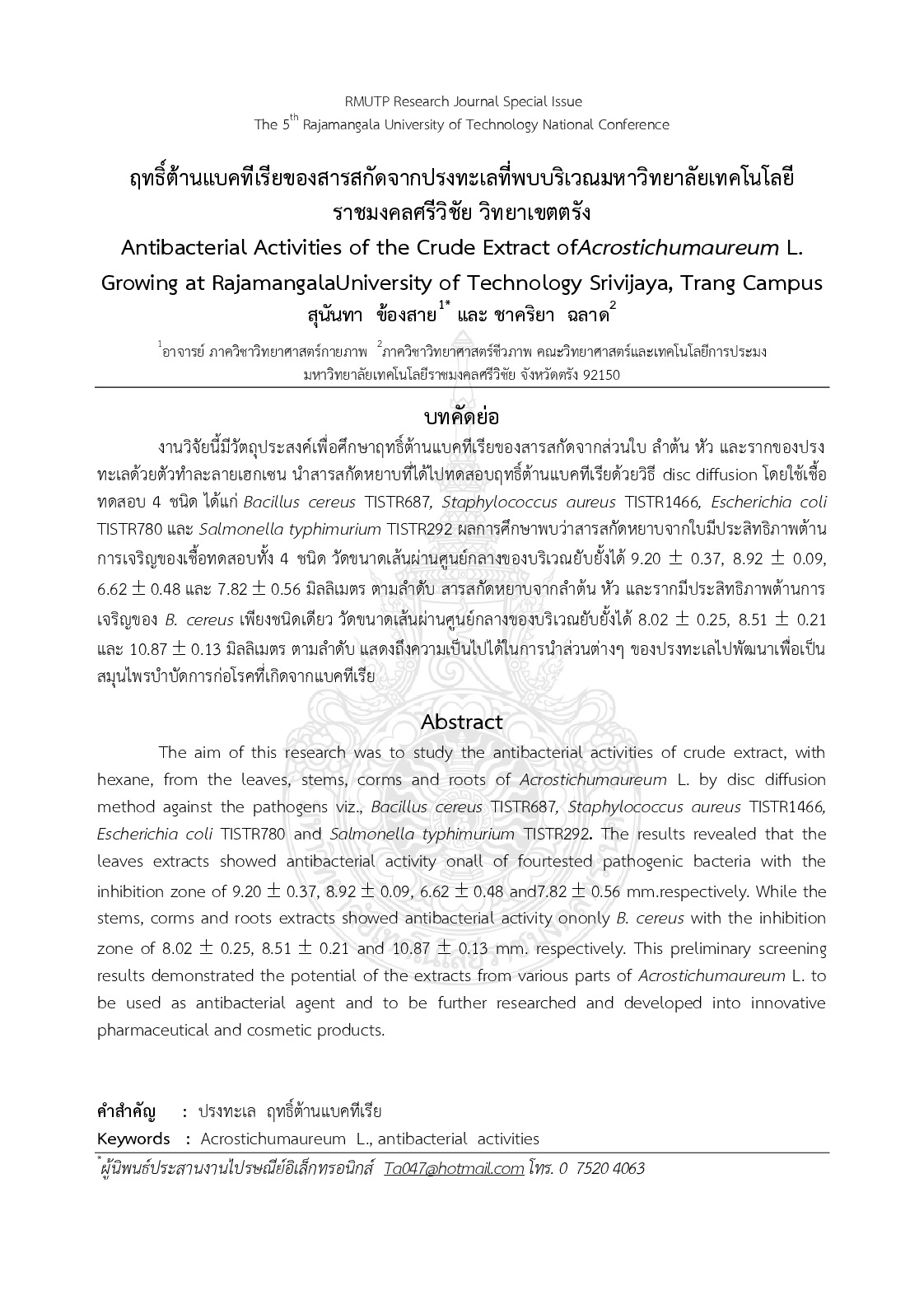
Antibacterial activities of the crude extract of acrostichumaureum l. growing at Rajamangala University of Technology Srivijaya, Trang Campus
The aim of this research was to study the antibacterial activities of crude extract with hexane from the leaves stems corms and roots of Acrostichumaureum L. by disc diffusion method against the pathogens viz. Bacillus cereus TISTR687 Staphylococcus aureus TISTR1466 Escherichia coli TISTR780 and Salmonella typhimurium TISTR292. The results revealed that the leaves extracts showed antibacterial activity onall of fourtested pathogenic bacteria with the inhibition zone of 9.20 0.37 8.92 0.09 6.62 0.48 and7.82 0.56 mm.respectively. While the stems corms and roots extracts showed antibacterial activity ononly B. cereus with the inhibition zone of 8.02 0.25 8.51 0.21 and 10.87 0.13 mm. respectively. This preliminary screening results demonstrated the potential of the extracts from various parts of Acrostichumaureum L. to be used as antibacterial agent and to be further researched and developed into innovative pharmaceutical and cosmetic products.
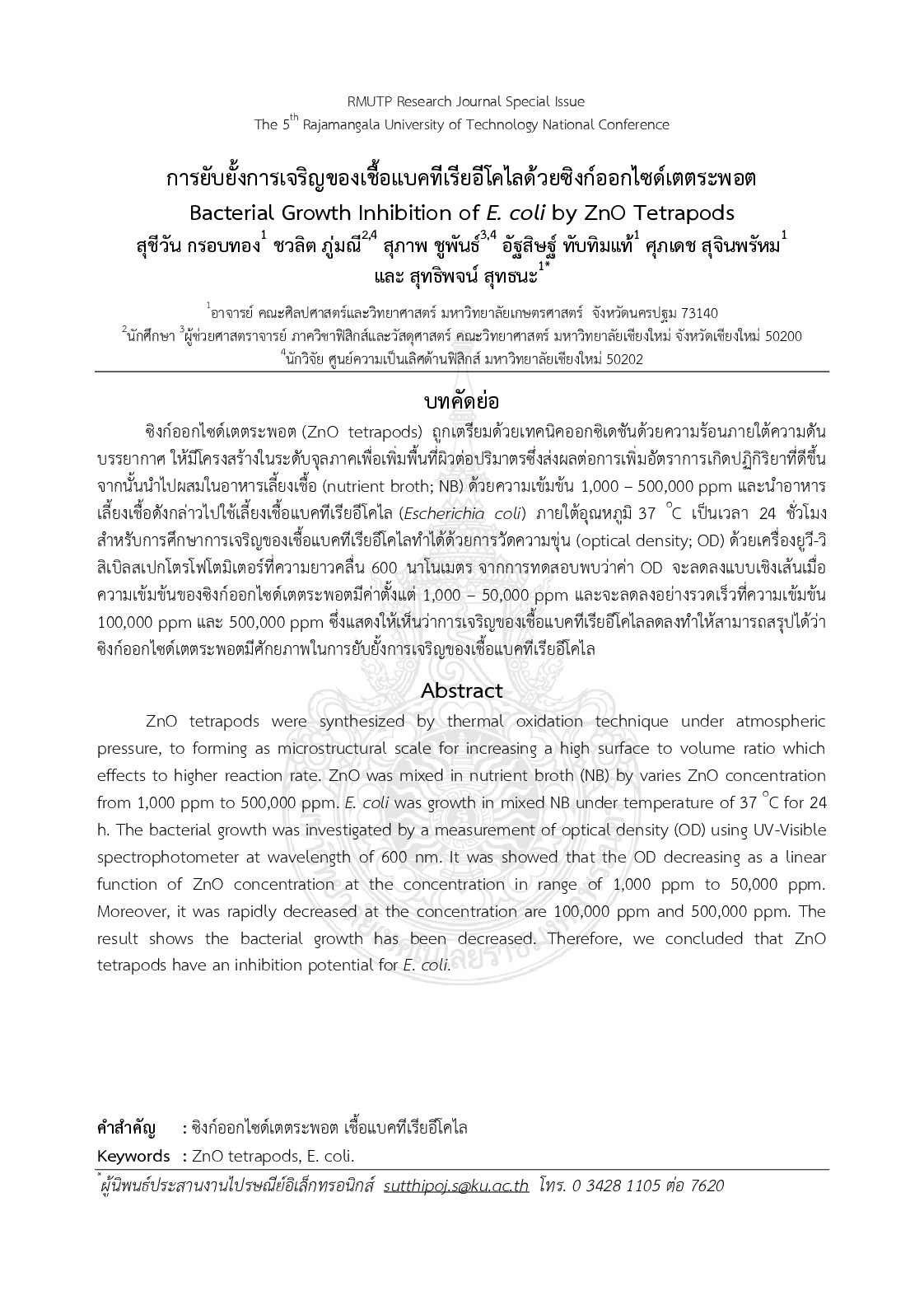
Bacterial growth inhibition of e. coli by zno tetrapods
ZnO tetrapods were synthesized by thermal oxidation technique under atmospheric pressure to forming as microstructural scale for increasing a high surface to volume ratio which effects to higher reaction rate. ZnO was mixed in nutrient broth (NB) by varies ZnO concentration from 1000 ppm to 500000 ppm. E. coli was growth in mixed NB under temperature of 37 oC for 24 h. The bacterial growth was investigated by a measurement of optical density (OD) using UV-Visible spectrophotometer at wavelength of 600 nm. It was showed that the OD decreasing as a linear function of ZnO concentration at the concentration in range of 1000 ppm to 50000 ppm. Moreover it was rapidly decreased at the concentration are 100000 ppm and 500000 ppm. The result shows the bacterial growth has been decreased. Therefore we concluded that ZnO tetrapods have an inhibition potential for E. coli.