จำนวน Repository ( 19 )

Development of parent stock of thai indigenous chicken : chee by selection index
This research aimed to develop a flock of Thai indigenous chicken namely Chee with pure white feather in order to meet the requirement of domestic consumption and export of meat chickens. The genetics on growth must be improve with egg production was no affected. The selections were continuously done for 5 generations. Each generation 30 sires and 50 of 16 week old females were obtained. At suitable age 6 weeks after first egg laid the artificial inseminations were arranged twice weekly with 1: 5 of the male and female proportion. Eggs were collected to hatchery in the 3 consecutive weeks followed with the 2 week skips. Before the next AI of reciprocal cross the 3 groups were bred and 3 generations each. The newborn chickens from hatchery of each generation were weighed and the other measurements were done at the 4 weeks intervals. The data of weights at 16 week old chickens and breast widths were used to calculate for breeding value. The BLUP (Best Linear Unbiased Prediction) was a selection tool to select high selection index for replacement herd of each generation. For the females the 300 day egg productions were added. It was found that from the 1st to the 5th generation the average of 16 week old chickens were 1225.99 1265.86 1461.94 1326.16 and 1439.36 gram respectively. The average body weight gain was 213.37 gram and the average daily gain was 12.85 gram. The 16 week breast widths were 5.46 5.90 5.54 5.56 and 5.65 centimeter respectively. The ages of first egg laid were 211.30 178.66 175.83 171.91 and 171.10 day respectively. In the 5th generation egg production started about 40 days earlier than the 1st generation. The first egg weights were 1390 1426 1467.61 1446.33 and 1529 gram respectively. Egg productions at the 300 day old were 36.38 38.28 40.29 42.42 and 45.58 eggs and it could provide 9 eggs more than 1st generation.
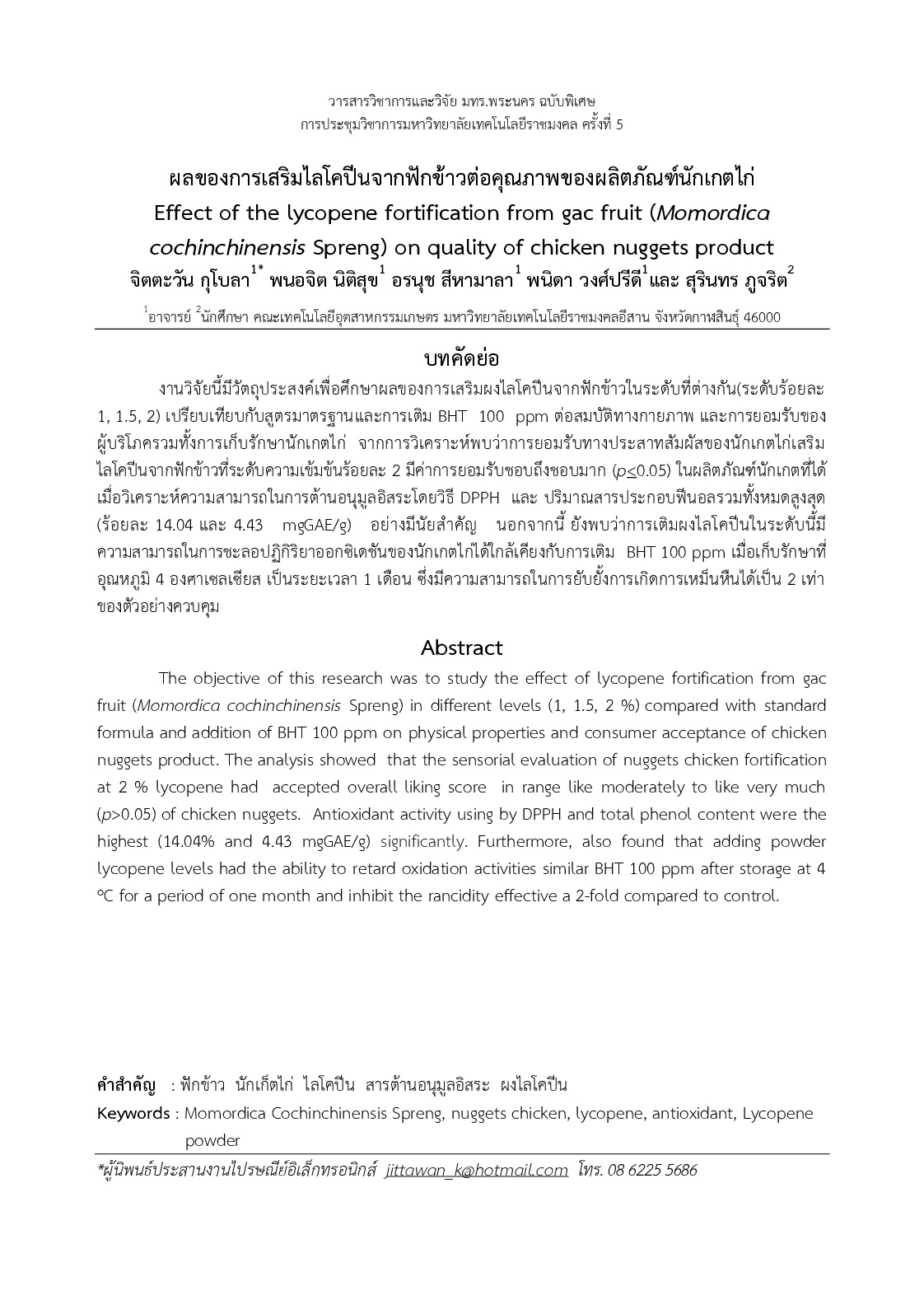
Effect of the lycopene fortification from gac fruit (momordica cochinchinensis spreng) on quality of chicken nuggets product
The objective of this research was to study the effect of lycopene fortification from gac fruit (Momordica cochinchinensis Spreng) in different levels (1 1.5 2 %) compared with standard formula and addition of BHT 100 ppm on physical properties and consumer acceptance of chicken nuggets product. The analysis showed that the sensorial evaluation of nuggets chicken fortification at 2 % lycopene had accepted overall liking score in range like moderately to like very much (p>0.05) of chicken nuggets. Antioxidant activity using by DPPH and total phenol content were the highest (14.04% and 4.43 mgGAE/g) significantly. Furthermore also found that adding powder lycopene levels had the ability to retard oxidation activities similar BHT 100 ppm after storage at 4 C for a period of one month and inhibit the rancidity effective a 2-fold compared to control.
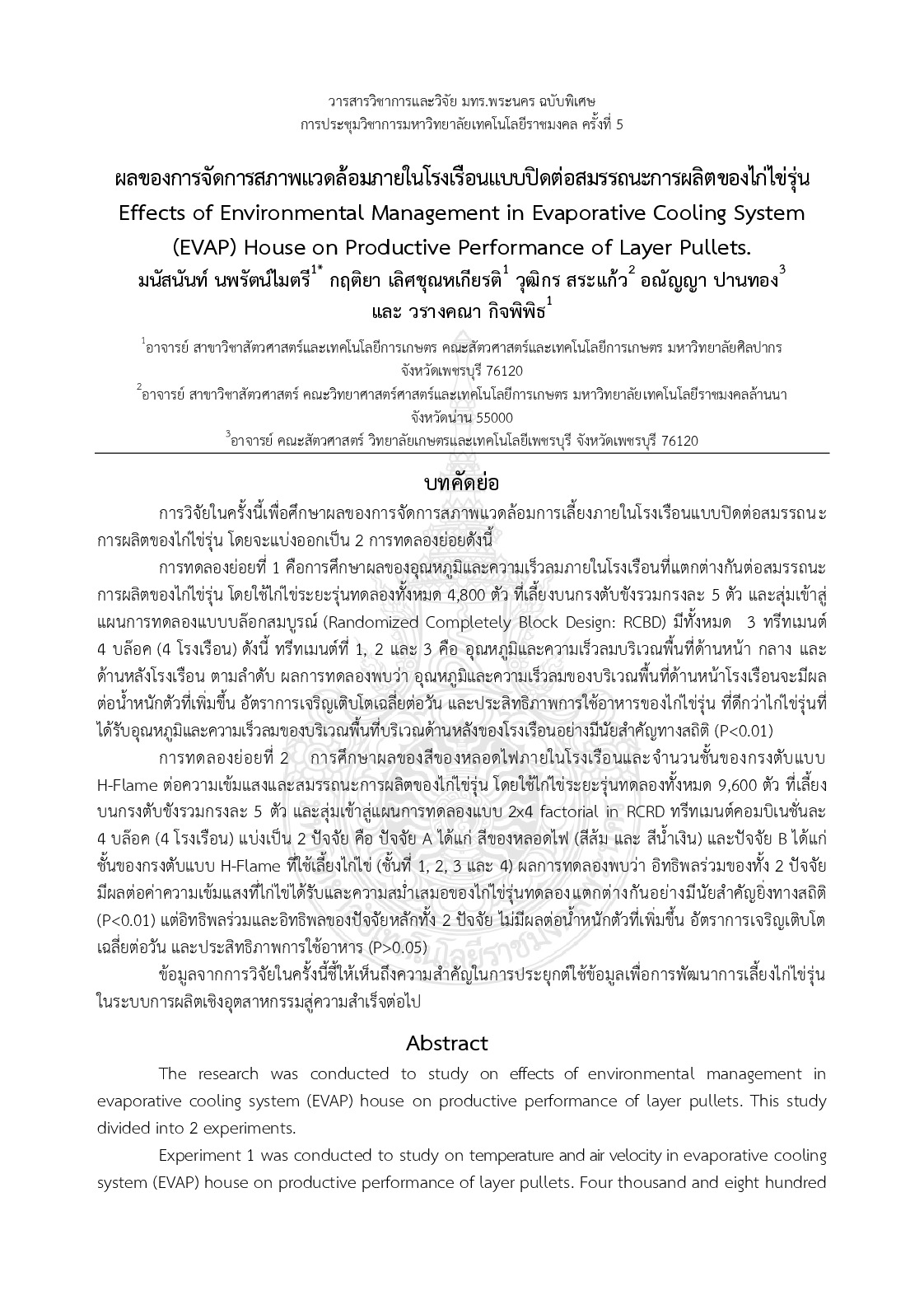
Effects of environmental management in evaporative cooling system (EVAP) house on productive performance of layer pullets
The research was conducted to study on effects of environmental management in evaporative cooling system (EVAP) house on productive performance of layer pullets. This study divided into 2 experiments. Experiment 1 was conducted to study on temperature and air velocity in evaporative cooling system (EVAP) house on productive performance of layer pullets. Four thousand and eight hundred layer pullets were raised on battery cage with 5 birds per cage and assigned in a Randomized Completely Block Design (RCBD) experiment with three treatments. Each treatment consisted of four blocks (four houses) and followed different temperature and air velocity in raising area of evaporative cooling system (EVAP) house as front area central area and back area. Results showed that temperature and air velocity in front area was grater body weight gain (BWG) average daily gain (ADG) and feed conversion ratio (FCR) of layer pullets than layer pullets were raised in back area of evaporative cooling system (EVAP) house (P<0.01) Experiment 2 was conducted to study on light color and number of H-Flame battery cage row in evaporative cooling system (EVAP) house on light intensity and productive performance of layer pullets. Nine thousand and six hundred layer pullets were raised on H-Flame battery cage with 5 birds per cage and assigned in a 2x4 factorial in Randomized Completely Block Design (RCBD) experiment with two factors. Factor A was light color comprised of range and blue). While Factor B was number of battery cage row comprised (first row second row third row and fourth row). Each treatment consisted of four blocks (four houses). Results showed that interaction between factor A and B on light intensity and uniformity of layer pullets with highly significantly different (P<0.01). However interaction between factor A and B and main effect (factor A and B) were investigated on body weight gain (BWG) average daily gain (ADG) and feed conversion ratio (FCR) (P>0.05). The data from this research was suggests the important for implicate to improve the egg production industry in further success.