จำนวน Repository ( 1574 )
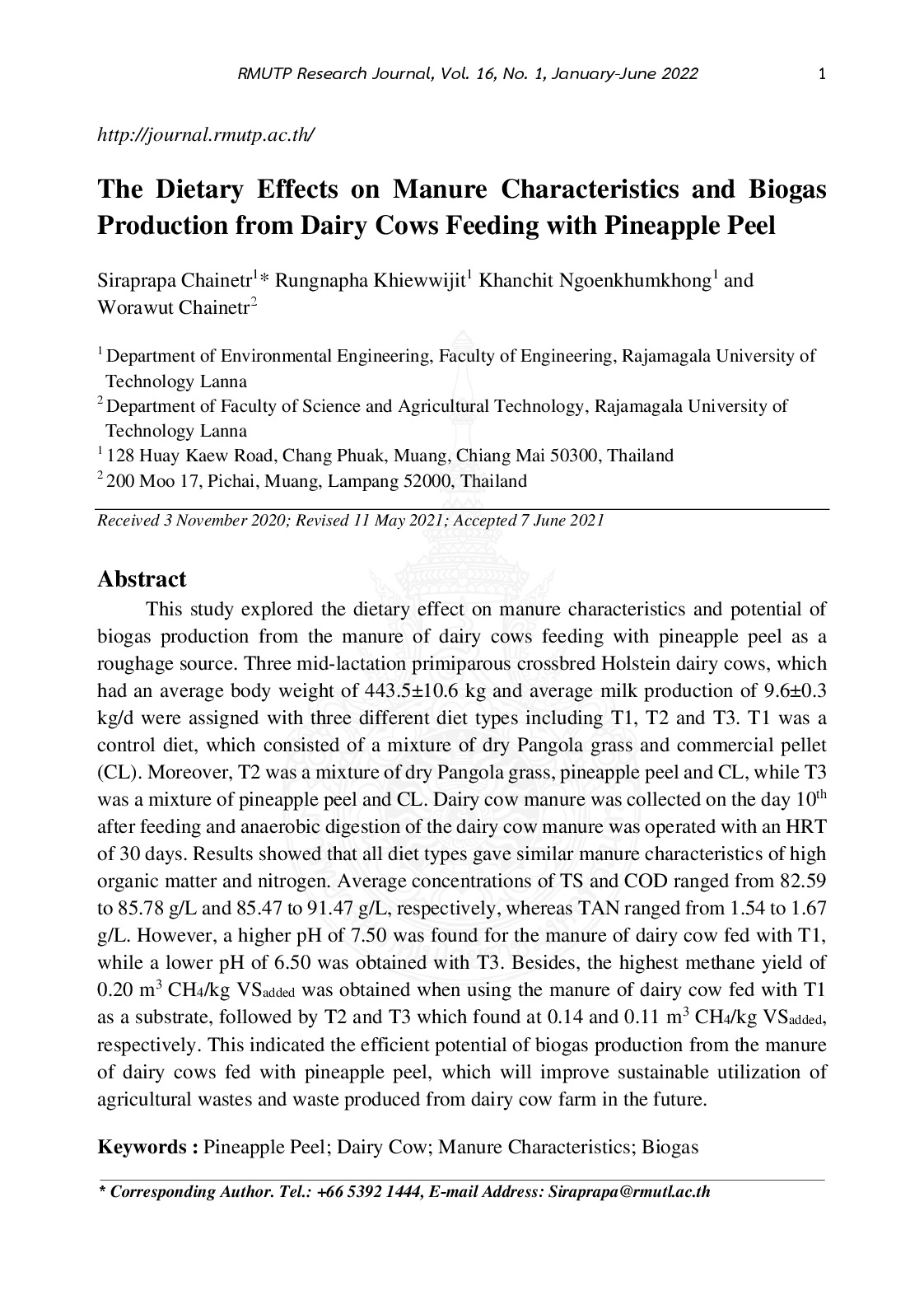
The Dietary effects on manure characteristics and biogas production from dairy cows feeding with pineapple peel
This study explored the dietary effect on manure characteristics and potential of biogas production from the manure of dairy cows feeding with pineapple peel as a roughage source. Three mid-lactation primiparous crossbred Holstein dairy cows which had an average body weight of 443.5±10.6 kg and average milk production of 9.6±0.3 kg/d were assigned with three different diet types including T1 T2 and T3. T1 was a control diet which consisted of a mixture of dry Pangola grass and commercial pellet (CL). Moreover T2 was a mixture of dry Pangola grass pineapple peel and CL while T3 was a mixture of pineapple peel and CL. Dairy cow manure was collected on the day 10th after feeding and anaerobic digestion of the dairy cow manure was operated with an HRT of 30 days. Results showed that all diet types gave similar manure characteristics of high organic matter and nitrogen. Average concentrations of TS and COD ranged from 82.59 to 85.78 g/L and 85.47 to 91.47 g/L respectively whereas TAN ranged from 1.54 to 1.67 g/L. However a higher pH of 7.50 was found for the manure of dairy cow fed with T1 while a lower pH of 6.50 was obtained with T3. Besides the highest methane yield of 0.20 m3 CH4/kg VSadded was obtained when using the manure of dairy cow fed with T1 as a substrate followed by T2 and T3 which found at 0.14 and 0.11 m3 CH4/kg VSadded respectively. This indicated the efficient potential of biogas production from the manure of dairy cows fed with pineapple peel which will improve sustainable utilization of agricultural wastes and waste produced from dairy cow farm in the future.
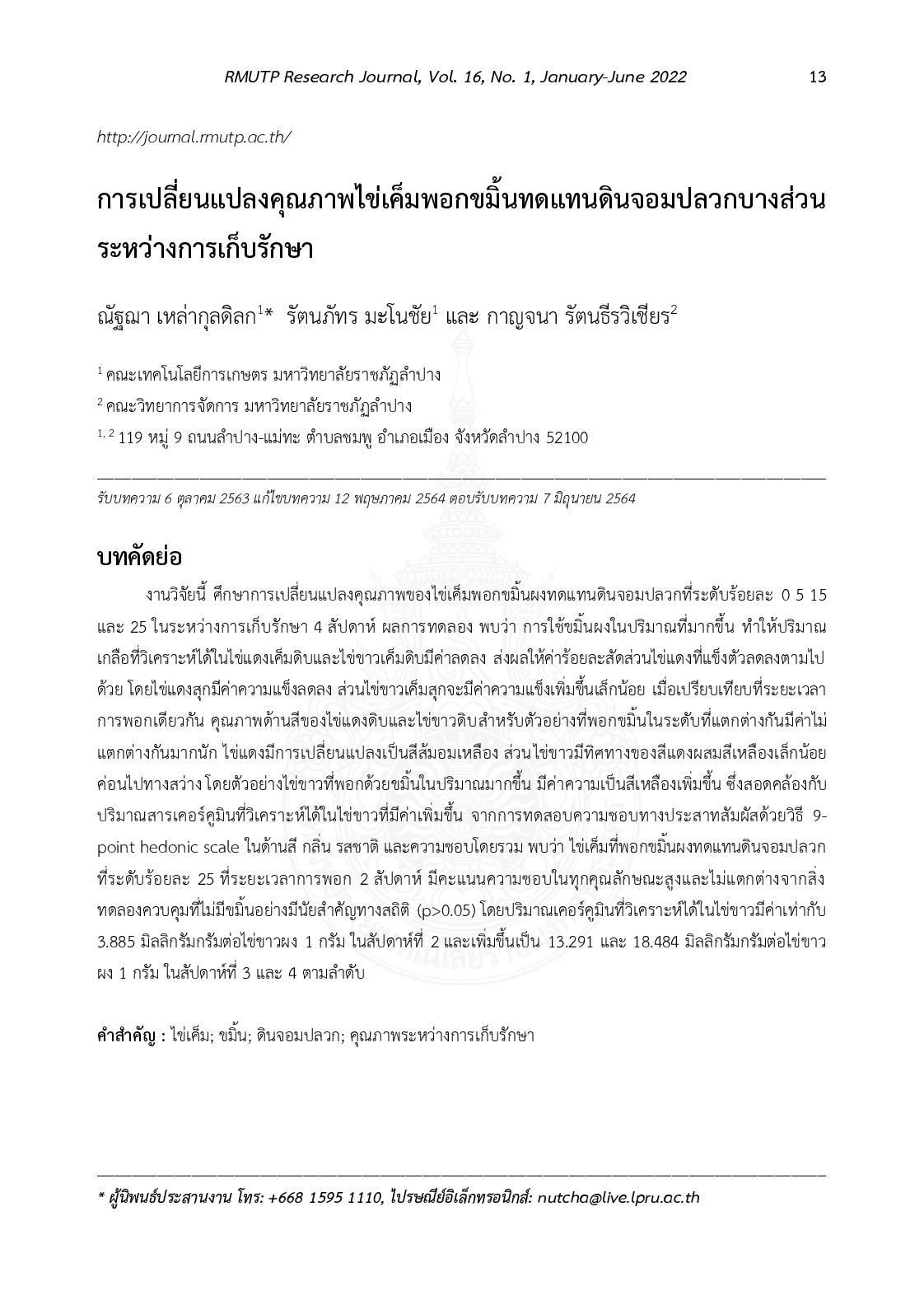
การเปลี่ยนแปลงคุณภาพไข่เค็มพอกขมิ้นทดแทนดินจอมปลวกบางส่วนระหว่างการเก็บรักษา
This research aimed to study the quality changes of coating salted eggs partially replacing soil from termite mound with turmeric powder at the level of 0% 5% 15% and 25% during storage for 4 weeks. The results showed that the increasing in turmeric level caused a decrease in salt content in raw egg yolk and raw egg white which led to decrease in hardening ratio of egg yolk. The hardness values of cooked - salted egg yolk decreased while those of cooked - salted egg white slightly increased. At the same salting period the color values of raw egg yolk and raw egg white coated with different levels of turmeric were slightly different. Egg yolks changed to a yellowish orange color while egg whites showed lightness with a direction of red and slightly yellowish color. The raw egg white coated with higher level of turmeric powder exhibited more yellowness which was in accordance with the increasing in curcumin content. From the results of 9-point hedonic scale in terms of color aroma overall taste and overall liking it was found that salted eggs coated with turmeric powder to partially replace soil at a level of 25% with 2 weeks of preserved duration had high scores of sensory acceptability which did not differ significantly from the control samples (0% turmeric) (p>0.05). The curcumin content analyzed in dry egg white was 3.885 mg/g at week 2 and increased to 13.291 and 18.484 mg/g at week 3 and 4 respectively.
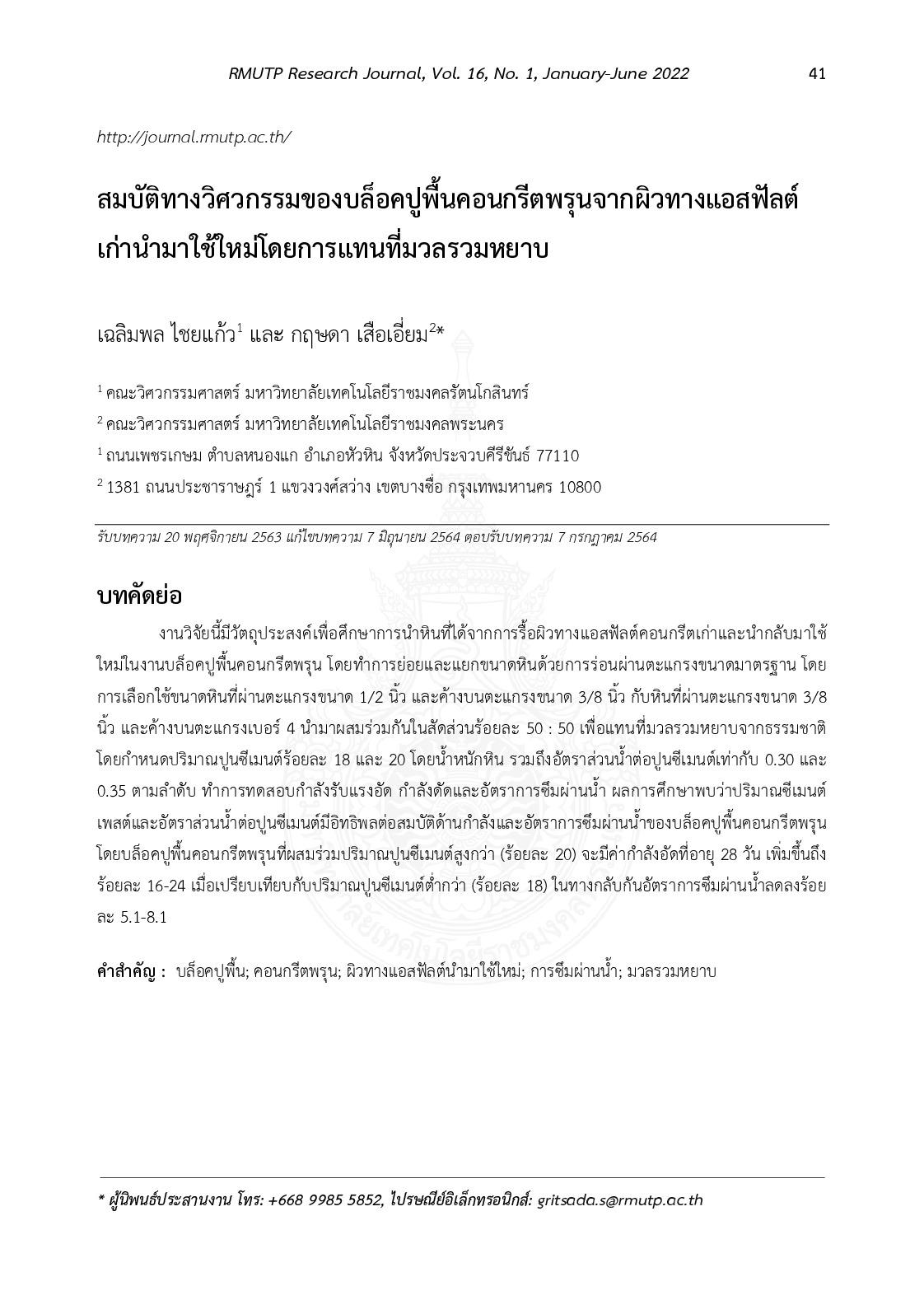
สมบัติทางวิศวกรรมของบล็อคปูพื้นคอนกรีตพรุนจากผิวทางแอสฟัลต์เก่านำมาใช้ใหม่โดยการแทนที่มวลรวมหยาบ
This research aimed to study the use of coarse aggregate obtained from removing old recycled asphalt pavement (RAP) in the production of the porous concrete paving block. Crushing and size separation of the coarse aggregate by using standard sieve size by selected the gradation size of the coarse aggregate that passed to sieve size 1/2” and retained on sieve size 3/8” and other that passed to sieve size 3/8” and retained on sieve size No.4 by mixing ratio 50 : 50 of the mass as replaced natural coarse aggregate. Portland cement quantity about 18% and 20% by weight of the aggregate. The water to cement ratio was 0.30 and 0.35 respectively. Compressive strength flexural strength and water permeability were investigated. The results showed that the cement content and water to cement ratio was influenced the strength properties and water permeability rate of the porous concrete paving block. The porous concrete paving block mixed with higher cement content (20%) had the compressive strength at the age of 28 days increased by 16-24% when compared with lower cement content (18%). On the other hand the water permeability rate decreased by 5.1-8.1%.
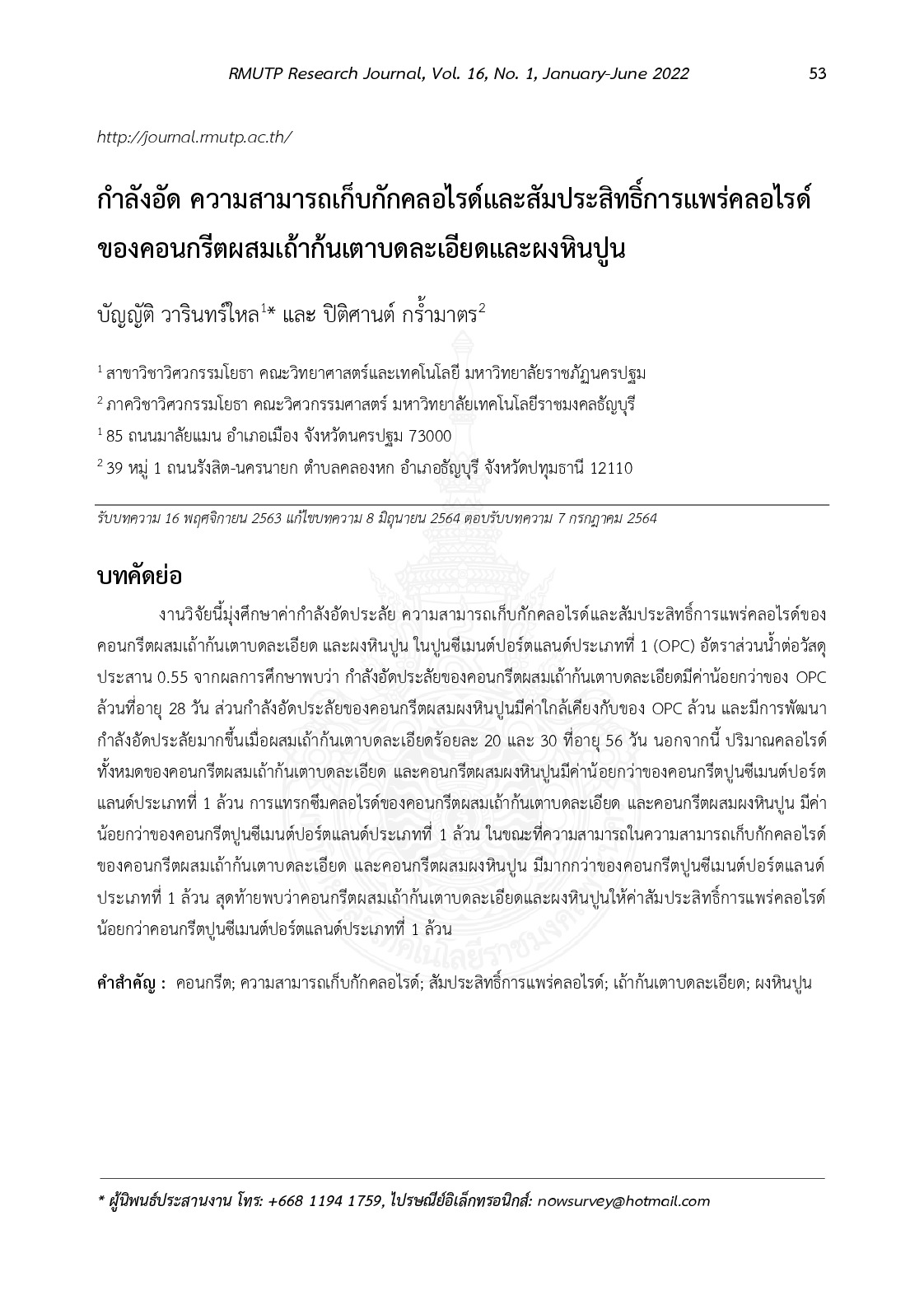
กำลังอัดความสามารถเก็บกักคลอไรด์และสัมประสิทธ์การแพร่คลอไรด์ของคอนกรีตผสมเถ้าก้นเตาบดละเอียดและผงหินปูน
This research was aimed to study the compressive strength chloride binding capacity and chloride diffusion coefficient of concrete replaced by ground bottom ash (GBA) and limestone powder in ordinary Portland cement (OPC). The water to binder ratios were 0.55. The results showed that the compressive strength of concrete with GBA was lesser than that of OPC concrete at 28 days. Also the compressive strength of concrete with limestone powder was close to that of OPC concrete and compressive strength could develop of concrete with GBA 20% and 30% higher than that of OPC concrete at 56 days. Moreover the total chloride of the concrete containing GBA and limestone powder was less than that of OPC concrete. The chloride penetration of the concrete containing GBA and limestone powder was less than that of OPC concrete. The chloride binding capacity of the concrete made with ground bottom ash and limestone powder were higher than that of OPC concrete. Finally the chloride diffusion coefficient of the concrete containing GBA and limestone powder was less than that of OPC concrete.
ผลของอุณหภูมิที่มีต่อค่าความต้านทานและความจุไฟฟ้าของข้าวเปลือกที่มีความชื้นแตกต่างกัน
This research proposes an application of resistive and capacitive soil moisture sensors to investigate the influences of paddy temperature on the electrical signal received from sensors when tested with paddy moisture in the range 9.2 - 22.75%wb at 40 - 80ºC to determine the relationship between paddy moisture and electrical signals. It was found that the mean signal values between 20 - 40 seconds from both sensors were inversely linear correlation with the moisture content of the paddy. Temperature is the factors that influence the measured electrical signal. R2 Adjust R2 (95% confidence interval) and RMSEC showed that the model developed from the resistive sensor signals was accurate in calculating the moisture content of paddy between medium to high temperature in range 60 - 80ºC more than the low temperature range. While the capacitive sensor signals model is accurate in calculating paddy moisture between low to medium temperature in range 40 - 60 ºC. Therefore the resistive soil moisture sensor is possible and more suitable for applying as a paddy moisture sensor in the high temperature drying processes than a capacitor soil moisture sensor.