จำนวน Repository ( 26 )

The Efficacy of Peroxyacetic Acid and Sodium Hypochlorite Solutions in Reducing Microorganisms on the Surface of Carved Fruits and Vegetables
This study examined the efficacy of two sanitizers; peroxyacetic acid (PAA) and sodium hypochlorite (NaOCl) in reducing total microbial counts on the carved leaf-shape surface of five types of fruits and vegetables: pumpkin carrot radish cantaloupe and Japanese cucumber. The samples were dipped for 3 or 5 min in various concentrations of PAA (40 60 or 80 mg/L) and NaOCl (50 or 75 mg/L) with distilled water as the control. After dipping the samples were drained for 5 min and the total plate counts were determined in triplicate. Dipping in 60 mg/L of PAA for 3 min was the best treatment for reducing microorganisms on the surface of carved carrot and radish; and 80 mg/L of PAA for 5 min was the best treatment for reducing microorganisms on the surface of carved pumpkin cantaloupe and Japanese cucumber. PAA at concentration 60 -80 mg/L showed potential as an effective sanitizer for carved fruits and vegetables more so than both concentrations of NaOCl.
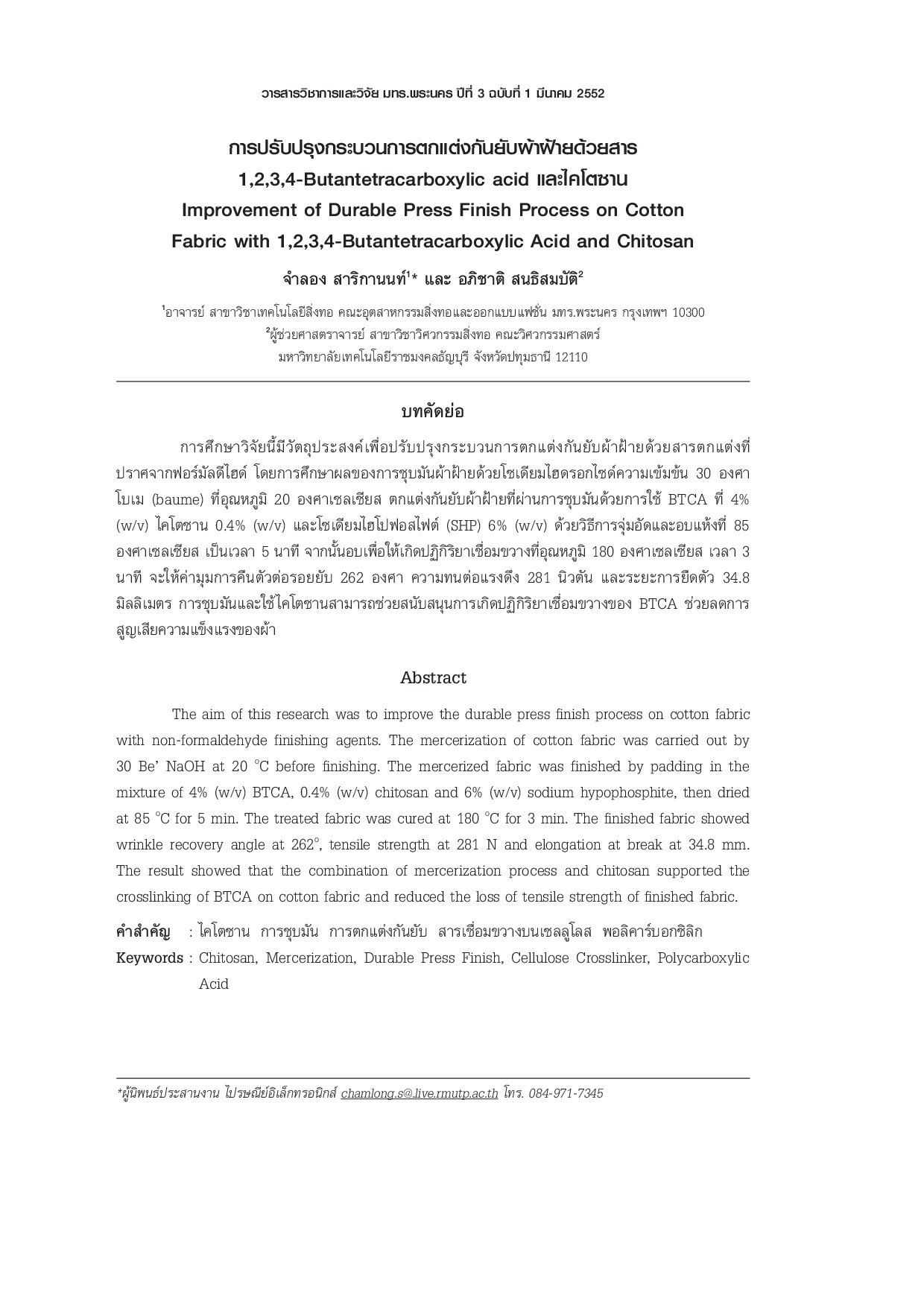
Improvement of Durable Press Finish Process on Cotton Fabric with 1,2,3,4-Butantetracarboxylic Acid and Chitosan
The aim of this research was to improve the durable press finish process on cotton fabric with non-formaldehyde finishing agents. The mercerization of cotton fabric was carried out by 30 Be’ NoOH at 20 C before finishing. The mercerized fabric was finished by padding in the mixture of 4% (w/v) BTCA 0.4% (w/v) chitosam and 6% (w/v) sodium hypophosphite then dried at 85 C for 5 min. The treated fabric was cured at 180 C for 3 min. The finished fabric showed wrinkle recovery angle at 262 tensile strength at 281 N and elongation at break at 34.8 mm. The result showed that the combination of mercerization process and chitosan supported the crosslinking of BTCA on cotton fabric and reduced the loss of tensile strength of finished fabric.
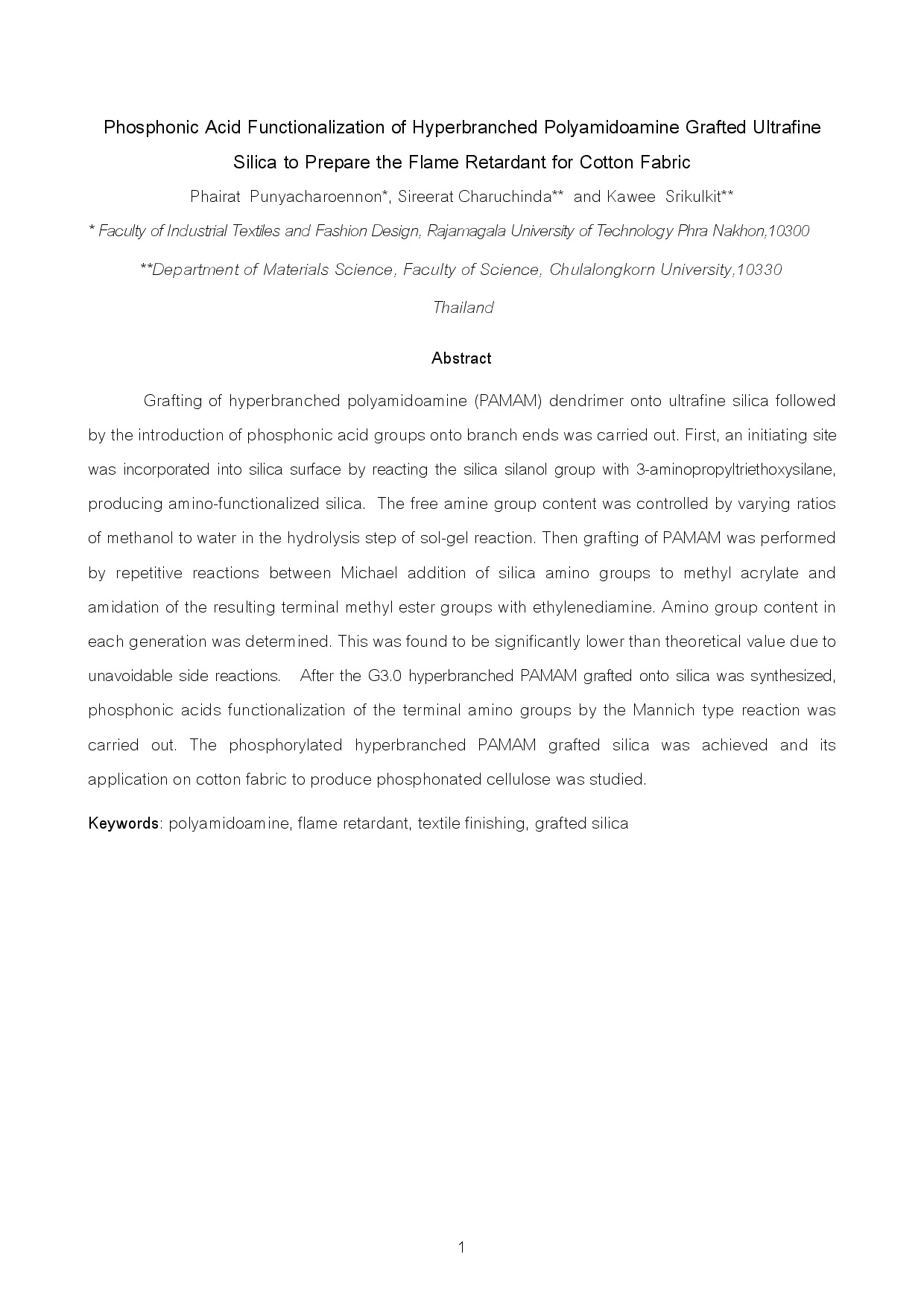
Phosphonic Acid Functionalization of Hyperbranched Polyamidoamine Grafted Ultrafine Silica to Prepare the Flame Retardant for Cotton Fabric
Grafting of hyperbranched polyamidoamine (PAMAM) dendrimer onto ultrafine silica followed by the introduction of phosphonic acid groups onto branch ends was carried out. First an initiating site was incorporated into silica surface by reacting the silica silanol group with 3-aminopropyltriethoxysilane producing amino-functionalized silica. The free amine group content was controlled by varying ratios of methanol to water in the hydrolysis step of sol-gel reaction. Then grafting of PAMAM was performed by repetitive reactions between Michael addition of silica amino groups to methyl acrylate and amidation of the resulting terminal methyl ester groups with ethylenediamine. Amino group content in each generation was determined. This was found to be significantly lower than theoretical value due to unavoidable side reactions. After the G3.0 hyperbranched PAMAM grafted onto silica was synthesized phosphonic acids functionalization of the terminal amino groups by the Mannich type reaction was carried out. The phosphorylated hyperbranched PAMAM grafted silica was achieved and its application on cotton fabric to produce phosphonated cellulose was studied.
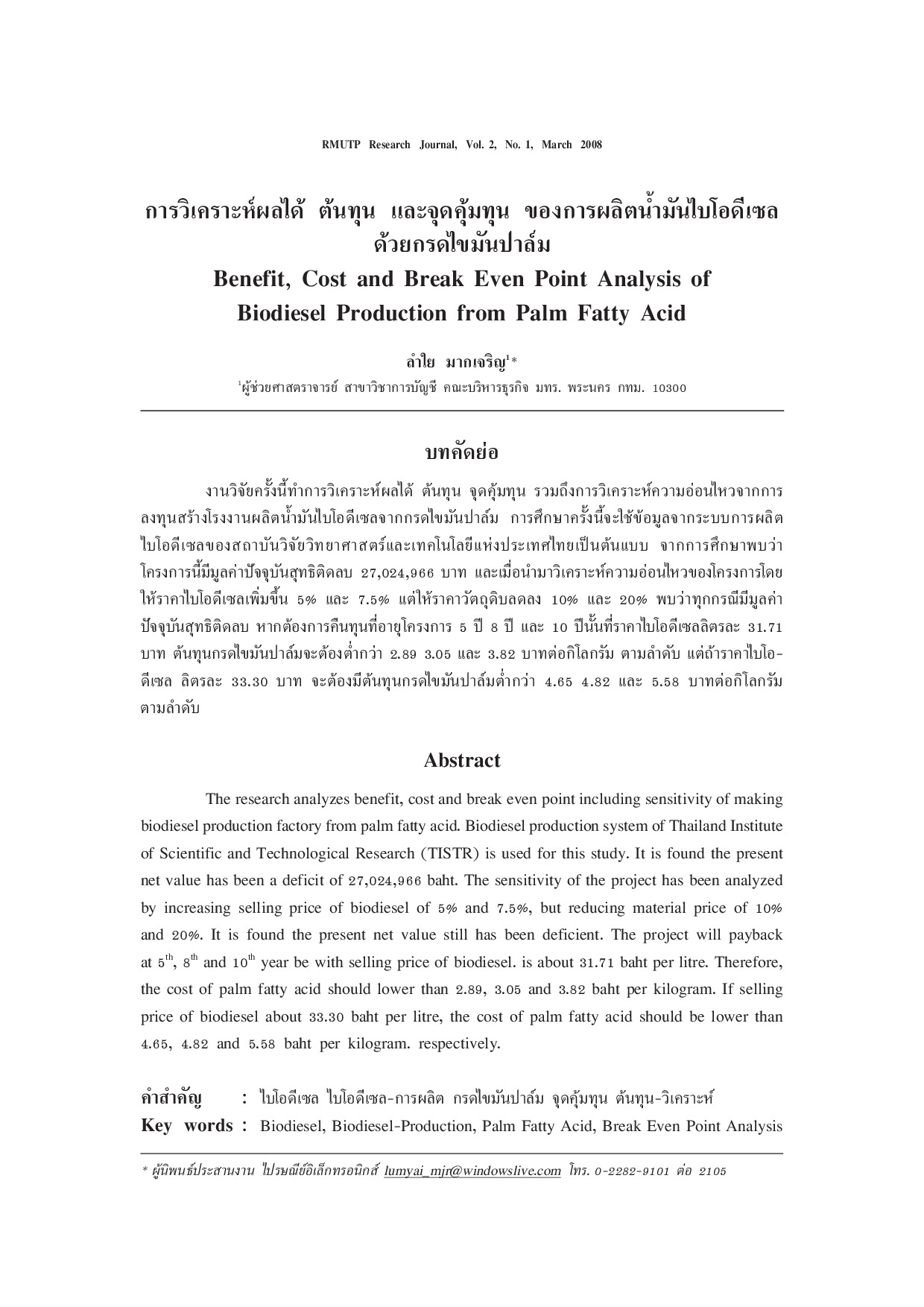
Benefit, Cost and Break Even Point Analysis of Biodiesel Production from Palm Fatty Acid
The research analyzes benefit cost and break even point including sensitivity of making biodiesel production factory from palm fatty acid. Biodiesel production system of Thailand Institute of Scientific and Technological Research (TISTR) is used for this study. It is found the present net value has been a deficit of 27024966 baht. The sensitivity of the project has been analyzed by increasing selling price of biodiesel of 5% and 7.5% but reducing material price of 10% and 20%. It is found the present net value still has been deficient. The project will payback at 5th 8th and 10th year be with selling price of biodiesel. is about 31.71 baht per litre. Therefore the cost of palm fatty acid should lower than 2.89 3.05 and 3.82 baht per kilogram. If selling price of biodiesel about 33.30 baht per litre the cost of palm fatty acid should be lower than 4.65 4.82 and 5.58 baht per kilogram. respectively.

การสร้างชุดเฝ้าระวังค่าความเป็นกรดเป็นเบสในน้ำแบบเวลาจริง
Nowadays the measurement technologies are continually growth in advanced. These can be seen in the developed and developing countries that research and develop the products which support the consumer behavior and/or country economy ic growth. However some advanced products are very expensive such as pH meter. Therefore this thesis develops the pH meter which allows the acid-base test of the water and it can be supported the agriculture. The proposed pH meter is included the pH pen sensor temperature sensor water level sensor. The proposed meter can measure the acid-base of the water by sending SMS alert signal via GSM module to the mobile phone of the farmer. As can be seen this thesis can prevent and solve the effect of the high acid-base of the water that possibly flows into the agriculture farm via using SMS alert signal of the mobile phone of the farmer.