จำนวน Repository ( 51 )
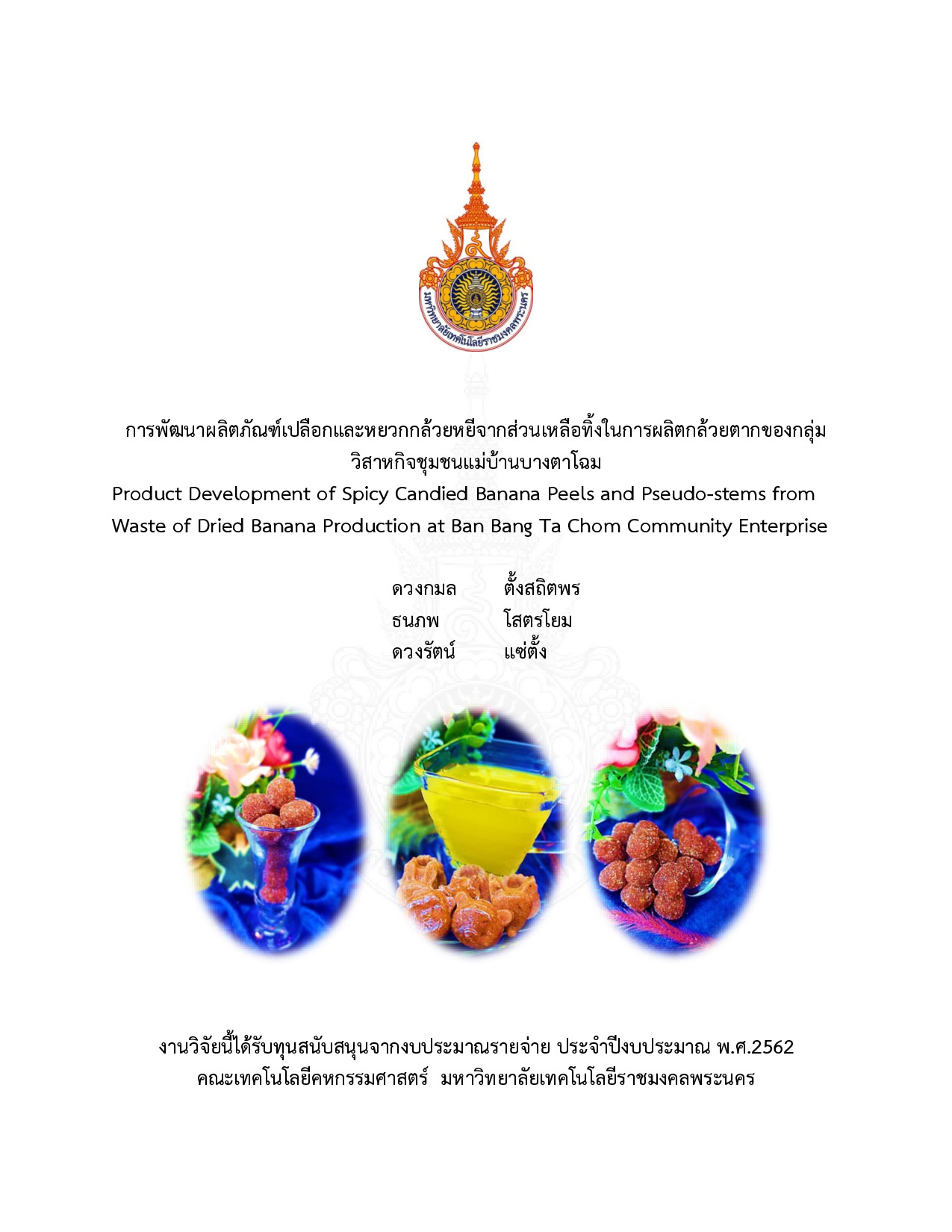
การพัฒนาผลิตภัณฑ์เปลือกและหยวกกล้วยหยีจากส่วนเหลือทิ้งในการผลิตกล้วยตากของกลุ่มวิสาหกิจชุมชนแม่บ้านบางตาโฉม
Product Development of Spicy Candied Banana Peels and Pseudo-stems from Waste of Dried Banana Production at Ban Bang Ta Chom Community Enterprise. The purpose of this study was developing formula and prototype of spicy candied from Banana Peels and Pseudo-stems waste of dried banana production for 3 products such as Banana Peels Spicy Candy Pseudo-stems Spicy Candy and Banana Peels and Pseudo-stems Gummy. The suitable condition for Banana Peels Spicy Candy was using banana peels as 20% after using tamarind sauce as 20% and fructose syrup as 20%. The result of physical analysis showed that : products have brown dark color flavor and taste sour and sweet and chemical analysis Total dietary fiber: TDF = 8.05 g : 100 and Total sugar = 66.82 g : 100 g The suitable condition for Pseudo-stems spicy candy was using Pseudo-stems as 20% after using tamarind sauce as 20% and fructose syrup as 20%. The result of physical analysis showed that : products have brown dark color flavor and taste sour and sweet and chemical analysis Total dietary fiber: TDF = 10.55 g : 100 g and Total sugar = 66.48 g : 100 g The suitable condition for Banana Peels and Pseudo-stems Gummy was using Banana Peels and Pseudo-stems as 15% after using flavored fruit juice as 75% and fructose syrup as 30%. The result of physical analysis showed that : products have brown light color flavor and taste sour and sweet and flexible texture chemical analysis Total dietary fiber: TDF = 18.91 g : 100 g and Total sugar = 40.85 g : 100 g The shelf life of 3 products in vacuum packaging (VP). The result of microorganism analysis less than standard for safe products. The consumer acceptability like extremely product and Interested in buying products.
การพัฒนาผลิตภัณฑ์สารสกัดจากผลกล้วยและเปลือกมะละกอทดแทนสารเคมีเพื่อยับยั้งเชื้อจุลินทรีย์ในครีมทาส้นเท้า
At present most human-related products contain a mixture of chemicals for inhibiting microorganisms polluting the environments and harming the users. The purpose of this research was to develop a product using banana and papaya peel extracts as replacers for the chemicals inhibiting microorganisms in heel cream. By extracting raw bananas and papaya peels with coconut oil the studying the efficacy of inhibition on E. coli S. aureus Aspergillus sp. and S. cerevisiae with Disk Diffusion method at the protein concentration were performed as follows: 25 50 100 and 150 micrograms per milliliter. The observation of clear zone to observer clear zone of inhibition. and the Turbidity method using light absorption at a length of 600 nm was also were shown the corresponding results of microbial inhibition. observed and showed the consistent results. Especially the papaya extract having the protein concentration at least of 150 micrograms per milliliter could inhibit all 4 microbe species but could not inhibit S. cerevisiae that indicated a good trend of no harm on human. When mixing the extract in the heel cream it was found that Heel cream containing banana extract papaya and both mixtures displayed the density of 0.9674 0.9103 and 0.8057 gram per cubic meter respectively. They could be stored at room temperature for more than 45 days and still maintained the properties of microbial inhibition by up to 80 percentages. When studying the satisfaction of consumers collected randomly from teenagers to elders at both sexes of 40 people more than 80 percentages of the customers were satisfied with the heel cream from all extracts. These all creams could make the feet soft and moisturized within 1 week. More suggestions were to improve the smell of heel cream products to be suitable for all age of consumers. Therefore this research could be concluded that banana and papaya peel extracts inhibiting microorganisms could be used as a heel cream for further continuously developing at the industrial level.
การพัฒนาขนมนิ่มนวลด้วยหัวปลีผงทดแทนแป้งข้าวเหนียวบางส่วน
This research studied: 1) the history of Nim Nuan dessert 2) the standard recipe of Nim Nuan dessert 3) The volume of syrup and banana bud power (BBP) which replaced glutinous rice flour in the standard recipe 4) the accepted recipe of Nim Nuan dessert by substitution of glutinous rice flour with BBP and 5) comparison of nutritional value between the standard formula and the accepted recipe of BBP Nim Nuan dessert. The experts in Thai Dessert field were interviewed about history and standard recipe of Nim Nuan dessert. The glutinous rice flour was substituted with BBP by 5% 10% 15% and 2 0 % of weight of glutinous rice flour in the developed Nim Nuan formulations. 9 – point hedonic scale was used for consumer acceptance testing and the nutritional values between the standard recipe and the accepted recipe of BBP Nim Nuan dessert were compared. The results showed that Nim Nuan dessert is a local dessert of Rayong Province the main ingredients are glutinous rice flour 32.57% syrup 31.27% rice flour 6.51% coconut 29.32% and salt 0.33%. The amount of BBP inverse proportion with volume syrup decrease 26.0% from 30.5% of syrup usage. The 9-point hedonic test show that the most satisfy of BBP Nim Nuan dessert recipe contains 15% of BBP. The sensory scores in appearance were 6.93±0.87 6.87±0.86 6.50±1.11 7.07±0.78 6.00±0.81 and 7 . 4 7 ±0.68 for appearance color smell taste texture and overall satisfaction respectively. Higher calorie value carbohydrate iron fiber calcium and phosphorus contents and lower in protein and fat contents were found in the accepted recipe BBP Nim Nuan dessert than that of original recipe.

การพัฒนาผลิตภัณฑ์เปลือกกล้วยน้ำว้าแช่อิ่มอบแห้ง
This research aimed to investigate the suitable method to product osmotically dehydrated banana peels and determine its shelf life as well as consumer acceptation. It was found that the proper method was the slow osmotic dehydration process with 30 40 and 50% of syrup (sucrose solution). This method led to the highest appearance color and flavor scores as accessed by the consumer. Therefore the slow osmotic dehydration process was selected for further study relating to the ratio between salt and malic acid (3:2 3:3 and 2:3 of syrup weight). The result show that no differences in appearance color flavor and texture scores were found among treatments however the sample treated with salt and malic acid in the ratio of 3:3 obtained the highest taste score. Thus the suitable process to produce the osmotically dehydrated banana peels was slow process with salt and malic in the ratio 3:3. According to the shelf life study the sample (100g) packed in metallic foil still compiled with Thai community standard of fruit and vegetable products during 12 weeks of storage under 25-30 °C. In addition the consumers also accepted the selected osmotically banana peel product.
การเตรียมกระดาษคราฟท์จากผักตบชวา ใบสับปะรด และกาบกล้วย
This research had a main purpose for studying the utilization of water hyacinth as the key component of paper production mixed with the agricultural waste as pineapple leaves and leaf sheath of banana tree. The paper pulps were prepared from 5 g/l NaOH at 90-95oC for 3 hours then bleaching with 5 g/l Hydrogen peroxide at 90-95oC for 30 minutes. The whole pulps were detached improvement with 5g/l Acramine 3187 before paper establishment production. Finally the strength of obtaining papers was consideration and competition to any craft paper type. As the results the appropriate ratio of paper was 70% water hyacinth (stem) 10% pineapple leaves and 20% leaf sheath of banana tree. It had 31.19 kN/m2 for bursting strength tearing strength as 309.17 mN and 0.49 mm thickness. The basis weight was 183±5 g/m2. The achieved paper was equivalent as KI craft paper. It was presented for packaging boxes and other procedures.