จำนวน Repository ( 37 )
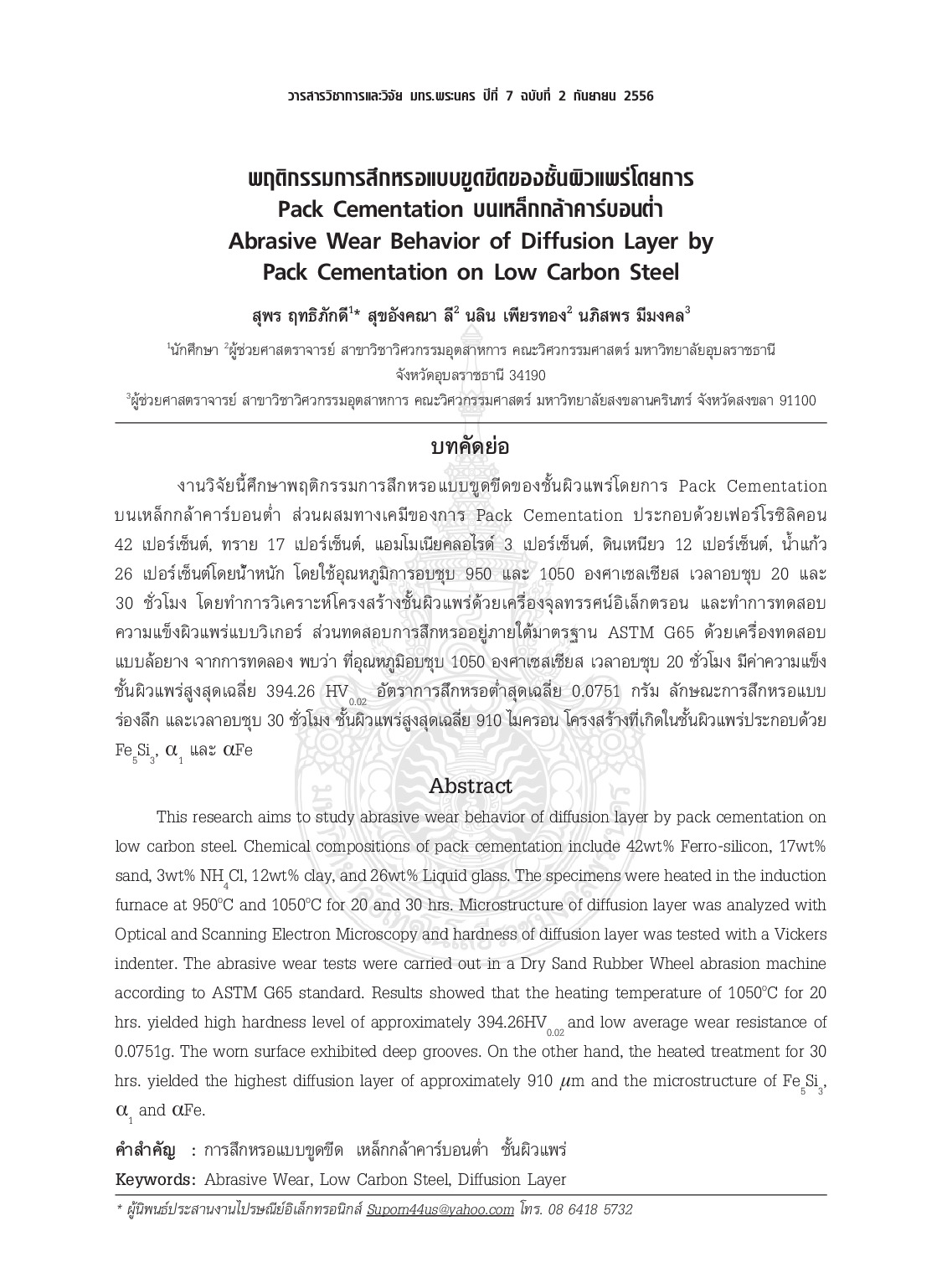
Abrasive wear behavior of diffusion layer by Pack Cementation on low carbon steel
This research aims to study abrasive wear behavior of diffusion layer by pack cementation on low carbon steel. Chemical compositions of pack cementation include 42wt% Ferro-silicon 17wt% sand 3wt% NH4Cl 12wt% clay and 26wt% Liquid glass. The specimens were heated in the induction furnace at 950?C and 1050?C for 20 and 30 hrs. Microstructure of diffusion layer was analyzed with Optical and Scanning Electron Microscopy and hardness of diffusion layer was tested with a Vickers indenter. The abrasive wear tests were carried out in a Dry Sand Rubber Wheel abrasion machine according to ASTM G65 standard. Results showed that the heating temperature of 1050?C for 20 hrs. yielded high hardness level of approximately 394.26HV0.02 and low average wear resistance of 0.0751g. The worn surface exhibited deep grooves. On the other hand the heated treatment for 30 hrs. yielded the highest diffusion layer of approximately 910?m and the microstructure of Fe5Si3 ?1 and ?Fe.

Phytotoxicity assessment of polycyclic aromatic hydrocarbons Co-Contamination in Soil during Economic Legume Seedling Growth
This research studied combined toxicities of 4 generally found Polycyclic Aromatic Hydrocarbons (PAHs) - anthracene fluorene fluoranthene and phenanthrene – during growth of 3 legume seedlings - cow pea mungbean and longbean - planted in varied combination of PAH contaminant in soil. Results showed that mungbean growth was more sensitive to PAH co-contaminated soil than cow pea and longbean. Co-contamination of all 4 PAHs was more toxic to legume than each pair of PAHs. Shoot length and fresh weight of legume seedling were more sensitive to co-contamination of all 4 PAHs than root length. Dry weight of legume seedling was the least sensitive to co-contamination of all PAHs.
Value of carbon stock in aboveground biomass of peat swamp forest, nakhon si thammarat province
This study was undertaken by using 10x10 m2 sampling plots chosen by stratified random sampling from 3 areas 50 plots for each area. Height and diameter of all trees with girth breast height (GBH) stem > 15 cm were measured. Aboveground biomass was estimated by allometric equation and the carbon stock was calculated by multiplying biomass value with conversion factor of 0.47. Result founded 4 tree species in 4 families. The Melaleuca cajuputi Powell had quite high density of 2091.31 tree/ha and other species found in some areas are Mitragyna brunonis Craib. Barringtonia coccinea Kostel. and Symplocos ferruginea Roxb with the density of 4.67 2.67 and 2.00 tree/ha respectively. Amount of aboveground carbon stock was 26.27 tonne C/ha. Mostly stem had higher carbon stock than branch and leaf at 19.92 4.94 and 1.62 tonne C/ha respectively. Average value of biomass carbon was 86.77 bath/ha.
Phytotoxicity assessment of polycyclic aromatic hydrocarbons Co-Contamination in Soil during Economic Legume Seedling Growth
This research studied combined toxicities of 4 generally found Polycyclic Aromatic Hydrocarbons (PAHs) - anthracene fluorene fluoranthene and phenanthrene – during growth of 3 legume seedlings - cow pea mungbean and longbean - planted in varied combination of PAH contaminant in soil. Results showed that mungbean growth was more sensitive to PAH co-contaminated soil than cow pea and longbean. Co-contamination of all 4 PAHs was more toxic to legume than each pair of PAHs. Shoot length and fresh weight of legume seedling were more sensitive to co-contamination of all 4 PAHs than root length. Dry weight of legume seedling was the least sensitive to co-contamination of all PAHs.
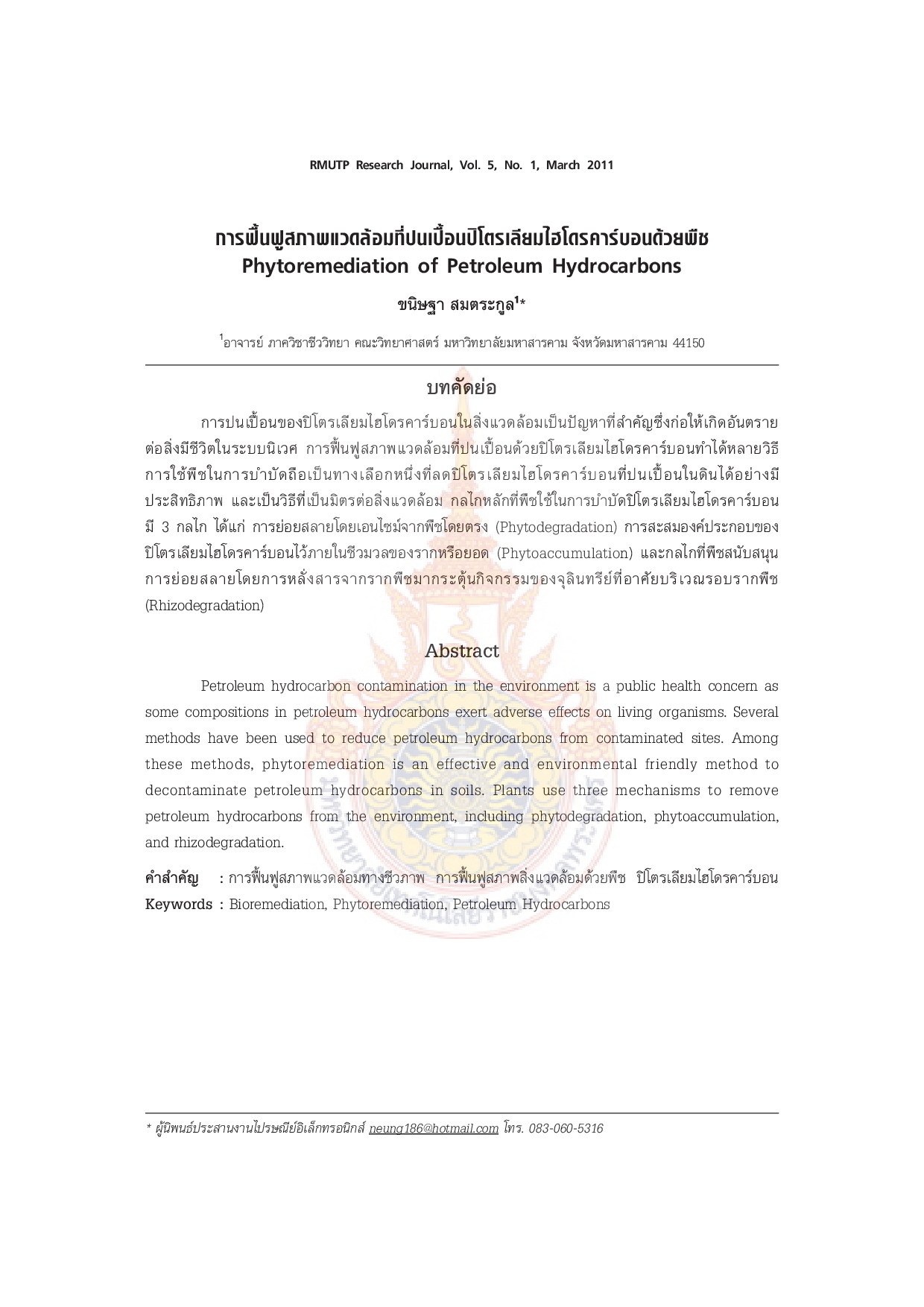
Phytoremediation of Petroleum Hydrocarbons
Petroleum hydrocarbon contamination in the environment is a public health concern as some compositions in petroleum hydrocarbons exert adverse effects on living organisms. Several methods have been used to reduce petroleum hydrocarbons from contaminated sites. Among these methods phytoremediation is an effective and environmental friendly method to decontaminate petroleum hydrocarbons in soils. Plants use three mechanisms to remove petroleum hydrocarbons from the environment including phytodegradation phytoaccumulation and rhizodegradation