จำนวน Repository ( 42 )
การศึกษาและพัฒนาเพื่อการออกแบบเฟอร์นิเจอร์จากกะลามะพร้าว
The study and Development for Furniture design by Coconut shell.. By giving priority to the use of natural materials in the development of products designed to replace the use of other types of wood with deforestation and the period of The study on Coconut shell. furniture design and furniture design and analysis to develop and test data from design professionals. To develop improvements in the production of prototype and test applications. To analyze and draw conclusions The piece consists of three pieces of furniture two seater sofa 160 cm wide and 80 cm long piece of 1 year and 1 sofa seat width 80 cm long and 80 cm 2. The research and development to design furniture from Coconut shell. can be found to develop products for the furniture to be used effectively. Can be developed to suit the use and beauty of natural forms.
การใช้เถ้ากะลามะพร้าวเป็นมวลรวมน้าหนักเบาในคอนกรีตบล็อกเพื่อการประหยัดพลังงาน
The objectives of this research are to study the production step proper ratio physical properties mechanical properties thermal insulation and sound insulation efficiency of concrete blocks mixed with coconut shell ash. The ratios of concrete block mixed with coconut shell ash include Portland cement type1: quarry dust: coconut shellash which equal to 1: 6.8: 0.2 1: 6.7: 0.3 1: 6.6: 0.4 1: 6.5: 0.5 and 1: 6.4: 0.6 by weight. Water per cement ratio are 0.6 by weight. The concrete block samples were casted by the general production as same as the ordinary concrete blocks and were tested follow TIS.58. From the results the best amount of coconut shell ash which put into concrete block is 1: 6.7: 0.3 of ratio. The proper ratios of coconut shell ash can decrease the density or weight and increase the thermal insulation and sound insulation efficiency of concrete blocks. However the high amounts of coconut shell ash effect to decrease the mechanical properties concrete blocks that are lower than TIS.58 standard.
การพัฒนาผลิตภัณฑ์วุ้นกรอบจากน้ำตาลสด
Fresh coconut syrup is a product from coconut spadix which has unique sweet taste and odor. Due to its short storage life it is usually processed into palm sugar. Development of new product from fresh coconut syrup would add more value by using it to produce crispy jelly. A suitable formula selected as a basic formula used 42.11 percent of refined sugar 56.14 percent of water and 1.75 percent of jelly powder. The basic formula was adjusted by calculating amount of water and soluble solids. Then a study was conducted to determine suitable amount of refined sugar heating period and drying temperature. It was found that a higher ratio of refined sugar and heating period led to increased concentration level of the mixture. As a result the crispy jelly had higher amount of sugar chips on the jellys surface and higher level of hardness. The highest score given by testers was for crispy jelly which used a ratio of fresh coconut syrup and refined sugar at 1:0.6 and 1:0.8 heating period of 5 minutes. Drying crispy jelly at higher temperature resulted in decreased drying period and higher degree of hardness. Drying at 70 degree Celcius produced crispy jelly with good quality which received the highest likeness score from testers. A study that kept crispy jelly in plastic box for at least 8 weeks showed that the tested condition could effectively maintain good quality of the crispy jelly.
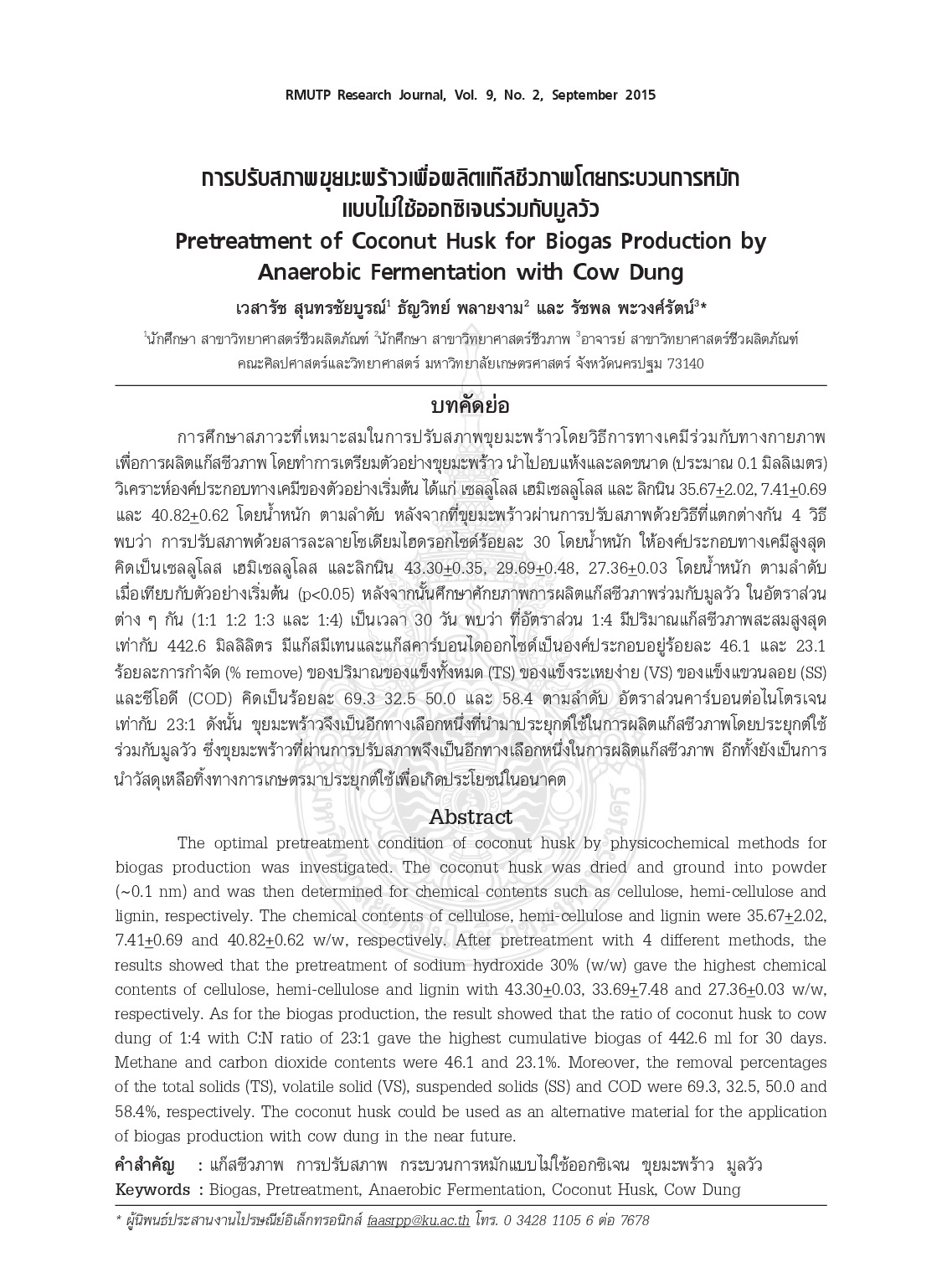
การปรับสภาพขุยมะพร้าวเพื่อผลิตแก๊สชีวภาพโดยกระบวนการหมักแบบไม่ใช้ออกซิเจนร่วมกับมูลวัว
The optimal pretreatment condition of coconut husk by physicochemical methods for biogas production was investigated. The coconut husk was dried and ground into powder (~0.1 nm) and was then determined for chemical contents such as cellulose hemi-cellulose and lignin respectively. The chemical contents of cellulose hemi-cellulose and lignin were 35.67±2.02 7.41±0.69 and 40.82±0.62 w/w respectively. After pretreatment with 4 different methods the results showed that the pretreatment of sodium hydroxide 30 % (w/w) gave the highest chemical contents of cellulose hemi-cellulose and lignin with 43.30±0.03 33.69±7.48 and 27.36±0.03 w/w respectively. As for the biogas production the result showed that the ratio of coconut husk to cow dung of 1:4 with C:N ratio of 23:1 gave the highest cumulative biogas of 442.6 ml for 30 days. Methane and carbon dioxide contents were 46.1 and 23.1 %. Moreover the removal percentages of the total solids (TS) volatile solid (VS) suspended solids (SS) and COD were 69.3 32.5 50.0 and 58.4 % respectively. The coconut husk could be used as an alternative material for the application of biogas production with cow dung in the near future.
การใช้ขุยมะพร้าวเพื่อเสริมความต้านทานแรงดึงของผลิตภัณฑ์แผ่นยางธรรมชาติ
This research aims to study the properties of natural rubber STR 20 at 100 phr with various contents of coir (e.g. 0 5 10 20 40 and 80 phr) and then mixed with chemical substance at constant ratio. After that the samples are ground by two-roll mill and formed by compression molding at 150 degree Celsius. This leads into the coir reinforcement natural rubber plate of dimension 30x30x0.5 cm. The properties of the natural rubber plates are tested under ASTM standard. From the results it is found that increasing in coir then the properties of resilience and density are improved at every mix ratio. However the tensile strength tear strength and wearing are increased at some certain value of coir. The samples give no water absorption at every mix ratio. The results from this research indicate that it can develop into the rubber floor tiles and rubber wall tiles for furnishing the buildings in natural style.