จำนวน Repository ( 120 )
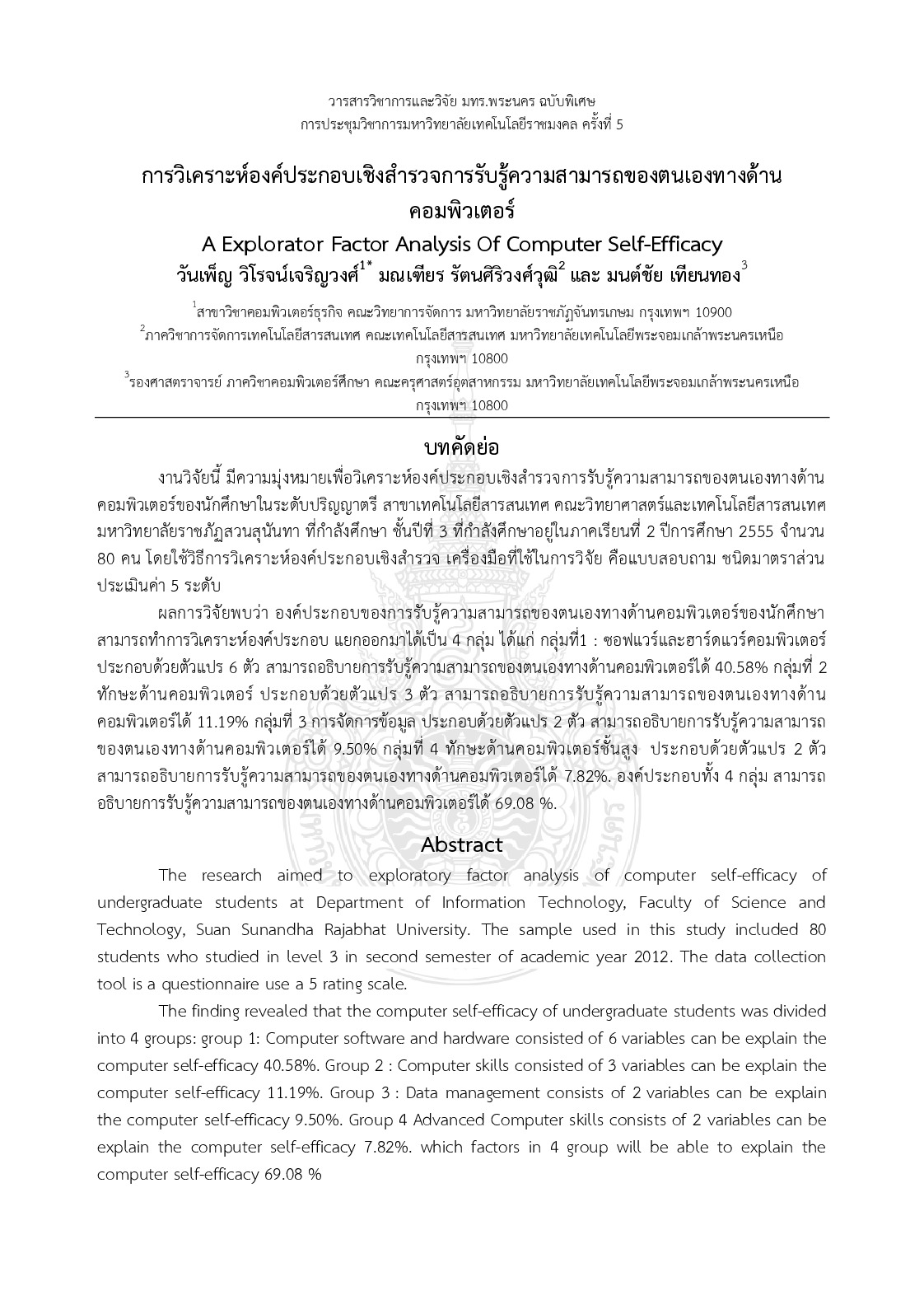
A explorator factor analysis Of computer self-efficacy
The research aimed to exploratory factor analysis of computer self-efficacy of undergraduate students at Department of Information Technology Faculty of Science and Technology Suan Sunandha Rajabhat University. The sample used in this study included 80 students who studied in level 3 in second semester of academic year 2012. The data collection tool is a questionnaire use a 5 rating scale. The finding revealed that the computer self-efficacy of undergraduate students was divided into 4 groups: group 1: Computer software and hardware consisted of 6 variables can be explain the computer self-efficacy 40.58%. Group 2 : Computer skills consisted of 3 variables can be explain the computer self-efficacy 11.19%. Group 3 : Data management consists of 2 variables can be explain the computer self-efficacy 9.50%. Group 4 Advanced Computer skills consists of 2 variables can be explain the computer self-efficacy 7.82%. which factors in 4 group will be able to explain the computer self-efficacy 69.08 %
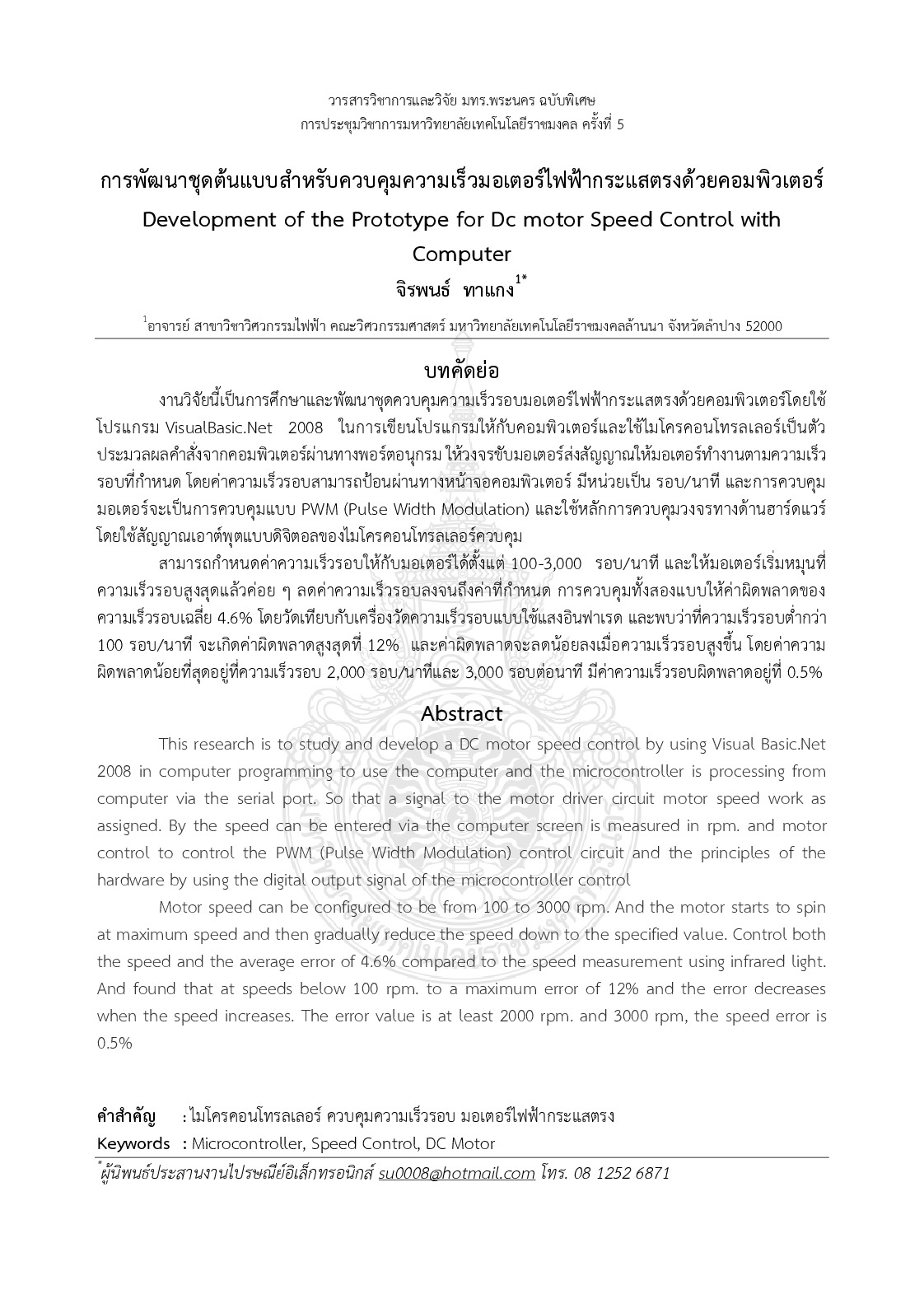
Development of the prototype for dc motor speed control with computer
This research is to study and develop a DC motor speed control by using Visual Basic.Net 2008 in computer programming to use the computer and the microcontroller is processing from computer via the serial port. So that a signal to the motor driver circuit motor speed work as assigned. By the speed can be entered via the computer screen is measured in rpm. and motor control to control the PWM (Pulse Width Modulation) control circuit and the principles of the hardware by using the digital output signal of the microcontroller control Motor speed can be configured to be from 100 to 3000 rpm. And the motor starts to spin at maximum speed and then gradually reduce the speed down to the specified value. Control both the speed and the average error of 4.6% compared to the speed measurement using infrared light. And found that at speeds below 100 rpm. to a maximum error of 12% and the error decreases when the speed increases. The error value is at least 2000 rpm. and 3000 rpm the speed error is 0.5%
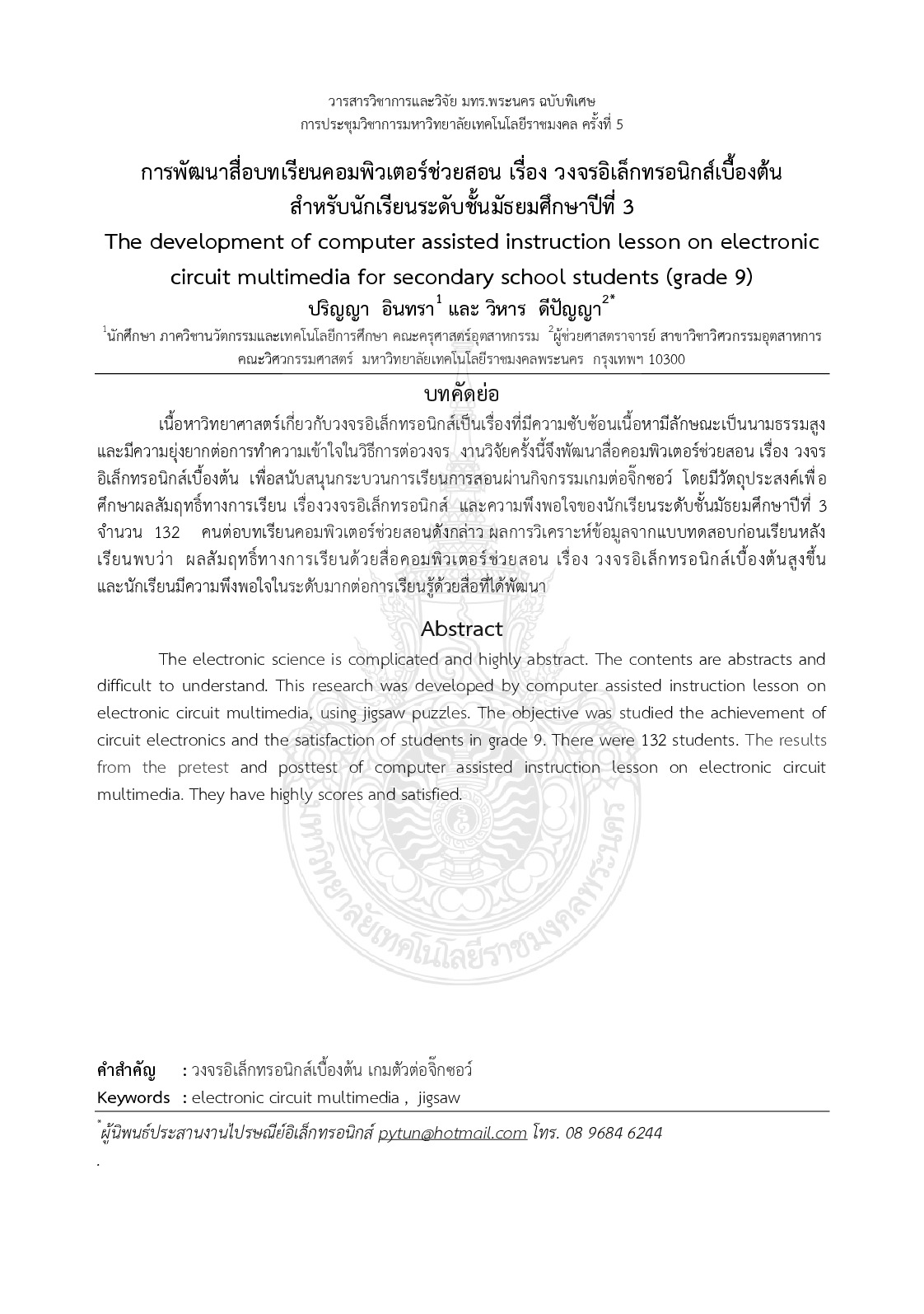
The development of computer assisted instruction lesson on electronic circuit multimedia for secondary school students (grade 9)
The electronic science is complicated and highly abstract. The contents are abstracts and difficult to understand. This research was developed by computer assisted instruction lesson on electronic circuit multimedia using jigsaw puzzles. The objective was studied the achievement of circuit electronics and the satisfaction of students in grade 9. There were 132 students. The results from the pretest and posttest of computer assisted instruction lesson on electronic circuit multimedia. They have highly scores and satisfied.
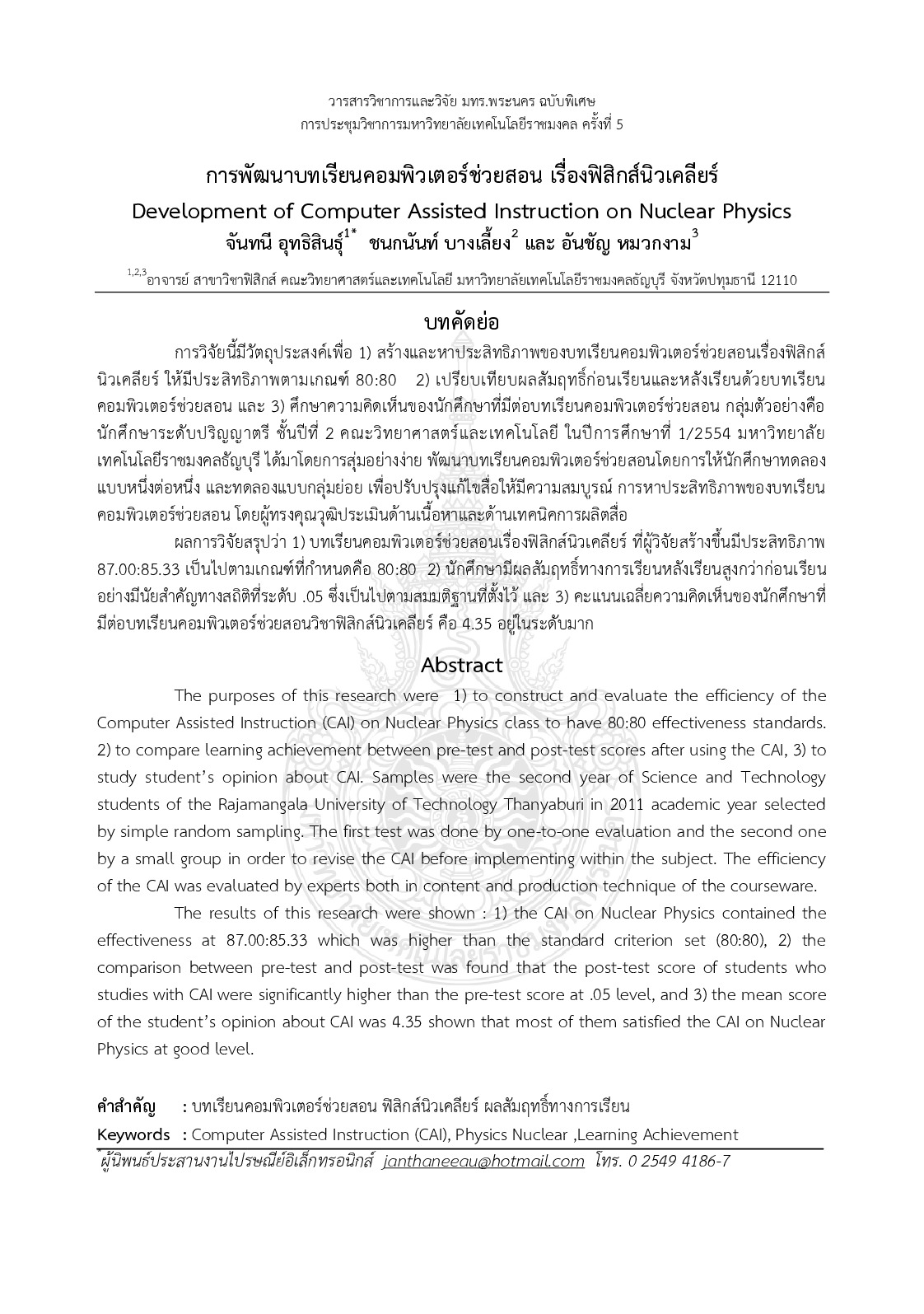
Development of computer assisted instruction on nuclear physics
The purposes of this research were 1) to construct and evaluate the efficiency of the Computer Assisted Instruction (CAI) on Nuclear Physics class to have 80:80 effectiveness standards. 2) to compare learning achievement between pre-test and post-test scores after using the CAI 3) to study student’s opinion about CAI. Samples were the second year of Science and Technology students of the Rajamangala University of Technology Thanyaburi in 2011 academic year selected by simple random sampling. The first test was done by one-to-one evaluation and the second one by a small group in order to revise the CAI before implementing within the subject. The efficiency of the CAI was evaluated by experts both in content and production technique of the courseware. The results of this research were shown : 1) the CAI on Nuclear Physics contained the effectiveness at 87.00:85.33 which was higher than the standard criterion set (80:80) 2) the comparison between pre-test and post-test was found that the post-test score of students who studies with CAI were significantly higher than the pre-test score at .05 level and 3) the mean score of the student’s opinion about CAI was 4.35 shown that most of them satisfied the CAI on Nuclear Physics at good level.

องค์ประกอบที่มีผลต่อความสามารถในการเรียนวิชาคอมพิวเตอร์กราฟิกส์
การวิจัยเรื่อง องค์ประกอบที่มีส่งผลต่อความสามารถในการเรียนวิชาคอมพิวเตอร์กราฟิกส์ ครั้งนี้ โดยมีวัตถุประสงค์เพื่อ 1) เพื่อศึกษาความสัมพันธ์ระหว่างสมรรถภาพทางสมอง แรงจูงใจภายในของตนเอง ลักษณะนิสัย และการรับรู้ความสามารถของตนเองกับความสามารถในการเรียนวิชาคอมพิวเตอร์กราฟิกส์ และ 2) เพื่อสร้างสมการพยากรณ์ความสามารถในการเรียนวิชาคอมพิวเตอร์กราฟิกส์ ของนักศึกษาสาขาวิชาไฟฟ้า แขนงวิชาวิศวกรรมคอมพิวเตอร์ มหาวิทยาลัยเทคโนโลยีราชมงคลพระนคร กลุ่มตัวอย่างได้แก่ นักศึกษาสาขาวิชาไฟฟ้า แขนงวิชาวิศวกรรมคอมพิวเตอร์ มหาวิทยาลัยเทคโนโลยีราชมงคลพระนคร จำนวน 15 คน ซึ่งได้มาโดยการสุ่มกลุ่มตัวอย่างแบบเจาะจง (Purposive Sampling) เครื่องมือที่ใช้ในการเก็บรวบรวมข้อมูลในครั้งนี้ประกอบด้วย 1) แบบทดสอบสมรรถภาพทางสมอง 2) แบบวัดแรงจูงใจภายในของตนเอง 3) แบบ ทดสอบวัดลักษณะนิสัย 4) แบบวัดการรับรู้ความสามารถของตนเอง และ 5) แบบทดสอบวัดความ สามารถด้านการเรียนวิชาคอมพิวเตอร์กราฟิกส์ สถิติที่ใช้ในการวิเคราะห์ข้อมูล ได้แก่ ค่าเฉลี่ย ค่าร้อยละ ส่วนเบี่ยงเบนมาตรฐาน และการวิเคราะห์ค่าสัมประสิทธิ์สหสัมพันธ์แบบพหุคูณ