จำนวน Repository ( 24 )
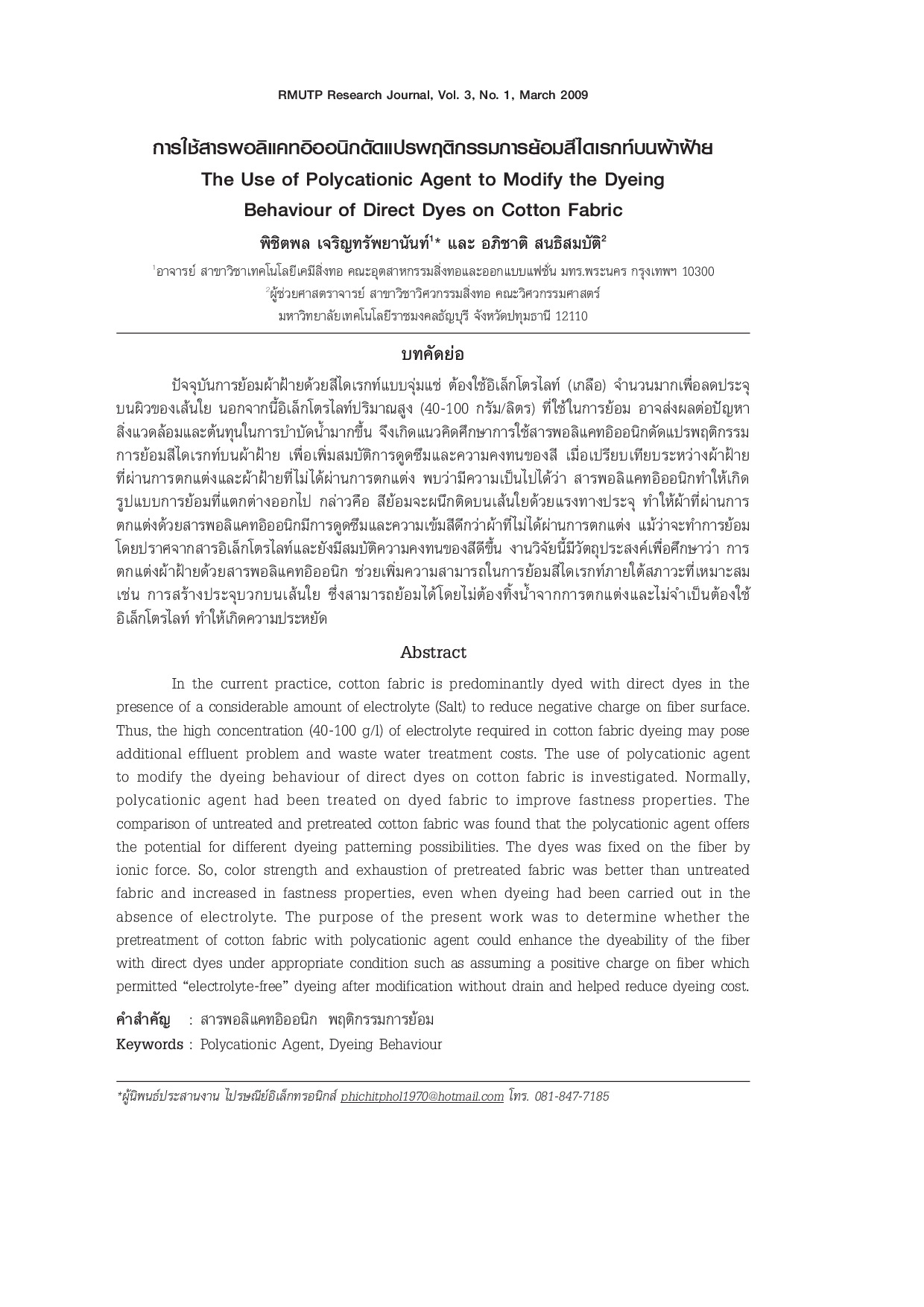
The Use of Polycationic Agent to Modify the Dyeing Behaviour of Direct Dyes on Cotton Fabric
In the current practice cotton fabric is predominantly dyed with direct dyes in the presence of a considerable amount of electrolyte (Salt) to reduce negative charge on fiber surface. Thus the high concentration (40-100 g/l) of electrolyte required in cotton fabric dyeing may pose additional effluent problem and waste water treatment costs. The use of polycationic agent to modify the dyeing behaviour of direct dyes on cotton fabric is investigated. Normally polycationic agent had been treated on dyed fabric to improve fastness properties. The comparison of untreated and pretreated cotton fabric was found that the polycationic agent offers the potential for different dyeing patterning possibilities. The dyes was fixed on the fiber by ionic force. So color strength and exhaustion of pretreated fabric was better than untreated fabric and increased in fastness properties even when dyeing had been carried out in the absence of electrolyte. The purpose of the present work was to determine whether the pretreatment of cotton fabric with polycationic agent could enhance the dyeability of the fiber with direct dyes under appropriate condition such as assuming a positive charge on fiber which permitted “electrolyte-free” dyeing after modification without drain and helped reduce dyeing cost.
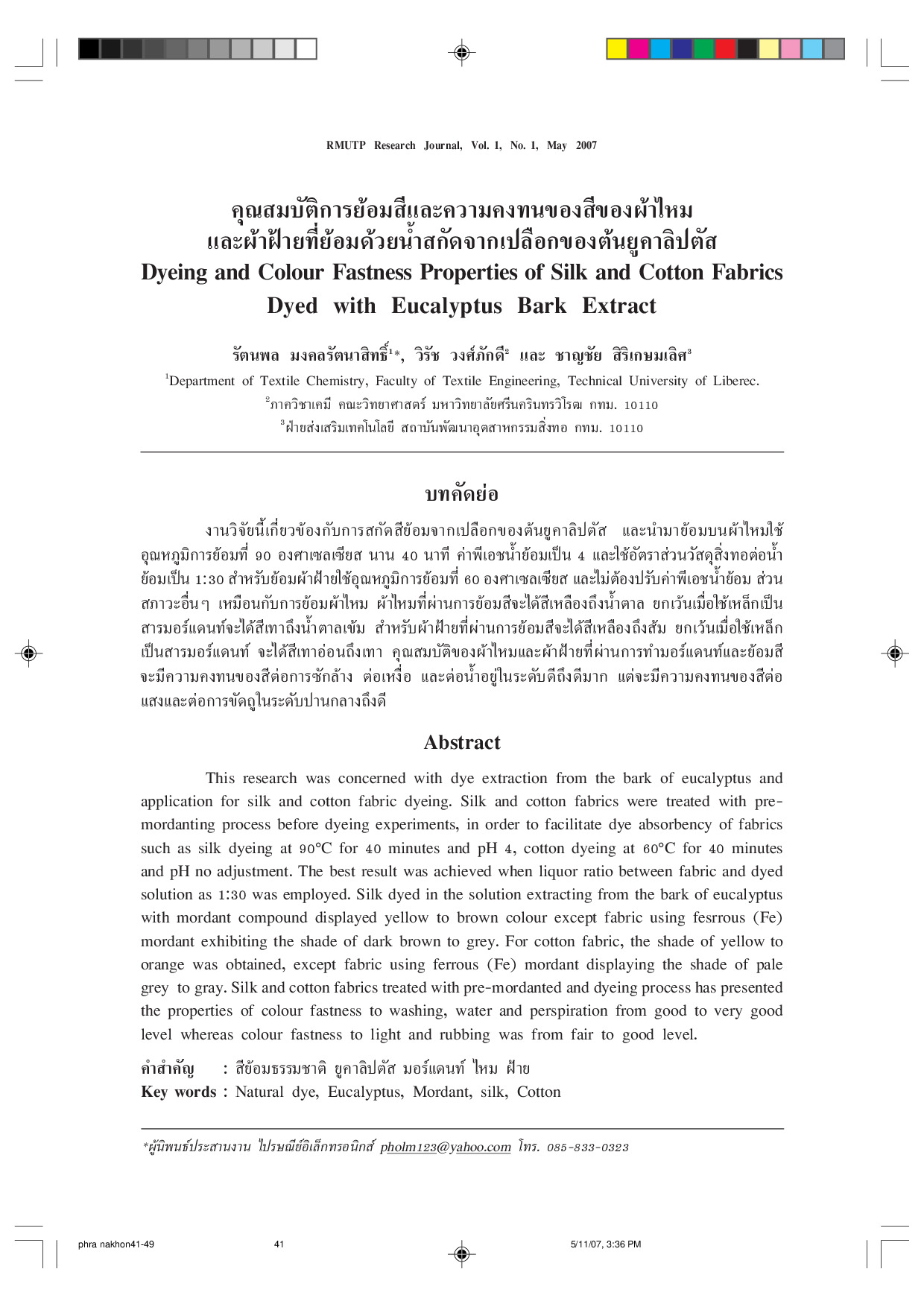
Dyeing and Colour Fastness Properties of Silk and Cotton Fabrics Dyed with Eucalyptus Bark Extract
This research was concerned with dye extraction from the bark of eucalyptus and application for silk and cotton fabric dyeing. Silk and cotton fabrics were treated with premordanting process before dyeing experiments in order to facilitate dye absorbency of fabrics such as silk dyeing at 90ฐC for 40 minutes and pH 4 cotton dyeing at 60ฐC for 40 minutes and pH no adjustment. The best result was achieved when liquor ratio between fabric and dyed solution as 1:30 was employed. Silk dyed in the solution extracting from the bark of eucalyptus with mordant compound displayed yellow to brown colour except fabric using fesrrous (Fe) mordant exhibiting the shade of dark brown to grey. For cotton fabric the shade of yellow to orange was obtained except fabric using ferrous (Fe) mordant displaying the shade of pale grey to gray. Silk and cotton fabrics treated with pre-mordanted and dyeing process has presented the properties of colour fastness to washing water and perspiration from good to very good level whereas colour fastness to light and rubbing was from fair to good level.
การศึกษาการบำบัดน้ำเสียจากการย้อมผ้าแบบเคลื่อนที่โดยใช้ถ่านกัมมันต์จากกะลามะพร้าว
The dyeing industry both of business size and household size where the remaining water from the dyeing process is dumped into pipes and flows into natural water sources causing sewage problems. Therefore a column type wastewater treatment system has been developed by using a filtration system along with an adsorption system. The materials used to treat the wastewater from dyeing are gravel sand charcoal from wood and activated carbon from coconut shell. The study was conducted on the synthesis activated carbon from coconut shell using for color and molecules adsorption. The amount of activated carbon from coconut shell was varied at 200 400 600 and 800 g applying with filter media and other adsorption materials taking 1 hour to treat the wastewater from dyeing. The parameter using to measure water quality consisted of color value pH suspended solids conductivity turbidity value COD and TKN to indicate the water quality before and after treatment evaluating the efficiency of the wastewater treatment system. The best ratio that can treat the color is the formula containing 800 g of coconut shell activated carbon. It was able to treat the color equal to 5.94 SU or 99.43 percent compared to the wastewater before treatment.
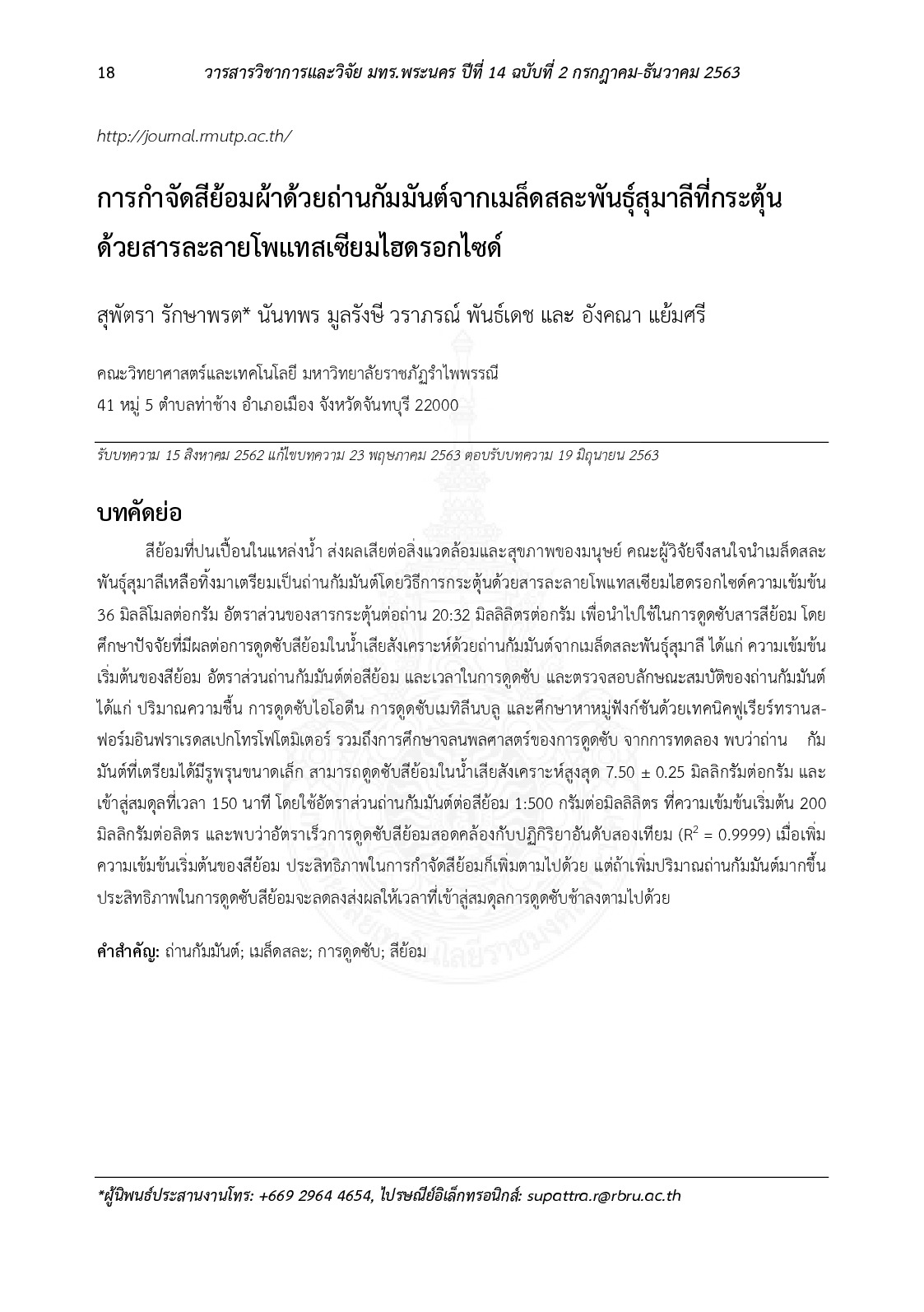
การกำจัดสีย้อมผ้าด้วยถ่านกัมมันต์จากเมล็ดสละพันธุ์สุมาลีที่กระตุ้น ด้วยสารละลายโพแทสเซียมไฮดรอกไซด์
Dyes contaminated in wastewater that negatively affecting the environment and human health. The objectives of this study to prepare activated carbon from Salacca zalacca (Sumalee) seeds activated by 36 mmol/g KOH dye solution and activated carbon ratio 20:32 ml/g for dye removal. The influents of dye removal from wastewater by Salacca zalacca (Sumalee) seeds activated carbon were investigated as initial dye concentration activated carbon and dye solution ratio and contraction time. The moisture content the iodine number the methylene blue index and the functional groups by FTIR technique of the Salacca zalacca (Sumalee) activated carbon were characterized and the kinetics adsorption were also analyzed. The results showed that the activated carbon was the microporous material the highest dye removal from wastewater was 7.50 ± 0.25 mg/g the equilibrium time was 150 min with the activated carbon to dye solution ratio of 1:500 g/ml for 200 mg/l initial concentration. The kinetics of the adsorption process can be described by a pseudo-second order model (R2 = 0.9999). When increasing the initial concentration of dyes the adsorption efficiency was increased. The amount of activated carbon increased resulting in lower adsorption efficiency and the equilibrium time was longer
การเลือกซื้อผลิตภัณฑ์ผ้าหม้อห้อมย้อมสีธรรมชาติของนักท่องเที่ยวจังหวัดแพร่
The purposes of this research are : 1) to study the personal factors at tourist in Phrae Province 2) to study is the factors of marketing mix use to purchasing of products Morhom Fabric Dyed in natural color of tourists in Phrae Province 3) to study is purchasing of products Morhom Fabric Dyed in natural color of tourists in Phrae Province 4) the relationship between personal factors with an option to is purchasing of the products Morhom Fabric Dyed in natural color of tourists in Phrae Province and 5) the relationship between marketing mix to purchasing of products Morhom Fabric Dyed in natural color of tourists in Phrae Province. The samples are tourists traveling in Phrae Province and buy products Morhom Fabric Dyed in natural color 405. The instruments are using in research questionnaires and interviews. The statistics are using for data analysis frequency percentage mean standard deviation and Chi-square. The research were found that as follows: 1) Tourists in Phrae Province Most were female aged 31-40 years with a bachelors degree. A career was as a private company employees .The averaged income per month 20001-30000 baht and domiciled in Phra Province. 2) Visitors were to the factors critical to the overall marketing mix at a high level. The first two items in order from most to least found that the side with the highest mean score. The product was the lower cost and minimal personnel.3) Most tourists were purchasing of products Morhom Fabric Dyed in natural color of tourists in Phrae Province for themself or them family. The choice of piece of fabric was dyed the clothing and apparel or garments were buying a shirt at the time of used and decoration shop the cushions as well as sorts of travelers choose and bought a bag with the purchase of products Morhom Fabric Dyed in natural color factors on choosing found that sex education estimate salary and the domicile of tourists was associating with the purchase of purchasing of products Morhom Fabric Dyed in natural color of tourists in Phrae Province .There were no significant correlation. And 5) the relationship between marketing mix to purchase of purchasing of products Morhom Fabric Dyed in natural color of tourists in Phrae Province found not correlation. The statistical significance level. 05.