จำนวน Repository ( 63 )

The development of english language instructional model using mobile electronic devices (m-Learning) for upper secondary students in secondary educational service area office 11
The purposes of this research were to (1) study the needs of teachers and students in Secondary Education Service Area Office 11 in English instruction using mobile electronic devices (m-Learning) and (2) to develop the model of English language instruction using mobile electronic devices (m-Learning) for Upper Secondary Students in Secondary Educational Service Area Office 11. The samples were 222 teachers and 394 students taken from Secondary Educational Service Area Office 11 using a Taro Yamane’s formula with the significant level of .05. The research procedure was divided into two phases. Phase one was the study of the needs of teachers and students in teaching and learning using mobile electronic devices two sets of questionnaires; one set for teachers and one set for students were used to collect data. A model of English instruction using mobile electronic devices was created in this phase. Phase two was the verification of the developed model by the experts. A verification form was used to collect data. Data were analyzed through mean and standard deviation. The research findings were as follows:
The educational successful in data structure and algorithm subject for information system field’s student Rajamangala University of Technology Isan
This applied research want to study the factors affecting the student‘ learning achievement instudying Data Structure and Algorithm. The samples were selected by stratified random sampling 93 students from 121 students who studied in semester 2/2009 by using questionnaire. The statistics used were descriptive statisticst-testOne way ANOVAPearson correlation and multiple regression at the significance level of 0.05. The findings revealed that the mean of grade point average was 2.69 their average midterm scores were 22.47 out of 35. The successful were grade point averagefair expectation of knowledgeand future application.The factors affecting student’s achievementwere basic knowledge of programmingmidterm scores studied resource and facilities. In addition the 2 year programme’ average midterm scores were higher than the 4 year programme ranging from 1.11 to 5.34 at the significance level of 0.05. The forecasting equation for learning achievement is
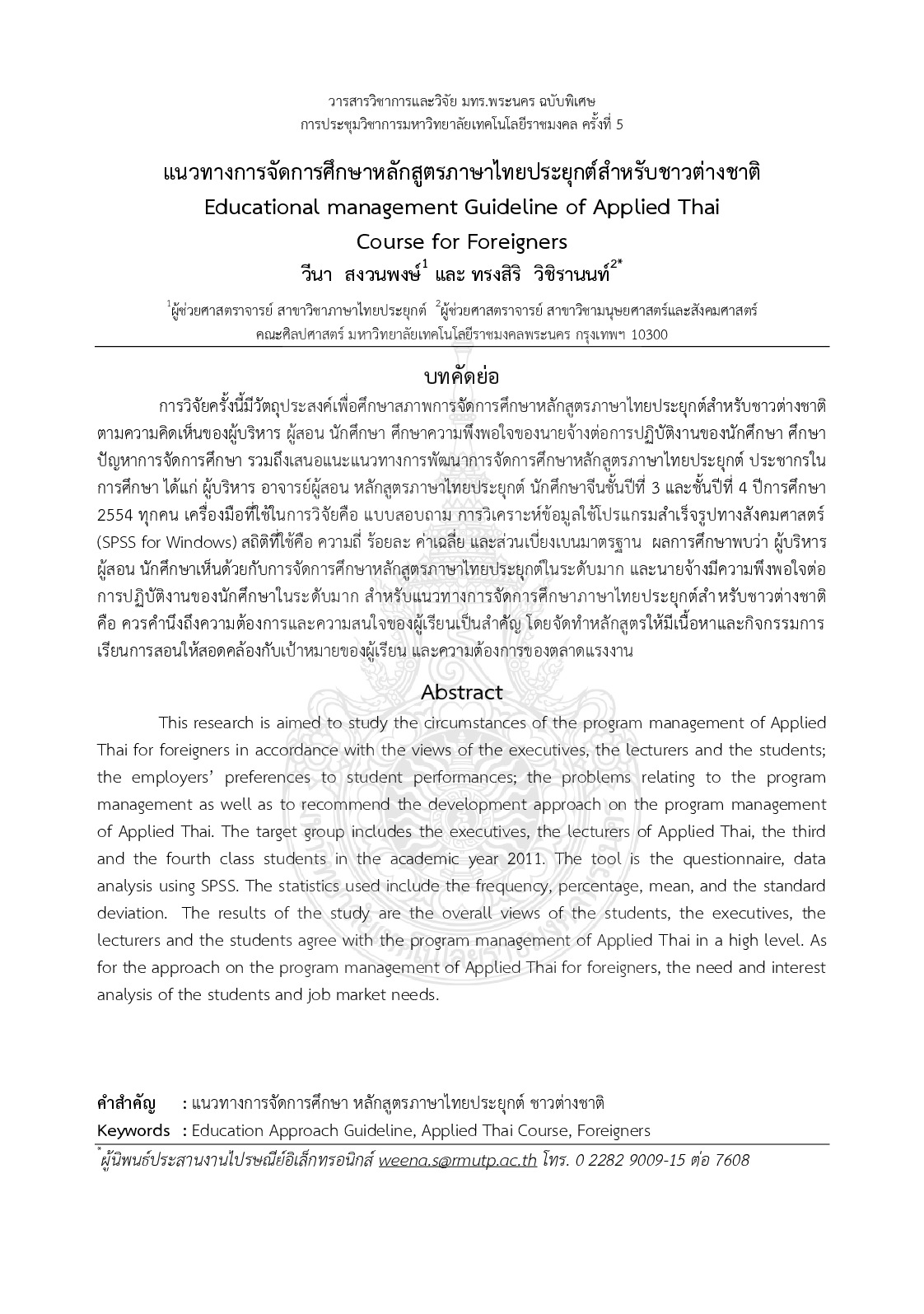
Educational management guideline of applied thai course for foreigners
This research is aimed to study the circumstances of the program management of Applied Thai for foreigners in accordance with the views of the executives the lecturers and the students; the employers’ preferences to student performances; the problems relating to the program management as well as to recommend the development approach on the program management of Applied Thai. The target group includes the executives the lecturers of Applied Thai the third and the fourth class students in the academic year 2011. The tool is the questionnaire data analysis using SPSS. The statistics used include the frequency percentage mean and the standard deviation. The results of the study are the overall views of the students the executives the lecturers and the students agree with the program management of Applied Thai in a high level. As for the approach on the program management of Applied Thai for foreigners the need and interest analysis of the students and job market needs.
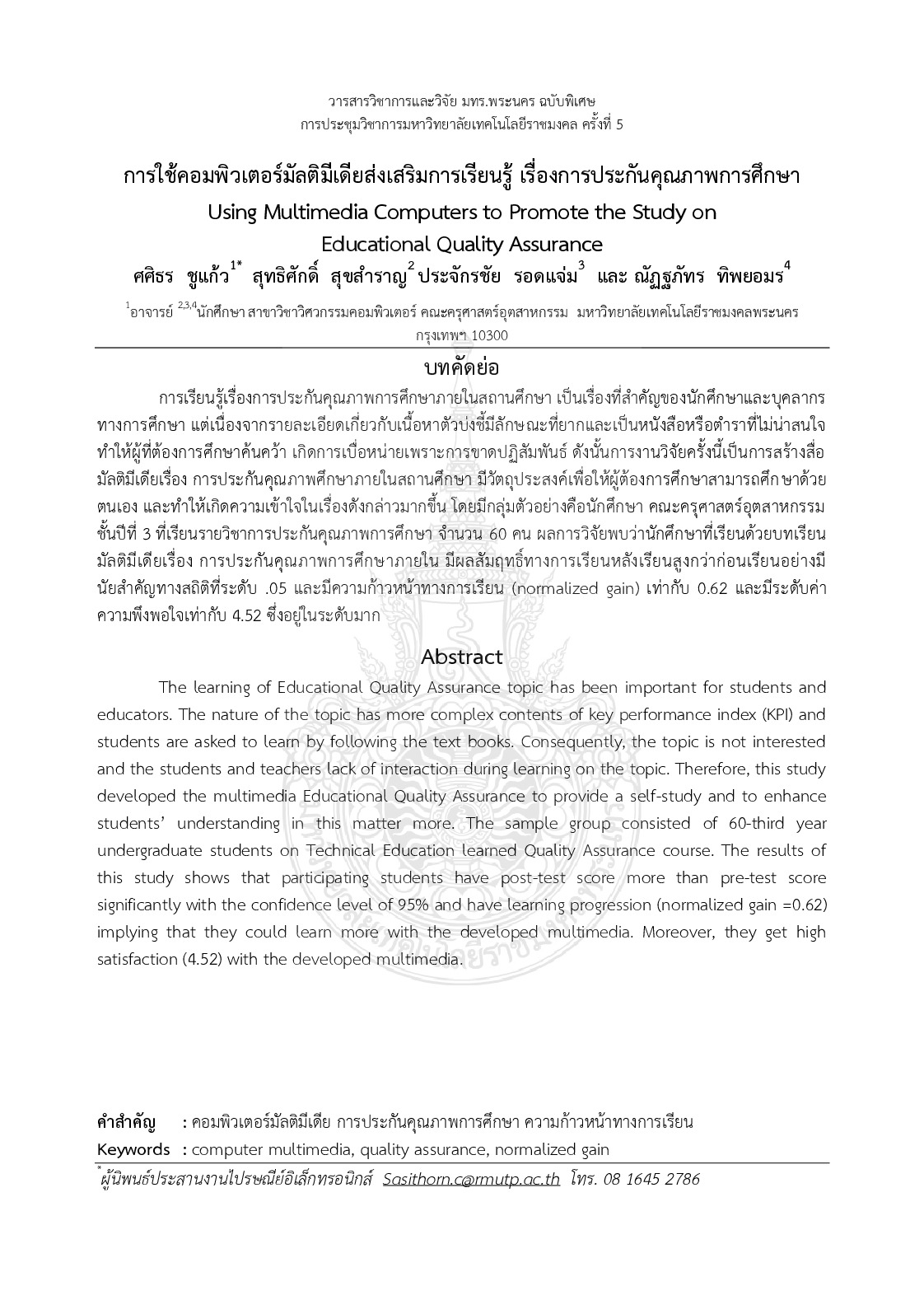
Using multimedia computers to promote the study on educational quality assurance
The learning of Educational Quality Assurance topic has been important for students and educators. The nature of the topic has more complex contents of key performance index (KPI) and students are asked to learn by following the text books. Consequently the topic is not interested and the students and teachers lack of interaction during learning on the topic. Therefore this study developed the multimedia Educational Quality Assurance to provide a self-study and to enhance students’ understanding in this matter more. The sample group consisted of 60-third year undergraduate students on Technical Education learned Quality Assurance course. The results of this study shows that participating students have post-test score more than pre-test score significantly with the confidence level of 95% and have learning progression (normalized gain =0.62) implying that they could learn more with the developed multimedia. Moreover they get high satisfaction (4.52) with the developed multimedia.
การทบทวนวรรณกรรมอย่างเป็นระบบและวิเคราะห์อภิมานคุณลักษณะที่สำคัญด้านวิทยาการหุ่นยนต์เพื่อการศึกษา
This article aims to synthesize literatures in Educational Robotics and presents key features of systematic literature review and structured meta-analysis of the literature. Population consists of 247 papers from 10 databases ranging from 1996 to 2012. Results show that common problems in Educational Robotics are high cost of tools license and differences in students’ background knowledge. Trends of existing researches focus on development of software and low cost robot training package in order to promote students’ practice in problem-solving skills and teamwork in experience-based learning to enhance self-motivation and experience with real world applications. It was also found from the synthesis that qualitative-based evaluation of tool and learning achievement process was rare even though it is a key factor that indicates quality of learning process.