จำนวน Repository ( 24 )

การเลือกฟังก์ชันการแจกแจงความน่าจะเป็นสะสมสำหรับแนวโน้มเพื่อสร้างตัวแบบสำหรับวิเคราะห์ข้อมูลอนุกรมเวลาหลายๆตัวพร้อมกันที่มีค่า อัตตสหสัมพันธ์แนวโน้ม และค่าผิดปกติ ด้วยวิธีของเบย์: กรณีศึกษาราคาหุ้นที่มีความผันผวนของตลาดหลักทรัพย์แห่งประเทศไทย
The objective of this research is to select a proper cumulative function for trend in an analysis of simultaneous multiple time series data with autocorrelation trend and outliers using a Bayesian method. The proposed model is applied to fluctuate stock price data in the stock exchange of Thailand. The data consist of the closing prices of 5 stocks. The algorithms are written in OpenBUGS and the performance of the model is evaluated via a simulation study in R. The cumulative distribution functions considered here are a Weibull cumulative distribution function and an exponential cumulative distribution. They are compared using RMSE MAPE and MAE as criteria. The research found that an exponential cumulative function for trends gives smaller values of the three criteria in both model fitting and model validation for the4 stocks EA NWR and KTB. However a Weibull cumulative distribution function gives smaller values of three criteria for the PTT in both model fitting and model validation.

Development of parent stock of thai indigenous chicken : chee by selection index
This research aimed to develop a flock of Thai indigenous chicken namely Chee with pure white feather in order to meet the requirement of domestic consumption and export of meat chickens. The genetics on growth must be improve with egg production was no affected. The selections were continuously done for 5 generations. Each generation 30 sires and 50 of 16 week old females were obtained. At suitable age 6 weeks after first egg laid the artificial inseminations were arranged twice weekly with 1: 5 of the male and female proportion. Eggs were collected to hatchery in the 3 consecutive weeks followed with the 2 week skips. Before the next AI of reciprocal cross the 3 groups were bred and 3 generations each. The newborn chickens from hatchery of each generation were weighed and the other measurements were done at the 4 weeks intervals. The data of weights at 16 week old chickens and breast widths were used to calculate for breeding value. The BLUP (Best Linear Unbiased Prediction) was a selection tool to select high selection index for replacement herd of each generation. For the females the 300 day egg productions were added. It was found that from the 1st to the 5th generation the average of 16 week old chickens were 1225.99 1265.86 1461.94 1326.16 and 1439.36 gram respectively. The average body weight gain was 213.37 gram and the average daily gain was 12.85 gram. The 16 week breast widths were 5.46 5.90 5.54 5.56 and 5.65 centimeter respectively. The ages of first egg laid were 211.30 178.66 175.83 171.91 and 171.10 day respectively. In the 5th generation egg production started about 40 days earlier than the 1st generation. The first egg weights were 1390 1426 1467.61 1446.33 and 1529 gram respectively. Egg productions at the 300 day old were 36.38 38.28 40.29 42.42 and 45.58 eggs and it could provide 9 eggs more than 1st generation.
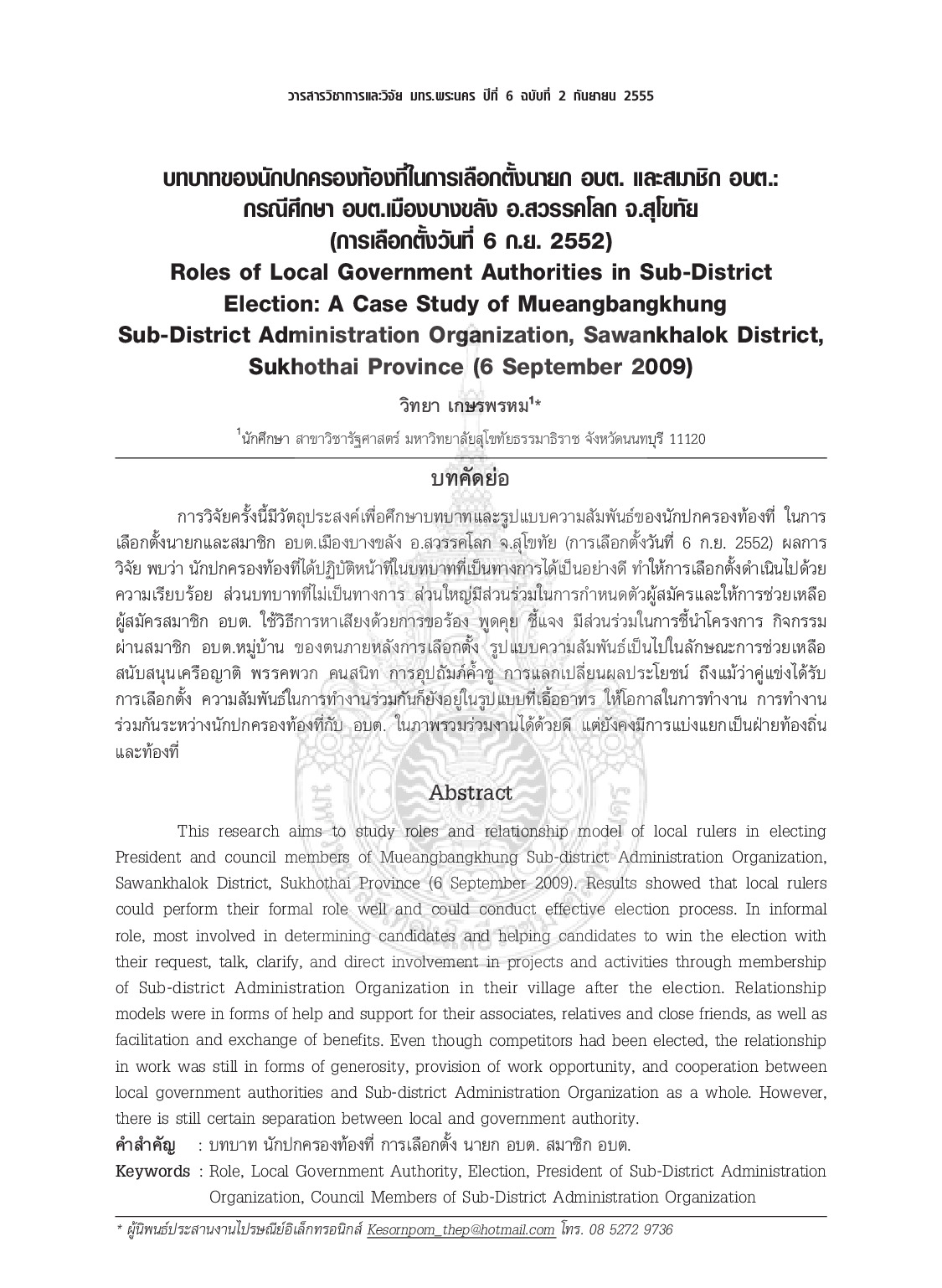
Roles of Local Government Authorities in Sub-District Election: A Case Study of Mueangbangkhung Sub-District Administration Organization, Sawankhalok District, Sukhothai Province (6 September 2009)
This research aims to study roles and relationship model of local rulers in electing President and council members of Mueangbangkhung Sub-district Administration Organization Sawankhalok District Sukhothai Province (6 September 2009). Results showed that local rulers could perform their formal role well and could conduct effective election process. In informal role most involved in determining candidates and helping candidates to win the election with their request talk clarify and direct involvement in projects and activities through membership of Sub-district Administration Organization in their village after the election. Relationship models were in forms of help and support for their associates relatives and close friends as well as facilitation and exchange of benef its. Even though competitors had been elected the relationship in work was still in forms of generosity provision of work opportunity and cooperation between local government authorities and Sub-district Administration Organization as a whole. However there is still certain separation between local and government author
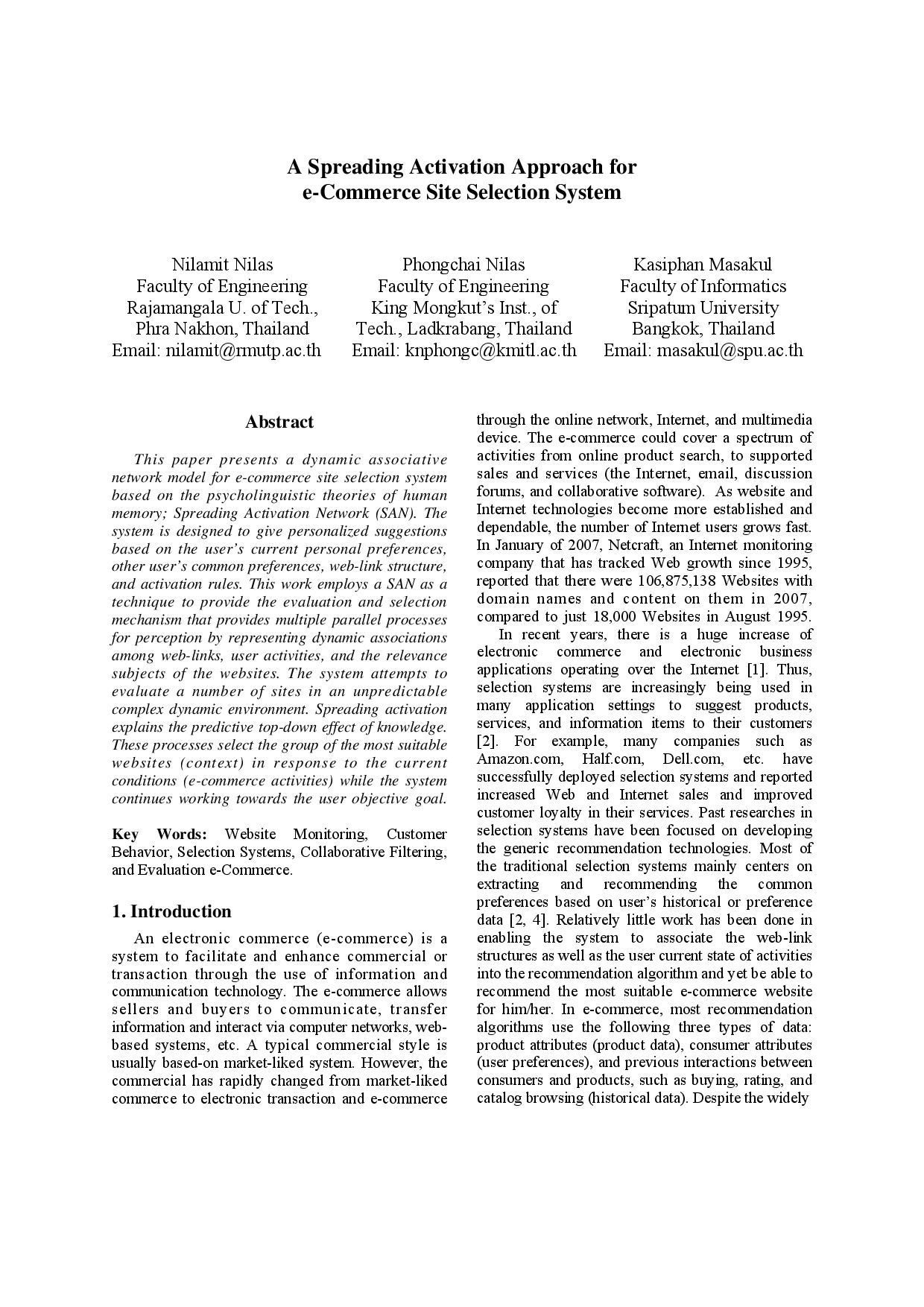
A Spreading Activation Approach for e-Commerce Site Selection System
This paper presents a dynamic associative network model for e-commerce site selection system based on the psycholinguistic theories of human memory; Spreading Activation Network (SAN). The system is designed to give personalized suggestions based on the user’s current personal preferences other user’s common preferences web-link structure and activation rules. This work employs a SAN as a technique to provide the evaluation and selection mechanism that provides multiple parallel processes for perception by representing dynamic associations among web-links user activities and the relevance subjects of the websites. The system attempts to evaluate a number of sites in an unpredictable complex dynamic environment. Spreading activation explains the predictive top-down effect of knowledge. These processes select the group of the most suitable websites (context) in response to the current conditions (e-commerce activities) while the system continues working towards the user objective goal.
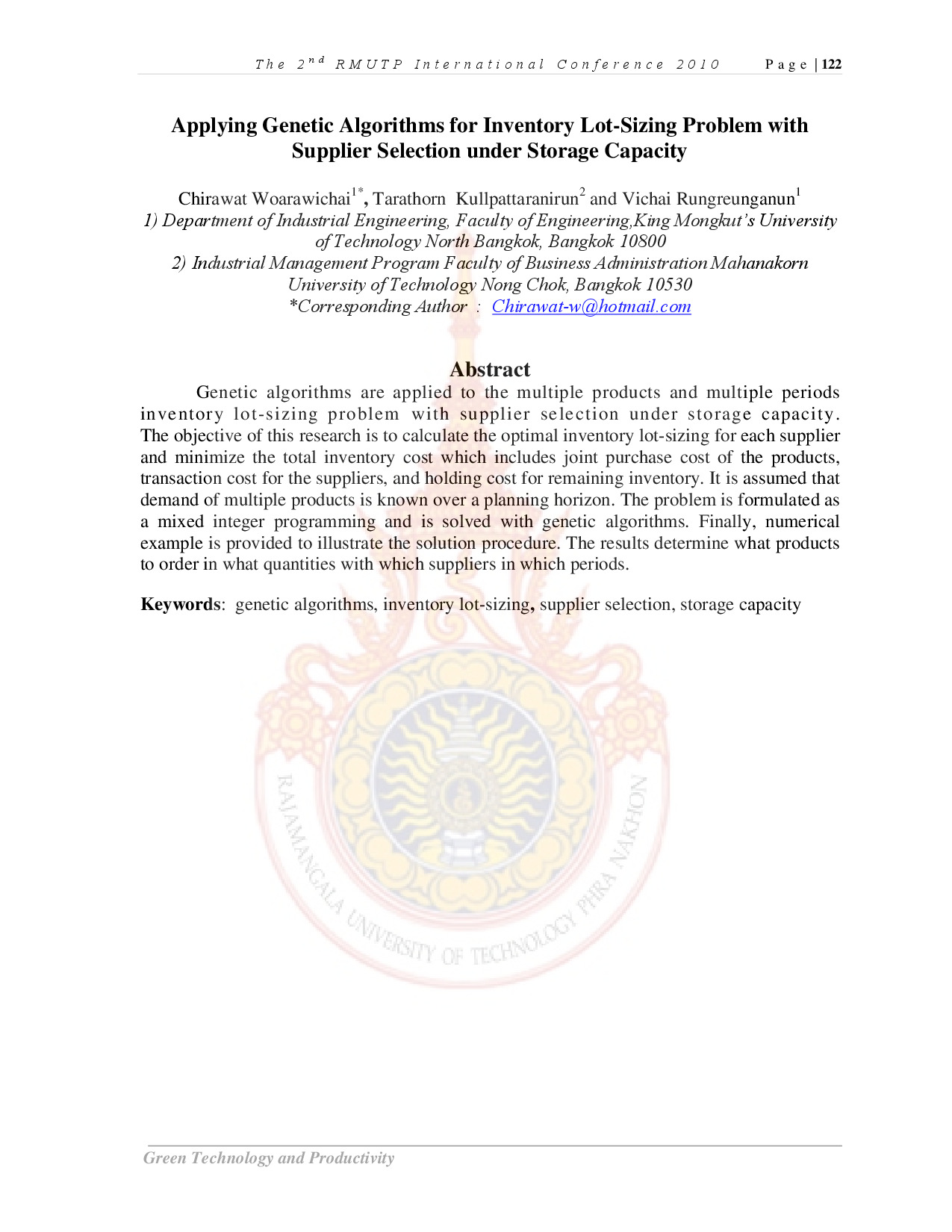
Applying Genetic Algorithms for Inventory Lot-Sizing Problem with Supplier Selection under Storage Capacity
Genetic algorithms are applied to the multiple products and multiple periods inventory lot-sizing problem with supplier selection under storage capacity. The objective of this research is to calculate the optimal inventory lot-sizing for each supplier and minimize the total inventory cost which includes joint purchase cost of the products transaction cost for the suppliers and holding cost for remaining inventory. It is assumed that demand of multiple products is known over a planning horizon. The problem is formulated as a mixed integer programming and is solved with genetic algorithms. Finally numerical example is provided to illustrate the solution procedure. The results determine what products to order in what quantities with which suppliers in which periods.