จำนวน Repository ( 24 )
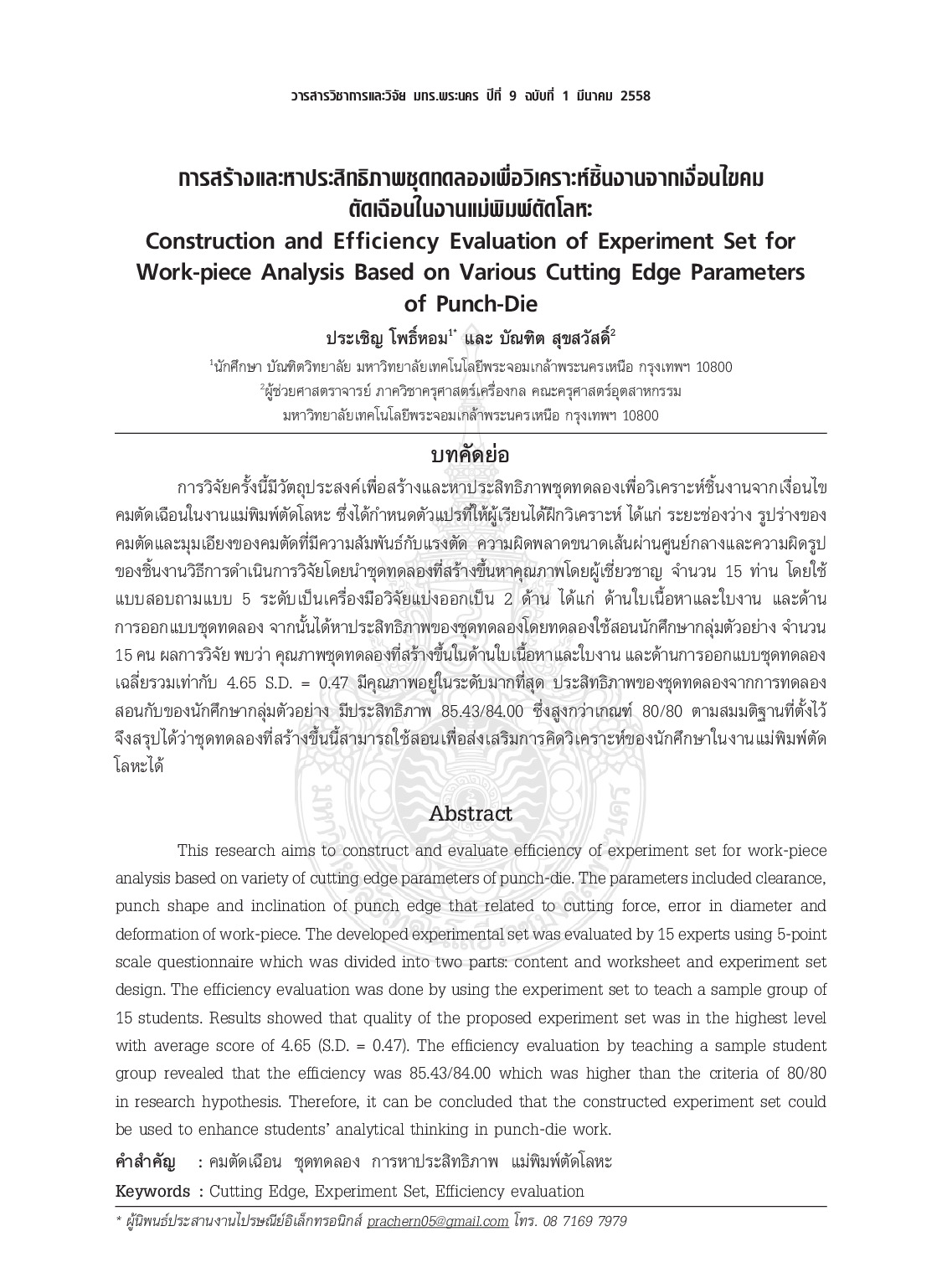
Construction and efficiency evaluation of experiment set for work-piece analysis based on various cutting edge parameters of punch-die
This research aims to construct and evaluate efficiency of experiment set for work-piece analysis based on variety of cutting edge parameters of punch-die. The parameters included clearance punch shape and inclination of punch edge that related to cutting force error in diameter and deformation of work-piece. The developed experimental set was evaluated by 15 experts using 5-point scale questionnaire which was divided into two parts: content and worksheet and experiment set design. The efficiency evaluation was done by using the experiment set to teach a sample group of 15 students. Results showed that quality of the proposed experiment set was in the highest level with average score of 4.65 (SD = 0.47). The efficiency evaluation by teaching a sample student group revealed that the efficiency was 85.43/84.00 which was higher than the criteria of 80/80 in research hypothesis. Therefore it can be concluded that the constructed experiment set could be used to enhance students’ analytical thinking in punch-die work.
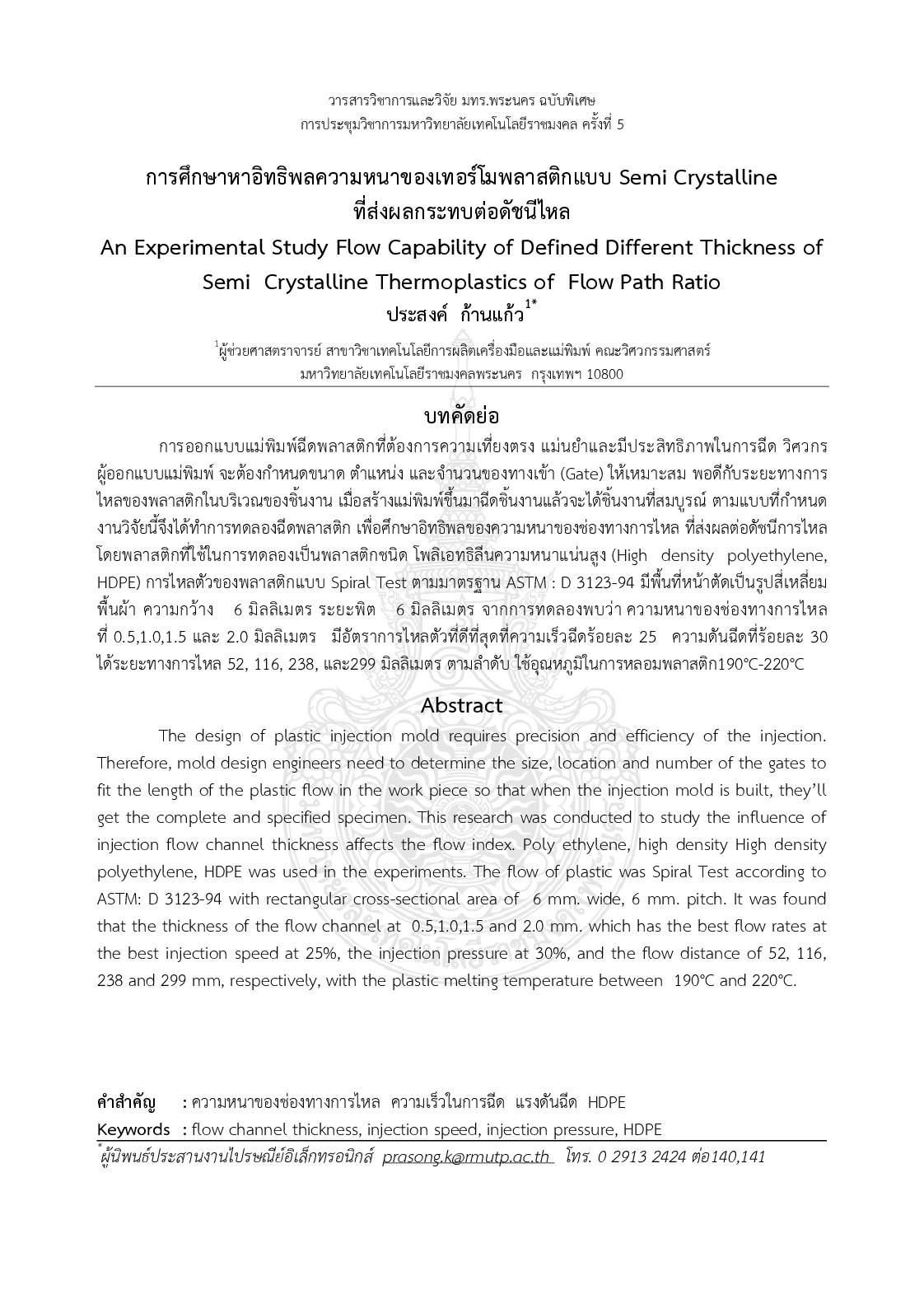
An experimental study flow capability of defined different thickness of semi crystalline thermoplastics of flow path ratio
The design of plastic injection mold requires precision and efficiency of the injection. Therefore mold design engineers need to determine the size location and number of the gates to fit the length of the plastic flow in the work piece so that when the injection mold is built they’ll get the complete and specified specimen. This research was conducted to study the influence of injection flow channel thickness affects the flow index. Poly ethylene high density High density polyethylene HDPE was used in the experiments. The flow of plastic was Spiral Test according to ASTM: D 3123-94 with rectangular cross-sectional area of 6 mm. wide 6 mm. pitch. It was found that the thickness of the flow channel at 0.51.01.5 and 2.0 mm. which has the best flow rates at the best injection speed at 25% the injection pressure at 30% and the flow distance of 52 116 238 and 299 mm respectively with the plastic melting temperature between 190 C and 220 C.

การสร้างชุดทดลองการสั่นสะเทือนอย่างง่าย
The objectives of this research are to construct and determine the quality and efficiency of a simple vibration experiment package. This experiment package design was based on free body diagram of content and main knowledge analyzed from behavioral objectives. Quality of the experiment package was assessed by 12 experts in 4 aspects which included theoretical sheet experimental sheet exercise sheet and experiment device design. The efficiency evaluation was performed by a sample group of 18 students. The exercise sheet was done by the students after finishing each teaching topic and examination sheet was done after finishing all teaching topics. Results showed that quality of the constructed simple vibration experiment package was in a high level of 4.8. Efficiency of the experiment package was 80.47/81.85 which was higher than specified in the research hypotheses. Therefore the experiment package could be applied to teach in any classroom with high students learning outcome.
The E-leaning on analysis of the experimental results by using graphs
The purposes of this research was to manufacture Electronics Media on Web and compare achievement between teaching using E-leaning and teaching using conventional techniques on Analysis of the Experimental Results by Using Graphs of Science and Technology Faculty at Rajamangala University of Technology Phra Nakhon.
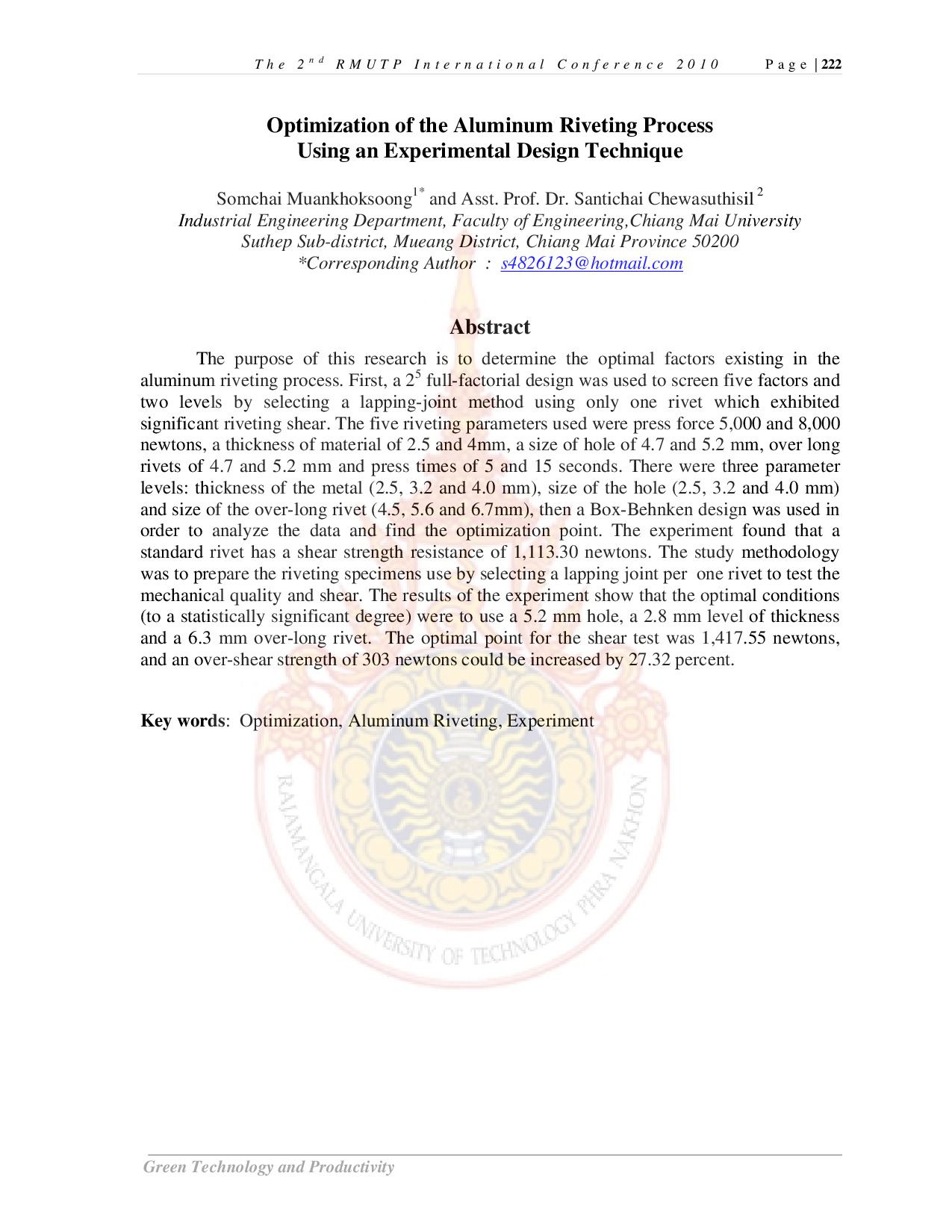
Optimization of the Aluminum Riveting Process Using an Experimental Design Technique
The purpose of this research is to determine the optimal factors existing in the aluminum riveting process. First a 25 full-factorial design was used to screen five factors and two levels by selecting a lapping-joint method using only one rivet which exhibited significant riveting shear. The five riveting parameters used were press force 5000 and 8000 newtons a thickness of material of 2.5 and 4mm a size of hole of 4.7 and 5.2 mm over long rivets of 4.7 and 5.2 mm and press times of 5 and 15 seconds. There were three parameter levels: thickness of the metal (2.5 3.2 and 4.0 mm) size of the hole (2.5 3.2 and 4.0 mm) and size of the over-long rivet (4.5 5.6 and 6.7mm) then a Box-Behnken design was used in order to analyze the data and find the optimization point. The experiment found that a standard rivet has a shear strength resistance of 1113.30 newtons. The study methodology was to prepare the riveting specimens use by selecting a lapping joint per one rivet to test the mechanical quality and shear. The results of the experiment show that the optimal conditions (to a statistically significant degree) were to use a 5.2 mm hole a 2.8 mm level of thickness and a 6.3 mm over-long rivet. The optimal point for the shear test was 1417.55 newtons and an over-shear strength of 303 newtons could be increased by 27.32 percent.