จำนวน Repository ( 18 )
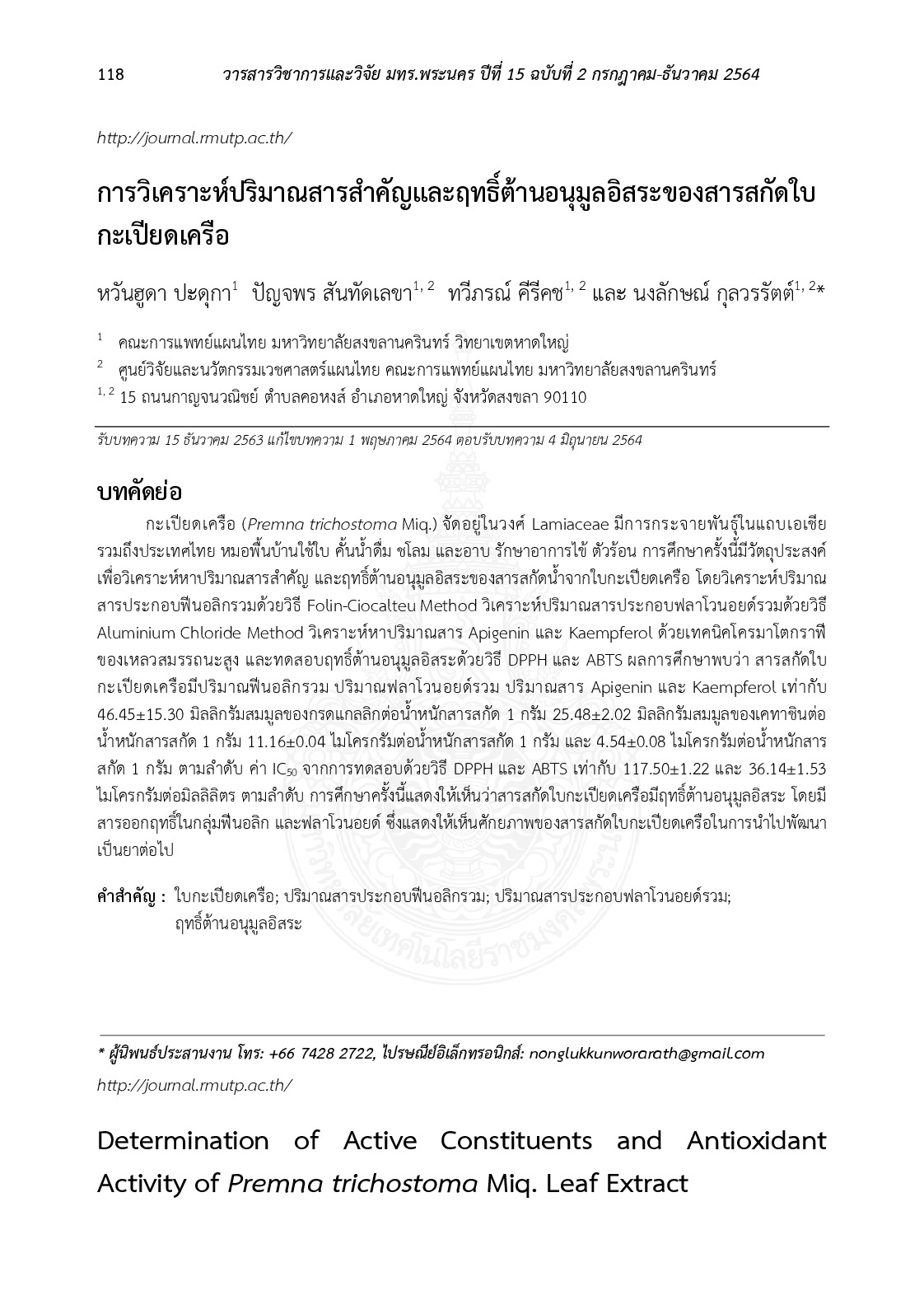
การวิเคราะห์ปริมาณสารสำคัญและฤทธิ์ต้านอนุมูลอิสระของสารสกัดใบกะเปียดเครือ
Premna trichostoma Miq. (Lamiaceae) mainly distribute in Asia including Thailand. Folk healers use this plant to treat fever as a juice splash and bathe. The aims of this study are to evaluate the quantity of active constituents and antioxidant activity of P. trichostoma leaf extract. Total phenolic compounds were determined using Folin-Ciocalteu method. Total flavonoid contents were determined by Aluminum chloride method. The amount of apigenin and kaempferol contents were analyzed by high performance liquid chromatography (HPLC). In addition the antioxidant activity was evaluated by DPPH and ABTS assay. The results showed that total phenolic contents total flavonoid contents and the amount of apigenin and kaempferol of P. trichostoma leaf extract was 46.45±15.30 mg GAE/g extract 25.48±2.02 mg CE/g extract 11.16±0.04 and 4.54±0.08 µg/g extract respectively. The IC50 values from the DPPH and ABTS assay was 117.50±1.22 and 36.14±1.53 µg/ml respectively. This study shows the antioxidant properties and active constituents of P. trichostoma leaf extract which indicates the potentials for further development of this plant
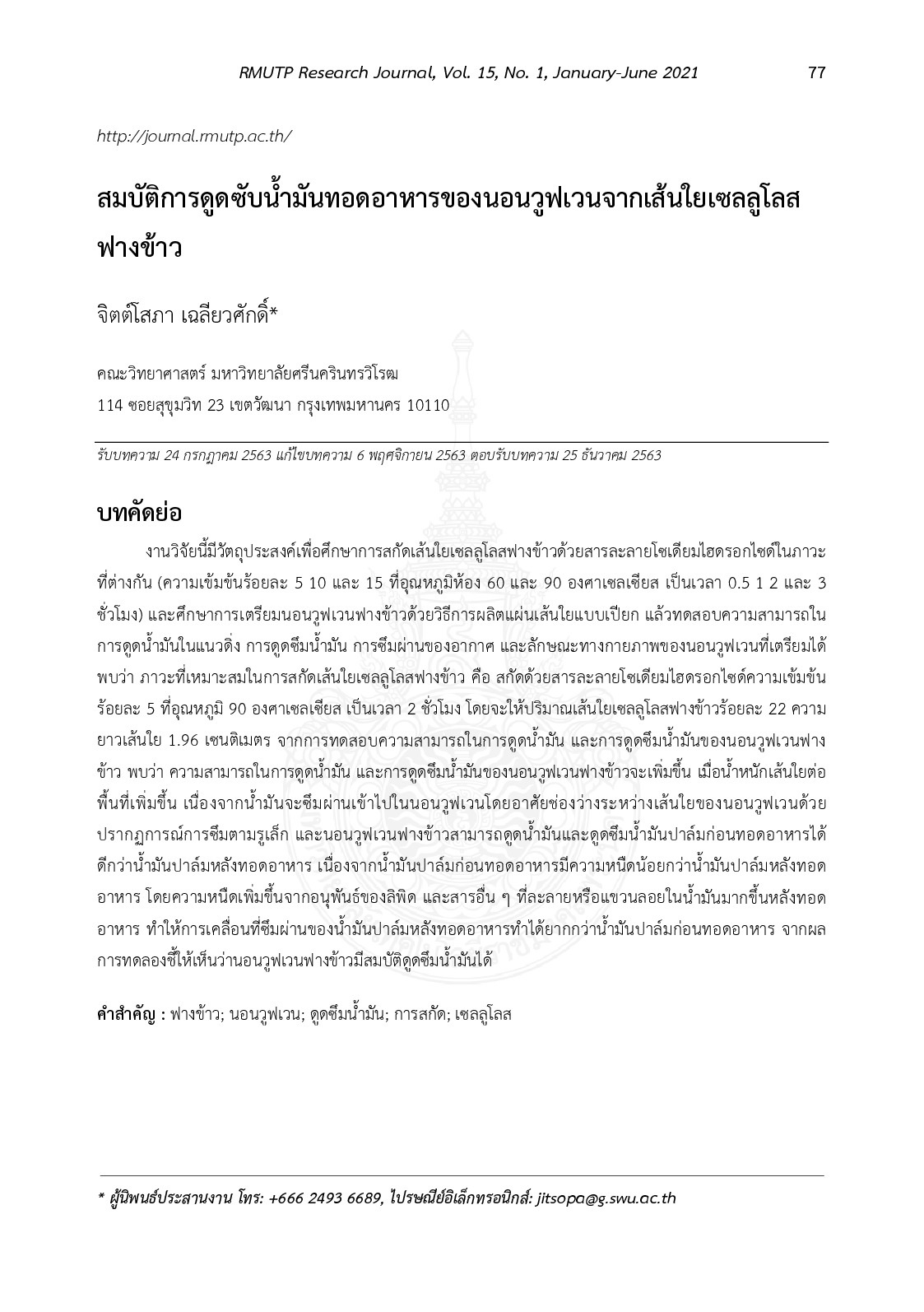
สมบัติการดูดซับน้ำมันทอดอาหารของนอนวูฟเวนจากเส้นใยเซลลูโลสฟางข้าว
The objectives of this research were to study cellulose fiber extraction from rice straw with sodium hydroxide in various conditions (with 5 1 0 and 1 0 % of sodium hydroxide at room temperature 60ºC and 90 ºC for 0.5 1 2 and 3 hours) and to study rice straw nonwovens preparation by the wet-laid process. Oil wicking ability oil absorption ability air permeability morphology and physical properties of prepared nonwovens were investigated. It was found that the optimal condition for cellulose fiber extraction from rice straw was 5% of sodium hydroxide at 90 ºC for 2 hours. At this condition the cellulose fiber yield of 2 2% and the fiber length of 1 . 9 6 cm were obtained. The oil wicking ability and oil absorption ability of rice straw nonwovens increased when weight per unit area increased. Therefore oil absorbed into gaps between fibers of the nonwovens by capillary effect. Moreover the nonwovens could wick and absorb virgin palm oil better than fried palm oil because virgin palm oil has a lower viscosity than fried palm oil. The viscosity increased from derived lipid and other substances which dissolve and disperse increasing after frying food. The results indicated that the rice straw nonwovens had oil absorption ability.
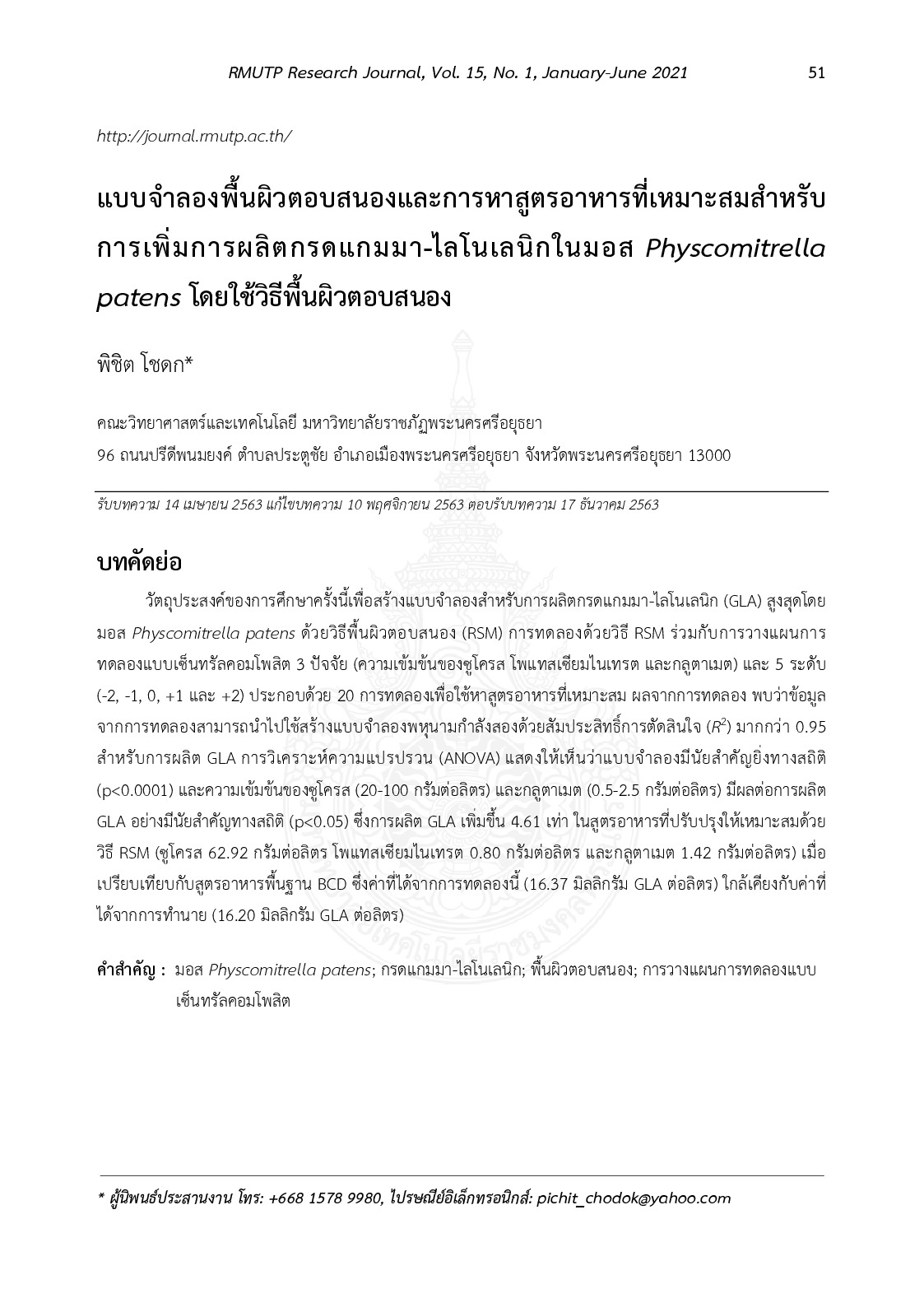
แบบจำลองพื้นผิวตอบสนองและการหาสูตรอาหารที่เหมาะสมสำหรับการเพิ่มการผลิตกรดแกมมา-ไลโนเลนิกในมอส Physcomitrella patens โดยใช้วิธีพื้นผิวตอบสนอง
The objective of this study is to obtain a model that maximize production of γ-linolenic acid (GLA) by the moss Physcomitrella patens employing response surface methodology (RSM). The RSM with a three-variables (sucrose potassium nitrate and glutamate concentrations) and five-level (-2 -1 0 1 and 2) central composite design (CCD) including 20 experimental runs was employed to optimize the medium composition. Results showed that the experimental data could be appropriately fitted into a second-order polynomial model with a coefficient of determination (R2) more than 0 .9 5 for GLA production. Analysis of variance (ANOVA) revealed that the model was highly significant (p<0.0001) and the effects of the sucrose (20-100 g/L) and glutamate (0.5-2.5 g/L) concentrations on GLA production were significant (p<0.05). The GLA production with the optimized culture medium (sucrose concentration of 62.92 g/L potassium nitrate of 0.80 g/L and glutamate concentration of 1 .4 2 g/L) by RSM increased 4.61 folds when compared with the standard BCD medium. This experimental value (16.37 mg GLA/L) fit well with the predicted values (16.20 mg GLA/L).