จำนวน Repository ( 26 )
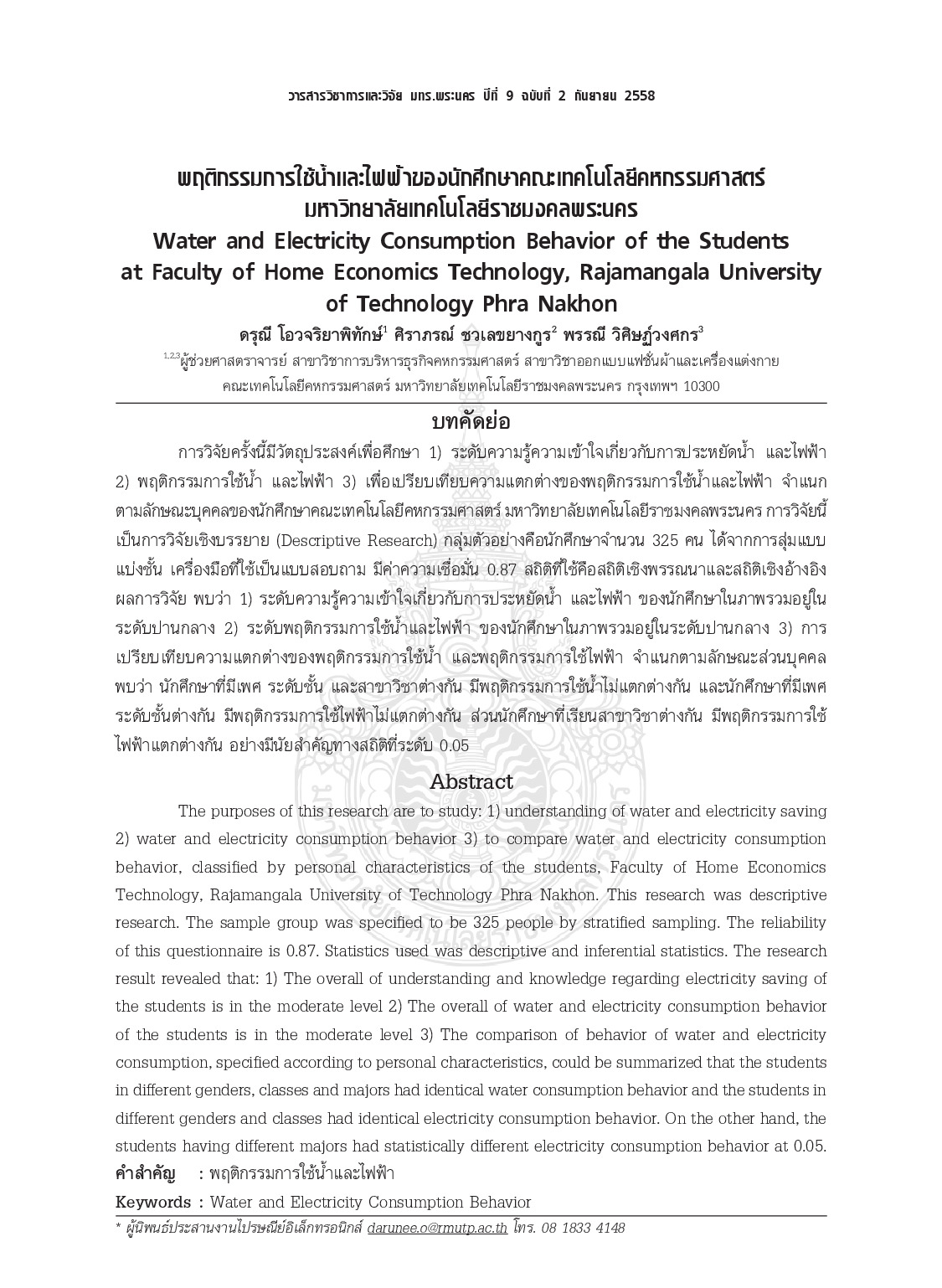
พฤติกรรมการใช้น้ำ และไฟฟ้าของนักศึกษาคณะเทคโนโลยีคหกรรมศาสตร์ มหาวิทยาลัยเทคโนโลยีราชมงคลพระนคร
The purposes of this research are to study: 1) understanding of water and electricity saving 2) water and electricity consumption behavior 3) to compare water and electricity consumption behavior classified by personal characteristics of the students Faculty of Home Economics Technology Rajamangala University of Technology Phra Nakhon. This research was descriptive research. The sample group was specified to be 325 people by stratified sampling. The reliability of this questionnaire is 0.87. Statistics used was descriptive and inferential statistics. The research result revealed that: 1) The overall of understanding and knowledge regarding electricity saving of the students is in the moderate level. 2) The overall of water and electricity consumption behavior of the students is in the moderate level. 3) The comparison of behavior of water and electricity consumption specified according to personal characteristics could be summarized that the students in different genders classes and majors had identical water consumption behavior and the students in different genders and classes had identical electricity consumption behavior. On the other hand the students having different majors had statistically different electricity consumption behavior at 0.05.
การศึกษาคุณธรรมจริยธรรมของนักศึกษา กรณีศึกษา นักศึกษาคณะเทคโนโลยีคหกรรมศาสตร์ มหาวิทยาลัยเทคโนโลยีราชมงคล
This research has the objectives to study about level of virtue and ethics and to compare virtue and ethics of students Faculty of Home Economics Technology Rajamangala University of Technology Phra Nakhon categorizing according to personal factors. This research is descriptive research. Sample group used in this research comprised students of Faculty of Home Economics Technology Rajamangala University of Technology Phra Nakhon. The sample group comprised 321 students. The research took samples by using stratified sampling. Tools used in data analyzing are questionnaires divided into three parts Part 1 : questions on personal background ; Part 2 : questionnaires on behavior regarding virtues and ethics of students ; part 3 composed of questionnaire regarding opinion on virtue and ethics of students including students of Faculty of Home Economics Technology Rajamangala University of Technology Phra Nakhon. Statistics used in data analysis included frequency percentage mean standard deviation and in testing of hypothesis using t-test statistics and ANOVA to analyze variance testing difference in pair by LSD methods. The research result found that 1. The research result found that level of behavior in virtue and ethics of students of Faculty of Home Economics Technology Rajamangala University of Technology Phra Nakhon in the overview the behavior was in very good level (x= 3.96). When the criterion It is in a very good level of 4 parts. Include The behavior in virtue and ethics in the aspect of pressure factors (x= 3.84). The behavior in virtue and ethics in the aspect of nourishing factors (x= 4.10). The behavior in virtue and ethics in the aspect of arresting factors (x= 3.84); the behavior in virtue and ethics in the aspect of supporting factors (x= 4.08). 2. Comparing difference of the behavior in virtue and ethics of students Faculty of Home Economics Technology Rajamangala University of Technology Phra Nakhon categorizing according to personal factors; the result was that students having different genders residence description and occupation of parents did not have different behavior in virtue and ethics. Students studying in different class levels and having different study result; had different behavior in virtue and ethics with
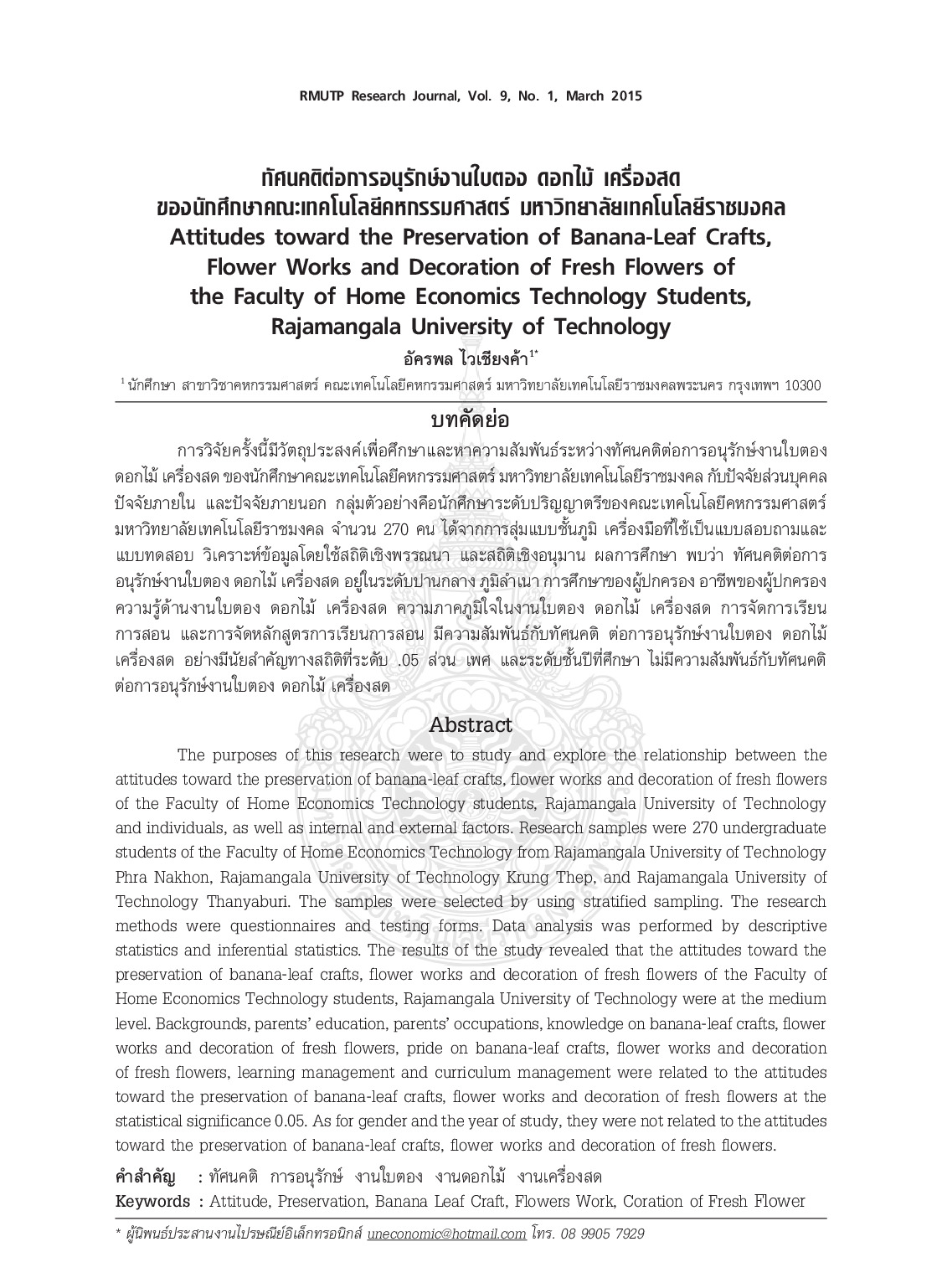
Attitudes toward the preservation of banana-leaf crafts, flower works and decoration of fresh flowers of the faculty of home economics technology students, Rajamangala University of Technology
The purposes of this research were to study and explore the relationship between the attitudes toward the preservation of banana-leaf crafts flower works and decoration of fresh flowers of the Faculty of Home Economics Technology students Rajamangala University of Technology and individuals as well as internal and external factors. Research samples were 270 undergraduate students of the Faculty of Home Economics Technology from Rajamangala University of Technology Phra Nakhon Rajamangala University of Technology Krung Thep and Rajamangala University of Technology Thanyaburi. The samples were selected by using stratified sampling. The research methods were questionnaires and testing forms. Data analysis was performed by descriptive statistics and inferential statistics. The results of the study revealed that the attitudes toward the preservation of banana-leaf crafts flower works and decoration of fresh flowers of the Faculty of Home Economics Technology students Rajamangala Univers
ปัจจัยที่ส่งผลต่อเจตคติต่อการทำงานในโรงงานอุตสาหกรรมเสื้อผ้าของนักศึกษา คณะเทคโนโลยีคหกรรมศาสตร์ มหาวิทยาลัยเทคโนโลยีราชมงคลพระนคร
This research aims to study the factors affecting the attitude of students in faculty of home economics technology towards work in factory of garment industry. Contain factor of personal characteristics of students the family background of students and the learning environment of students. Population is divisions of fashion merchandising technology and fashion clothing & textile design class 1-4 of Year 2555 total 210 people. Tool used was the questionnaire. Statistics used were percentage mean standard deviation correlation coefficient of Pearson and multiple regression analysis. The results showed factors affecting attitude towards work in factory of garment industry of students in faculty of home economics technology statistically significant at the .01 level has 3 factors. Sort by factors affecting most to the least 1) learning environment of students 2) Number of subjects for textile cutting and sewing learned ever 3) Personal characteristics of students and could explain the variability of attitude towards work in factory of garment industry at 77.1 percent of this population.
พฤติกรรมการใช้น้ำ และไฟฟ้า ของนักศึกษาคณะเทคโนโลยีคหกรรมศาสตร์ มหาวิทยาลัยเทคโนโลยีราชมงคลพระนคร
The purposes of this research are to study water and electricity consumption behavior of the students to study understanding of water and electricity saving and to compare the difference of water and electricity consumption behavior classified as personal characteristic of the students Faculty of Home Economics Technology Rajamangala University of Technology Phra Nakhon. This research was descriptive research. The sample group used in the research was the students Faculty of Home Economics Technology Rajamangala University of Technology Phra Nakhon. Size of the sample group was specified to be 325 people by stratified sampling. The tool used in data analysis was questionnaire divided into 3 parts including part 1: questions regarding general details of a respondent part 2: questions regarding knowledge of water and electricity saving consumption the students of Faculty of Home Economics Technology Rajamangala University of Technology Phra Nakhon and part 3: questions regarding water and electricity consumption behavior of the students Faculty of Home Economics Technology Rajamangala University of Technology Phra Nakhon. The statistics used in data analysis consisted of frequency percentage mean standard deviation and hypothesis testing using t-test and ANOVA (Analysis of Variance) for testing parallel difference by LSD method. The research result found that: 1. The level of water and electricity consumption behavior of the students Faculty of Home Economics Technology Rajamangala University of Technology Phra Nakhon was overall in the moderate level. 2. The level of understanding and knowledge regarding water and electricity saving of the students Faculty of Home Economics Technology Rajamangala University of Technology Phra Nakhon was overall in the moderate level. 3. The comparison of different behavior of water and electricity consumption specified according to personal characteristics could be summarized that the students having different gender class and major had identical water consumption behavior and the students having different gender class and major had identical electricity consumption behavior. On the other hand the students having different major had statistical significance in electricity consumption behavior at 0.05