จำนวน Repository ( 96 )
การขึ้นรูปวัสดุสังเคราะห์เส้นใยธรรมชาติภายใต้สภาวะความดันและอุณหภูมิสูงเพื่อผลิตชิ้นส่วนยานยนต์
Currently the automotive industry plays an important role on the economic growth in Thailand. As the same time the waste of automotive parts has increased as well. As a results the automotive parts made from three different natural fiber parts was studied consisting of hyacinths sugarcane and pineapple leaf fiber. By of 50 x 250 x 20 mm of mold dimension the specimens were produced under 700 W of heating stick and measured temperature by a K type of thermometer. There were 3 same proportion specimens made from: 1) sugar cane fiber: husk: latex adhesive 2) water hyacinth fiber: husk: latex adhesive 3) pineapple fiber: husk: latex adhesive in the ratio of 25:25:50 by weight which were formed under temperature between 100GC and 105°C at 5 MPa of pressure and leading to find out the bending moment ability. The test results show that the specimen made from sugar cane fiber has the highest value 5482.5 Nand 4061.11 N/mm2 of bending moment and bending stress respectively. It was more than specimen made of water hyacinth 29.84 % and pineapple fiber 65.01 %.
การใช้ประโยชน์จากเส้นใยผักตบชวาในผลิตภัณฑ์แผ่นใยอัดซีเมนต์ภายนอกอาคารสำหรับวิสาหกิจชุมชน
This research aims to study the water hyacinth fiber inside high-density fiber cement board. By using ratio components among cement : fine sand : water hyacinth fiber : water : catalyst accelerated the formations of cement (aluminum sulfate (AI2 (SO4) 3) calcium chloride (CaCl2) sodium silicate (Na2SiO3)) on the ratio 1: 0.2: 0.075: 0.3: 0.03 by weight of total water hyacinth fiber with the steel grating inside. By compressing the mixture cast machine at normal temperature (30 - 35 °C). From the test results the ratio of B4 is the appropriate ratio from the 1st year research result to produce the high-density fiber cement board with the steel grating inside 0.81mm #0.5”. It can pass the TIS 878-2537 standard of Cement Board and good based-on high density and physical properties mechanical properties and thermal insulation. Accelerate the formation of the most suitable cement is calcium chloride (CaCl2).
การพัฒนาผลิตภัณฑ์แผ่นยิปซัมประเภททนไฟผสมเส้นใยจากใบต้นข้าวโพดสำหรับใช้ในอาคารประหยัดพลังงาน
This research aims to develop the gypsum refractory board mixed with corn leaf coir. The 5 ratios of gypsum plaster: corn leaf coir: tap water: sodium silicate are equal to 1: 0: 1: 0.03 1: 0.100: 1: 0.03 1: 0.150: 1: 0.03 1: 0.200: 1: 0.03 1: 0.250: 1: 0.03 และ 1: 0.300: 1: 0.03 by weighted. The gypsum refractory boards were produce by casting in normal temperature (30 – 35 degree of Celsius). The properties testing of gypsum refractory board mixed with corn leaf coir followed the TIS 219-2009 standard (gypsum plasterboard) included: breaking load nail pull resistance deflection water absorption density and thermal conductivity coefficient. From the results 1: 150: 1: 0.03 is the most suitable ratio of gypsum refractory board mixed with corn leaf coir. This developed gypsum refractory boards can reduce the quantity of corn leaf waste and get the good thermal insulation gypsum refractory board products.
การพัฒนาคุณภาพเส้นใยไหมด้วยนาโนเทคโนโลยี เพื่อกลุ่มธุรกิจเกษตรกรเลี้ยงหนอนไหมจังหวัดสุรินทร์
This research is to study the quality development of silk fibers by nanotechnology for the Silkworm farmer business groups of Surin Province. The research purposes are to study the efficiency and process of silkworm rearing using nanotechnology. To test the quality of silk fibers obtained from raising silkworms using nanotechnology. To compare of silkworm rearing results using nanotechnology and to transfer technology to improve silk quality with nanotechnology for silkworm farming business group in Surin Province. The results are as follows 1. The researchers designed the recording schedule which the party can record the changes easily of silk worm development during each day. This research allows the researchers to collect data from the farmer is more easily and finely into 4 groups of experiments with 3 nanotechnology formulas: 1. ZINC OXIDE 2. SILVER NANO and 3. ZINC OXIDE and SILVER NANO with 50:50 percentages each. The silk used in the experiment was “Nang Noi” which is popularly silkworm variety in every household in Surin province.When experimenting must clean the house and rinsing the container with DI WATER for aperiod of 7 months 2. This research is divided into 4 groups. Group 1: Silkworm feed normal methods without the use of nanotechnology. Group 2 silkworms feed with Nano substances such as ZINC OXIDE SILVER NANO ZINC OXIDE and SILVER NANO in 15 percentage concentration. Group 3 silkworms feed with Nano substances are ZINC OXIDE SILVER NANO ZINC OXIDE and SILVER NANO with 30 percentage concentration. Group 4 silkworms feed with Nano substances are ZINC OXIDE SILVER NANO ZINC OXIDE and SILVER NANO with 45 percentage concentration 3. The Results and comparison of silkworm rearing using nanotechnology the best formula feed is formula 1. When feeding Nano-sprayed on mulberry leaves using 3% 15% zinc silver and silver zinc it is found that the growth of worms in each age was good growth and not being a disease. Moreover Silkworms are slightly better and more alert than normal farming. The length in ages 3 - 4 - 5 is going in a better direction. Amount of eating mulberry leaves in each age. As usually eating more in ages 2 and 3 after passing the silk production process and testing the quality of silk fibers in the laboratory were found that the silk fibers are smooth not lacking toughness: Tenacity at 3.06 4.60 and 4.60 respectively and also result in fiber amount increase and also the color of the silk fibers is golden quite clear beautiful and consistent color. 4. When technology transfer to the Silkworm farmer business groups of Surin Province as workshop for 3 days. Most participants are satisfied with the highest levels in all questions.
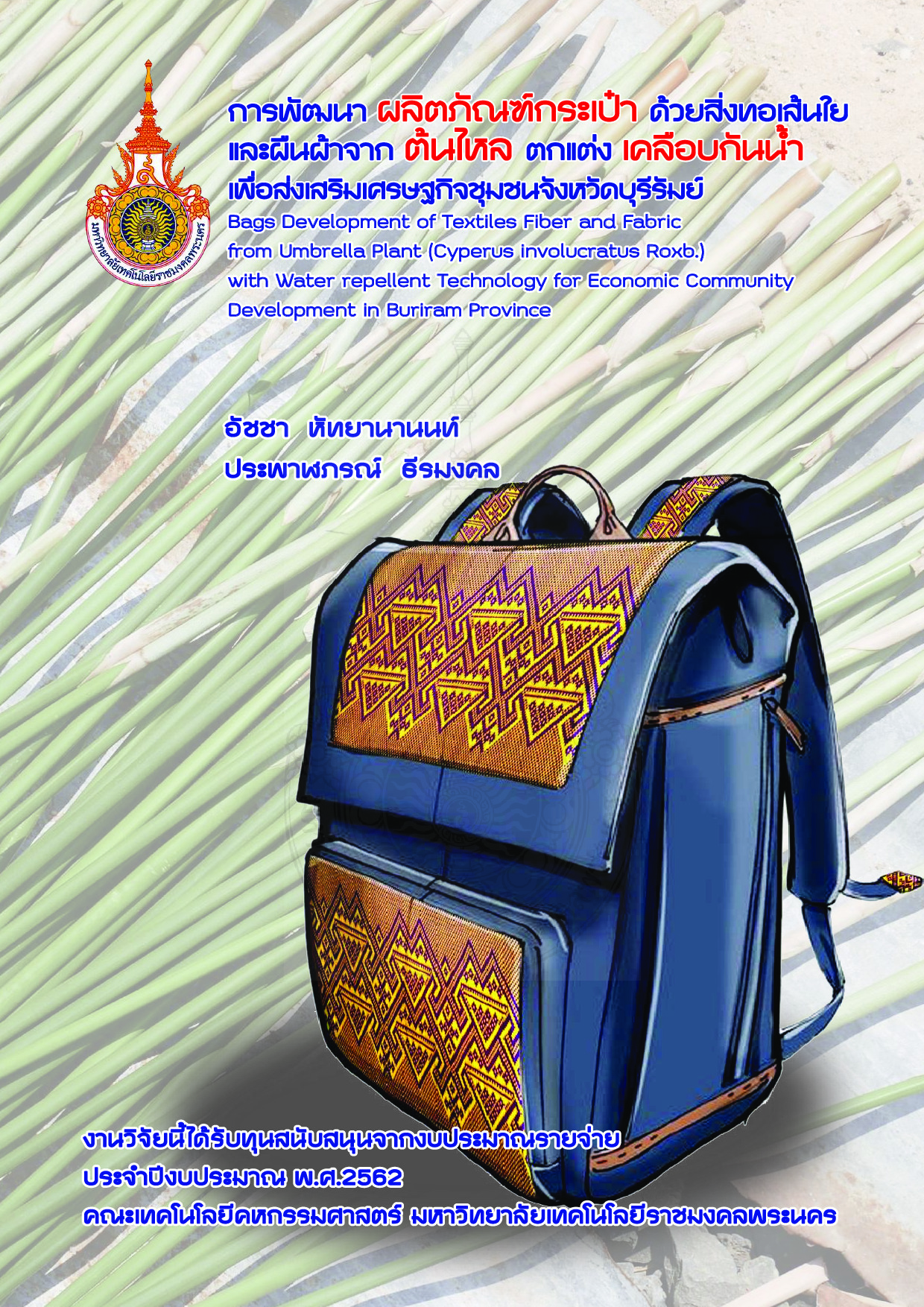
การพัฒนาผลิตภัณฑ์กระเป๋าด้วยสิ่งทอเส้นใยและผืนผ้า จากต้นไหลตกแต่งเคลือบกันน้ำ เพื่อส่งเสริมเศรษฐกิจชุมชนจังหวัดบุรีรัมย์
The proposes of this research were to study the development of bag products with textiles fibers and fabrics from decorative flowing water-resistant coating to promote community economy in Buri Ram Province. With the objective To study the process of producing yarn from fibers from the flow source To design and develop textile and bag products from yarn from the Lai Ton To study the effect of coating with waterproofing on bag products using textiles fibers and fabric from the flow. And to transfer knowledge and technology for utilization to community groups and interested people in next fiscal year This research can be summarized as follows: 1. The study of Ton Lai found that most villagers grow Lai Ton and make products as a supplementary career. In using this flow source in this research the researcher used a large flow source with a diameter of about 1 hour and can be separated into 4 small strands for research and production. The dyes used are synthetic because they will get fresh colors save time and be consistent. 2. The researcher designed 2 designs of weaving designs with the idea of using the original pattern to add edit and then create the pattern that the community groups like and can actually produce it as a product. After getting the fabric pattern then design into 10 bags of women and men bags using leather as an ingredient Decorate the bag to look interesting increase the price and increase the target audience. Which will be different from the original. That uses colored fabric and striped fabric as decorative items. 3. Coating with waterproofing on the bag products with textiles fibers and fabrics from the flow found that the fabric that has been coated with water repellent. When pouring water on the water surface there is a clumping together. No water penetration through fibers. When wiping clean the fibers are still dry not wet. Which is different from fabric that has not been coated namely water is able to penetrate immediately and create moisture on the fabric surface. If stored for a long time it can cause mold. 4. Schedule of technology transfer with the plan to transfer the research in the budget year 2020. For 3 day knowledge transfer and workshop was 30 participants. The group consisted of weaving mats from Ban Bu community Chorakhe Mak Subdistrict Prakhon Chai District. Buriram province