จำนวน Repository ( 35 )
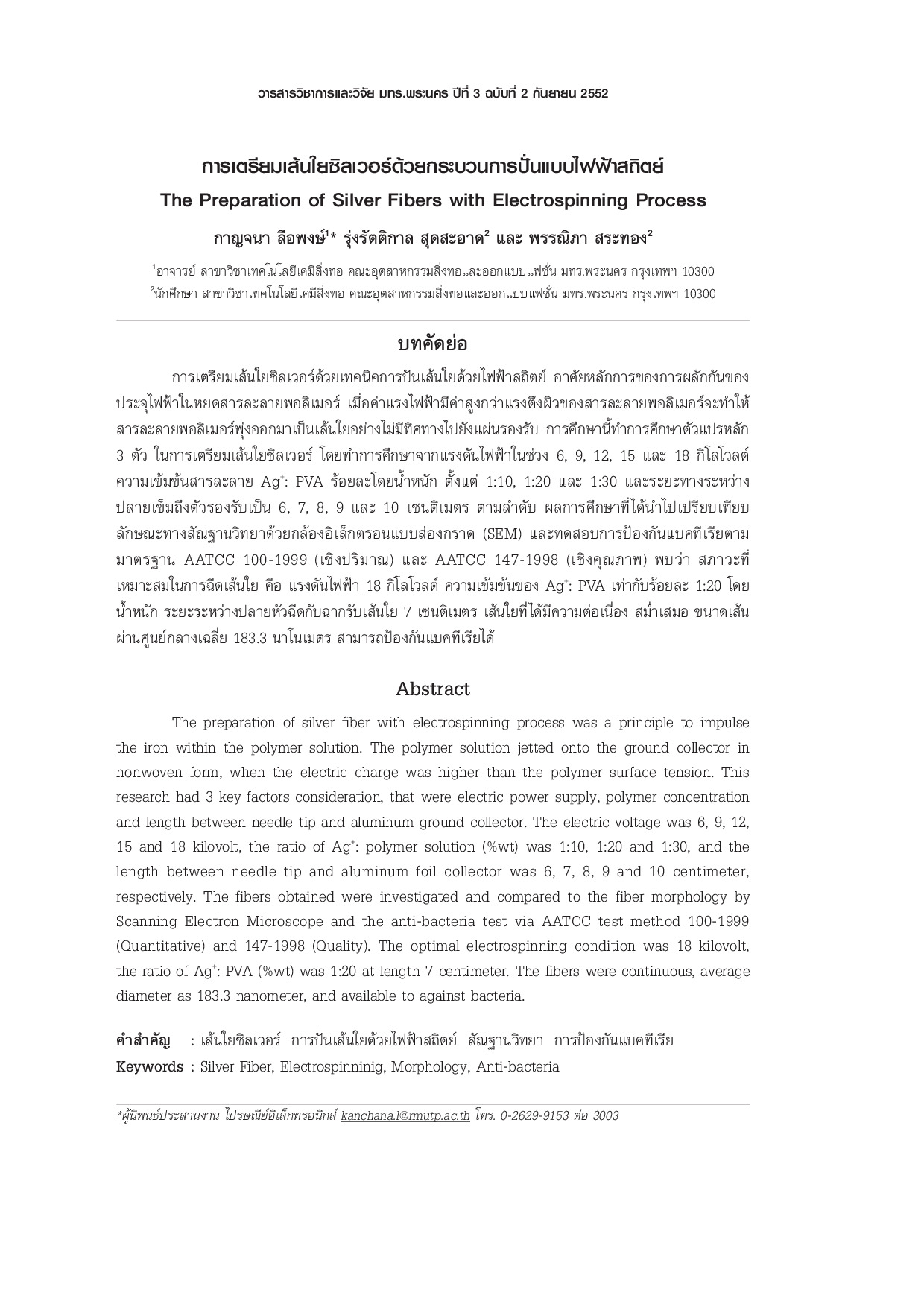
The Preparation of Silver Fibers with Electrospinning Process
The preparation of silver fiber with electrospinning process was a principle to impulse the iron within the polymer solution. The polymer solution jetted onto the ground collector in nonwoven form when the electric charge was higher than the polymer surface tension. This research had 3 key factors consideration that were electric power supply polymer concentration and length between needle tip and aluminum ground collector. The electric voltage was 6 9 12 15 and 18 kilovolt the ratio of Ag : polymer solution (%wt) was 1:10 1:20 and 1:30 and the length between needle tip and aluminum foil collector was 6 7 8 9 and 10 centimeter respectively. The fibers obtained were investigated and compared to the fiber morphology by Scanning Electron Microscope and the anti-bacteria test via AATCC test method 100-1999 (Quantitative) and 147-1998 (Quality). The optimal electrospinning condition was 18 kilovolt the ratio of Ag : PVA (%wt) was 1:20 at length 7 centimeter. The fibers were continuous average diameter as 183.3 nanometer and available to against bacteria.
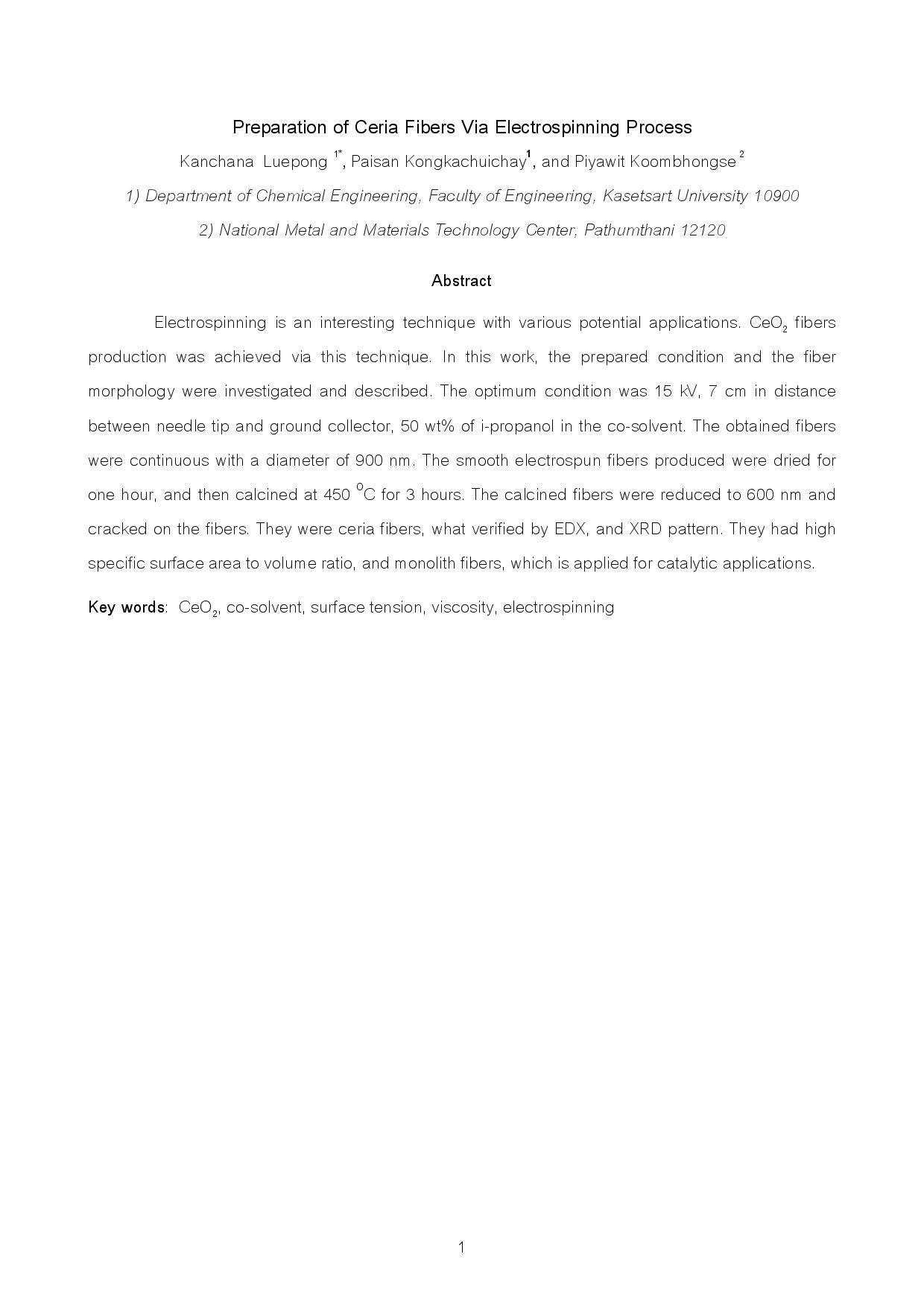
Preparation of Ceria Fibers Via Electrospinning Process
Electrospinning is an interesting technique with various potential applications. CeO2 fibers production was achieved via this technique. In this work the prepared condition and the fiber morphology were investigated and described. The optimum condition was 15 kV 7 cm in distance between needle tip and ground collector 50 wt% of i-propanol in the co-solvent. The obtained fibers were continuous with a diameter of 900 nm. The smooth electrospun fibers produced were dried for one hour and then calcined at 450 OC for 3 hours. The calcined fibers were reduced to 600 nm and cracked on the fibers. They were ceria fibers what verified by EDX and XRD pattern. They had high specific surface area to volume ratio and monolith fibers which is applied for catalytic applications.
ผลของเส้นใยธรรมชาติและการปรับปรุงผิวที่มีต่อสมบัติทางความร้อนและกายภาพของพอลิแลคติกแอซิด
his research work aimed to study the effects of the addition of sisal fiber and surface treatment by epoxy silane on the physical and thermal properties of polylactic acid (PLA). Specimens of PLA and unidirectional fiber-reinforced composite were processed by a compression molding machine and evaluated the physical and thermal properties by water absorption measurement and differential scanning calorimetry (DSC) analysis respectively. The result showed that water absorption tended to increase by adding sisal fiber whereas surface treatment of sisal fiber by epoxy silane improved water resistance of composites. The water absorption values at immersion time of 5 days were 0.89 1.13 and 1.26 % for PLA PLA/treated sisal fiber composite and PLA/untreated sisal fiber composite respectively. For thermal properties the addition of sisal fiber led to decreases in glass transition temperature and crystallinity. These were because the presence of continuous fiber might interfere with the crystallization of PLA. The surface treatment of continuous fiber with epoxy silane led to difficult crystallization. The good interfacial adhesion interrupted PLA alignment.
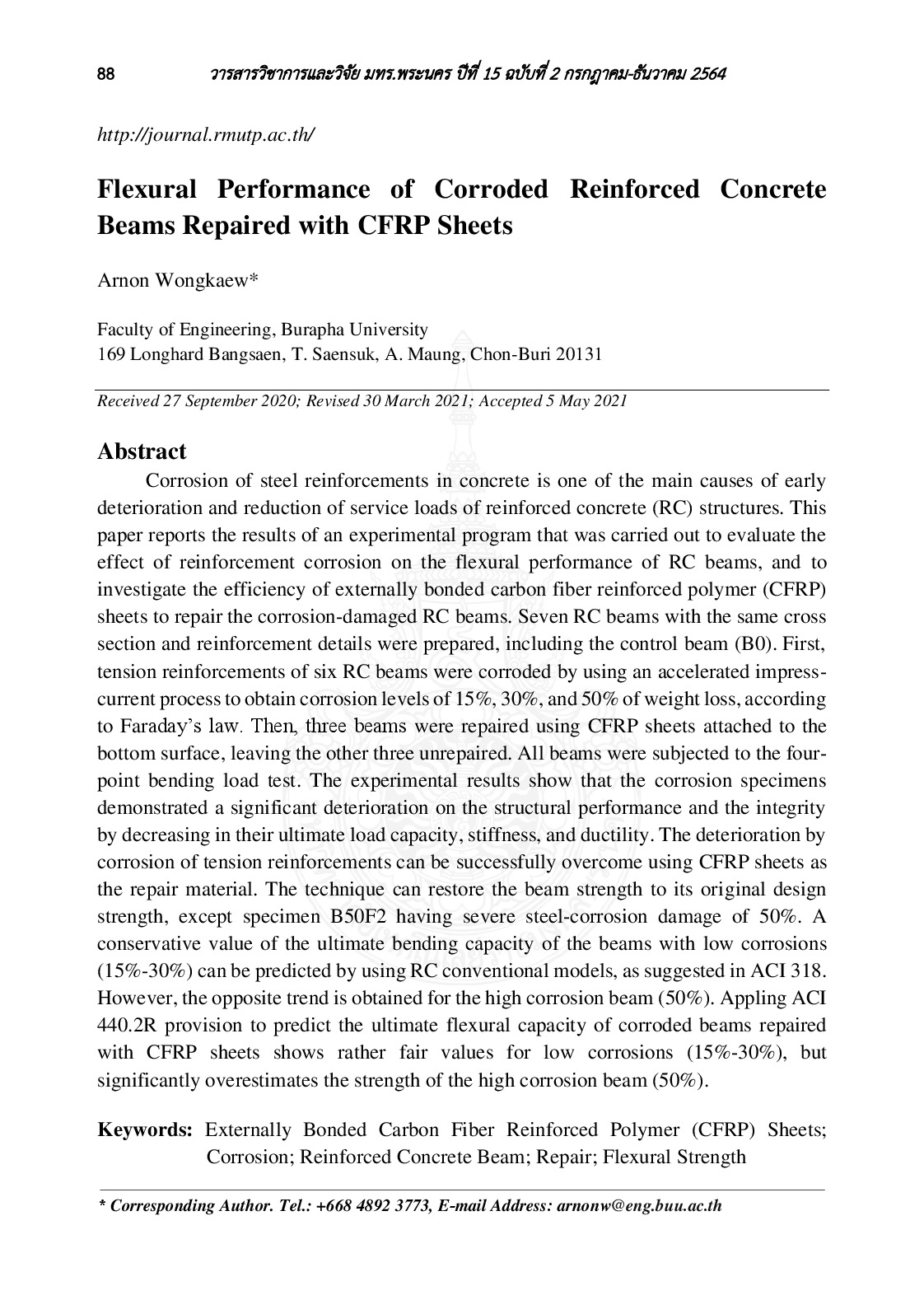
Flexural performance of corroded reinforced concrete beams repaired with CFRP sheets
Corrosion of steel reinforcements in concrete is one of the main causes of early deterioration and reduction of service loads of reinforced concrete (RC) structures. This paper reports the results of an experimental program that was carried out to evaluate the effect of reinforcement corrosion on the flexural performance of RC beams and to investigate the efficiency of externally bonded carbon fiber reinforced polymer (CFRP) sheets to repair the corrosion-damaged RC beams. Seven RC beams with the same cross section and reinforcement details were prepared including the control beam (B0). First tension reinforcements of six RC beams were corroded by using an accelerated impress-current process to obtain corrosion levels of 15% 30% and 50% of weight loss according to Faraday’s law. Then three beams were repaired using CFRP sheets attached to the bottom surface leaving the other three unrepaired. All beams were subjected to the four-point bending load test. The experimental results show that the corrosion specimens demonstrated a significant deterioration on the structural performance and the integrity by decreasing in their ultimate load capacity stiffness and ductility. The deterioration by corrosion of tension reinforcements can be successfully overcome using CFRP sheets as the repair material. The technique can restore the beam strength to its original design strength except specimen B50F2 having severe steel-corrosion damage of 50%. A conservative value of the ultimate bending capacity of the beams with low corrosions (15%-30%) can be predicted by using RC conventional models as suggested in ACI 318. However the opposite trend is obtained for the high corrosion beam (50%). Appling ACI 440.2R provision to predict the ultimate flexural capacity of corroded beams repaired with CFRP sheets shows rather fair values for low corrosions (15%-30%) but significantly overestimates the strength of the high corrosion beam (50%).
Properties of polypropylene conductive fiber from sheath-core bicomponent fiber
This is the study of a conductive sheath-core bicomponent fibers. The intentions of the experiments were to investigate feasibility of conductive sheath-core bicomponent fiber forming using selected materials and the fibers’ properties. The trails were to extrude the bicomponent fibers with conductive materials in sheath section and supporting materials in core section. The conductive carbon black was selected as conductive material to compound with polypropylene. The virgin polypropylene was chosen as core material in the fibers. It was problematic to form fibers using the conductive carbon black polypropylene compound alone therefore the virgin polypropylene was used as the core section in the fibers to promote production stability. The sheath-core carbon black compound bicomponent fibers were steadily produced with designated machine settings. The produced fibers were tested for their physical and mechanical properties and electrical conductivity. The results shows that the fibers with the carbon black polypropylene compound as the fibers’ sheath section and the virgin polypropylene as the fibers’ core section have conductive property. The conductivity of the fibers increased when their sheath sections were thicker as the ratio of the carbon black compound become higher. Even though thicker sheath section of the fibers (40% and over) have higher conductivity the physical properties of the fibers become weaken and less applicable as textile fibers.