จำนวน Repository ( 19 )
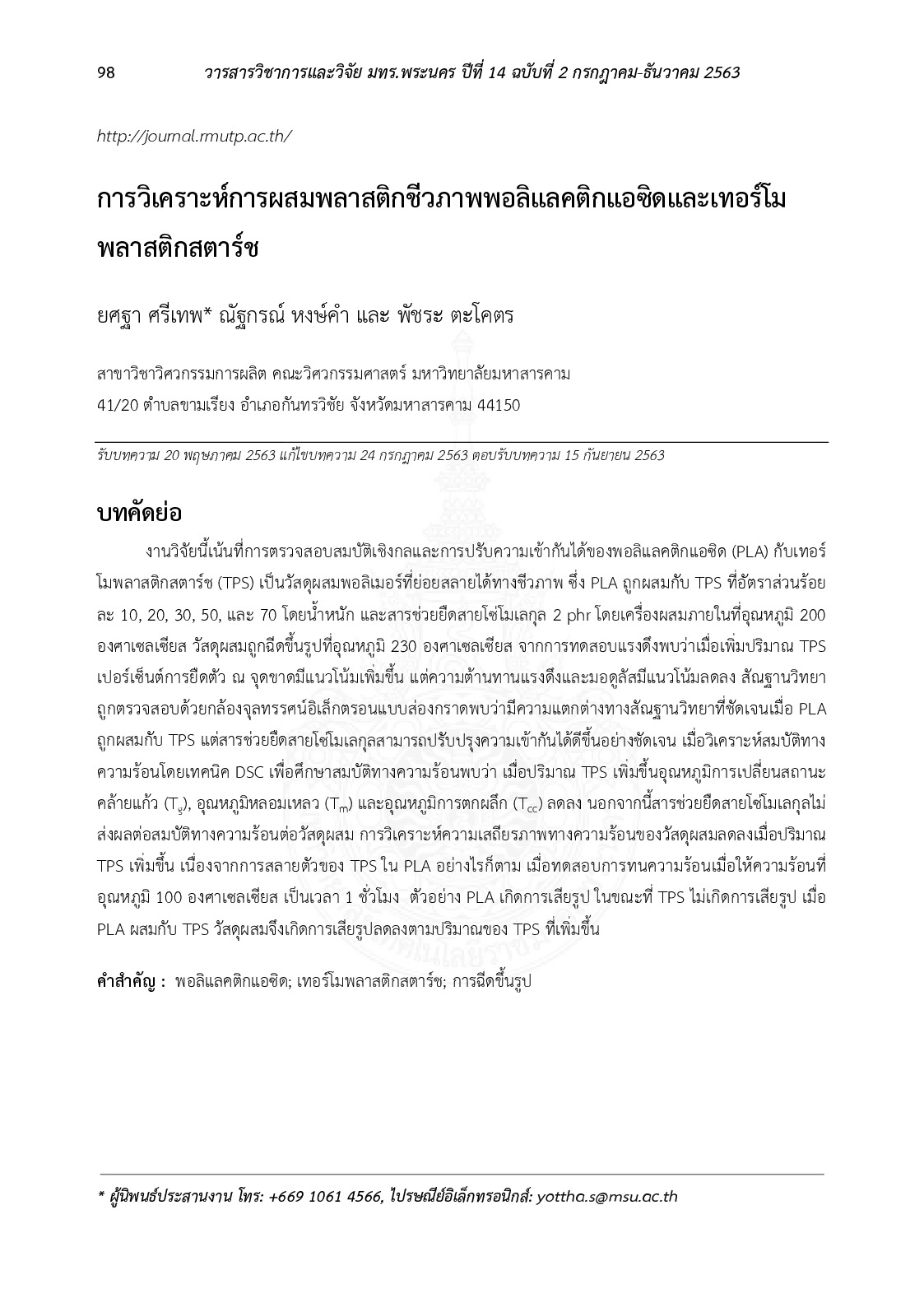
การวิเคราะห์การผสมพลาสติกชีวภาพพอลิแลคติกแอซิดและเทอร์โมพลาสติกสตาร์ช
This research was concentrated on characterized mechanical properties and adjusted compatibility of poly (lactic acid) (PLA) with thermoplastic starch (TPS) as biodegradable polymers composites. PLA was blended with TPS at the proportion of 10 20 30 50 and 70 wt% as well as 2 phr chain extender by an internal mixer at 200°C. The blended materials were then injection molded at 230°C. Tensile testing showed that as the amount of TPS increase the elongation at break tended to increase but the tensile strength and modulus tended to decrease. The morphology was investigated by scanning electron microscope. It was found that distinct phase between PLA and TPS was observed. Yet adding the chain extender clearly improved the compatibility between PLA and TPS. The blended materials were also analyzed by differential scanning calorimetry method to study thermal properties. It was found that as the amount of TPS increased the glass transition temperature (Tg) melting temperature (Tm) and cold crystallization temperature (Tcc) deceased. Additionally chain extenders did not affect thermal properties. The thermal stability of the composites decreased when increasing the amount of TPS because of the degradation of TPS in PLA. However when heated at 100ºC for 1 hr the PLA sample bent while TPS did not bend. When PLA was mixed with TPS the composite was bent according to adding TPS.
การพัฒนาคุณภาพของภาพนูนต่ำที่ทำจากวัสดุธรรมชาติชนิดต่างๆ
Based on the research on creation of bas-relief molds for production of bas-reliefs made from boiled pineapple leafs conducted by Rachadasak Pengcum of which purpose was to help generate income for members of Pineapple Leaf Paper Community Enterprise Ban Pasang Wiwat Mueang District Chiang Rai Province it was found that the bas-reliefs need further improvements in terms of appearance and durability as well as the use of other natural raw materials to produce them. The researcher therefore has considered developing the previous research by applying other 3 valueless natural materials which include rice straw water hyacinth and banana stem skin to make bas-reliefs for different beautiful surfaces of the products. Also the quality of bas-reliefs has been comparatively investigated by surveying satisfactions of members of the Community Enterprise and visitors to the project towards the bas-reliefs made from rice straw water hyacinth and banana stem skin. The total period of questionnaire distribution was 3 months. There are 59 respondents administering the questionnaires most of whom (43 persons) are female which accounts for 72.88 per cent. The majority of the respondents (25 persons) obtained junior/senior secondary school diplomas or equivalent accounting for 42.37 per cent. 16 respondents or 27.12 percent are 60 years of age. As for satisfactions towards the bas-reliefs made from rice straw 89 times of “strongly agree” was selected whereas 126 times of “pretty much agree” 75 times of “fairly agree” and 5 times of “disagree” were marked by the respondents. Concerning the bas-reliefs made from water hyacinth 87 times of “strongly agree” was selected while 97 times of “pretty much agree” 110 times of “fairly agree” and 1 time of “disagree” were chosen. When asked about the bas-reliefs made from banana stem skin the respondents selected 77 times of “strongly agree” 99 times of “pretty much agree” 110 times of “fairly agree” and 8 times of “disagree”.
การวิจัยและพัฒนาผลของอุณหภูมิต่ำที่เกี่ยวข้องต่อการเร่งการแข็งตัวของยางซิลิโคนเหลวชนิด RTV (Room temperature vulcanization)
การวิจัยฉบับนี้ได้กล่าวถึงการลดระยะเวลาการทำแม่พิมพ์ยางซิลิโคนโดยเร่งความแข็งด้วยอุณหภูมิต่ำ เนื่องจากแม่พิมพ์ยางซิลิโคนใส สามารถเก็บรายละเอียดของชิ้นงานได้ดีและสามารถมองเห็นชิ้นงานด้านในได้แต่แม่พิมพ์ยางซิลิโคนใสใช้เวลาในการแข็งตัวนาน จึงได้ศึกษาและทำการทดลองนำเอาอุณหภูมิความเย็นเข้ามาช่วยในการเร่งการแข็งตัวของซิลิโคนใสโดกำหนดอุณหภูมิเป็น 3 อุณหภูมิ ประกอบด้วย 10 5 0 องศาเซลเซียล แต่อุณหภูมิแบ่งเป็น 3 ช่วงเวลา ประกอบด้วย 2 3 4 ชั่วโมง จึงทำการการทดลองขั้นต่อไป จากการทดลองโครงการลดระยะเวลาการทำแม่พิมพ์ยางซิลิโคนใสโดยเร่งความแข็งด้วยอุณหภูมิต่ำเพื่อหาอุณหภูมิและช่วงระยะเวลาที่เหมาะสมในการเร่งความแข็งของซิลิโคนใส พบว่าที่อุณหภูมิ 5 องศาเซลเซียล ช่วงระยะเวลา 3 ชั่วโมงมีค่าความแข็งใกล้เคียงกับมาตรฐานและมีความเหมาะสมที่สุด เนื่องจากผลการทดลองพบว่าอุณหภูมิและระยะเวลาที่เหมาะสมที่สุดนั้นสามารถลดระยะเวลาการแข็งตัวของซิลิโคนใสได้ 6 ชั่งโมงและมีประสิทธิภาพใกล้เคียงกับชิ้นงานมาตรฐาน
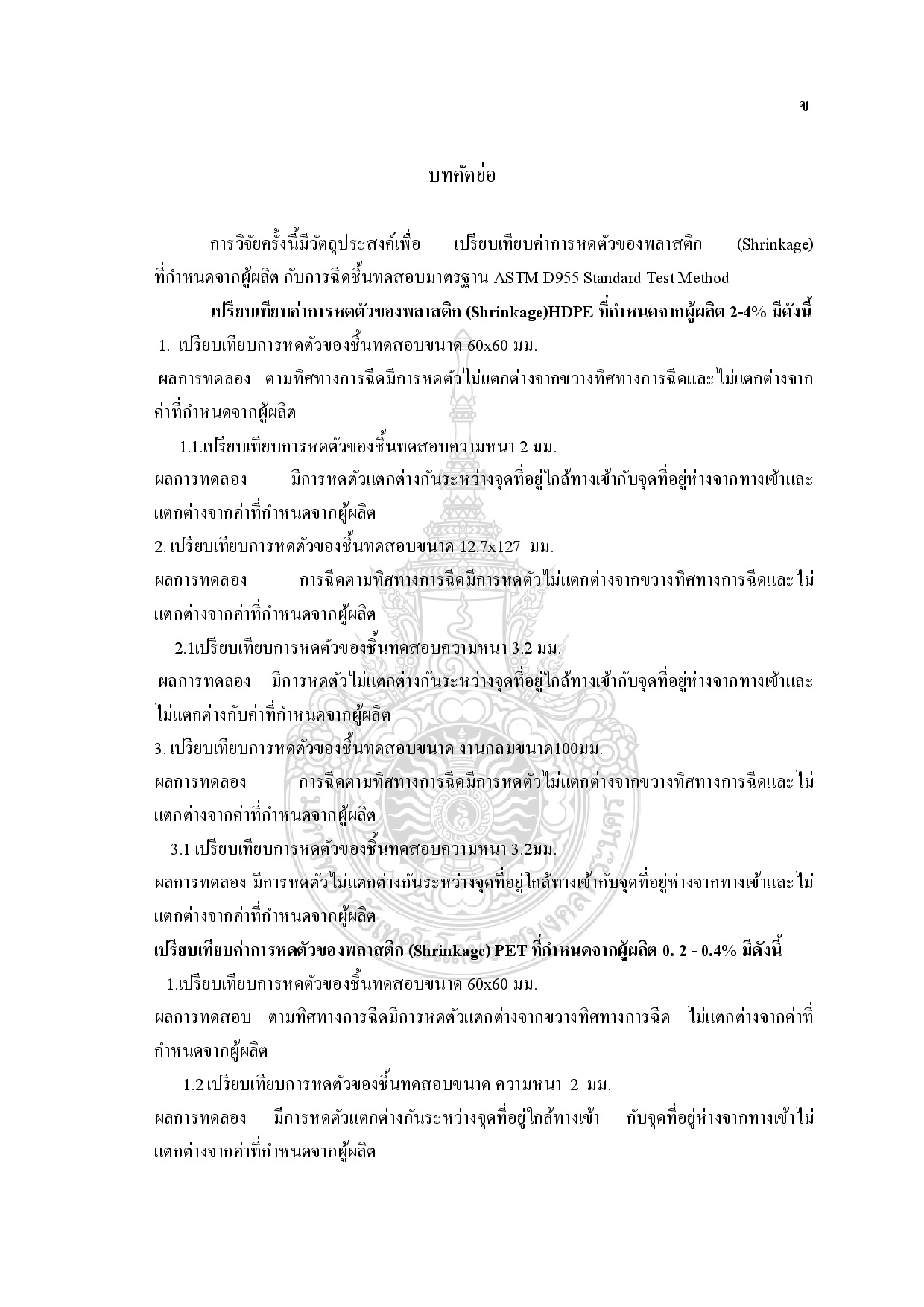
This research aims to compare the shrinkage value that limited from manufacturer with the ASTM D955 Standard Test Method
Comparing the shrinkage values of HDPE 2 – 4 % that limited from manufacturer are as the following: 1. Comparing the shrinkage of 60 X 60 mm. specimen The result showed that there aren’t any shrinkage differences among follow the injection across the injection and the limited value from the manufacturer. 1.1 Comparing the shrinkage of the specimen with 2 mm. thick The result showed that the shrinkage between at the point nearby the entrance is different from at the point further from the entrance and it is also different from the limited value from the manufacturer. 2. Comparing the shrinkage of 12.7 X 27 mm. specimen The result showed that there aren’t any shrinkage differences among follow the injection across the injection and the limited value from the manufacturer. 2.1 Comparing the shrinkage of the specimen with 3.2 mm. thick The result showed that there aren’t any shrinkage differences among the point nearby the entrance the point further from the entrance and the limited value from the manufacturer. 3. Comparing the shrinkage of 100 mm. round specimen The result showed that there aren’t any shrinkage differences among follow the injection across the injection and the limited value from the manufacturer. 3.1 Comparing the shrinkage of the specimen with 3.2 mm. thick The result showed that there aren’t any shrinkage differences among the point nearby the entrance the point further from the entrance and the limited value from the manufacturer. Comparing the shrinkage values of PET 0.2 - 0.4% that limited from manufacturer are as the following: 1. Comparing the shrinkage of 60 X 60 mm. specimen The finding revealed that the shrinkage value of the follow injection is different from the across injection but it is not different from the limited value from the manufacturer. 1.2 Comparing the shrinkage of the specimen with 2 mm. thick The finding revealed that the shrinkage value between the point nearby the entrance and the point further from the entrance are different but the same as the limitation from the manufacturer. 2. Comparing the shrinkage of 12.7 X 27 mm. specimen The finding revealed that the shrinkage value of the follow injection is different from the across injection but the same as the limited value from the manufacturer. 2.1 Comparing the shrinkage of the specimen with 3.2 mm. thick The result showed that there aren’t any shrinkage differences among follow the injection across the injection and the limited value from the manufacturer. 3. Comparing the shrinkage of 100 mm. round specimen The finding revealed that the shrinkage value of the follow injection is different from the across injection but it is not different from the limited value from the manufacturer. 3.1 Comparing the shrinkage of the specimen with 3.2 mm. thick The finding revealed that the shrinkage value of the follow injection the across injection and the limited value from the manufacturer are the same. Both comparing HDPE and PET have statistical significance at 0.05