จำนวน Repository ( 29 )
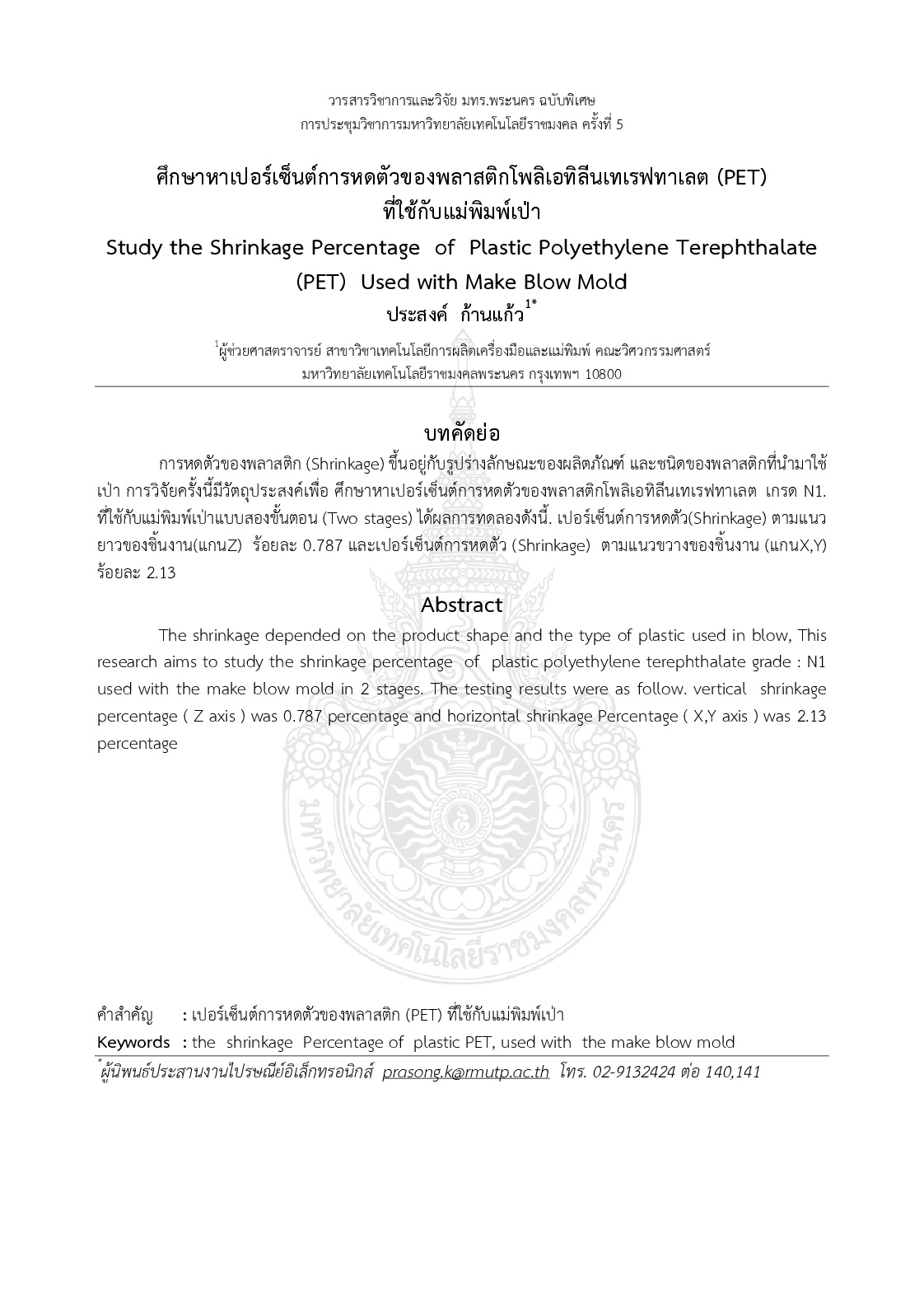
Study the shrinkage percentage of plastic polyethylene terephthalate (PET) used with make blow mold
The shrinkage depended on the product shape and the type of plastic used in blow This research aims to study the shrinkage percentage of plastic polyethylene terephthalate grade : N1 used with the make blow mold in 2 stages. The testing results were as follow. vertical shrinkage percentage ( Z axis ) was 0.787 percentage and horizontal shrinkage Percentage ( XY axis ) was 2.13 percentage
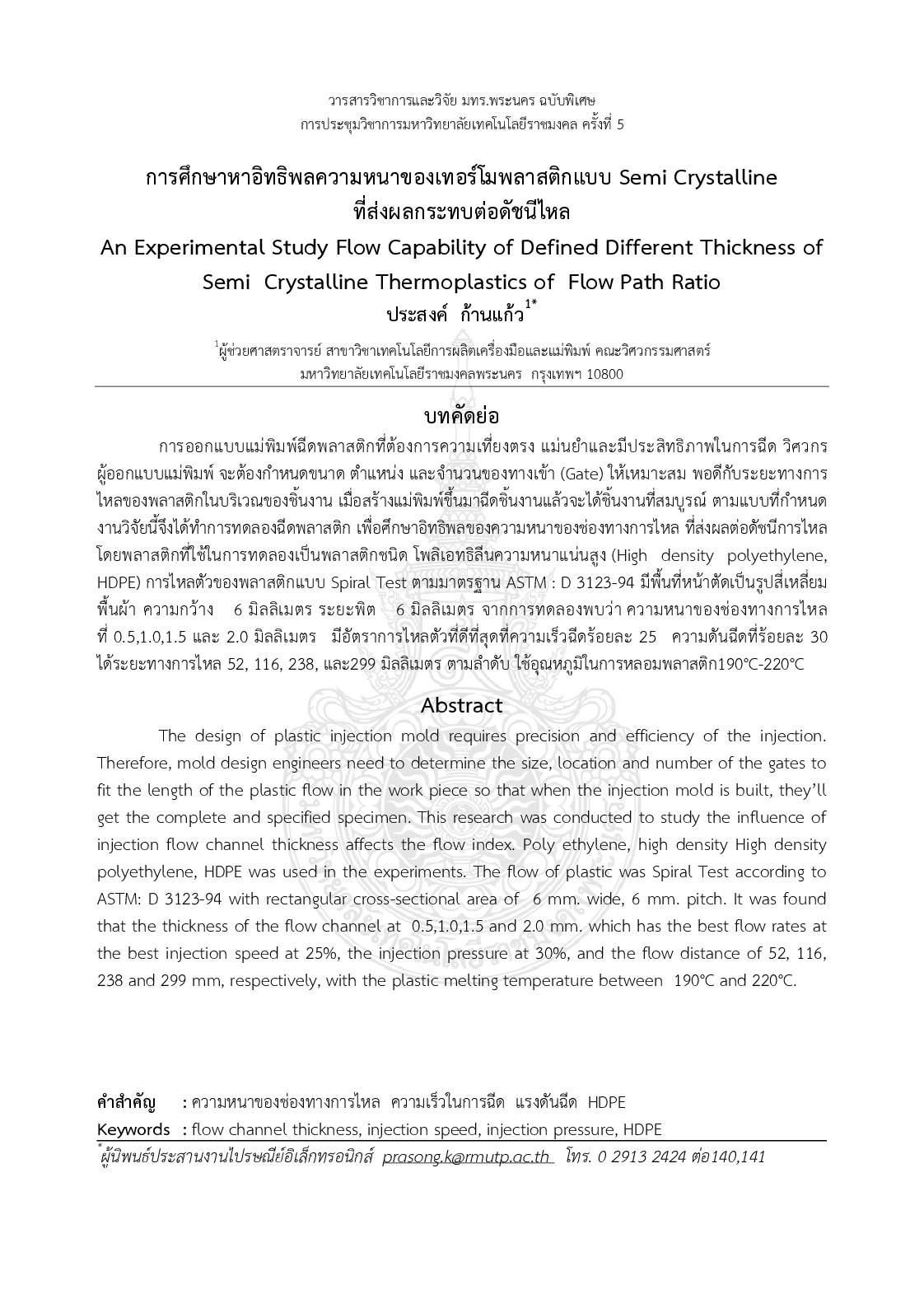
An experimental study flow capability of defined different thickness of semi crystalline thermoplastics of flow path ratio
The design of plastic injection mold requires precision and efficiency of the injection. Therefore mold design engineers need to determine the size location and number of the gates to fit the length of the plastic flow in the work piece so that when the injection mold is built they’ll get the complete and specified specimen. This research was conducted to study the influence of injection flow channel thickness affects the flow index. Poly ethylene high density High density polyethylene HDPE was used in the experiments. The flow of plastic was Spiral Test according to ASTM: D 3123-94 with rectangular cross-sectional area of 6 mm. wide 6 mm. pitch. It was found that the thickness of the flow channel at 0.51.01.5 and 2.0 mm. which has the best flow rates at the best injection speed at 25% the injection pressure at 30% and the flow distance of 52 116 238 and 299 mm respectively with the plastic melting temperature between 190 C and 220 C.
การเปรียบเทียบวัสดุที่ใช้ทำแม่พิมพ์ฉีดที่ทำจากอลูมิเนียมเกรด A7075 กับ เหล็กเกรด P20
Material selection for mold making are not only material prices wages but also there are other factors such as thermal strength shine and resistance to temperature changing that caused distortion and cracks. Preform injection molding from Polyethylene Terephthalate (PET) consumes time for drying granulated plastic in 4 – 6 hours at 140 - 160°C and injects at 280 – 300 °C. This is a very high temperature to inject into mold at 10 – 15°C in cool area. The material for mold making must be able to resist to thermal shock. Today molding machines are made of grade P20 steel (Standard JIS) to produce preform that takes long cycle time due to poor cooling. The research aims to compare the pricing time in mold making to preform injection time that made of aluminum -A7075 grade and grade P20 steel. The experiment is to make a mold that made of aluminum A7075 grade and grade P20 steel injects 15 gram preform. The PET is used to blow into a blow mold with pressure at 30 – 35 bar (Two – Stage) that are 2 bottles of 350 ML. The results of material selection for preform mold making showed that aluminum A7075 grade is cheaper 27.04% the mold price is cheaper 23.6% and consumes less cycle time than grade P20 steel.
ศึกษาการหดตัวของพลาสติกโพลิเอทิลีนเทเรฟทาเลต ที่ใช้กับแม่พิมพ์เป่า
This research aims to study the shrinkage of plastic polyethylene Terephthalate used with the make blow mold in 2 stages. The shrinkage of work piece was determined in order to design the mold ; Z axis = 1% XY axis = 2.5% . The testing results were as follow. 1. Horizontal shrinkage(Z axis) was 0.85% which differed from the determined shrinkage(1%) at 0.15% 2. Vertical shrinkage(XY axis) was 1.83% that is 0.67% which differed from the determined shrinkage(2.5%) at 0.67%
Creating and finding Efficiency Validation of computer Assisted Instruction Focused on the Mold Plastic Injection Making Kind Two Plate
The purposes of the research were to create and find efficiency validation ofcomputer assisted instruction focused on the mold plastic injection making kind two plate for the standard 90/90 and analyze the students learning achievement after using computer assisted instruction. The samples were the 15 first year diploma tool & die students Rajamangala Institute of Technology North Bangkok Campus. The researcher experimented by using pretest and then using the computer assisted instruction focus on the mold plastic injection making kind two plate mold base make mold and adjust next the students did the posttest. After that the researcher calculated to find the computer assisted instruction efficiency and analyzed the students learning achievement after studying. The result revealed that the computer assisted instruction efficiency was efficient for standard 90/90. And after studying by using computer assisted instruction the students learning achievement increased significantly at 0.05.