จำนวน Repository ( 36 )

The Mechanical strength of white rice kernel related to milling quality
The processes of rough rice milling for increase head rice yield are depending on several factors. The paddy rigidities are the one of these is effect to head rice yield. In the past research papers were showed that the qualities of milling were measuring from head rice yield and rigidities of rough rice were rerated to head rice yields. In this research aim to test the rigidities of the white rice with the bending test and showing the relation between white rice rigidities and head rice yield. The PTT1 RD41 RD31 and RD49 rice varieties were used in the experiment. The result showed that the high relation between the brown rice yield and head rice yield with determination coefficient was 0.81and the brown rice yield was heavy weight more than the head rice yield about 20%. The determination coefficient between the white rice rigidities and head rice yield was 0.16 showed that the less relation.
Compressive strength determination of bottom ash mixed with dust stone and portland cement
This research was to determine the appropriated mixing ratio of bottom ash and admixture (dust rock and Portland cement type 1) for improving the compressive strength. Bottom ash was used instead of soil and the quantities of admixture were 0 2 4 6 8 and 10% by dry weight of bottom ash. The specimens were cured for 7 14 28 and 90 days. Results of compressive strength test show that the admixture of 8% was the best mixing ratio. The increasing primary strength is developed from hydration reaction and the increasing secondary strength at 90 days is developed from pozzolanic reaction. Moreover the compressive strength of this specimen is close to the compressive strength of laterite
Effect of bottom ash as fine aggregate on strength of concrete
This research was aimed to study the effect of bottom ash (BA) as fine aggregate in fly ash concrete and cement-only concrete on strength of water-cured and uncured concrete. The water to binder ratios were 0.35 and 0.55 to represent high strength and normal strength concrete respectively. The weight percentages of replacement of cement by fly ash were 0 and 30%. The replacement ratios of bottom ash as fine aggregate were 0 10 and 30% by volume of fine aggregate. The results indicated that the slump and setting time of concrete increased with the increase of bottom ash content. In contrast the compressive and tensile strength decreased with the increase of bottom ash content. From the curing sensitivity index it was showed that the fly ash concrete required longer curing period than cement-only concrete. In case of high strength concrete the use of bottom ash in fly ash concrete can reduce curing sensitivity of concrete
Variables affecting to signal strength of wireless networks 5 GHz
The climate change is a natural phenomenon and effect on atmospheric which is the media of wireless communication. For the high performance in the telecommunication system this study therefore aimed to study the variables affecting to signal strength of wireless networks. The values of temperature humidity pressure and the signal strength of wireless networks 5 GHz were measured. The sample of this study was 148 access-points of TOT in Yasothon Province. For statistical analyses Pearsons correlation and regression were employed. The findings revealed that: 1) the average level of signal strength was 69.44 –dBm. The average levels of temperature humidity and pressure were 28.085 ?C 73.145% and 1004.246 hPa respectively 2) variables that had great influences on signal strength of wireless networks consisted of temperature humidity and pressure and 3) ambient variables of temperature humidity and pressure could predict the level of signal strength at 76.8%
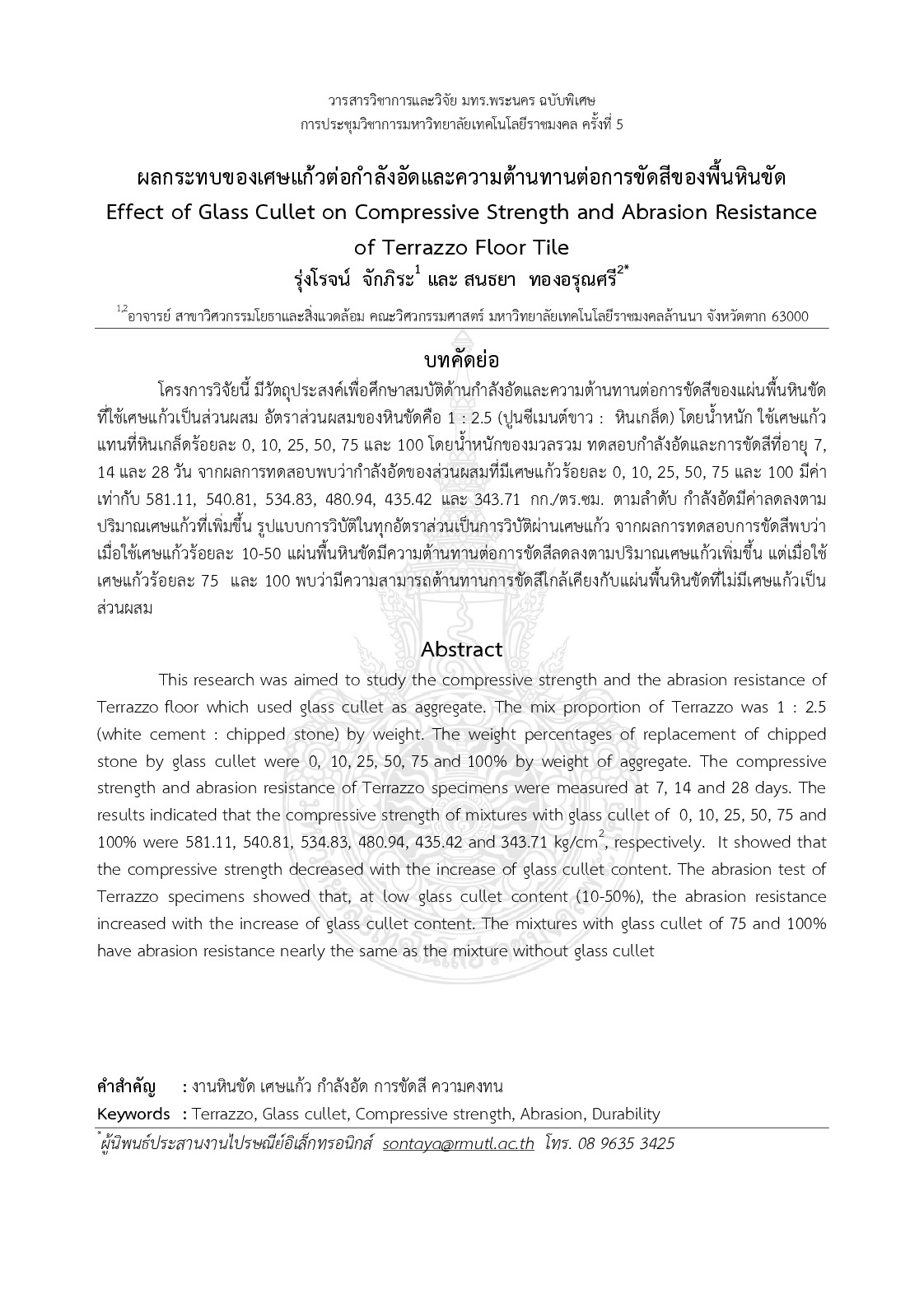
Effect of glass cullet on compressive strength and abrasion resistance of terrazzo floor tile
This research was aimed to study the compressive strength and the abrasion resistance of Terrazzo floor which used glass cullet as aggregate. The mix proportion of Terrazzo was 1 : 2.5 (white cement : chipped stone) by weight. The weight percentages of replacement of chipped stone by glass cullet were 0 10 25 50 75 and 100% by weight of aggregate. The compressive strength and abrasion resistance of Terrazzo specimens were measured at 7 14 and 28 days. The results indicated that the compressive strength of mixtures with glass cullet of 0 10 25 50 75 and 100% were 581.11 540.81 534.83 480.94 435.42 and 343.71 kg/cm2 respectively. It showed that the compressive strength decreased with the increase of glass cullet content. The abrasion test of Terrazzo specimens showed that at low glass cullet content (10-50%) the abrasion resistance increased with the increase of glass cullet content. The mixtures with glass cullet of 75 and 100% have abrasion resistance nearly the same as the mixture without glass cullet