จำนวน Repository ( 25 )
Community strength by means of self-sufficiency economic development : A case study of Chalermkiatpattana Village, Huay Sat Yai Sub-district,Hua Hin District Prachuapkhirikhan Province
The objective of this research was to study the strength of community and the way to strengthen community based on self-sufficiency economy. The data were collected through the sample in 145 households at Chalermkiatpattana Village Huay Sat Yai Sub-district Hua Hin District Prachuapkhirikhan Province. The study discovered the following results: 1. The average rating scale of communitys strength of Chalermkiatpattana Village Huay Sat Yai Sub-district Hua Hin District Prachuapkhirikhan Province was at high level (71.5%). When considering the strength factors individually the result was found that; -The rating scale of strength in Learning Process and Religion and Culture were at high level 73% and 81% respectively. -The rating scale of strength in Self-sufficiency Economy of the Community was at moderate level (60.5%). 2. The ways to strengthen community of Chalermkiatpattana village Huay Sat Yai Sub-district Hua Hin District Prachuapkhirikhan Province were based on self-sufficiency economy concerning with 3 factors; Learning Process Religion and Culture and Selfsufficiency Economy of the Community. The results of these factor relationships were; -The relationship of Self-sufficiency Economy of the Community and Learning Process was at high level (r=.794). -The relationship of Self-sufficiency Economy of the Community and Religion and Culture was at high level (r=.729). -The relationship of Learning Process and Religion and Culture was at high level (r=.723). The Self-sufficiency Economy of the Community (r=.950) the Learning process (r=.901) and the Religion and Culture (r=.913) had a high level of relationship with the strength of community.

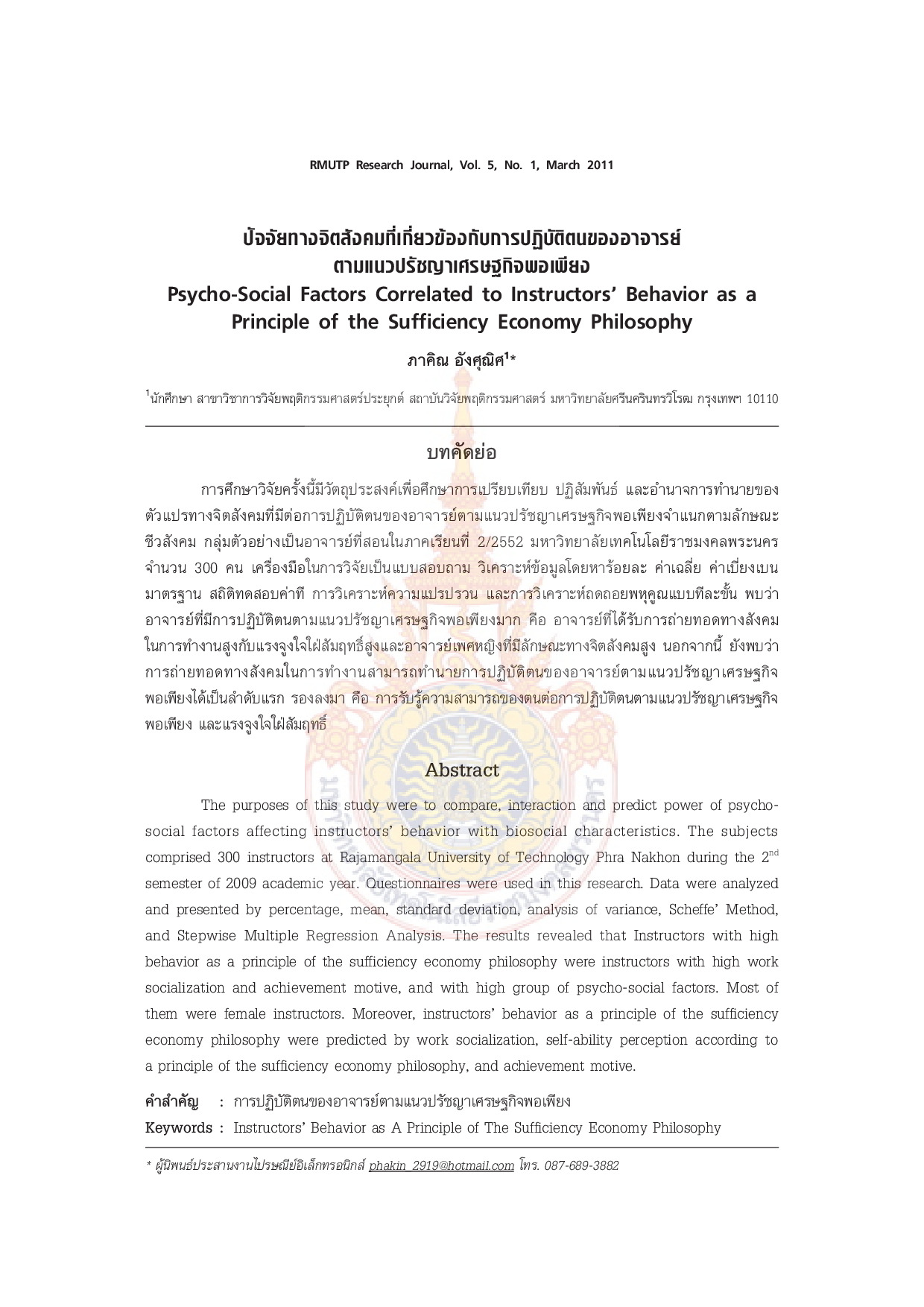
Psycho-Social Factors Correlated to Instructors’ Behavior as a Principle of the Sufficiency Economy Philosophy
The purposes of this study were to compare interaction and predict power of psychosocial factors affecting instructors’ behavior with biosocial characteristics. The subjects comprised 300 instructors at Rajamangala University of Technology Phra Nakhon during the 2nd semester of 2009 academic year. Questionnaires were used in this research. Data were analyzed and presented by percentage mean standard deviation analysis of variance Scheffe’ Method and Stepwise Multiple Regression Analysis. The results revealed that Instructors with high behavior as a principle of the sufficiency economy philosophy were instructors with high work socialization and achievement motive and with high group of psycho-social factors. Most of them were female instructors. Moreover instructors’ behavior as a principle of the sufficiency economy philosophy were predicted by work socialization self-ability perception according to a principle of the sufficiency economy philosophy and achievement motive
Marketing factors sociological effects and attitude which influence to the buying of sufficiency economics book for population in Bangkok
This survey was conducted from 480 samples that were randomly conducted by typical sampling method. Data were collected by using Influence of Marketing sociological factors and attitudes have towards influencing the buying decision of Sufficiency Economic books. questionnaires. The result of this research found that: Marketing factors have effects upon buying decision of sufficiency economic books with factors such as product price place promotion have effect in decision making of buying sufficiency economic book at 0.05 significance level. Sociological factors also show influence in buying sufficiency economic books with attributes such as family values source of news social class and social values affecting decision of buying sufficiency economic books at significant level 0.05. Attitudes relative effects on buying sufficiency economic books decision making can be segregated into different interest groups. Only attitudes of the group who have heard or aware and the group of applied of concept of sufficiency economy philosophy have no effect on their buying decision. In the group who understand the philosophy attitudes shows no effect towards their buying decision. Lastly in the group who understand the philosophy the outcome shows no relevance on their buying decision. Highly educated group with post graduate studies attitudes have tendency to think that sufficiency economic philosophy tend constraint progress. The higher age group showed limited interest to sufficiency economic philosophy.