จำนวน Repository ( 286 )
การศึกษาการใช้สีไทยโทนสำหรับงานเบเกอรี กรณีศึกษาครีมแต่งหน้าเค้ก
The purposes of the study of Thaitone colors using for bakery work: Buttercream case study were to examine the proper basic recipe of buttercream which used in the study of Thaitone mixing to examine the appropriate ratio of colors in mixing Thaitone colors for buttercream and to examine the acceptance of Thaitone colors using for bakery work. In terms of the entrepreneurs buttercream case study the experiment was planned by the Randomized complete block design (RCBD) at a 95 percent confidence level. The experiment was conducted to evaluate the sensory quality of appearance color odor taste texture and overall preference and compare the differences of the average by using the Duncan New Multiple Range Test (DMRT) and computer program. There were 30 participants for testing the taste with 5 – point hedonic scale method. The result showed that the third basic recipe of buttercream was accepted the most. The averages of appearance color odor taste texture and overall preference were 3.53 3.96 3.66 3.26 3.76 and 3.70 respectively. The result of physical testing revealed that it was stable insoluble and there was no expansion although at a 30- degree Celsius room temperature. According to the result of the study of the entrepreneur’s acceptance of Thaitone color buttercream it was found that Kulap color 45.47 17.44 and 2.67 were accepted the most from the entrepreneurs at the most level accounting for 35 percent. Chan color which its brightness was L*53.23 having a red-color value of a*2.16 and yellow-color value of b*26.01 was accepted the most from the entrepreneurs at the most level accounting for 45 percent. Also Namlai color which its brightness was L*45.39 having a red-color value of a*-19.03 and yellow-color value of b*-6.90 was accepted the most from the entrepreneurs at the most level accounting for 60 percent. According to the study of the entrepreneur’s acceptance of Thaitone color mixing guide for buttercream it was found that it could be applied with the bakery products in entrepreneur’s shops accounting for 100 percent. Moreover the Thaitone color buttercream mixing guide could be most productively applied in the bakery businesses accounting for 55 percent.
การใช้ผงถั่วเหลืองทดแทนกะทิในน้ำยากะทิผง
Study on the amount of soybean powder for substitution of coconut milk powder. The purpose is to reduce fat from coconut milk and use soybean powder to replace the concentration of finished coconut milk. By studying the basic formula of coconut milk powder by selecting 3 formulas and taking the most scores formula Bake at 70 degrees Celsius for 7 hours humidity at 1%. The results of consumer acceptance study by measuring the quality of the appearance texture color smell By leading to being accepted by consumers Testing the quantity of soybean powder suitable for the product by measuring the quality of appearance texture color smell. To be acceptedby consumers Study on shelf life of soybean powder substitution products in coconut milk powder in replacement of soybean powder Suitable and accepted by consumers Taken separately in an aluminum foil bag During the 2 month storage period quality assessments are done every 2 weeks. By measuring moisture color Aw and general microbes and mold yeast. Found that longer duration increased moisture and microbial values. But the number of microbes is less than 1 × 10³ colonies pergram which does not exceed the standard of the community product standards.
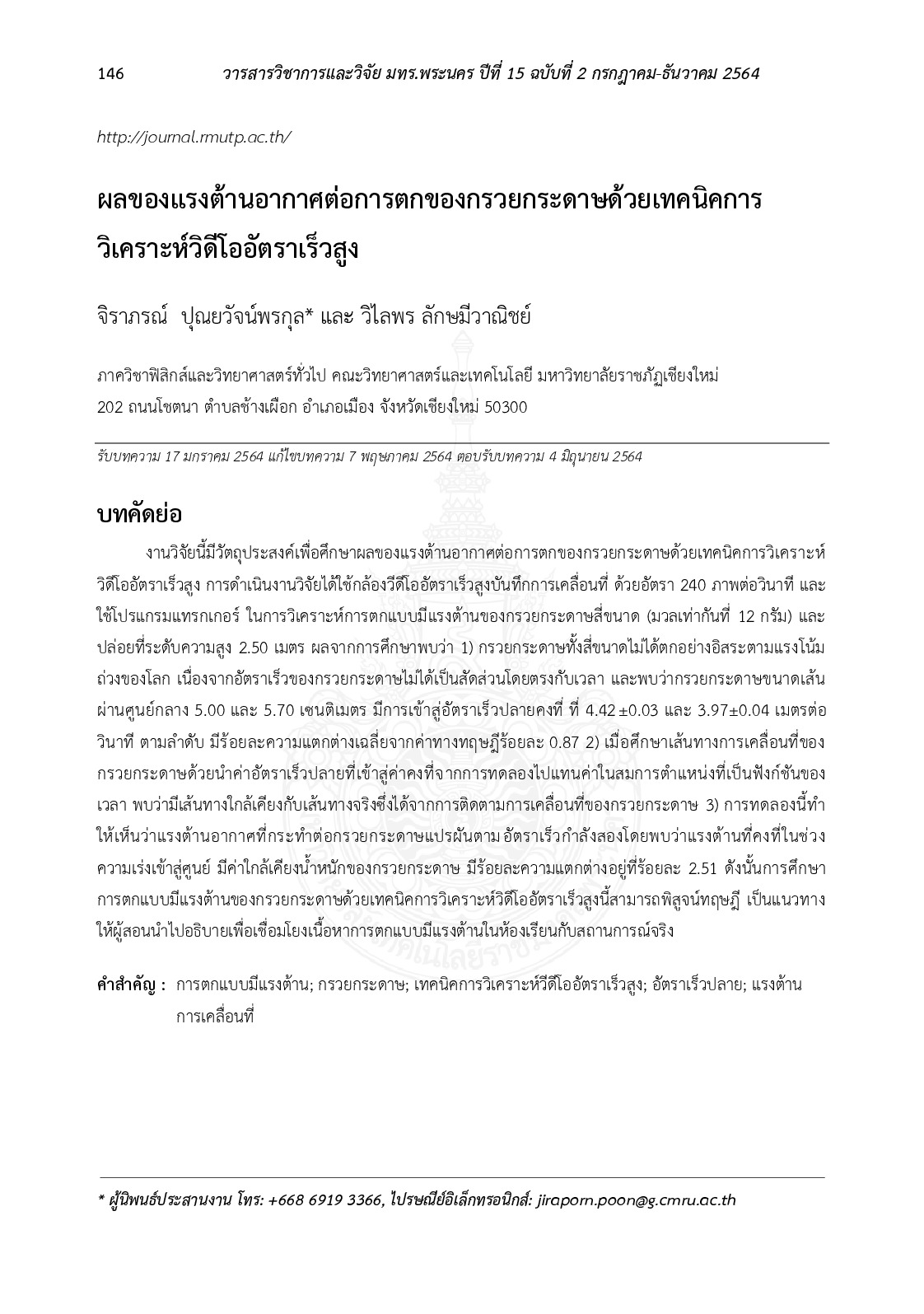
ผลของแรงต้านอากาศต่อการตกของกรวยกระดาษด้วยเทคนิคการวิเคราะห์วิดีโออัตราเร็วสูง
This research was aimed to study of the effect of dragging force on paper cone falling by using the high-speed video analysis technique. Four different sizes of paper cones ranged from 3.00-5.70 centimeter were used. The cones having the same mass of 12 g and falling from 2.50 meters height were recorded for 240 frames per second and then were analyzed using the Tracker Video Analysis software. The results showed that (1) all four different sizes of paper cones were not freely fall with the Earths gravity due to indirect proportion with time of theirs speeds. The terminal speed of two large cones having diameter of 5.00 and 5.70 centimeters were 4.42±0.03 and 3.97±0.04 meters per second respectively. Only 0.87% of these experimental values were different from the theoretical ones. (2) The theoretical trajectory of these cones falling using the terminal speed from the experimental agrees with the theoretical ones. (3) The experimental drag force showed a second order function of the paper cone’s speed. The evaluated drag force during terminal area is approximately equal to the cone weight. Thus this technique can help students and teachers to visualize simple physics phenomena and relate them to the physics principles learnt in the classroom
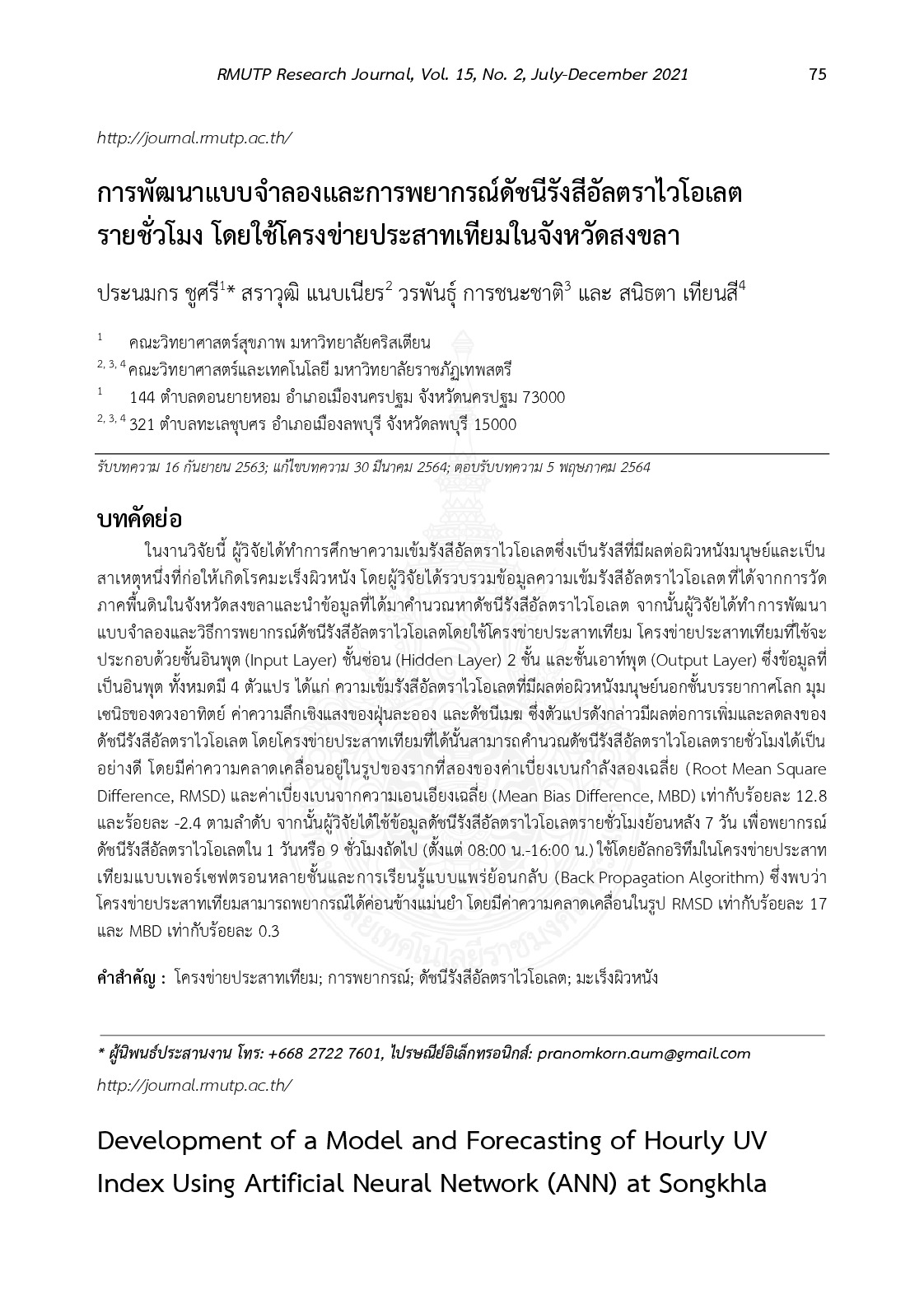
การพัฒนาแบบจำลองและการพยากรณ์ดัชนีรังสีอัลตราไวโอเลตรายชั่วโมง โดยใช้โครงข่ายประสาทเทียมในจังหวัดสงขลา
In this work solar erythemal ultraviolet radiation (EUV) which affects human skin and skin cancer was investigated at Songkhla province (7.2°N 100.6°E). EUV was converted to UV index then the data was used for model development and forecasting of hourly UV index using Artificial Neural Network (ANN). The ANN model has one input layer two hidden layers and one output layer. This input layer consists of extraterrestrial erythemal ultraviolet radiation solar zenith angle aerosol optical depth and cloud index which affect ultraviolet radiation and the output layer is hourly UV index. The results show that hourly UV index obtained from ANN and that from the measurement are in reasonable agreement with root mean square difference of 12.8% and mean bias difference of -2.4%. For forecasting of the hourly UV index the data for 7 days earlier was used for forecasting the next UV index for one day or nine-hour (08:00 am.-16:00 pm.). Multi-layer perceptron and back propagation algorithm were used in the model forecasting. The results show that the UV index from the model forecasting is reasonable agrees with UV index from measurement with root mean square difference of 17.0% and mean bias difference of 0.3%.
การควบคุมคุณภาพและลดการสูญเสียในกระบวนการประกอบชิ้นส่วนบังโคลนหน้าแก้มข้างรถยนต์ด้วยวิธีโพคา-โยเกะ
This study aimed to use Poka-Yoke techniques to help prevent errors and reduce loss in Front Side Fender Model assembly process. The researchers used four tools in the 7QC tools which were Check Sheet Cause-and-Effect Diagram and Graphs to search for causes and ways to solve problems and Cause and Effect Matrix and ECRS Techniques. The study revealed that the main cause of the problems was that the incorrect assembled side fenders were submitted to another department. This mistake had bad effects on time and workforce spent for correcting work including more expenses. The mistakes occurred because there was no tool for detecting errors in the work piece. Therefore the researchers use Poka-Yoke techniques in order to decrease errors by designing a control system for target detection while it was moving through the process. After collecting data the study showed that before the improvement during January to August 2019 the number of problems caused by the process were 0.093. However the number of problems after the improvement during September to December 2019 reduced to 0. It was obvious that this improvement reduced the loss from the front side fender assembly process up to 100.