จำนวน Repository ( 131 )
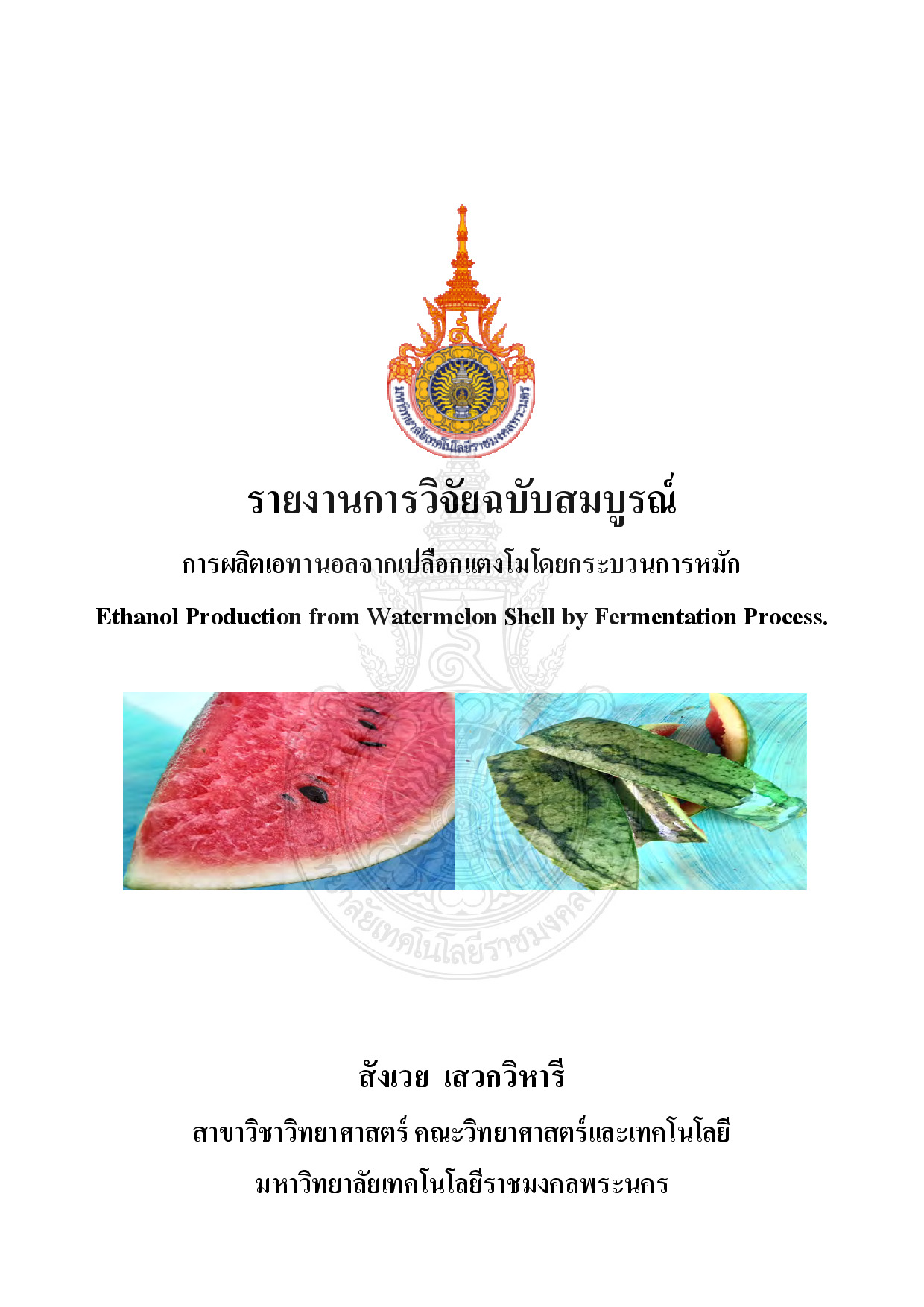
การผลิตเอทานอลจากเปลือกแตงโมโดยกระบวนการหมัก
Ethanol is a form of renewable energy. That can be used as fuel. Can replace gasoline or diesel. Fuel is an important factor driving the countrys economy. Ethanol can be produced from agricultural products garbage and various waste. his research uses watermelon rind. Which is waste from the community as a raw material for the production of ethanol by the fermentation process the microorganisms used in the fermentation process are ball flour. After fermentation for 6 hours it was found that the watermelon rind weighing 10 grams measured the concentration of alcohol. The concentration was 9.3 % VOL 18 Brix %. 20 grams of watermelon rind measuring the concentration of alcohol The concentration of 8.1 % VOL 16 Brix % of watermelon rind at 30 grams measured the concentration of alcohol. Get the concentration 8 % VOL 16 Brix % watermelon rind at 40 grams measure the concentration of alcohol get the concentration of 7.9 % VOL 15.1 Brix % and watermelon rind at 50 grams measure the concentration of alcohol the concentration of 7 % VOL 15 Brix %. Therefore it can be said that the watermelon rind which is waste from the community. Is a raw material with high potential for ethanol production to be used as a renewable energy source Instead of using raw materials from food plants and other energy crops.
การพัฒนาชุดเพาะปลูกในน้ำแบบประหยัดพลังงาน
This research is the development of an energy - saving water planting kit. The objective is to develop a prototype of an energy - saving water planting kit by applying solar energy as an energy source that is controlled by the Arduino board through a blynk application and study the efficiency of the water culture planting kit. By comparing electricity usage rates between solar energy and electric power from the household. In this study there were 4 experimental sets. The experiment was water cultivation without installation 2 experimental sets and 2 experimental sets were installed using green salad vegetables. In research the 45 days growth period consisted of leaf length and width root length number of leaves and height. There is also a comparison of the efficiency of AB fertilizer and soy milk hormones to reduce chemical usage. The research has shown that the use of the soybean milk hormone provided a high growth rate of Lactuce sativaVar. Longifolla than AB fertilizer. There are many nutrients but only in small amounts. When used as a nutrient for plant growth needs to be changed daily. Considering the economic value using AB fertilizer as a nutrient will be worth more than soy milk hormones. For the installation of the instruction set and the LED lamp was suitable for Lactuce sativaVar. Longifolla growing than not installing the instruction set and the LED lamp. These can save electricity cost of 85 baht per month.
การสังเคราะห์อนุภาคนาโนโลหะโดยการระเหยด้วยเลเซอร์ในน้ำ
Nanomaterials are widely used in many applications such as medicine cosmetic industry and other. When the size of the particle is reduced the number of atoms on the surface and the ratio between surface area to volume of the material increase result in the enhancement of the material’s physical magnetic and optical properties. There are many methods to synthesize the nanoparticle such as grinding chemical reaction electrochemical method and laser ablation. In this research laser ablation was chosen to synthesize the metal nanoparticles because this method is quick and convenient and does not produce hazardous waste. The results show that the laser with 6V electric potential could synthesize the metal nanoparticles with the smallest size. The metal nanoparticles with larger size were obtained when higher electrical potential of 8V and 10V were used. In conclusion the electric potential of the laser affects the size of the metal nanoparticle obtained from laser ablation.
ถุงดูดซับธรรมชาติจากกากกาแฟหมักด้วยน้ำคีเฟอร์เพื่อดูดซับคราบน้ำมันปนเปื้อน
Oil spills in every household caused by cooking are difficult to eliminate when accumulating for a long time. In this study the researchers aimed to develop the remaining coffee grounds for oil absorption. From 2 coffee ground samples types A and B obtained from different coffee shop & coffee grounds type A demonstrated more effective in absorbing vegetable oil. The sample A was thus treated with hydrogen peroxide (H2O2) solution at the concentration of 0.5 1 3 33 50 80 and 100 percentages for 30 minutes and determined for the efficiency in oil elimination. The sample with at least 80 % (v/v) H2O2 showed the most effectiveness in absorbing oil. The coffee grounds that were later treated with pineapple juice fermented Kefir could help increase coffee ground degradation at 51.07 percentages. The Kefir treated coffee grounds packed in an absorbent bag revealed higher effectiveness in oil absorption at least 51.07 percentages compared to the controls that were cotton bag and coffee a harboring at the percentages of 73.85 and 30.04 respectively. This coffee ground bag after thrown into the ground could be decomposed in nature for 52 percentages within 1 month. Due to the oil elimination properties of the coffee grounds that are environmentally and human friendly as well as low cost it is possible to develop the kefir treated coffee grounds for being oil-absorbing products that can come in contact with human skin.
การเพิ่มประสิทธิภาพการถ่ายเทความร้อนของหอทำความเย็นระบบปิดด้วยวิธีสเปรย์น้ำ
A closed wet cooling tower became popular for heat transfer process but the existing system was not sufficient for the heat transfer of the manufacturing line. This research aimed at investigating the heat transfer enhancement of the 200-ton closed cooling tower by installing spray nozzles to spray water to the condenser. The distance between the spray nozzles and the condenser were 20 30 40 50 and 60 centimeters. The mass flow rates of water spray were 8 10 12 and 14 liters per minute. The objectives of the study therefore were to study the heat transfer coefficient of cooling water and to evaluate the economic value of this improvement option’s investment costs. In this study the outlet temperature of the cooling tower was set to be less than 37°C the difference of inlet and outlet water temperature was 2.9°C and the overall heat transfer rate approximated 360 kW. The results of the study reported that the distance of the spray nozzles and the condenser was at 30 centimeters and the mass flow rate of water spray was 12 liters per minute. The rate of heat transfer was 362 kW. The efficiency of the cooling system was 0.8 which became suitable for real use. In addition to considering value investing the results showed that the payback period was 0.47 years and the net present value was 1693801 baht. The rate of return received from the project was 207% which was worth investing.