จำนวน Repository ( 19 )
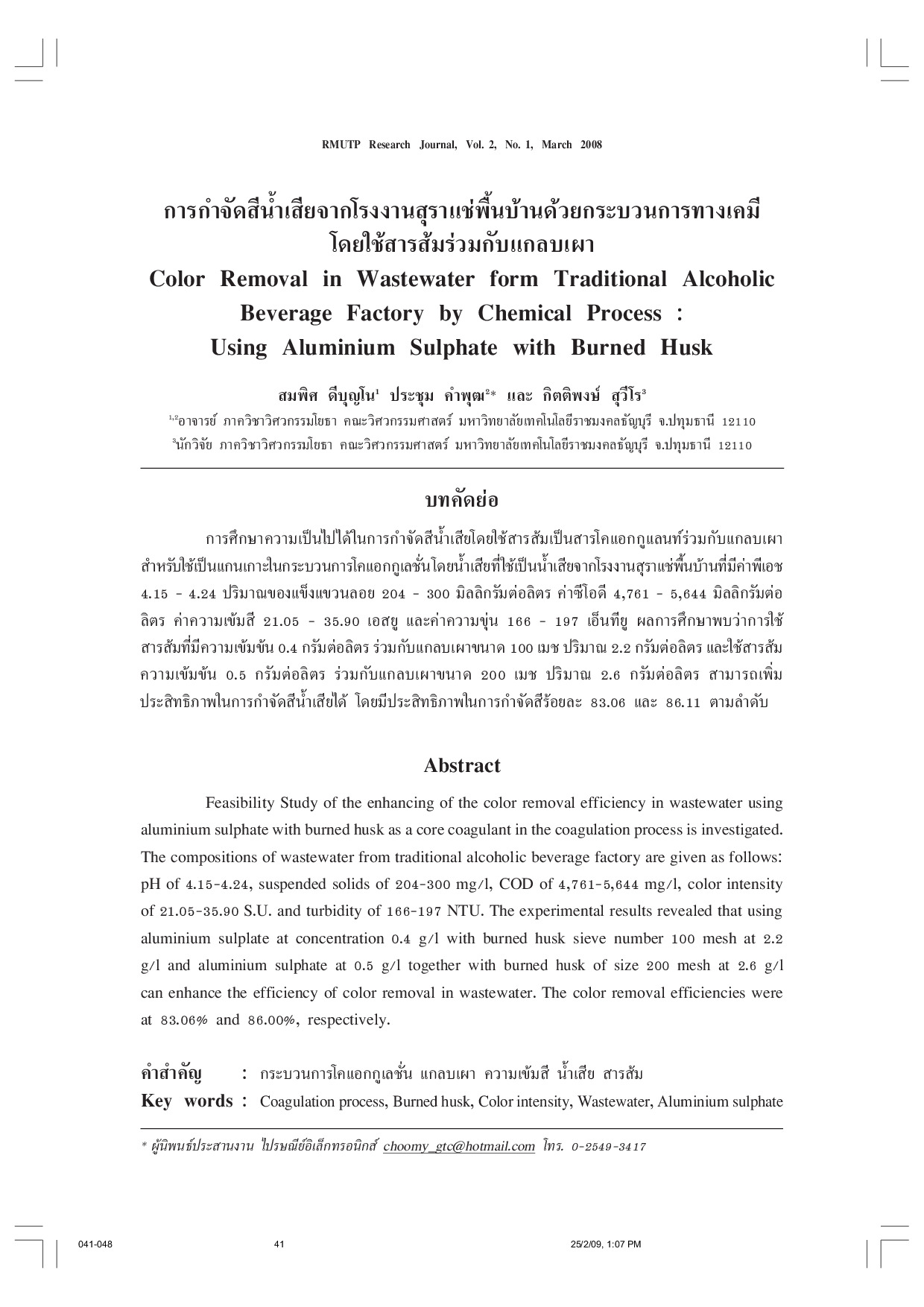
Color Removal in Wastewater form Traditional Alcoholic Beverage Factory by Chemical Process : Using Aluminium Sulphate with Burned Husk
Feasibility Study of the enhancing of the color removal efficiency in wastewater using aluminium sulphate with burned husk as a core coagulant in the coagulation process is investigated. The compositions of wastewater from traditional alcoholic beverage factory are given as follows: pH of 4.15-4.24 suspended solids of 204-300 mg/l COD of 4761-5644 mg/l color intensity of 21.05-35.90 S.U. and turbidity of 166-197 NTU. The experimental results revealed that using aluminium sulplate at concentration 0.4 g/l with burned husk sieve number 100 mesh at 2.2 g/l and aluminium sulphate at 0.5 g/l together with burned husk of size 200 mesh at 2.6 g/l can enhance the efficiency of color removal in wastewater. The color removal efficiencies were at 83.06% and 86.00% respectively.
การศึกษาสมบัติทางกลของโพลิเอทิลีนน้ำหนักโมเลกุลสูงยิ่งยวดเชิงประกอบสำหรับล้อ Run-flat
This research project aimed to test the mechanical properties and the capability in wear resistance of ultra-high molecular weight polyethylene composite as well as determine the optimal formulation of UHMWPE-based composites which had a main component of aluminum oxide. The developed formula was used in the manufacture of run-flat wheels and thus applied to build run-flat wheels with an understanding of the proper molding conditions under the run-flat wheel forming process. Two materials used in the research consisted of super-high molecular weight polyethylene (UHMWPE) as the base material and the additive of aluminum oxide (Al2O3). The parameters employed in the hot compression process to obtain the specimen for the experiment consisted of compressive force temperature time and the ratio between super-high molecular weight polyethylene and aluminum oxide. The test for mechanical properties consisted of an impact test a hardness test according to the ASTM D2240 standard a tensile test according to the ASTM D638 standard type I and a wear test according to the ASTM G77 standard. The results indicated that a hot compression condition under a pressure of 5 MPa a temperature of 210°C for 90 min and using 5% Al2O3 HTM 30 material caused mixed uneven powder particle sizes between 2 to 5 µm. The tensile test results inferred the yield strength of 20.52 MPa ultimate tensile strength at 29.96 MPa breaking strength at 22.83 MPa elongation at break at 265.8% and modulus of elasticity at 784.46 MPa. The highest hardness was 62 shore D the high impact strength was 586.8 J/m and it was displayed for the wear rate of hot compression specimens made of UHMWPE mixed with 5% HTM-30. Moreover it introduced a coefficient of friction the wear rate and the density of 0.12 8.66E-11 mm3/N.m and 1.2446958 g/cm3 respectively.

อิทธิพลของความเร็วรอบที่ส่งผลต่อสมบัติทางกลของการเชื่อมอะลูมิเนียมต่างชนิด ระหว่าง SSM7075 กับ SSM356 ด้วยการเชื่อมเสียดทาน
The objective of this research is to study how rotation speeds affect mechanical properties with friction welding between semi-solid metal 7075 aluminum alloys and semi-solid metal 356 aluminum alloys. The factor of interest is rotation speeds with different conditions at 800 1000 1200 1400 and 1600 rpm respectively. 1.8 millimeter for burn of length 30 seconds for welding time and clockwise rotation are set as a control constant condition for the entire experiment. After friction welding we found that different rotation speeds significantly affected mechanical properties of these alloys. At rotation speed 1400 rpm the maximum tensile strength is 122.24 MPa and the maximum hardness in welded zone is 140.5 HV. The microstructure size is 2.250 µm long and 2.144 µm wide. Its size in welded zone is practically small because of friction force. Moreover this friction force causes the mixture of MgZn2 and Mg2Si in welded zone.
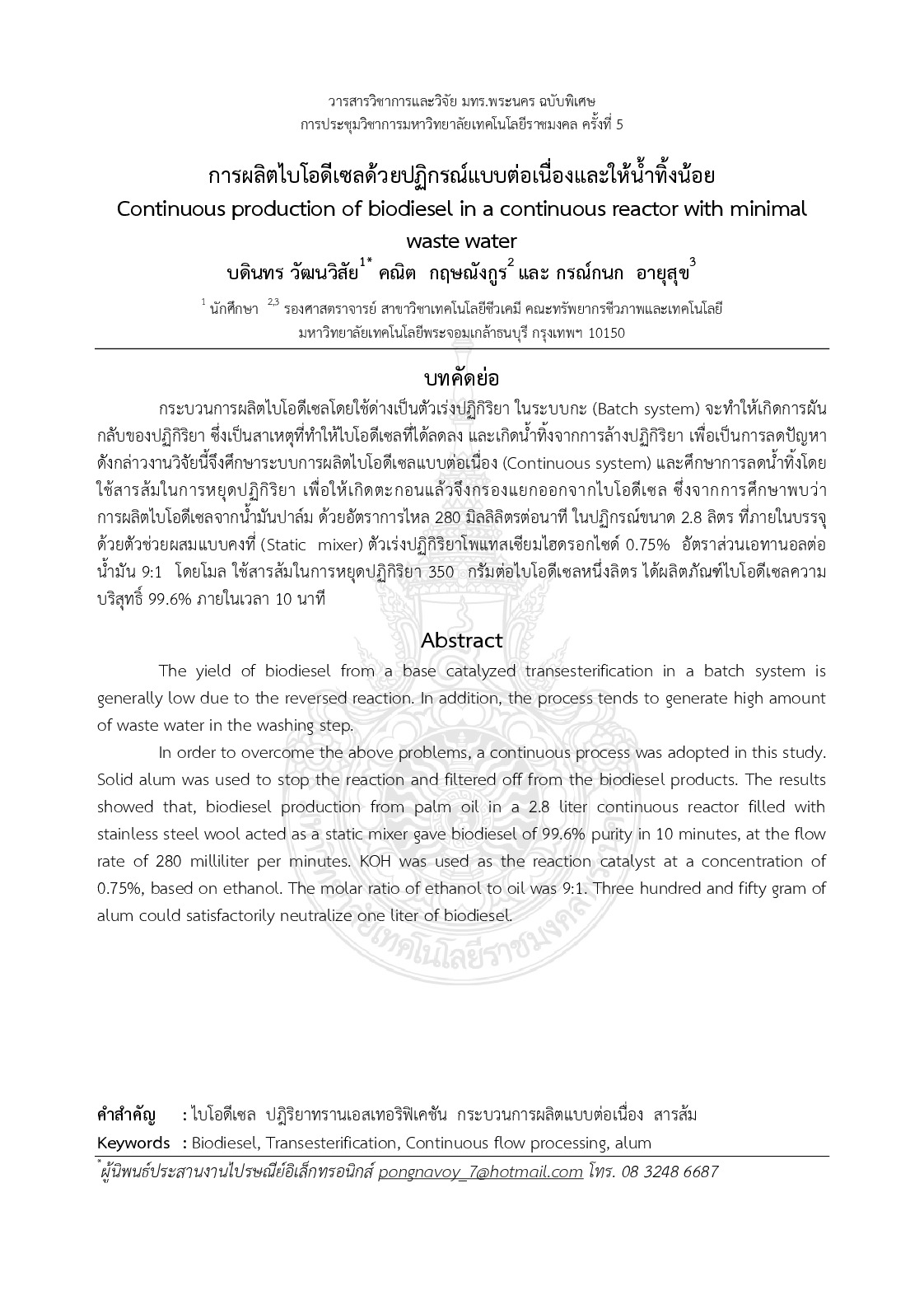
Continuous production of biodiesel in a continuous reactor with minimal
The yield of biodiesel from a base catalyzed transesterification in a batch system is generally low due to the reversed reaction. In addition the process tends to generate high amount of waste water in the washing step. In order to overcome the above problems a continuous process was adopted in this study. Solid alum was used to stop the reaction and filtered off from the biodiesel products. The results showed that biodiesel production from palm oil in a 2.8 liter continuous reactor filled with stainless steel wool acted as a static mixer gave biodiesel of 99.6% purity in 10 minutes at the flow rate of 280 milliliter per minutes. KOH was used as the reaction catalyst at a concentration of 0.75% based on ethanol. The molar ratio of ethanol to oil was 9:1. Three hundred and fifty gram of alum could satisfactorily neutralize one liter of biodiesel.