จำนวน Repository ( 23 )
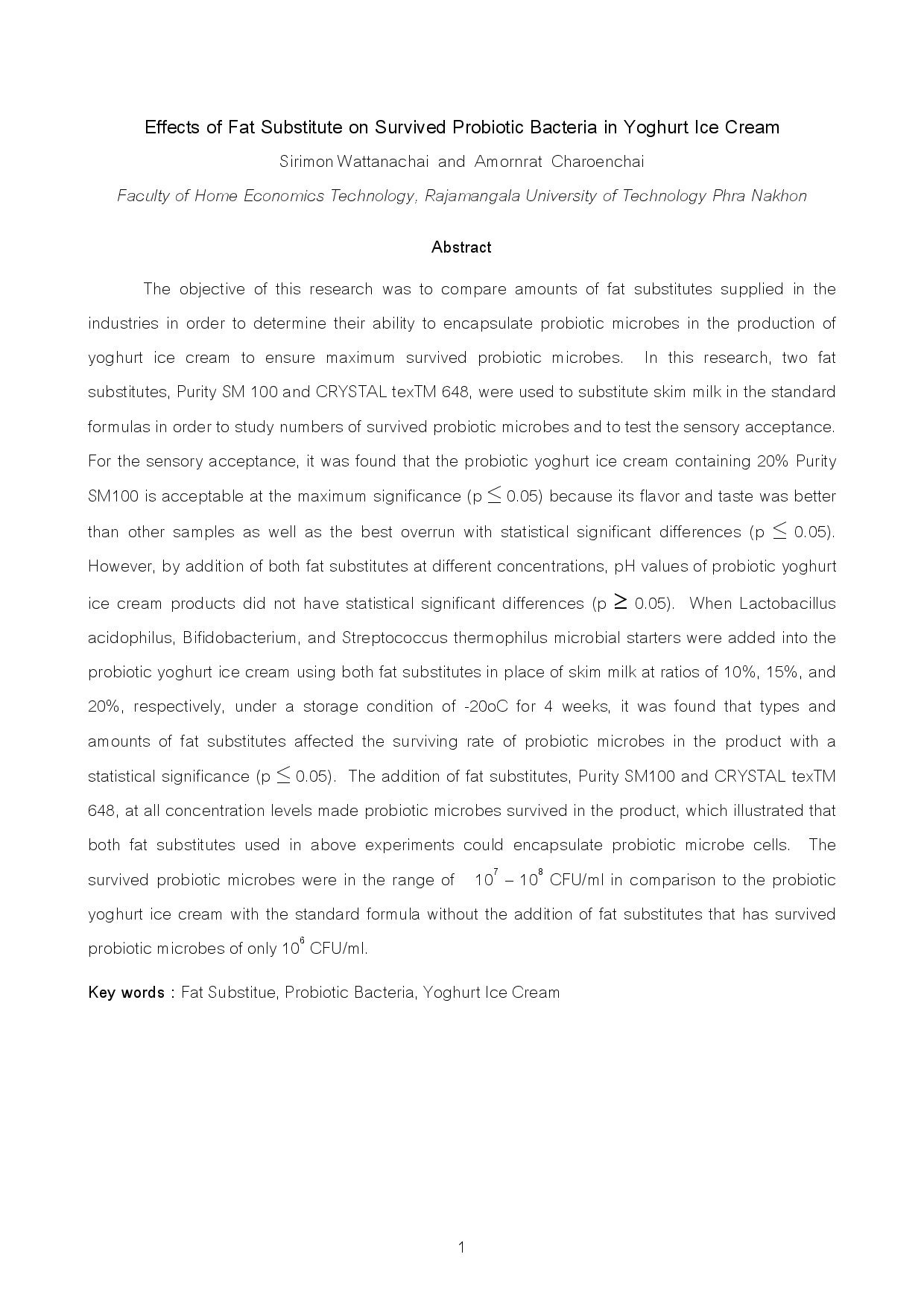
Effects of Fat Substitute on Survived Probiotic Bacteria in Yoghurt Ice Cream
The objective of this research was to compare amounts of fat substitutes supplied in the industries in order to determine their ability to encapsulate probiotic microbes in the production of yoghurt ice cream to ensure maximum survived probiotic microbes. In this research two fat substitutes Purity SM 100 and CRYSTAL texTM 648 were used to substitute skim milk in the standard formulas in order to study numbers of survived probiotic microbes and to test the sensory acceptance. For the sensory acceptance it was found that the probiotic yoghurt ice cream containing 20% Purity SM100 is acceptable at the maximum significance (p ≤ 0.05) because its flavor and taste was better than other samples as well as the best overrun with statistical significant differences (p ≤ 0.05). However by addition of both fat substitutes at different concentrations pH values of probiotic yoghurt ice cream products did not have statistical significant differences (p ≥ 0.05). When Lactobacillus acidophilus Bifidobacterium and Streptococcus thermophilus microbial starters were added into the probiotic yoghurt ice cream using both fat substitutes in place of skim milk at ratios of 10% 15% and 20% respectively under a storage condition of -20oC for 4 weeks it was found that types and amounts of fat substitutes affected the surviving rate of probiotic microbes in the product with a statistical significance (p ≤ 0.05). The addition of fat substitutes Purity SM100 and CRYSTAL texTM 648 at all concentration levels made probiotic microbes survived in the product which illustrated that both fat substitutes used in above experiments could encapsulate probiotic microbe cells. The survived probiotic microbes were in the range of 107 – 108 CFU/ml in comparison to the probiotic yoghurt ice cream with the standard formula without the addition of fat substitutes that has survived probiotic microbes of only 106 CFU/ml.
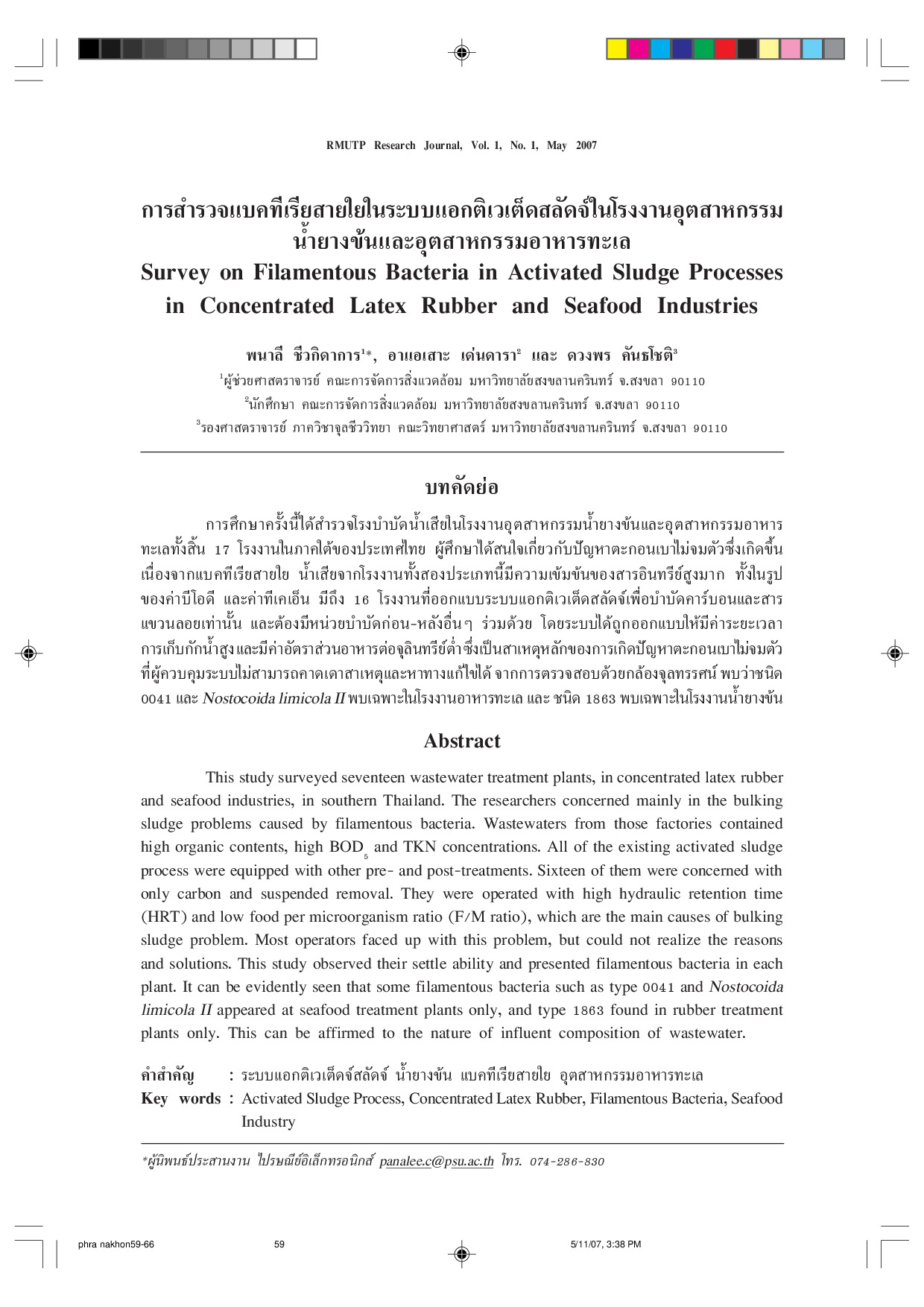
Survey on Filamentous Bacteria in Activated Sludge Processes in Concentrated Latex Rubber and Seafood Industries
This study surveyed seventeen wastewater treatment plants in concentrated latex rubber and seafood industries in southern Thailand. The researchers concerned mainly in the bulking sludge problems caused by filamentous bacteria. Wastewaters from those factories contained high organic contents high BOD5 and TKN concentrations. All of the existing activated sludge process were equipped with other pre- and post-treatments. Sixteen of them were concerned with only carbon and suspended removal. They were operated with high hydraulic retention time (HRT) and low food per microorganism ratio (F/M ratio) which are the main causes of bulking sludge problem. Most operators faced up with this problem but could not realize the reasons and solutions. This study observed their settle ability and presented filamentous bacteria in each plant. It can be evidently seen that some filamentous bacteria such as type 0041 and Nostocoida limicola II appeared at seafood treatment plants only and type 1863 found in rubber treatment plants only. This can be affirmed to the nature of influent composition of wastewater.
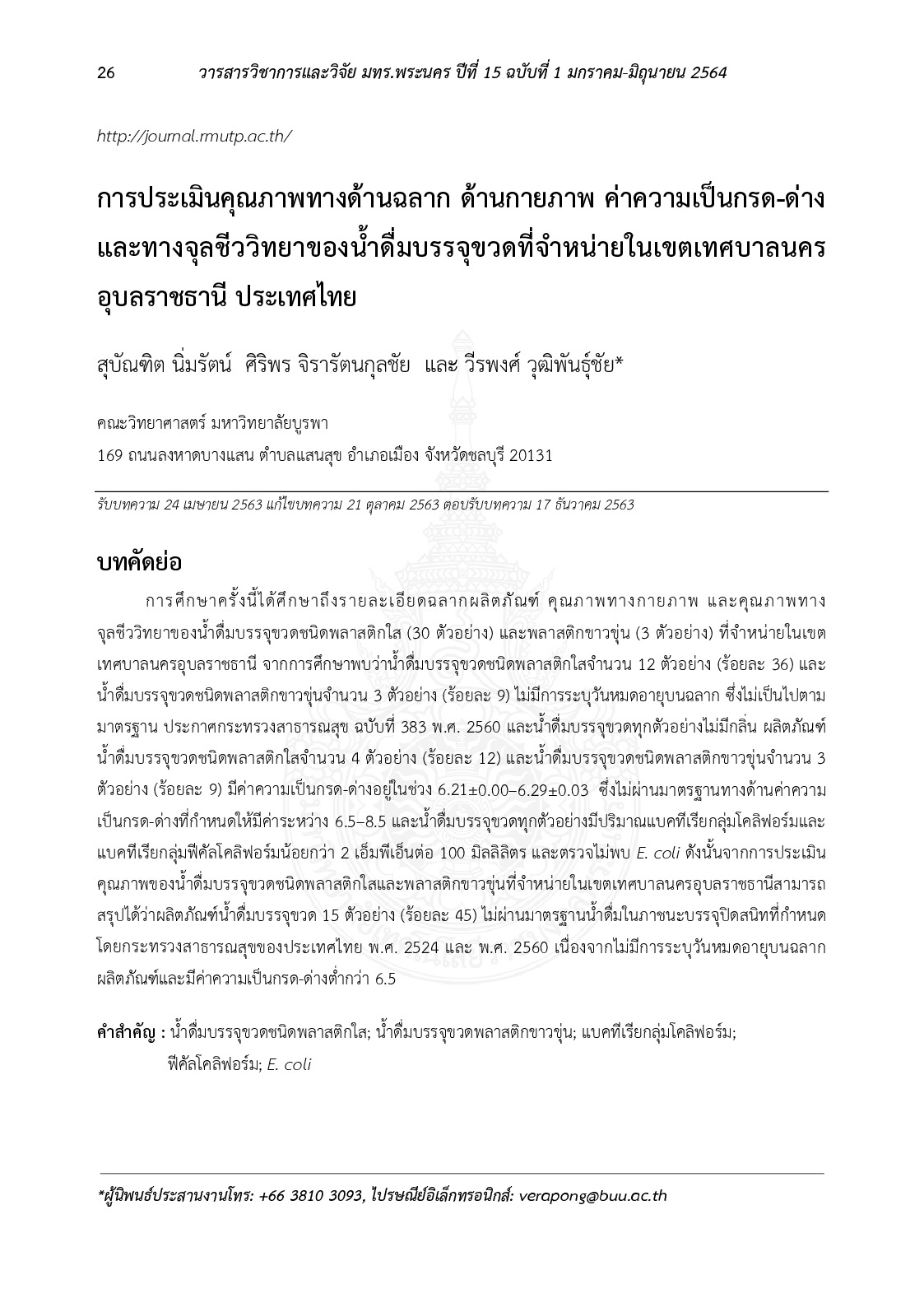
การประเมินคุณภาพทางด้านฉลาก ด้านกายภาพ ค่าความเป็นกรด-ด่าง และทางจุลชีววิทยาของน้ำดื่มบรรจุขวดที่จำหน่ายในเขตเทศบาลนครอุบลราชธานี ประเทศไทย
. In this study examination of label information physical and microbiological qualities was performed in 30 clear-plastic and 3 opaque-plastic bottled drinking water products distributed in city municipality of Ubon Ratchathani. Results showed that 12 clear-plastic (36%) and 3 opaque-plastic (9%) bottled drinking water samples had no expiry date on the product labels which were discordant to the criteria for drinking water in sealed containers imposed by the Ministry of Public Health of Thailand no. 383 (2017). Odorless appearances of all drinking water samples were observed. Values of pH in 4 clear-plastic (12%) and 3 opaque-plastic (9%) bottled drinking water samples were in the ranges of 6.21±0.00–6.29±0.03 which were below the allowable limit (pH 6.5–8.5). All bottled drinking water products contained numbers of total coliform and fecal coliform bacteria less than 2 MPN/100 mL and were devoid of E. coli. Therefore based on the quality of clear-plastic and opaqueplastic bottled drinking water products distributed in city municipality of Ubon Ratchathani 1 5 samples (45%) did not meet standard for drinking water in sealed containers declared by the Ministry of Public Health of Thailand (1981 and 2017) owing to no expiry date labeled on the products and pH value below 6.5.

Effects of chitosan contents on latex properties and physical properties of natural rubber latex/chitosan composites
In this study natural rubber latex/chitosan (NRL/CT) composites were prepared by latex mixing. The effects of chitosan on latex properties and physical Properties of NRL/CT composite films were focused. It was found that there was no significant change in the latex properties with increasing CT content. Increasing CT contents of 0.5 to 8.0 phr caused the rising of 300 % modulus of the NRL/CT composite whereas the opposite trend was found for tensile strength and elongation at break. The antimicrobial efficacy of the chitosan-incorporated rubber was slightly enhanced from that of the non-chitosan rubber. By comprehensive consideration CT content suitable for antibacterial gloves according to Thai industrial standards (TIS 1056-1: 2013) was 1 phr. For other latex products that require high modulus and antibacterial activity such as tubing pillow foam rubber nipple and catheter CT could be used at higher contents from 2 to 4 phr.
มาตรฐานน้ำดื่มบรรจุขวดที่จำหน่ายในจังหวัดอ่างทอง
In this study water quality standard of bottled drinking water distributed in Ang Thong Province was investigated. The results showed that clear plastic bottled drinking water presented completely label information and MFD./EXP. clearly appearance and odourless presented in all samples while Total Dissolved Solid (TDS) of tested clear plastic bottled drinking water samples were in a range of 1±0.00 to 277±0.00 mg/L. Coliform bacteria and fecal coliform bacteria of all tested water samples were less than 2.2 MPN/100 mL and E. coli and total heterotrophic bacteria were not found in all samples. pH values of 18 tested samples were less than 6.5 (60.00%) plastic bottled drinking water samples. Tested opaque plastic bottled drinking water samples showed completely label information and MFD./EXP. clearly appearance and odourless found in all samples while TDS of tested opaque plastic bottled drinking water samples were in a range of 12±0.00 to 13±0.00 mg/L. Coliform bacteria and fecal coliform bacteria of tested water samples were less than 2.2 MPN/100 mL and E. coli and total heterotrophic bacteria were not found in all samples. pH values of 3 tested samples were less than 6.5 (100.00%). Indeed assessment of both types of bottled drinking water samples distributed in Ang Thong Province Thailand based on 6 qualities assessment of standard for drinking water in sealed container set by Ministry of Public Health of Thailand revealed that the tested clear and opaque plastic bottled drinking water samples met the standard for 40.00% and 0% based on pH respectively.