จำนวน Repository ( 20 )

Phytotoxicity assessment of polycyclic aromatic hydrocarbons Co-Contamination in Soil during Economic Legume Seedling Growth
This research studied combined toxicities of 4 generally found Polycyclic Aromatic Hydrocarbons (PAHs) - anthracene fluorene fluoranthene and phenanthrene – during growth of 3 legume seedlings - cow pea mungbean and longbean - planted in varied combination of PAH contaminant in soil. Results showed that mungbean growth was more sensitive to PAH co-contaminated soil than cow pea and longbean. Co-contamination of all 4 PAHs was more toxic to legume than each pair of PAHs. Shoot length and fresh weight of legume seedling were more sensitive to co-contamination of all 4 PAHs than root length. Dry weight of legume seedling was the least sensitive to co-contamination of all PAHs.
The development of medicinal plant extracts to control Weed germination and growth
Study on the inhibition of germination and growth of weeds in rice fields. The extract from the leaves of Xy/ocorpus gongeticus Parkins and Porinori onomense Hance using fermentation Maceration and extraction techniques for Sequential Extraction with three types of solvent hexane ethyl acetate and methanol. The resuLts showed that Leaf extract of Xy/ocorpus gongeticus Parkins with ethylacetate at a concentration of 2000 -3000 ppm showed the highest inhibition of germination and growth of weeds. When the substance to be separated by chromatographic techniques showed that the extracts inhibited the germination and growth percentage of Fl is the highest. Leaf extract of Porinori onomense Hance with hexane at a concentration of 2000 3000 ppm showed the highest inhibition of germination and growth of weeds. When the substance to be separated by chromatographic techniques showed that the extracts inhibited the germination and growth percentage of F4 is the highest. Which can be used for research and development of natural products from plants to control weeds in rice fields to develop further research to commercialization
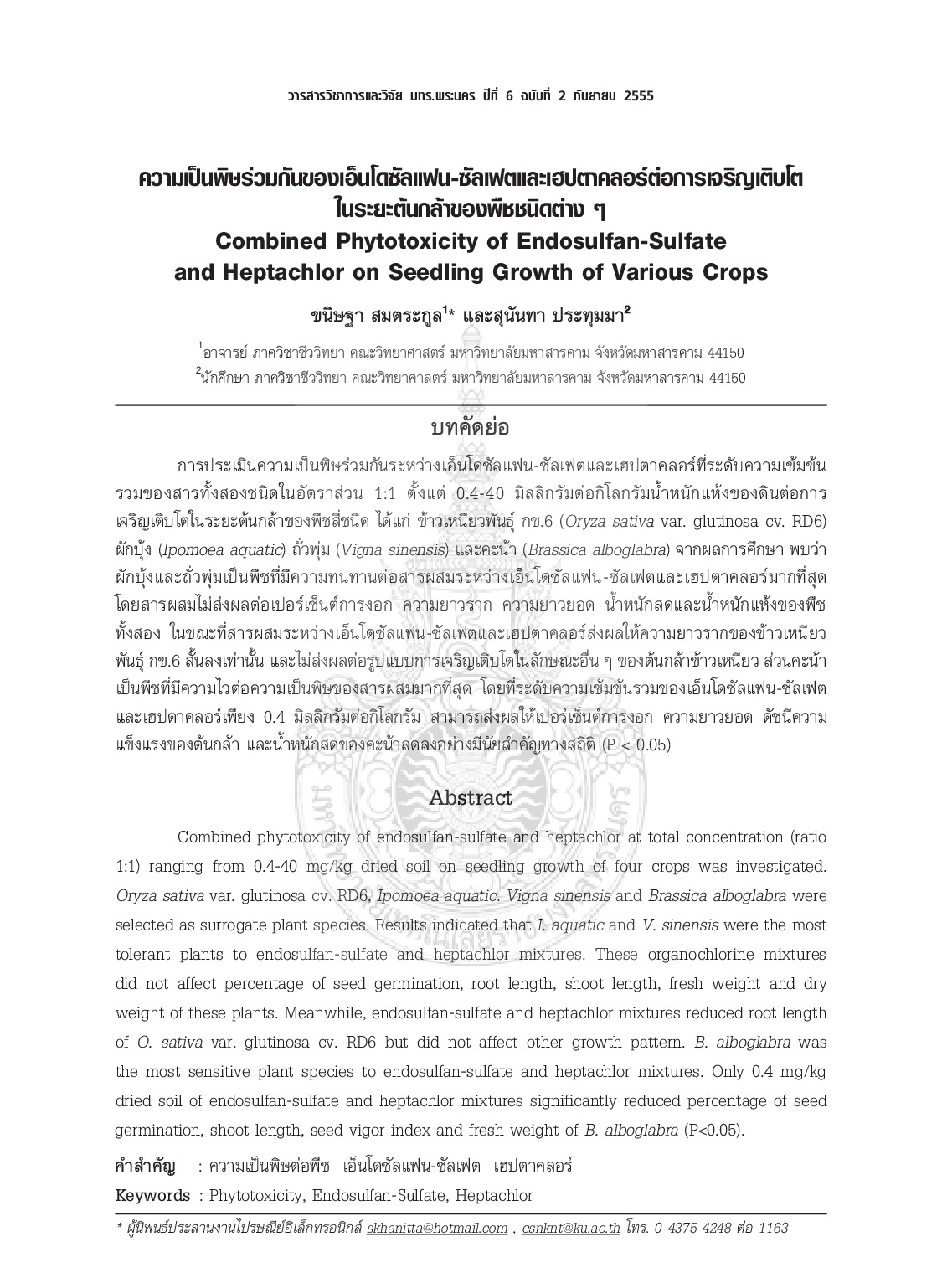
Combined Phytotoxicity of Endosulfan-Sulfate and Heptachlor on Seedling Growth of Various Crops
Combined phytotoxicity of endosulfan-sulfate and heptachlor at total concentration (ratio 1:1) ranging from 0.4-40 mg/kg dried soil on seedling growth of four crops was investigated. Oryza sativa var. glutinosa cv. RD6 Ipomoea aquatic. Vigna sinensis and Brassica alboglabra were selected as surrogate plant species. Results indicated that I. aquatic and V. sinensis were the most tolerant plants to endosulfan-sulfate and heptachlor mixtures. These organochlorine mixtures did not affect percentage of seed germination root length shoot length fresh weight and dry weight of these plants. Meanwhile endosulfan-sulfate and heptachlor mixtures reduced root length of O. sativa var. glutinosa cv. RD6 but did not affect other growth pattern. B. alboglabra was the most sensitive plant species to endosulfan-sulfate and heptachlor mixtures. Only 0.4 mg/kg dried soil of endosulfan-sulfate and heptachlor mixtures signif icantly reduced percentage of seed germination shoot length seed vigor index and fresh weight of B. alboglabra (P<0.05)
การศึกษาประสิทธิภาพของน้ำหมักและทำนองเพลงที่มีผลต่อการเจริญเติบโตของต้นกุหลาบหนู
The objectives of this research were to study the growth rate of microbial sludge in the fermented juice and to study the efficiencies of fermented juice and melodies on Fairy Rose growth. In the experiments the growth rate of microbial sludge was analyzed with 10 parameters for 4 weeks. Moreover the Fairy Rose was divided into 2 groups used and non-used the fermented juice. Each experimental group was tested with 3 types of melodies including jazz classical and Mozart. All experiments were set 3 replications by the total number of 24 Fairy Roses. The growth of the Fairy rose was analyzed by considering the number of leaf Height length of root and mass. The experimental results showed that the growth of microbial sludge in fermented juice was good and produced microbial sludge in fermented juice approximately 1063 ±158 mg/L on average. The Fairy Rose more growing with water and fermented juice. The number of leaves was 144±11 leaves in average Height was 30±1 cm in average Length of root was 38±8 cm in average and weight of Fairy Rose at the end of experimentation was found 400 g in average. In the case of melody affected Fairy Roses growth was classical. The growth of fairy roses found that the number of leaves was 143±6 leaves in average height was 29±1 cm in average Length of root was 34±1 cm in average and weight of Fairy Roses at the end of experimentation was 93 g in average
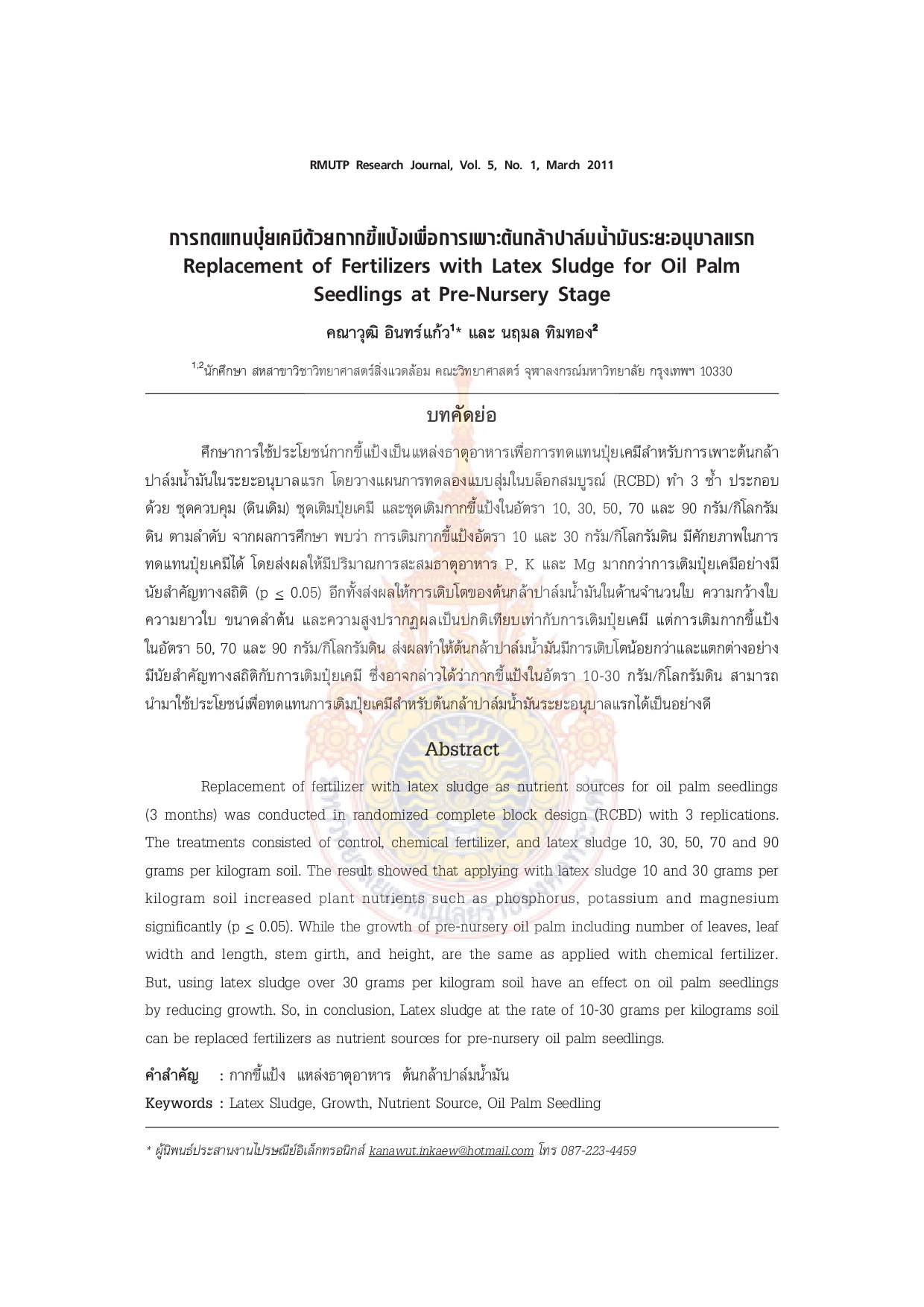
Replacement of Fertilizers with Latex Sludge for Oil Palm Seedlings at Pre-Nursery Stage
Replacement of fertilizer with latex sludge as nutrient sources for oil palm seedlings (3 months) was conducted in randomized complete block design (RCBD) with 3 replications. The treatments consisted of control chemical fertilizer and latex sludge 10 30 50 70 and 90 grams per kilogram soil. The result showed that applying with latex sludge 10 and 30 grams per kilogram soil increased plant nutrients such as phosphorus potassium and magnesium significantly (p <≤ 0.05). While the growth of pre-nursery oil palm including number of leaves leaf width and length stem girth and height are the same as applied with chemical fertilizer. But using latex sludge over 30 grams per kilogram soil have an effect on oil palm seedlings by reducing growth. So in conclusion Latex sludge at the rate of 10-30 grams per kilograms soil can be replaced fertilizers as nutrient sources for pre-nursery oil palm seedlings