จำนวน Repository ( 23 )
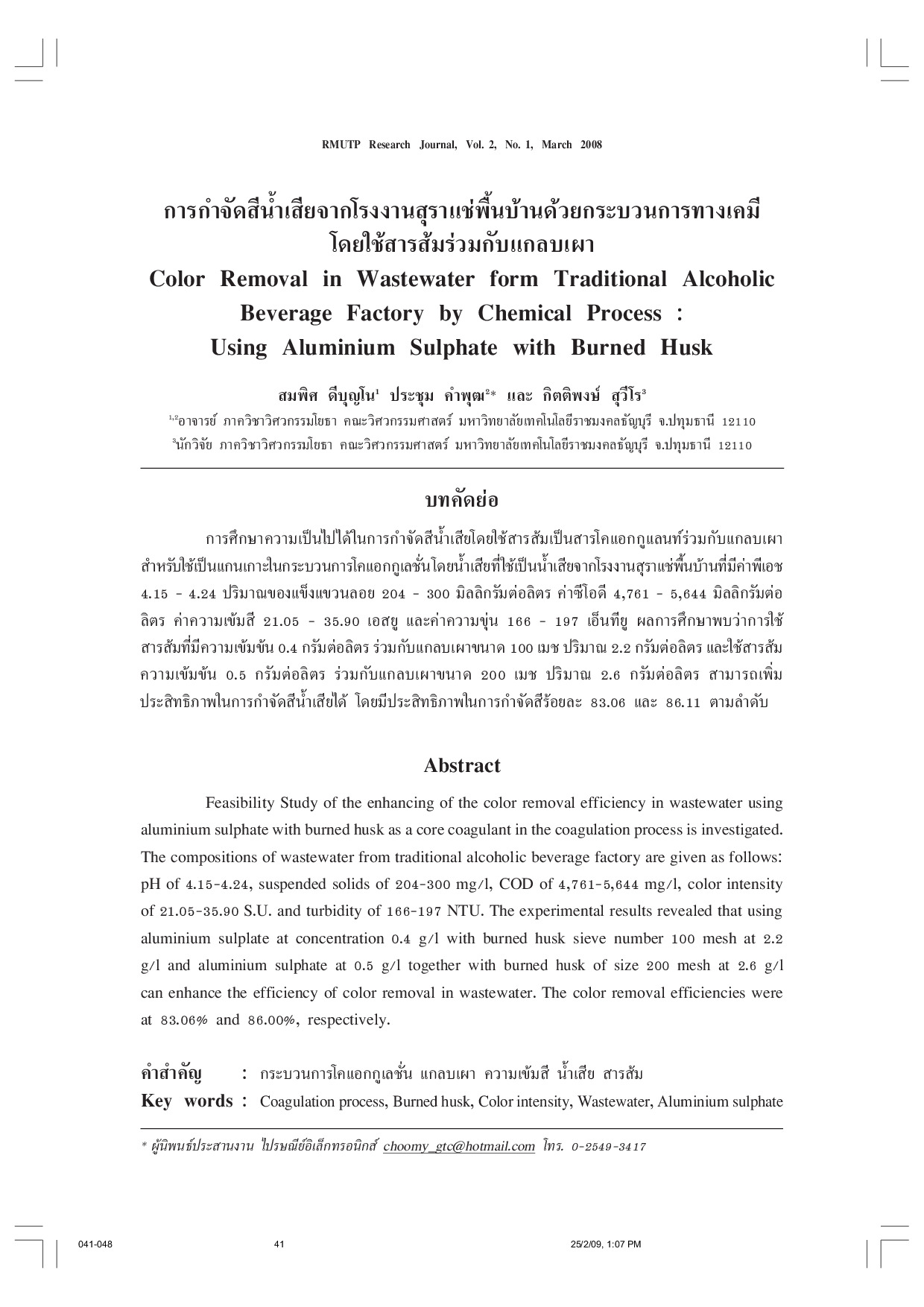
Color Removal in Wastewater form Traditional Alcoholic Beverage Factory by Chemical Process : Using Aluminium Sulphate with Burned Husk
Feasibility Study of the enhancing of the color removal efficiency in wastewater using aluminium sulphate with burned husk as a core coagulant in the coagulation process is investigated. The compositions of wastewater from traditional alcoholic beverage factory are given as follows: pH of 4.15-4.24 suspended solids of 204-300 mg/l COD of 4761-5644 mg/l color intensity of 21.05-35.90 S.U. and turbidity of 166-197 NTU. The experimental results revealed that using aluminium sulplate at concentration 0.4 g/l with burned husk sieve number 100 mesh at 2.2 g/l and aluminium sulphate at 0.5 g/l together with burned husk of size 200 mesh at 2.6 g/l can enhance the efficiency of color removal in wastewater. The color removal efficiencies were at 83.06% and 86.00% respectively.

Strength, porosity and corrosion resistance of ternary blend Portland cement, rice husk ash and fly ash mortar
This paper presents a study of the strength porosity and corrosion resistance of mortars made with ternary blends of ordinary Portland cement (OPC) ground rice husk ash (RHA) and classified fly ash (fine fly ash FA). Compressive strength porosity and accelerated corrosion with impressed voltage (ACTIV) were tested. The results show that the use of ternary blend of OPC RHA and FA produces mortars with improved strengths at the low replacement level with RHA and FA and at the later age in comparison to that of OPC mortar. The porosity of mortar containing pozzolan reduces with the low replacement level of up to 20% of pozzolan but increases with the 40% replacement level. The chloride induced corrosion resistance of mortar as measured by ACTIV is however significantly improved with the use of both single pozzolan and the ternary blend OPC RHA and FA. The corrosion resistance of ternary blend mortar is higher than that of mortar containing single pozzolan. The use of ternary blend OPC RHA and FA is very effective in enhancing chloride induced corrosion of mortar.
พัฒนาวัสดุคอมโพสิทเถ้าทิ้งจากการผลิตในอุตสาหกรรมและเกษตรกรรมเป็นวัสดุก่อสร้าง
จากการทดลองวิจัยพบว่าองค์ประกอบทางเคมีของเถ้าแกลบมีซิลิกอน ออกไซด์ (SiO2) แคลเซียม ออกไซด์ (CaO) โพแทสเซียม ออกไซด์ (K2O) เป็น 94.00% 2.00% 2.80% ตามลำดับและพบสารประกอบ Silicon Oxide (SiO2) : Cristobalite เถ้าแกลบมีผลการทดสอบหาความหนาแน่นปรากฏมีค่า 2.24 g/cm3 ความถ่วงจำเพาะ 1.43 ค่า Loss on Ignition 7.94 % การกระจายตัวของขนาดอนุภาค 53.65 μm พื้นที่ผิว Single point BET 30.07 m2/g พื้นที่ผิว Multi point BET 30.44 m2/g การขึ้นรูปตามอัตราส่วนของ เถ้าแกลบ – พลาสติก ที่เถ้าแกลบ 100%และ90 % ไม่สามารถอัดขึ้นรูปได้เนื่องจากเถ้าแกลบมีมวลที่ละเอียดเมื่อขึ้นรูปจะไม่เกิดการยึดเกาะระหว่างมวลกับพลาสติกดังรูปในตารางและขึ้นรูปได้แต่ไม่สมบูรณ์ที่ เถ้าแกลบ 80% ส่วนอัตราส่วนเถ้าแกลบตั้งแต่ 70%-0% สามารถขึ้นรูปได้สมบูรณ์ ตัวอย่างทดสอบเถ้าแกลบ-พลาสติกที่มีกำลังอัดน้อยกว่า 70 ksc. ที่อัตราส่วนเถ้าแกลบ 60% ขึ้นไป ตัวอย่างกำลังระหว่าง 70-100 ksc. 2 ตัวอย่างที่อัตราส่วนเถ้าแกลบที่ 40-50% และมากกว่า 100 ksc. ที่อัตราส่วนเถ้าแกลบที่น้อยกว่า 30% โดยสามารถรับกำลังได้สูงสุดที่ 200.79 ksc. เถ้าแกลบผสมพลาสติกเมื่อเพิ่มปริมาณพลาสติกมากขึ้นกำลังรับแรงเพิ่มตามลำดับ ผู้ใช้ควรเลือกใช้ตามความเหมาะสมกับงาน ปริมาณเถ้าแกลบ 70% ขึ้นไปตัวอย่างจมน้ำและปริมาณเถ้าแกลบต่ำกว่า 60% ก้อนตัวอย่างทดสอบลอยน้า ตัวอย่างสามารถดูดซึมน้าได้น้อยกว่า 30% ทุกตัวอย่างที่สามารถขึ้นรูปได้ ซึ่งสามารถนำไปใช้ในงานก่อสร้างได้ เถ้าแกลบผสมปลาสติกไม่เกิดการเปลี่ยนแปลงปริมาตรหรือเกิดน้อยมาก ซึ่งเป็นคุณสมบัติที่ดีของวัสดุก่อสร้าง จากการทดสอบด้วยกล้องขยายกาลัง 50x พบว่าดินลูกรังสามารถขึ้นรูปได้ด้วยการประสานของพลาสติกโดยยิ่งมีอัตราส่วนของพลาสติกมากยิ่งทำให้มีความสามารยึดเกาะขึ้นรูปและกำลังได้ดีตามไปด้วย
นวัตกรรมคอนกรีตต้นทุนต่ำไหลเข้าแบบง่ายโดยการใช้เถ้าทิ่้ง
This research presents a study of the compressive strength porosity chloride penetration resistance to carbonation and corrosion of self-compacting concrete containing fly ash ground rice husk-bark ash and ground bottom ash. Portland cement (CT) is partially replaced with pozzolans 0-40% by weight of the cementitious materials. Fly ash ground rice husk-bark ash and ground bottom ash have a high potential to be used as a good cementitious material. The results show that the compressive strength and low porosity of self-compacting concrete improves substantially with partial replacement of Portland cement with fly ash. Self-compacting concrete mix cement containing 20-40% of pozzolans can be used to make cementitious materials. The use of fly ash ground rice husk-bark ash and ground bottom ash produces concrete mix with good strength and resistance to chloride and corrosion.
การวิจัยด้านวัสดุปูนฉาบที่เป็นมิตรต่อสิ่งแวดล้อม
This research studies the potential for using waste ash from industrial and agricultural by-products as a plastering material. This paper presents a study of the water requirement compressive strength flexural strength normal consistency setting time and air content of plastering material containing classified fly ash (FA) and ground rice husk ash (RHA). Fine fly ash and fine rice husk ash have a high potential to be used as a good pozzolanic material. The use of finer pozzolan results in a stronger and denser mortar which is due to better Q!spersion and filling effect as well as an increase in the pozzolanic reaction. Fine fly ash and fine rice husk ash can be incorporated into mortar as replacement of the mortar mix cement for the plastering. Mortar mix cement containing 20% fine fly ash and fine rice husk ash can be used to make plastering materials.