จำนวน Repository ( 23 )

ศึกษาสีผิวอิฐดินดิบลูกรังด้วยวัสดุธรรมชาติ
จากการทดลองวิจัยพบว่าอัตราส่วนผสมของดินลูกรังผสมสีธรรมชาติครั่งและสีครามในระยะเวลาการบ่ม 28 วัน ตามข้อกำหนดมาตรฐานของวิศวกรรมสถานแห่งประเทศไทยในพระบรมราชูปถัมภ์ สำหรับอิฐดินเผา (อิฐมอญ) ที่ว่าการต้านทานแรงอัดของอิฐจะต้องๆไม่น้อยกว่า 20 ksc ในทุกอัตราส่วนผสมไปถือว่าไปใช้งานต่อไปได้ การเปลี่ยนแปลงขนาดและปริมาตรในระยะเวลา 28 วัน จากการทดสอบและบันทึกการเปลี่ยนแปลงขนาดและปริมาตร จากดิน 3 แหล่ง ได้แก่ บ่อลุงวร จังหวัดสระบุรี อำเภอบ้านโป่ง จังหวัดราชบุรี และอำเภอท่ามะกา จังหวัดกาญจนบุรี พบว่ามีความสัมพันธ์กับกำลังของดินคือ ดินที่มีความสามารถในการรับกำลังสูงจะมีการเปลี่ยนแปลงปริมาตรน้อยตามไปด้วย การเปลี่ยนแปลงสีการาติดของสีธรรมชาติทั้ง 2 สีในระยะเวลา 28 วัน โดยการเปรียบเทียบกับตัวอย่างก้อนอิฐที่ผสมกับน้ำปะปา สีธรรมชาติในระดับที่1 ทั้ง 2 สี จะไม่แตกต่างกับสีของก้อนดินผสมน้ำปะปา เกิดการติดของน้อยมากไม่เหมาะสมจะนำมาใช้ในการเคลือบสีของสีธรรมชาติในระดับที่ 1และสีธรรมชาติในระดับที่ 2 ทั้ง 2 สี จะเกิดการติดของสีมากกว่าสีธรรมชาติในระดับที่ 1 ในอัตราส่วนผสม 10 % จะติดสีน้อยมาก อัตราส่วนผสม 15 % จะติดสีน้อย อัตารส่วนผสม 20 % จะติดสีปานกลาง อัตราส่วนผสม 25 % จะติดสีมาก ตามปริมาณสีที่เพิ่มขึ้น
ศึกษาความสามารถรับกำลังของดินดิบลูกรัง
จากการทดลองวิจัยพบว่าตัวอย่างดินที่ใช้ในงานวิจัยมีกำลังของดินเพิ่มขึ้นตามร้อยละปริมาณปูนที่เพิ่มขึ้นตามลำดับค่าอยู่ในช่วง 24.55-104.22 ksc. ตัวอย่างดินทุกแหล่งที่มีส่วนผสมของปริมาณปูนร้อยละ 0-1 ทุกความชื้นเมื่อนำไปแช่น้ำไม่สามารถก่อตัวขึ้นรูปอยู่ได้ ดินที่มีส่วนผสมของปริมาณปูนร้อยละ 5-10 ทุกความชื้อเมื่อนำไปแช่น้ำ มีร้อยละการเปลี่ยนแปลงปริมาตรอยู่ที่ 5.92-12.5 และดินที่มีส่วนผสมของปริมาณปูนร้อยละ 20 ของทุกความชื้นเมื่อนำไปแช่น้ำมีร้อยลการเปลี่ยนแปลงปริมาตรอยู่ที่ 0.01-6.96 และจากผลการทดสอบการดูดซึม น้ำพบว่าตัวอย่างดินทุกแห่งที่มีส่วนผสมของปูนปริมาณปูนร้อยละ 0-1 ทุกความชื้น เมื่อนำไปแช่น้ำไม่สามารถก่อตัวขึ้นรูปอยู่ได้ ดินที่มีส่วนผสมของปริมาณปูนร้อยละ 5-20 ทุกความชื้อ เมื่อนำไปแช่น้ำมีร้อยละการดูดซึมน้ำร้อยละ 10.25-19.95
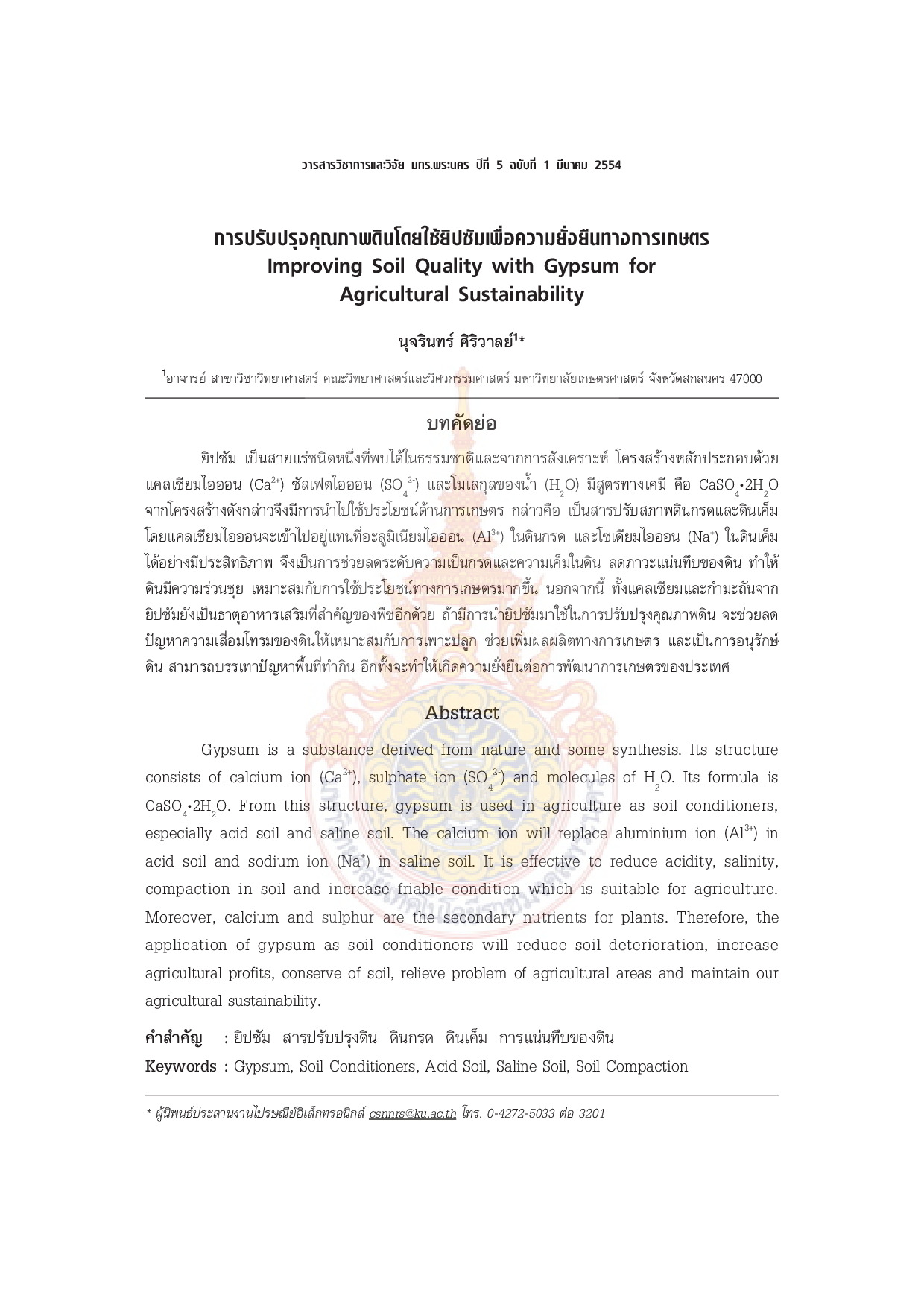
Improving Soil Quality with Gypsum for Agricultural Sustainability
Gypsum is a substance derived from nature and some synthesis. Its structure consists of calcium ion (Ca2+) sulphate ion (SO4 2-) and molecules of H2O. Its formula is CaSO4.2H2O. From this structure gypsum is used in agriculture as soil conditioners especially acid soil and saline soil. The calcium ion will replace aluminium ion (Al3+) in acid soil and sodium ion (Na+) in saline soil. It is effective to reduce acidity salinity compaction in soil and increase friable condition which is suitable for agriculture. Moreover calcium and sulphur are the secondary nutrients for plants. Therefore the application of gypsum as soil conditioners will reduce soil deterioration increase agricultural profits conserve of soil relieve problem of agricultural areas and maintain our agricultural sustainability
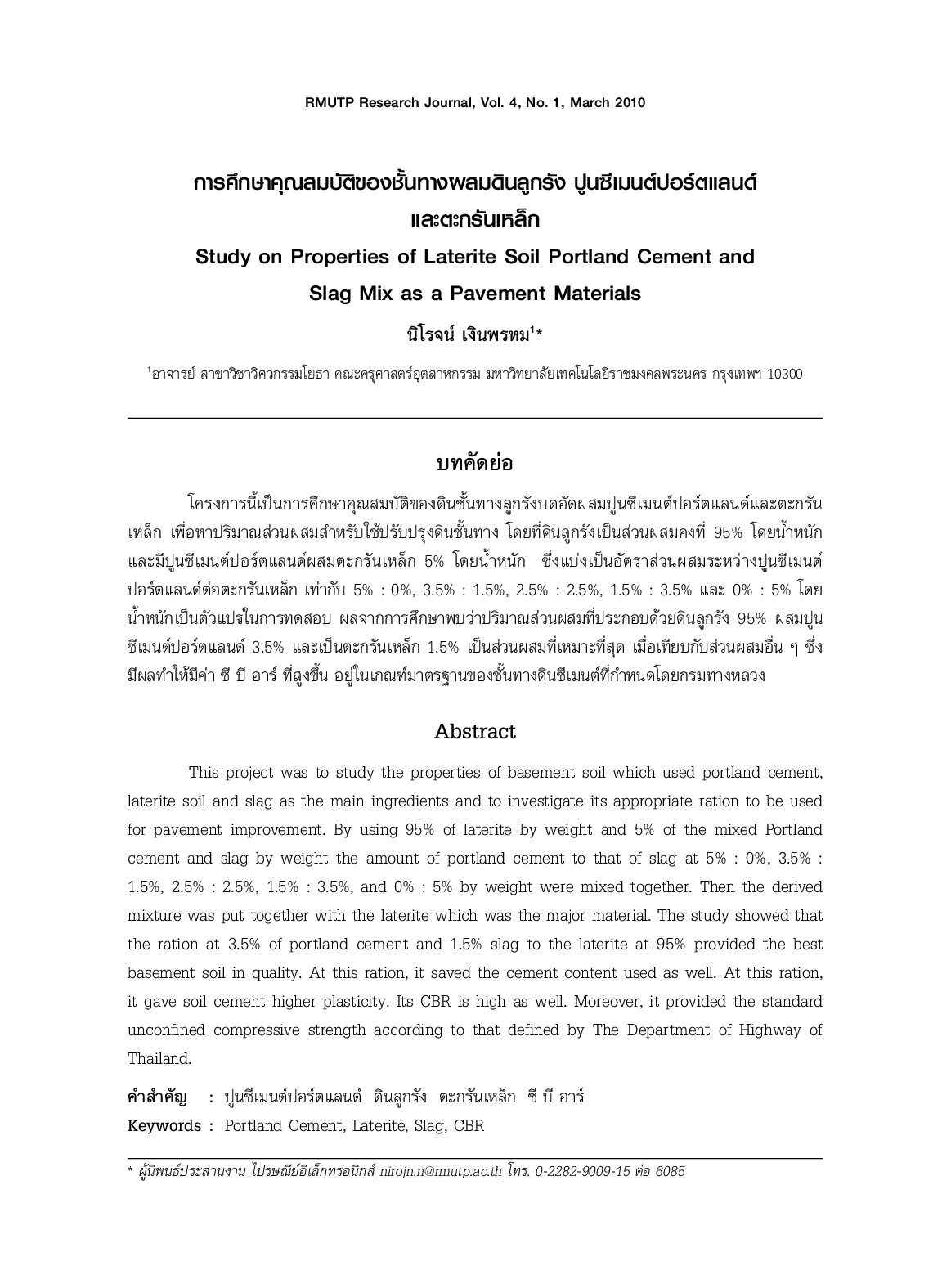
Study on Properties of Laterite Soil Portland Cement and Slag Mix as a Pavement Materials
This project was to study the properties of basement soil which used portland cement laterite soil and slag as the main ingredients and to investigate its appropriate ration to be used for pavement improvement. By using 95% of laterite by weight and 5% of the mixed Portland cement and slag by weight the amount of portland cement to that of slag at 5% : 0% 3.5% : 1.5% 2.5% : 2.5% 1.5% : 3.5% and 0% : 5% by weight were mixed together. Then the derived mixture was put together with the laterite which was the major material. The study showed that the ration at 3.5% of portland cement and 1.5% slag to the laterite at 95% provided the best basement soil in quality. At this ration it saved the cement content used as well. At this ration it gave soil cement higher plasticity. Its CBR is high as well. Moreover it provided the standard unconfined compressive strength according to that defined by The Department of Highway of Thailand.
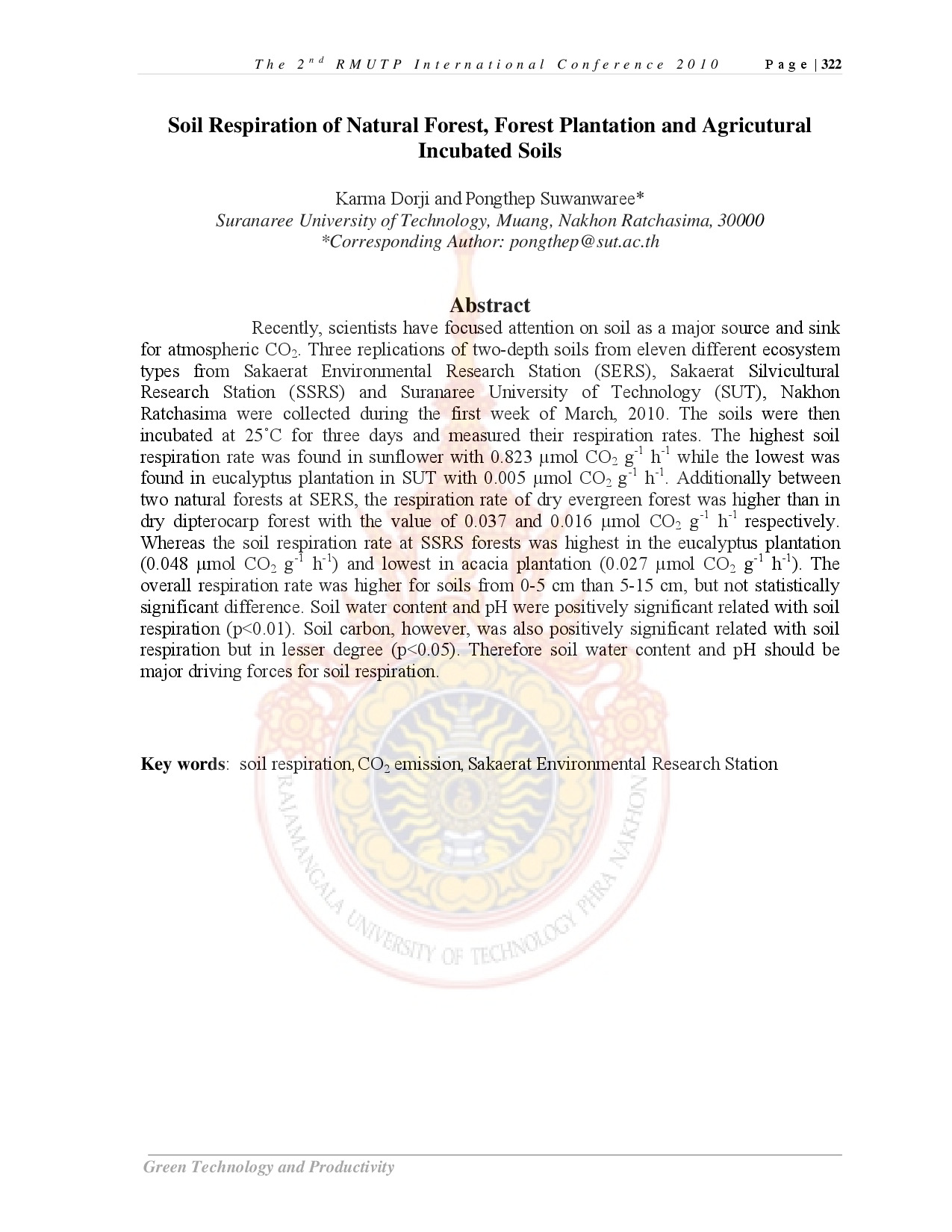
Soil Respiration of Natural Forest, Forest Plantation and Agricutural Incubated Soils
Recently scientists have focused attention on soil as a major source and sink for atmospheric CO2. Three replications of two-depth soils from eleven different ecosystem types from Sakaerat Environmental Research Station (SERS) Sakaerat Silvicultural Research Station (SSRS) and Suranaree University of Technology (SUT) Nakhon Ratchasima were collected during the first week of March 2010. The soils were then incubated at 25°C for three days and measured their respiration rates. The highest soil respiration rate was found in sunflower with 0.823 μmol CO2 g-1 h-1 while the lowest was found in eucalyptus plantation in SUT with 0.005 μmol CO2 g-1 h-1. Additionally between two natural forests at SERS the respiration rate of dry evergreen forest was higher than in dry dipterocarp forest with the value of 0.037 and 0.016 μmol CO2 g-1 h-1 respectively. Whereas the soil respiration rate at SSRS forests was highest in the eucalyptus plantation (0.048 μmol CO2 g-1 h-1) and lowest in acacia plantation (0.027 μmol CO2 g-1 h-1). The overall respiration rate was higher for soils from 0-5 cm than 5-15 cm but not statistically significant difference. Soil water content and pH were positively significant related with soil respiration (p<0.01). Soil carbon however was also positively significant related with soil respiration but in lesser degree (p<0.05). Therefore soil water content and pH should be major driving forces for soil respiration.